Let me paint a picture for you. It’s June 15th. You’re a brand owner in Chicago. Your summer linen collection was supposed to hit the website on June 1st. The photo shoot is done. The email marketing is queued up. The influencers have their samples. But the fabric? The 5,000 yards of custom-striped linen from that "cheap" supplier in China? It’s sitting in a warehouse in Ningbo. It missed the vessel cutoff by two days. The next sailing is in 10 days. That means it arrives at your warehouse July 5th. By the time you cut, sew, and ship to customers, it’s July 25th. Summer is over. Your "Summer Collection" is now a "Clearance Rack Collection." You just lost 70% of your potential full-price revenue.
I’ve watched this movie play out hundreds of times from my office at Shanghai Fumao. And here’s the brutal truth I tell every new client: A $0.50 per yard savings on fabric price is meaningless if late delivery forces you to mark down the finished garment by $15. The fashion calendar is a ruthless dictator. It doesn’t care about your supplier’s excuses. It doesn’t care about Chinese New Year. It doesn’t care about port congestion. Miss the window, and you miss the margin. Let me explain why fabric delivery is the single most fragile link in your supply chain, and more importantly, how to build a buffer that protects your brand from the calendar.
How Do Fabric Delays Collapse the Entire Retail Calendar?
Fabric delivery isn’t just Step 1. It’s the Foundation. Everything else—cutting, sewing, trimming, finishing, packing, shipping to the distribution center, and marketing launch—is stacked on top of it. When the fabric moves, the whole tower leans. And the later the fabric is, the fewer options you have to straighten it out.
Most brands operate on a Critical Path Method (CPM) timeline. Let’s say your lead time from fabric receipt to DC delivery is 8 weeks. If the fabric is 4 weeks late, you don’t just push the launch by 4 weeks. You push it by 6-8 weeks because you’ve lost your production slot. The factory that was booked for your cutting in Week 1 now has another client’s work in Week 5. They can’t just drop everything and do your work the minute your late fabric arrives. You go to the back of the queue.
And the costs compound. You pay for Air Freight to catch up (which can eat 20-30% of your margin). You pay Overtime at the sewing factory. You miss the Prime Selling Window. A swimsuit sold in June is full price. That same swimsuit sold in August is 40% off. The fabric delay didn’t just cost you time. It cost you the right to sell at full margin. Let’s break down the two biggest calendar collisions.
What Is the Real Cost of Air Freight vs Sea Freight for Late Goods?
I want to put real numbers on this because too many buyers treat air freight as a magical "undo" button. It’s not. It’s a financial emergency measure.
Let’s look at a typical shipment of Lightweight Woven Fabric (e.g., Viscose Challis) from Shanghai to Los Angeles.
- Weight: 3,000 KG (about 6,600 lbs).
- Volume: 15 Cubic Meters.
| Shipping Method | Transit Time | Approx Cost (2025 Rates) | Cost per KG | Impact on Landed Cost |
|---|---|---|---|---|
| Sea Freight (LCL) | 25-35 Days | $800 – $1,200 | $0.35 | Baseline |
| Air Freight (Express) | 3-5 Days | $12,000 – $15,000 | $4.50 | Massive |
That’s a $12,000 difference. For a small brand, that’s the entire marketing budget. For a mid-size brand, that’s the profit on the whole order.
And here’s the kicker: Air freight only saves Transit Time. It doesn’t save Production Time. If the fabric is still on the knitting machine in China, putting it on a plane doesn’t make the needles move faster. I had a client in 2024 who air-freighted 500 kilos of printed modal for a launch. They paid $4,000 extra. It arrived on a Tuesday. They cut it on Wednesday. But because they were a small brand, they had to wait 5 days for their sewing contractor to finish another job. They gained 2 days on the calendar but spent $4,000 for the privilege. It was a bad trade. For a deeper dive into the cost-benefit analysis, this is a useful calculator mindset: how to calculate whether air freight is worth the cost for fashion shipments. And this article explains the hidden fees: understanding air freight surcharges and how they inflate the final landed cost.
Why Do Cutting and Sewing Windows Get Permanently Lost?
This is the part that brand owners who’ve never set foot in a factory don’t understand. A sewing line is like a Broadway Show. It’s booked for a specific run. The cast (workers), the set (machines), and the props (trims) are all scheduled months in advance.
If your fabric arrives on June 1st, the factory has 20 sewers waiting. They finish the 2,000 units in 10 days. The sewers then move to the next brand’s order on June 12th.
If your fabric arrives Late on June 12th, the factory manager has a problem. Those 20 sewers are now stitching someone else’s dresses. They are Unavailable for 2-3 weeks until that batch is done. The factory might offer you a "Split Line"—meaning 2 or 3 sewers work on your order part-time. That 10-day job now takes 30 Days. Your "late" fabric just got even later because of Capacity Loss.
I work with a US contemporary brand that produces 80% of their knits with Shanghai Fumao. We have a Firm Booking System. If we promise greige fabric delivery on March 15th, they have a cutting slot booked for March 18th. If we miss March 15th, we don’t just pay for air freight. We pay a Penalty for Lost Cutting Slot because their factory charges them for the downtime. That’s how serious this is. This is a common issue discussed in industry circles: how to manage production scheduling and avoid losing cutting slots due to late fabric. And for a broader view, this explainer on the critical path method in garment manufacturing is very clear.
Why Is Chinese New Year the Most Underestimated Delay Factor?
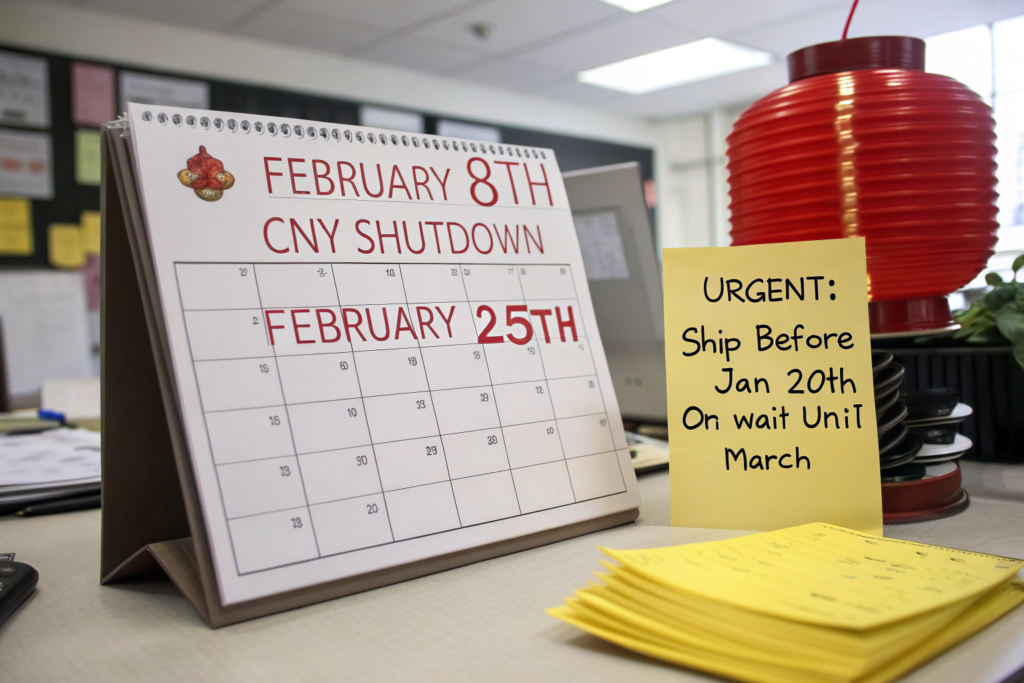
Every year, around November, I send a "Heads Up" email to all my US clients. The subject line is always the same: "CNY 2026 Planning – Act Now or Wait Until March." And every year, about 20% of recipients ignore it. They come back to me on January 20th with a "quick re-order" of 2,000 yards of fleece. And I have to tell them: "The dye house closes in 48 hours. You’re looking at a March 15th shipment. I’m sorry."
Western brands underestimate Chinese New Year because they compare it to their own Christmas shutdown. They think, "Okay, a week off. No big deal." That’s a fatal miscalculation. CNY is not a week. It’s a System Reset. The entire industrial workforce of the world’s largest textile cluster migrates back to their hometowns. The logistics networks go dormant. The chemical supply for dyes stops. And the ramp-up afterward is slow and unpredictable. Let’s look at the two most painful consequences: the labor shortage and the logistics gridlock.
How Does the 3-Week Labor Shortage Impact Dyeing and Finishing?
Let me give you the real timeline from my experience in Keqiao. The official holiday might be 7 days. But the practical impact on your fabric order is 4 to 6 Weeks.
Phase 1: The Pre-Holiday Rush (2 Weeks Before).
The dyeing factories are overwhelmed. Every brand in the world is trying to squeeze in "one last order." The factories overbook by 30%. They run machines 24/7. Quality Control drops. I refuse to put any critical color-matching orders through our partner dye houses during this week. The chance of a rushed, off-shade batch is too high.
Phase 2: The Shutdown (2 Weeks).
Nothing moves. No steam in the pipes. No water treatment. The machines are cold. If your fabric is half-finished in a basket, it sits there for 14 days. That can cause Crease Marks and Mildew if the humidity is high.
Phase 3: The Ramp-Up (2-3 Weeks After).
This is the killer. The factory doors open. But only 60% of the workers come back on Day 1. The rest are stuck in train stations, visiting extended family, or they’ve switched jobs to a factory closer to their hometown. The workers who are there are rusty. They make mistakes. Dye lot consistency in the first week back is the worst of the year.
I tell my clients at Shanghai Fumao: Any order placed after December 15th will likely ship in March. Not January. Not February. March. Plan for it. If you need February delivery, you must have the fabric in greige form and ready for finishing by January 5th at the absolute latest. This is a well-documented phenomenon, and you can read more about the specific logistics in this guide to Chinese New Year shutdown dates and supply chain impact for importers. And for a firsthand account from a factory perspective, this article on managing production during CNY from a sourcing agent’s view is very insightful.
What Happens to Shipping Schedules in the Post-Holiday Crunch?
The pain doesn’t end when the fabric leaves the dye house. It just moves to the port. For about three weeks after CNY, the Ports of Shanghai and Ningbo experience Vessel Blanking and Equipment Shortages.
The Backlog Effect:
Imagine a highway where all the cars stopped for two weeks. When the road reopens, everyone floors the gas pedal at the same time. That’s the container shipping market in late February.
- Space Crunch: Shipping lines reduce capacity (blank sailings) in the first week back because there’s no cargo. Then, in week two and three, a Tidal Wave of delayed cargo hits the terminals. There aren’t enough vessels. Your container gets Rolled (bumped to the next week’s sailing).
- Container Shortage: All the empty containers are in the wrong place. They’re stacked up in Europe and the US because no ships brought them back during the holiday. So you have a container full of linen ready to go, but No Empty Box to put it in.
I’ve seen a shipment ready on February 25th wait until March 10th just for a container and a vessel slot. That’s another two weeks of delay after production is complete. This is why we at Shanghai Fumao book our space allocations with the steamship lines 6 weeks in advance for post-CNY sailings. We know the crunch is coming. You can track this phenomenon in real-time using industry data like this analysis of container availability and blank sailings after Chinese New Year. And this is a good primer on why containers get rolled and how to reduce the risk of shipment delays.
How to Build a Production Timeline That Accounts for Reality?
Okay, we’ve established that the calendar is trying to kill your margin. So how do we fight back? Not with hope. With Math. A realistic production timeline is a series of buffers stacked on top of each other. If you build the schedule assuming everything will go perfectly, you are planning to fail. You need to assume the truck will break down, the dye lot will be off-shade, and the port will be congested. And then you build a schedule that survives those shocks.
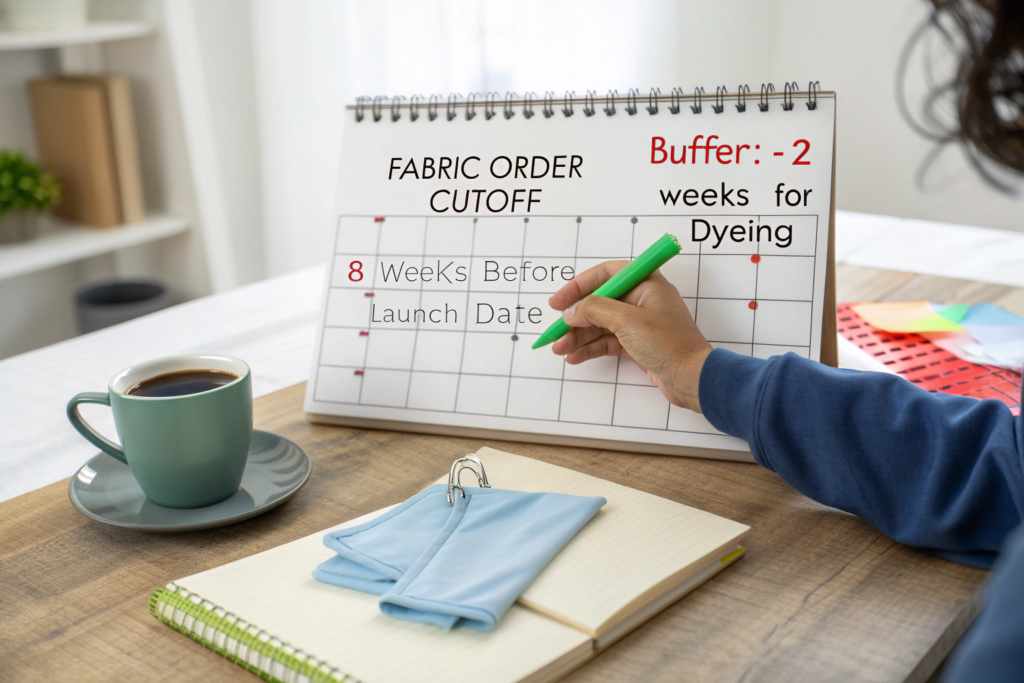
At Shanghai Fumao, we use a Reverse-Engineering approach to timelines. We start with the In-Store Date (or Launch Date) and work backward. We add padding at every vulnerable node. This is not about being slow. It’s about being reliable. A predictable 10-week lead time is infinitely more valuable than an optimistic 6-week lead time that actually takes 12 weeks.
What Is a Realistic Lead Time for Custom Dyed Woven Fabric?
Let’s break down a typical order for Custom Color Linen from Shanghai Fumao. This is fabric where we have to dye the yarn or dye the piece goods to your specific Pantone match.
The "Optimistic" Timeline (What a desperate salesman might tell you):
- Lab Dip Approval: 1 week
- Yarn Dyeing: 1 week
- Weaving: 2 weeks
- Finishing: 1 week
- Total: 5 Weeks (You will be disappointed.)
The Shanghai Fumao Realistic Timeline (What I actually quote):
| Step | Description | Time | Notes / Buffer Reason |
|---|---|---|---|
| 1. Lab Dip & Strike-Off | Match Pantone, send physical swatch for approval. | 2-3 Weeks | Shipping time to US included. Revisions add time. |
| 2. Greige Yarn Prep | Sourcing the raw yarn for dyeing. | 1 Week | Yarn availability fluctuates. |
| 3. Yarn Dyeing | Dyeing the yarn cones in the specific color. | 2 Weeks | Weather impacts drying time. Re-dye if shade off. |
| 4. Weaving | Running the looms. | 2-3 Weeks | Depends on loom availability and fabric width/density. |
| 5. Finishing | Washing, softening, tenter framing. | 1 Week | High Risk of Delay. Finishing mills are bottlenecks. |
| 6. Inspection & Packing | 4-Point inspection and rolling. | 3-5 Days | Don’t skip this. |
| 7. Buffer / Contingency | Just in case. | 1 Week | Mandatory. Something will go wrong. |
| Total Lead Time | 9-11 Weeks |
I had a client last year who needed linen for a July 4th promotion. We started the Lab Dip on April 1st. They approved the dip quickly (1 week shipping, 2 days approval). We hit every milestone. The fabric was ready on June 1st. But the port of LA was congested. It took 7 days to get a chassis. The fabric arrived June 18th. They cut and sewed in a rush, air-freighted the finished goods to their DC, and launched July 1st. It was tight. Without that 1-week buffer, they would have missed it. This is the kind of detail you need to understand: realistic lead times for custom textile manufacturing from Asia explained. And this is a breakdown of how long each step of fabric production actually takes.
How Far in Advance Should You Book Greige Fabric for Bulk Orders?
For Greige Fabric (un-dyed, raw fabric straight off the loom), the lead time is shorter, but the planning horizon needs to be Longer. Greige is a commodity. If you wait until you have a PO from your customer, the specific greige you need (e.g., 20s Compact Cotton Jersey, 180 GSM) might be Sold Out. The mill might have just run that batch for H&M and the next run is in 4 weeks.
This is where Inventory Planning separates the pros from the amateurs. If you know you’re going to sell 10,000 yards of a specific jersey knit every season, you should not be buying it "order by order." You should be buying Greige Stock.
The Strategy We Recommend at Shanghai Fumao:
- Forecast Baseline Volume: Work with us to estimate your core fabric needs for the next 6 months.
- Reserve Greige Capacity: We hold a certain amount of loom capacity for your specific yarn count and construction.
- Hold in "Greige Store": We weave the fabric to the greige stage. It sits in our warehouse, ready to be dyed.
- Dye to Order: When you get your specific color POs, we pull the greige and dye it. Lead time drops from 9 weeks to 3-4 Weeks.
This requires a bit of trust and a bit of cash flow to hold the inventory. But it’s the single best way to beat the calendar. A large US workwear brand we work with does exactly this. They keep 30,000 yards of their core twill in greige stock in Keqiao. When they need 5,000 yards of "Navy" for a sudden re-order, we ship it in 3 weeks. Their competitors wait 10 weeks. They win the business every time. For a deeper understanding of this model, this is a great explanation: how greige fabric inventory programs work for just-in-time apparel manufacturing. And for the textile-specific terminology, this glossary entry on greige goods and their role in the supply chain is helpful.
What Penalties and Protections Should Be in Your Fabric Contract?
All the planning in the world won’t protect you if the contract you signed with the supplier has no teeth. I say this as a supplier: You need a contract that aligns our incentives. If I can deliver late and it costs me nothing, I’m a saint if I still prioritize your order when things get busy. But if I know that a late delivery will cost me money, suddenly your order goes to the top of the pile.
This isn’t about being adversarial. It’s about being professional. A good contract protects both parties. It clarifies what happens when the unpredictable happens. The two most important clauses you need to negotiate are Liquidated Damages (LD) and Force Majeure. And you need to understand the difference between them.

What Is a Liquidated Damages Clause for Late Textile Shipments?
This is a pre-agreed amount of money the supplier pays you for every day or week the shipment is late. It’s Not a Penalty (penalties are often unenforceable in court). It’s an estimate of the Financial Damage you will suffer due to the delay (lost margin, air freight differential, etc.).
A Standard LD Clause for Fabric:
"In the event of a delay in shipment exceeding 7 days from the agreed ‘Latest Shipment Date’ on the Proforma Invoice, Supplier agrees to credit Buyer 2% of the invoice value of the delayed portion per week of delay, up to a maximum of 10% of the total invoice value."
Why This Works:
- 2% per Week: This roughly covers the cost of money (interest) and the beginning of margin erosion.
- 10% Cap: This is reasonable. If we’re more than 5 weeks late, the fabric is basically worthless to you anyway, and we’re better off canceling the order.
- It Focuses the Mind: When our production manager at Shanghai Fumao sees a PO with an LD clause, they put a Red Star on the job ticket. It gets prioritized.
I had a situation in 2023 where our yarn supplier for a special recycled poly had a machine breakdown. We knew we were going to be 10 days late shipping a container of French Terry to a US client. Because we had an LD clause in the contract, we proactively offered the client a 2% Credit before they even asked. We owned the mistake. They used the credit to offset the cost of air freighting a small portion of the fabric. The relationship remained strong because the financial consequence was clear and fair. This is a legal overview of the concept: understanding liquidated damages clauses in international supply contracts. And for a more practical textile sourcing angle, this guide to drafting a fair penalty clause for delayed fabric shipments is quite useful.
How Does a Force Majeure Clause Protect the Buyer Too?
Force Majeure ("Superior Force") is the clause that says: "If something crazy happens that’s out of our control—war, typhoon, pandemic, port strike—neither of us is liable for the delay."
Most buyers see this as a Supplier Protection. And it is. If a typhoon hits Ningbo and the port closes for 3 days, I’m not paying you 2% LD. It wasn’t my fault. BUT, a well-written Force Majeure clause should also protect YOU, the buyer.
Here is the language I advise clients to push for:
"If a Force Majeure event delays shipment by more than 21 days, Buyer shall have the right to cancel the undelivered portion of this order without penalty and receive a full refund of any deposit paid for such undelivered goods."
Why This Matters:
If the delay stretches from "inconvenient" to "season-ending," you need an Exit Ramp. You don’t want to be forced to accept and pay for Spring fabric that arrives in Summer. You want the right to walk away and get your deposit back.
I had this exact scenario play out during the Suez Canal blockage in 2021. A European client had fabric stuck on a vessel for 4 weeks. The standard Force Majeure would have left them on the hook to accept the goods whenever they arrived. But their contract had the 21-Day Cancellation Clause. They exercised it. They canceled the order. We sold the fabric to another client in a different hemisphere where the season was opposite. It was a clean break. No lawsuits. No bad blood. This is a critical nuance often missed in template contracts: how force majeure clauses apply to delayed deliveries and buyer cancellation rights. And for the specific impact on global shipping, this analysis of the Suez Canal blockage and its legal implications for cargo owners is a good case study.
Conclusion
Late fabric delivery doesn’t just annoy your production manager. It destroys your brand’s credibility with retailers. It erases your full-price selling window. It forces you into expensive air freight and overtime that decimate your margin. The #1 cause of this cascade is a failure to plan for the predictable chaos of the global textile calendar—the CNY shutdown, the post-holiday port crunch, and the inherent variability of dyeing natural fibers.
You can’t control the weather or the port workers’ union. But you can control your timeline. Build in the buffers. Book greige fabric early. Demand a contract with a fair Liquidated Damages clause to keep your supplier honest and a Force Majeure exit ramp to protect yourself from disaster. At Shanghai Fumao, we’d rather have an honest conversation about a 10-week lead time and hit it on the nose than promise a 6-week miracle and deliver a 12-week nightmare. Predictability is the most valuable currency in this business.
If you’re tired of sweating the calendar and you want a partner who builds production schedules based on reality, not wishful thinking, let’s talk. We can map out your seasonal fabric needs and lock in capacity before the rush hits. Reach out to our Business Director, Elaine, at elaine@fumaoclothing.com. Let’s make sure your next collection launches when the customer is ready to buy, not when it’s time for the clearance rack.