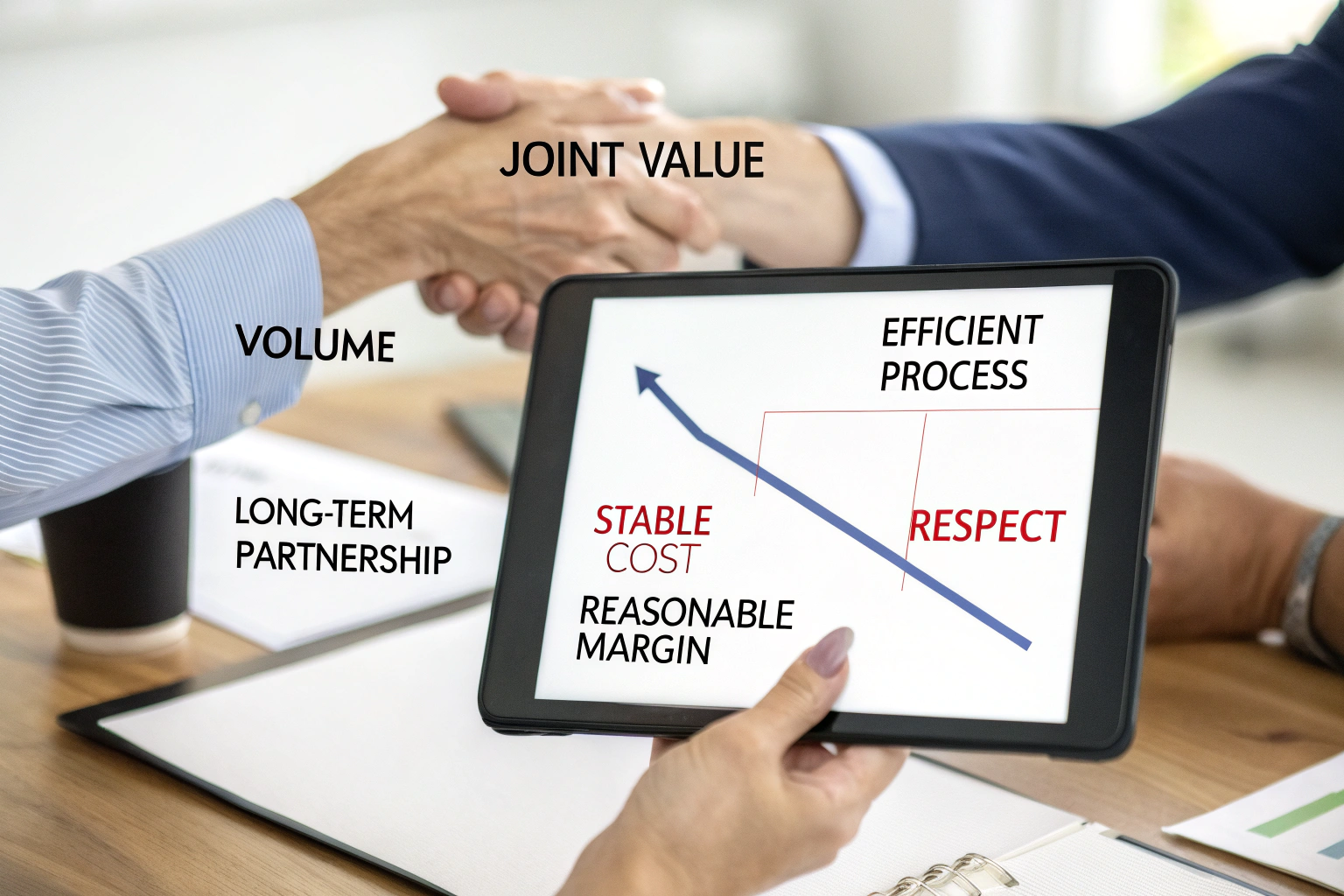
You’ve received a quotation from a Chinese fabric supplier. The price seems high. Your instinct is to reply with a blunt “Your price is too high, can you do better?” and hope for the best. If this is your strategy, you’re leaving money—and a potential long-term partnership—on the table. Effective negotiation with Chinese suppliers isn’t about haggling; it’s about strategic communication that transforms a transactional conversation into a collaborative problem-solving session. As a supplier on the other side of thousands of these discussions at Shanghai Fumao, I can tell you the buyers who win the best terms are never the ones who just ask for a discount.
Think of it like this: approaching a negotiation by only talking price is like trying to lower the cost of a custom-built house by only arguing over the hourly wage of the bricklayer. You’re missing the bigger picture of materials, design complexity, and timeline. The real leverage lies in understanding what drives their costs and aligning your request with their business logic.
This guide will move beyond basic “ask for 10% off” advice. I’ll reveal the cost structures we see, the questions that make us respect a buyer, and the tactical moves that actually work to secure sustainable, win-win pricing. I’ll share real examples of negotiations that succeeded and failed, from the supplier’s perspective.
What Information Do I Need Before I Even Start Negotiating?
Walking into a price discussion unprepared is the fastest way to lose credibility and leverage. From our side, a vague request for a “cheaper price” signals you don’t understand your own needs or our industry. Your preparation is your power.
First, know your exact specifications inside and out. This goes beyond “polyester jersey.” You need: precise composition (e.g., 95% Polyester, 5% Spandex), fabric weight in GSM (grams per square meter), width (in cm or inches), and key performance requirements (e.g., colorfastness to washing level 4, moisture-wicking, UPF 50+). A buyer who sends a tech pack or a reference sample with clear notes immediately stands out as professional. This allows us to provide an accurate cost, not a guess that includes a high-risk buffer.
Second, be transparent about your realistic volumes and timeline. Are you sampling for a potential bulk order of 5,000 meters in 3 months, or are you ordering 500 meters next week? These scenarios have vastly different cost implications for production scheduling, yarn purchasing, and minimum order quantities (MOQs). Pretending you’ll order more later to get a lower price now is a tactic we see through instantly and it damages trust.

How Does Order Volume Really Affect the Unit Price?
The relationship isn’t always linear, and understanding the “breakpoints” is crucial. Let’s break down a real case from our production of a custom twill:
- Sample Order (100 meters): Price is at its highest. Covers setup for weaving, dyeing formula creation, and lab dips. It’s essentially a development project. (Let’s say $8/meter).
- Small Bulk (1,000-3,000 meters): The setup costs are amortized. The yarn can be bought from the spinner’s stock, but dyeing runs might be sub-optimal for the dyeing factory. ($5.5/meter).
- Standard Bulk (10,000 meters): This hits the efficient “lot size” for our dyeing partner. We buy yarn at a better price, and the weaving mill runs for a full, efficient shift. ($4.2/meter).
- Large Bulk (50,000+ meters): We can contract directly with the yarn producer, securing the best price and guaranteed supply. All factory scheduling is optimized. ($3.6/meter).
Asking, “What is the price break at 5,000m, 10,000m, and 20,000m?” shows you think strategically. It opens a conversation about planning. Maybe committing to 10,000m over three staggered shipments gets you close to the 10,000m price. This is a negotiable point. For deeper insights, study MOQ strategies for importing fabrics from Asia on industry sourcing platforms.
Why Should I Share My Target Price or Budget?
This is counter-intuitive for many buyers, but it’s one of the most effective ways to accelerate a productive negotiation. A statement like “Our target FOB Shanghai price for this fabric is $4.75/meter for an initial order of 8,000m” is incredibly powerful.
It does three things: 1) It shows you’ve done your market homework and are serious. 2) It forces us to be creative within a known framework. Can we meet it with a functionally equivalent but slightly different yarn blend? Can we adjust the finishing process? 3) It instantly filters out whether a deal is possible. If your target is 30% below our true cost, we can tell you immediately and explain why, saving everyone time. If it’s within 10-15%, that’s a standard negotiation zone. Hiding your budget leads to wasted cycles of offers and counteroffers that go nowhere. Understanding Incoterms 2020 and their impact on landed cost is essential for setting a realistic target price, as explained on global trade resource sites.
What Are the Biggest Cost Drivers I Can Actually Influence?
Price isn’t arbitrary. It’s the sum of raw material, labor, overhead, and profit. Your negotiation power increases when you engage on these specific components, not just the final number.
Raw Materials (Yarn) is King. This is often 60-70% of our fabric cost. The price of cotton, polyester, wool, etc., fluctuates daily based on commodity markets. A savvy buyer asks, “Is this quote based on current yarn market prices? If we place the order next month, will it be adjusted?” In a falling market, you might negotiate a clause to lock in a price closer to the production date. In a rising market, placing a deposit to lock in today’s yarn cost is a valuable service we offer.
Complexity Has a Cost. Every additional step adds money. Do you need a jacquard weave instead of a plain weave? That’s more expensive loom setup and slower production. Do you need a proprietary moisture-wicking finish or a custom 7-color digital print versus a simple 2-color rotary print? Each choice has a price tag. The question is: “Which of these specifications has the highest impact on cost, and are there alternative ways to achieve a similar look/feel?” For instance, we helped a Danish brand replace a very complex (and expensive) woven structure with a cleverly printed design on a simpler base cloth, cutting the fabric cost by 35% while keeping 90% of the visual effect.

Can Negotiating Payment Terms Be Better Than a Price Discount?
Absolutely. For a established supplier like us, favorable payment terms can sometimes be more valuable than a slight price increase. Cash flow is the lifeblood of manufacturing.
Standard terms might be 30% deposit, 70% before shipment. If you can offer 40% deposit, it significantly de-risks our raw material purchase and gives us more leverage with our own yarn suppliers, potentially lowering our input cost. In some cases, for a very reliable, long-term client, we might accept a higher percentage against a copy of the Bill of Lading, which is less risky for you than paying 100% before shipment. Offering to use Secure Payment Methods like Letter of Credit (L/C) at Sight also builds tremendous trust, as it guarantees our payment upon fulfilling the contract. The savings we get from reduced financial risk and friction can be shared with you as a better price. It’s a classic win-win. Learn more about balancing price and payment term negotiations in international trade from financial trade portals.
How Does Production Timing Affect My Negotiating Power?
Timing is a hidden lever. Factories have peak seasons (Mar-May, Aug-Oct) and slow seasons (Jun-Jul, Nov-Dec). Placing an order for delivery during our slow season gives us a powerful incentive to keep our machines and workers occupied. You have much more leverage to negotiate in December than in March.
A real example: An Australian client needed a bulk order of brushed fleece in April 2023 (peak season). Our initial quote was firm due to full capacity. They then asked, “What if we can delay the production and ship in late July?” That moved it into a slower period. We were able to offer a 7% discount because we could schedule it efficiently without overtime pay and secure better slot rates from the finisher. Asking “Is there a time of year where you could produce this more cost-effectively?” demonstrates strategic thinking and can unlock savings. Always consult a Chinese manufacturing and holiday calendar for production planning.
What Negotiation Tactics Backfire with Chinese Suppliers?
Some “clever” tactics are red flags that make us defensive and less willing to compromise. Avoid these pitfalls:
- The Bluff (“I have a cheaper quote from another supplier”): This is the most common and least effective. If it’s true, we’ll ask for the spec details to see if it’s comparable (often it’s not). If we sense it’s a bluff, we’ll call it by saying “That’s a good price, you should take it.” The conversation ends.
- The Nickel-and-Dime: Arguing over every tiny line item on a complex quote for a small order wastes time. Focus on the big drivers: yarn, MOQ, and payment terms.
- Disrespect for Expertise: Questioning every technical explanation without basis. A better approach is “Can you help me understand why this jacquard is so much more? What are the alternatives?”
- Last-Minute Changes After Price is Set: This is the ultimate trust-breaker. Agreeing on a price for a 300GSM fabric and then asking for 320GSM “at the same price” after the contract is signed will create ill will and potential quality issues as the supplier is forced to cut corners.
The most successful buyers are respectful, consistent, and view us as a partner in reducing total cost, not an adversary to be beaten down.

How Can I Build the Relationship for Better Long-Term Pricing?
The first order is rarely the most profitable for either party. The real value is in the repeat business. Signal that you’re a long-term partner, not a one-time shopper.
- Be Reliable and Communicate Clearly: Pay deposits on time. Provide clear feedback on samples. Respond to our queries promptly. This reduces our administrative cost and stress.
- Give Credit Where It’s Due: If we do a good job, tell us. A simple “The last shipment was excellent, our production went smoothly” builds immense goodwill. We are more likely to go the extra mile or offer our best price first to a client who appreciates the effort.
- Visit or Have a Virtual Meeting: Putting a face to the name and seeing our operation at Shanghai Fumao builds a human connection that emails cannot. It transforms the relationship from transactional to personal. After a Canadian client’s team visited us in Keqiao in late 2023, our communication became more open, and we collaboratively found ways to reduce costs on their core fabric by 12% over the next year through value engineering.
What Concessions Can I Offer That Cost Me Little But Add Value for Them?
Think about what is expensive or risky for them but low-cost for you.
- Flexible Shipping: Can you accept a slightly longer delivery window (e.g., 5 weeks instead of 4)? This allows for more efficient production planning.
- Consolidated Orders: Can you group fabric orders for multiple styles into one larger production run? This reduces setup changes.
- Simplified Packaging: Do you need each roll in individual poly bags with custom stickers, or can you accept a simpler, standard export packaging? This saves labor and material cost for us.
- Providing References: Offer to be a reference client or provide a testimonial if the project goes well. This has real business development value for us.
Offering these after you’ve discussed price shows you’re looking for a balanced deal.
How Do I Navigate the Final Stages and Lock In the Deal?
The negotiation isn’t over when you agree on a number. The final steps are about cementing the agreement and preventing misunderstandings.
Get Everything in Writing in a Proforma Invoice (PI). The PI should detail: exact fabric specifications, quantity, price (with currency and Incoterms), payment terms, delivery date, port of destination, and quality standards (e.g., “AQL 2.5 on major defects”). Any verbal agreements about packaging, testing, or sampling must be included here. This document is your contract.
Use a Third-Party Inspection as a Safety Net, Not a Threat. Frame this as a standard procedure for your business that protects both parties. Say “For all our imports, we use SGS for a pre-shipment inspection. This just ensures everything meets the spec we agreed on in the PI before payment is finalized.” This is professional and expected, not a sign of distrust. Be prepared to pay for it—it’s your quality control cost.
Be Decisive. Once terms are agreed and the PI is sent, place your deposit promptly. Hesitation or trying to re-open negotiations at this stage can cause us to release production slots and raw materials, potentially delaying your order and undermining the trust you’ve built.

What If We Still Can’t Agree on Price?
It’s okay to walk away respectfully. A simple “Thank you for your time and detailed quotation. Unfortunately, we are too far apart on price to proceed at this time. We will keep your information on file for future projects that may be a better fit” maintains a positive relationship. The market changes, and your needs may change. Burning bridges serves no one.
Sometimes, the gap reveals a fundamental mismatch. Perhaps you need a lower-tier supplier, or we specialize in higher-value, technical fabrics. A transparent dead-end is better than a forced, unhappy partnership that leads to quality problems later.
How Can I Use a Sourcing Agent or My Own Visit to Strengthen My Position?
A good, local sourcing agent is worth their fee if they have deep factory relationships and can verify a supplier’s true capacity and reputation. They can negotiate on the ground in real-time. However, choose carefully—a bad agent just adds cost and confusion.
Visiting the trade show in person or touring the factory, like many of our successful clients do, is the ultimate power move. It shows serious commitment and allows for nuanced discussion. You can see the quality of the machinery, the organization of the warehouse, and meet the QC team. During a factory tour, you can point to a process and ask “How could we adjust this to save cost?” The answers you get face-to-face are always more revealing. Planning a productive supplier visit to China’s textile hubs requires research, which you can find guides for on major business travel sites.
Conclusion
Effective price negotiation with Chinese fabric suppliers is not a battle to be won, but a value equation to be optimized. It succeeds when you shift the conversation from “lower your price” to “how can we achieve my target cost together?” This requires preparation, an understanding of the supplier’s cost structure, and a focus on building a credible, long-term partnership.
Remember, your greatest leverage comes from being a knowledgeable, reliable, and respectful buyer. By focusing on volume timing, payment terms, and cost-driver specifics—and by avoiding adversarial tactics—you position yourself to secure not just a good price, but a reliable supply of quality fabric that supports your business for seasons to come.
If you’re ready to approach your next fabric sourcing project with this strategic mindset, we should talk. At Shanghai Fumao, we respect and respond best to buyers who do their homework and seek a fair partnership. We’re transparent about our costs and are always willing to explore creative ways to meet your budget without compromising on the integrity of our product. To start a constructive conversation about your next fabric requirement, contact our Business Director, Elaine. She can connect you with our sales team who are equipped for detailed, collaborative quoting. Reach out to Elaine at: elaine@fumaoclothing.com.