
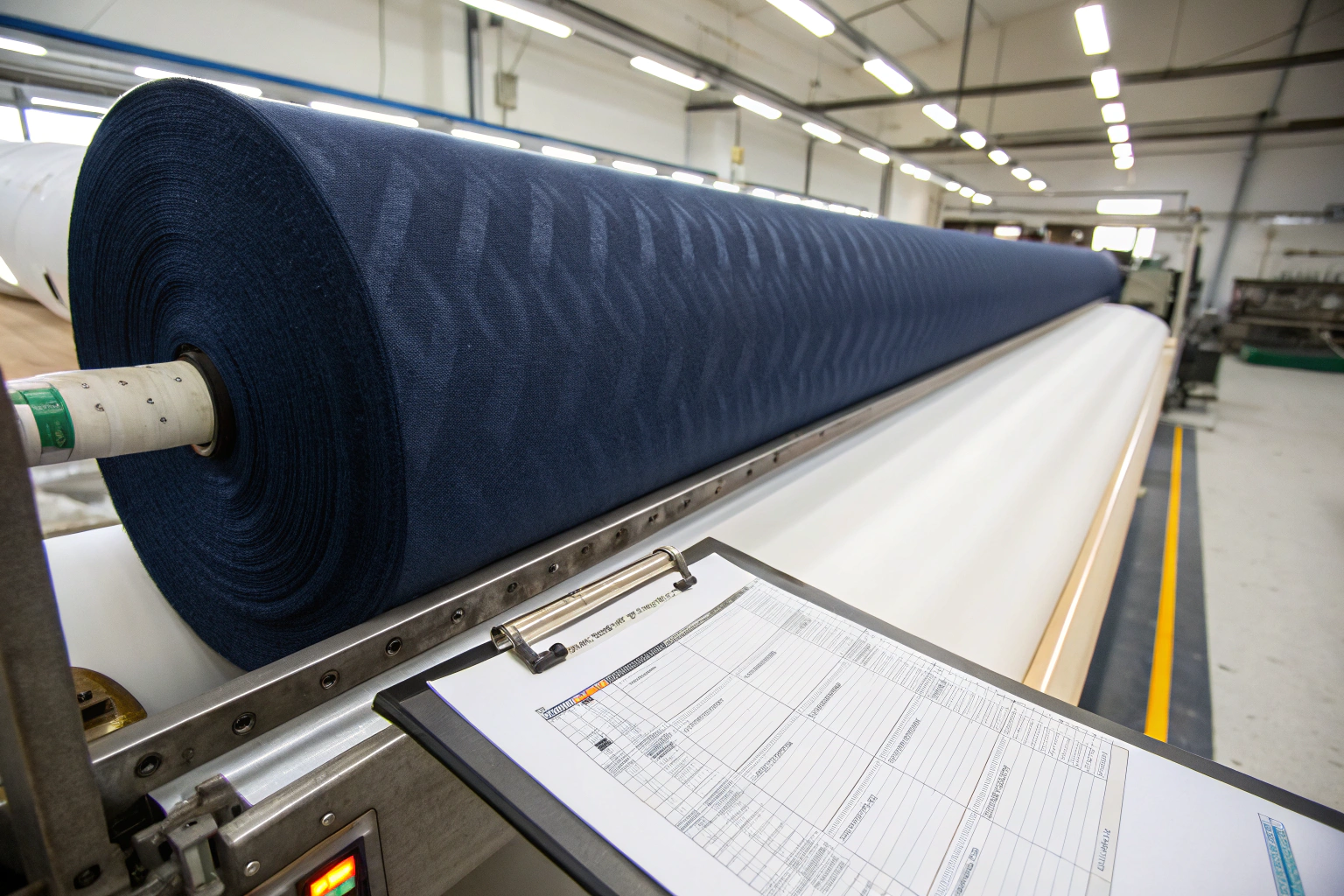
You finally found a supplier. The price is right. The hand feel sample you have pinned to your mood board looks incredible. You wire the 30% deposit and wait six weeks. The shipping notification hits your inbox and you feel that rush of relief. Then the pallets arrive at your 3PL. You cut open the first roll. It’s five shades lighter than the lab dip. You unroll a few yards. A massive dye streak runs right down the middle. Your stomach drops. You just spent $15,000 on fabric you cannot sell. You’re now facing a chargeback dispute with the mill, a missed launch deadline, and an inbox full of angry emails from pre-order customers. This nightmare happens because buyers trust the supplier’s word instead of demanding verifiable, standardized test data for every single roll.
Every roll of fabric leaving a reputable mill should be accompanied by a digital or physical report card proving it meets four non-negotiable criteria: color continuity, dimensional stability, structural integrity, and chemical safety. At Shanghai Fumao, we don’t consider a roll "finished" until it clears our internal 4-point inspection system and our CNAS-accredited lab validates the batch sample. The tests I’m about to outline are not optional add-ons for premium clients. They are the baseline requirement for any brand that wants to avoid chargebacks and maintain a consistent fit across thousands of units. If your current supplier balks when you ask for a Shrinkage Test report or a Color Spectrophotometer reading, that’s a massive red flag. You are flying blind, and eventually, you will crash into a mountain of returned merchandise.
You might think quality control is just about finding holes and stains. That’s the kindergarten level of fabric inspection. The real threats to your brand are invisible until the garment is sewn and washed by your end customer. That’s when the seams pucker because the fabric skewed. That’s when the red dye bleeds onto the white collar. That’s when the fabric stretches out like a trash bag after one wear. This article isn’t a generic overview of textile terms. It’s a walk-through of the exact equipment we use, the specific ASTM and AATCC standards we follow, and the pass/fail thresholds we enforce on the floor of our inspection facility in Keqiao. By the end, you’ll know exactly what to demand from your next shipment.
What Is a 4-Point Fabric Inspection and Why Does It Matter?
The term "4-Point System" gets thrown around Alibaba chats and sourcing emails like it’s a magic spell that guarantees perfection. It doesn’t. It’s a statistical tool. It’s a language for quantifying how many flaws are acceptable before a roll gets rejected. If you don’t understand the scoring methodology, a mill can send you a report that says "Passed 4-Point" while the actual fabric is riddled with tiny slubs and knots that will drive your cut-and-sew factory insane. You need to know how the math works so you can set the right pass/fail threshold for your specific product type.
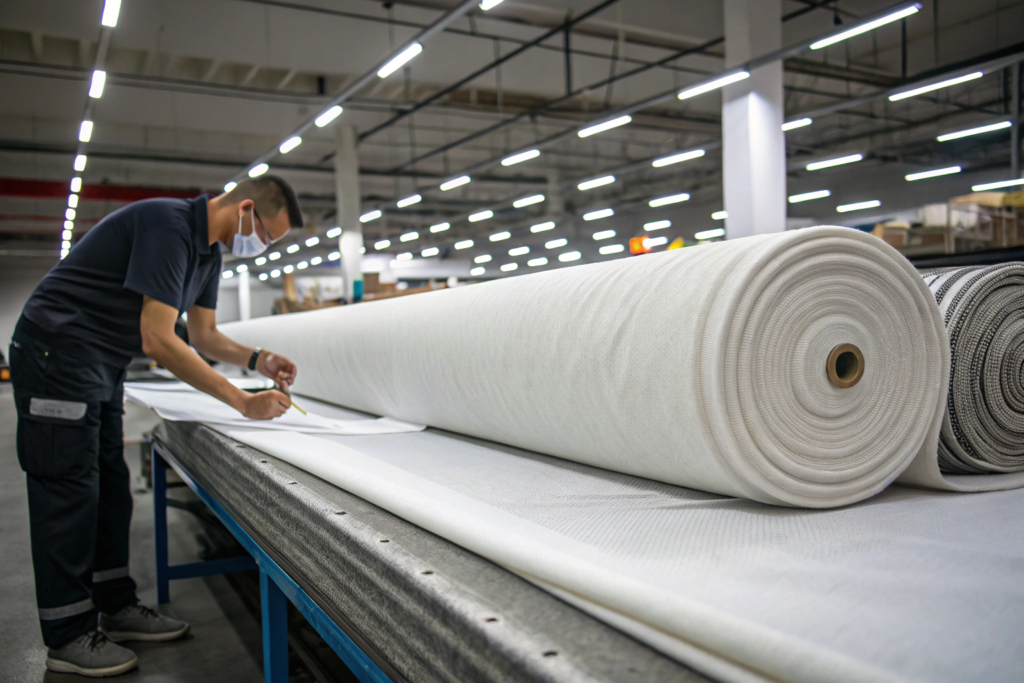
The 4-Point System assigns penalty points based on the length of a defect. A hole or stain smaller than 3 inches gets 1 point. Between 3 and 6 inches gets 2 points. Between 6 and 9 inches gets 3 points. Anything over 9 inches gets 4 points. The inspector marks these on the fabric edge and totals them up over 100 linear yards. Then we calculate Points per 100 Square Yards. That final number tells you the defect density. For high-end fashion fabric, we aim for ≤20 points per 100 sq yds. For utility lining or cheap promotional tote bags, maybe ≤40 points is acceptable. The key is that you, the buyer, must define this before production starts.
At Shanghai Fumao, our inspection process is integrated with our fabric inspection factory workflow. We use automated optical inspection (AOI) cameras combined with human eyes. The machine catches the tiny warp breaks; the human catches the subtle shading variances. Why does this matter so much? Because a single 4-point hole in the wrong place ruins a marker layout. If you’re cutting a fitted dress and the hole is right in the center front bodice, you can’t just cut around it. You have to splice the fabric, which adds labor cost and seam waste. A roll with a low point score but clustered defects is actually worse than a roll with a higher score but evenly spaced defects. This is the kind of nuance you only learn by walking the inspection floor. For a deeper look at how the system is applied globally, this resource on how to implement the 4 point fabric inspection system for apparel quality control is a standard reference we share with new hires.
How Many Defect Points Per 100 Yards Should You Actually Reject?
There is no one-size-fits-all answer. I’ve seen brands reject perfectly usable fabric because they demanded "Zero Points"—which is physically impossible for a woven natural fiber. Conversely, I’ve seen factories ship absolute garbage with a 45-point score because the buyer only asked for "no major holes." You have to align the acceptable score with the End-Use Garment.
Let me give you a practical grading scale we use internally at Fumao based on garment type:
| Garment Category | Max Acceptable Points (Per 100 Sq Yds) | Common Defect Tolerance |
|---|---|---|
| Premium Wovens (Silk, High-End Shirting) | ≤ 15 Points | Zero tolerance for stains or yarn contaminants in the first 3 yards. |
| Standard Apparel (Cotton Poplin, Twill) | ≤ 25 Points | Minor slubs okay if spaced more than 10 yards apart. |
| Denim & Casual Bottoms | ≤ 35 Points | Natural slubs and nep are part of the character. Reject only for holes or broken warp lines. |
| Accessories & Bags (Canvas, Heavy Nylon) | ≤ 40 Points | Holes over 1 inch are still a rejection. |
| Home Textiles (Sheeting, Drapery) | ≤ 20 Points | Light shading on the edge (selvedge) is okay; face shading is not. |
Here’s a specific case from January 2026. We shipped 8,000 yards of a linen/viscose blend to a Los Angeles-based women’s wear brand. The spec sheet agreed on ≤25 points. The actual shipment averaged 18 points. However, the inspector flagged one specific roll with 32 points. The issue? Burl Mark—a fuzzy lump of unspun fiber woven into the cloth. It wasn’t a hole. Under a 25-point allowance, it might have squeaked by. We rejected the roll anyway. Why? Because that fabric was destined for a semi-sheer blouse. That burl mark would look like a giant zit in the middle of the back panel. The client would have lost that blouse to a second-quality sale. We swapped the roll from our buffer stock. That’s the difference between checking a box and actually protecting a brand’s yield. For more context on yield calculations, this thread on how to calculate fabric yield and cutting loss in garment production helps illustrate why a single defect can cost more than just the fabric.
Why Do Knitted Fabrics Need a Different Grading Standard Than Wovens?
Knits lie. Wovens are honest. That’s a saying we have on the floor. A woven fabric has a rigid grid. A broken end or a missing pick is a clear, static flaw. A knit fabric is a living, breathing chain of loops. It stretches. It curls. A defect in a knit—say, a Drop Stitch or a Barre Mark—might be nearly invisible on the inspection table in a relaxed state. But put that same knit on a steam table or stretch it over a dress form, and that tiny defect opens up into a gaping hole or a glaring horizontal stripe.
This is why we don’t just use the 4-Point System for knits. We augment it with Stretch and Recovery Testing. You can have a knit roll with zero visual defects (a perfect 0-point score), but if the yarn tension was uneven in the knitting machine, the fabric will have Spirality. Spirality is the devil. It means the fabric wants to twist. You cut a perfect square for a t-shirt front panel, wash it once, and the side seam rotates to the front of the wearer’s chest. The garment looks drunk.
At Shanghai Fumao, we test every single knit lot for Course Count and Wales Count (stitch density) and Skew. We use a standard AATCC 179 test method. We lay the fabric flat, mark a perfect square with a template, wash it per care label instructions, and then measure the % of twist. For a standard jersey t-shirt, we reject anything over 5% Spirality. For a structured Ponte Roma pant, we want less than 2%. Here’s a real-world example: In November 2025, a Canadian activewear client reported that their first production run of leggings had a "twisted leg" issue. The fabric came from a third-party mill. We analyzed the roll. The visual defects were minimal (Score 18). But the Skew was 8.2%. That means the fabric was cut off-grain. There is no way to fix that in sewing. The entire 2,000 yards had to be used for solid color blocking where the twist wasn’t noticeable. That’s a costly salvage operation that proper knit grading would have prevented. Understanding the mechanical differences between fiber types is key here; you can learn more about how to identify and prevent fabric spirality and skew in jersey knit production.
How Can You Verify Color Consistency Across Multiple Dye Lots?
Color is the number one reason for fabric returns in the fashion industry. Period. Full stop. You approved a specific "Dusty Rose" lab dip under the fluorescent lights of your New York office. The bulk production arrives and under the California sun, it looks like "Bubblegum Pink." Or worse, the sleeve matches the approved standard, but the body fabric came from a different dye lot and is half a shade lighter. When that garment hits the retail floor or the e-commerce photo studio, the seam between the sleeve and body glows like a neon sign.
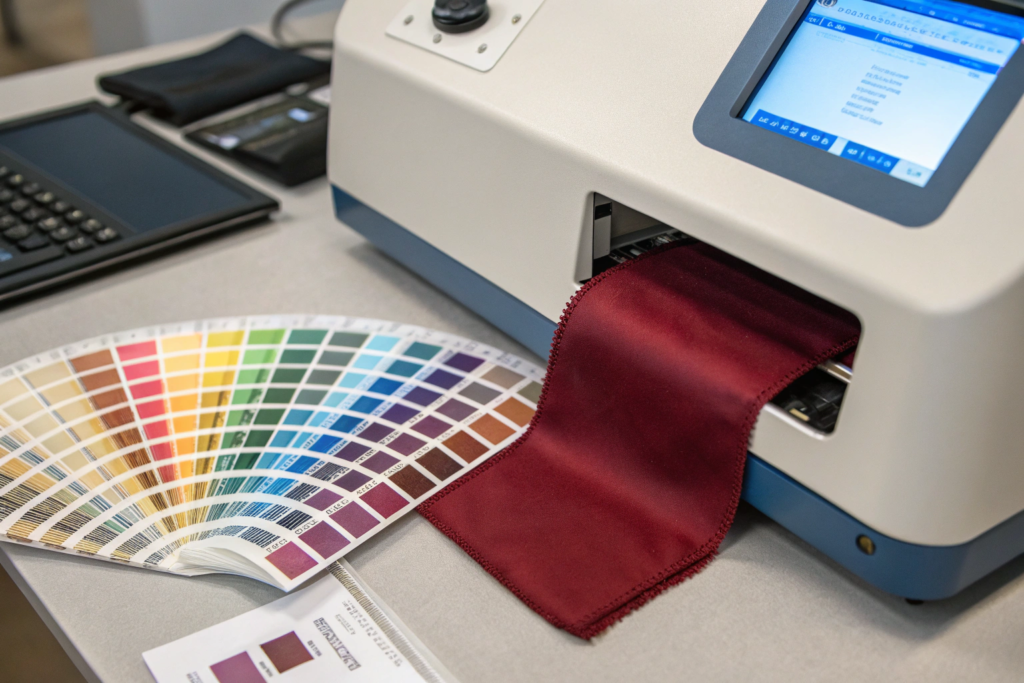
The human eye is a terrible tool for color approval because it’s subjective and easily fatigued. A professional colorist knows that after looking at red for 60 seconds, you can’t see the blue undertones anymore. That’s why we use instruments. At Shanghai Fumao, every single dye lot is verified against the client’s Lab Dip Standard using a Spectrophotometer. This machine measures the precise amount of light reflected at every wavelength across the visible spectrum. It doesn’t care if the operator is tired or if the room is a little dark. It gives a numerical value for the color.
We use the CIELAB Color Space model. The machine measures Delta E (dE) . Delta E is the mathematical distance between the color you wanted and the color we made. The human eye generally cannot perceive a difference if dE is less than 1.0. A trained eye might spot a dE of 1.5. Your customer will definitely spot a dE of 2.5 or higher, especially on a solid color garment next to a matching accessory. At Fumao, our internal pass/fail standard for bulk dye lots is dE ≤ 1.2 for critical fashion colors and dE ≤ 1.8 for basic commodity colors. If the machine says dE is 2.3, we don’t even show the sample to the merchandiser. We send it back for re-dyeing or stripping. This is non-negotiable.
What Is a Spectrophotometer and How Does It Prevent Color Complaints?
Think of a spectrophotometer as a digital nose for color. It "sniffs" the light reflecting off the fabric and tells you the exact recipe of wavelengths. It removes the guesswork and the arguments. Instead of a client email saying "This feels too yellow," we can reply with, "The Delta E is 1.1, which is within the agreed commercial tolerance. The perceived yellowness may be due to the optical brighteners in your office paper." Data wins.
Here is how the process works in our Keqiao lab:
- Calibration: The tech calibrates the machine using a pure white ceramic tile and a black trap. This sets the baseline for 100% reflection and 0% reflection.
- Standard Measurement: We place the approved Lab Dip (the "Master Standard") on the port. The machine saves the spectral curve.
- Batch Measurement: We take a swatch from the bulk dye lot. We fold it twice to ensure opacity (so the background color doesn’t bleed through). We measure it 4 times in different spots to account for fabric texture.
- Comparison: The software calculates the Delta E (dE CMC or dE 2000).
Here is a simplified table of what different Delta E (dE CMC) values actually mean in the real world of a garment rack:
| Delta E Value (dE CMC) | Visual Perception | Business Implication |
|---|---|---|
| 0.0 – 1.0 | Invisible difference. | Perfect. Acceptable for all components (trim, body, lining). |
| 1.0 – 1.5 | Perceptible only by trained colorist under controlled light. | Acceptable for bulk garment delivery. Fumao Internal Standard. |
| 1.5 – 2.5 | Noticeable difference under store lighting. | Danger Zone. Do not mix this lot with previous lots in the same style. Risk of customer return if paired with a web image. |
| 2.5 + | Obvious mismatch. "That’s a different shirt." | Reject. Chargeback territory. |
A case in point: February 2026, a UK menswear brand ordered a re-run of a popular navy chino fabric. The lab measured a dE of 2.1 against the previous season’s standard. Visually, under our 5000K light booth, it looked slightly redder. The brand manager was in a rush and wanted to ship. We advised against it. We said, "If a guy buys these pants to match the jacket he bought last year, he will return them." They took our advice, we re-dyed the lot (a 4-day delay), and the final dE was 0.9. They avoided what would have been a minimum 15% return rate on a core program. For those wanting to understand the visual impact, this guide on how to read a spectrophotometer color report for textile lab dips is essential reading for any brand manager.
Can You Guarantee a Perfect Color Match Between Nylon Lace and Polyester Satin?
No. And any mill that promises you a "perfect" match between two different fiber contents or two different fabric structures is lying to your face. Let me explain the physics of why this is impossible, even with the best spectrophotometer in the world.
Fabric is not a flat piece of paper. It has Texture, Luster, and Opacity. A shiny polyester satin reflects light like a mirror. The specular highlight bounces straight back at the spectrophotometer’s sensor. A matte nylon lace absorbs and scatters light through its holes. The background (usually the black backing of the machine or the white table underneath) influences the reading. Even if the dye recipe is identical, the perceived color will be different.
This is a huge pain point for lingerie and bridal brands. They want the satin body to match the lace trim. Here is the Fumao Protocol for minimizing this mismatch:
- Visual Assessment (The Primary Metric): For trim-to-body matching, we prioritize the Light Booth Visual Check over the spectrophotometer dE. We use a D65 (Daylight) and an A (Incandescent) light source. The fabric must look like a match to the human eye under both lights. This is called Metamerism. A bad match looks the same under one light but different under another.
- On-Tone Dyeing: We don’t just use the same dye percentages. We use a "Slightly Dirties" approach for the lace. Because lace is see-through, it naturally looks lighter. We often have to add a tiny touch of black or brown (less than 0.01% owf) to the lace dye bath to give it the same "visual weight" as the opaque satin.
- Pressured Approval: We send a "Simulated Garment" photo to the client. We physically stack the lace swatch on top of the satin swatch in our photo studio. We email a high-res image and say, "This is the visual reality. Do you approve?"
In August 2025, a European luxury sleepwear brand rejected a shipment because the black lace trim looked "charcoal grey" next to the "jet black" silk charmeuse. The dE between the two dyes was only 1.4. But visually, it was a disaster. The solution? We switched the lace yarn from a bright trilobal nylon to a Full Dull Nylon. The full dull yarn absorbs light instead of reflecting it. Suddenly, the visual match was perfect, even though the dE on the spec sheet increased to 1.8! This is why you can’t manage by numbers alone. For a deeper understanding of this phenomenon, I often point designers to this article on how to manage metamerism and color matching issues in textile manufacturing. It saves a lot of heartache.
Which Physical Tests Prevent Shrinkage and Seam Slippage Claims?
You can have the most beautiful color and the cleanest inspection report, but if the garment comes out of the customer’s washing machine two sizes smaller, you are dead in the water. Shrinkage and Seam Slippage are the silent killers of brand reputation because the damage occurs after the point of sale. The customer can’t inspect for shrinkage in the fitting room. They discover it a week later when they pull a crumpled, child-sized version of your $128 shirt out of the dryer.
These are not just "cotton problems." Polyester can shrink from heat relaxation. Silk can shrink from water agitation. Viscose can lose 8% of its length if not properly sanforized. At Shanghai Fumao, we test every single batch of fabric that comes off our finishing line for Dimensional Stability. We have a dedicated washing machine and tumble dryer that only runs AATCC standard tests. We don’t guess. We wash it and measure it. This is the only way to provide accurate care label instructions and accurate cuttable width estimates to your pattern maker.
The same principle applies to Seam Strength. A beautiful French seam is useless if the yarns inside the fabric just slide apart under tension, leaving a gaping hole along the stitching line. This is called Seam Slippage. It’s most common in silks, rayons, and loosely woven linens. If you are making a fitted dress or a pair of pants that will be stressed when the wearer sits down, you must know the Seam Slippage value.
How Much Shrinkage Is Actually Acceptable for Cotton Apparel?
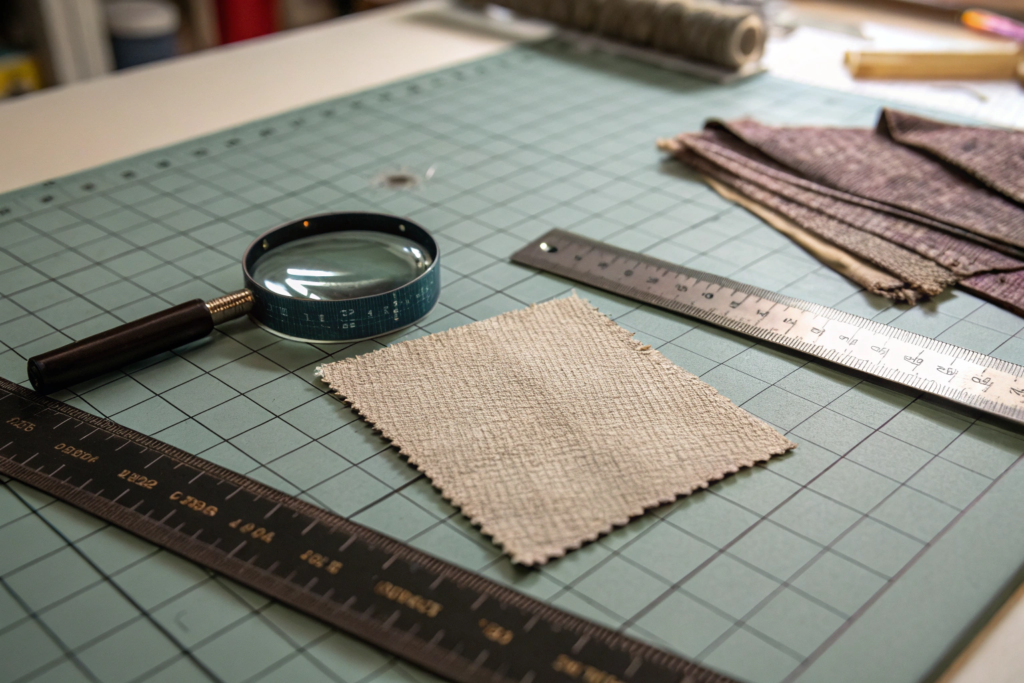
Let’s set realistic expectations. 100% cotton will shrink. It’s a natural fiber. The cellulose chains relax when wet and contract when dried with heat. If you are making a loose, oversized boxy tee, 3-4% shrinkage might be acceptable because the consumer won’t notice the fit difference. If you are making a tailored cotton poplin dress shirt with darts and a collar stand, even 2% shrinkage is a disaster. The collar feels tight. The sleeves pull back from the wrist.
The industry standard (AATCC 135) defines acceptable shrinkage based on how the fabric is marketed. Here is the breakdown we use at Fumao when setting client expectations:
| Fabric Construction | Expected Shrinkage (Length x Width) | Required Pre-Treatment at Mill |
|---|---|---|
| 100% Cotton Knit (Jersey) | 5% x 5% | Compacting required. We run the fabric through a compactor machine that overfeeds the fabric to pre-shrink it mechanically. |
| 100% Cotton Woven (Poplin) | 3% x 2% | Sanforizing required. The fabric is stretched on a rubber belt and compressed lengthwise. |
| Cotton/Poly Blends (60/40) | 2% x 2% | Compacting recommended. Less shrinkage due to polyester stability. |
| Viscose / Rayon | 6-8% x 4% | Critical Warning: Rayon swells massively in water. Must be garment washed or fabric washed at the mill. Do not ship flat. |
Here is where the rubber meets the road. In December 2025, a San Francisco streetwear brand used our 100% Cotton 20/Single Jersey. The spec sheet said "Compacted, expected shrinkage 5%." They cut the fabric and made t-shirts. They did not wash the garments before shipping. Their care label said "Machine Wash Cold, Tumble Dry Low." The customer followed that label. The shirt shrunk 8% in length. The 5% was our fabric test result under laboratory conditions. The extra 3% came from the aggressive heat of the consumer’s home dryer. The client was furious. But here’s the thing—we had warned them. The lab report we sent with the shipment stated: "Note: Additional progressive shrinkage up to 3% may occur in consumer tumble drying." They didn’t read the fine print. Now, we advise all cut-and-sew clients to Pre-Wash the bulk fabric or Garment Dye the finished tees if they want zero consumer shrinkage. It adds cost, but it eliminates returns. For a more technical dive into the mechanics, this resource on how to test fabric shrinkage using AATCC 135 standard for apparel manufacturers is what we use to train our QC staff.
Why Does Seam Slippage Ruin Silk Dresses and How Do We Test It?
Silk charmeuse is the most elegant, fluid, and expensive fabric in the world. It is also one of the most infuriating fabrics to sew if the yarns are not locked in place. Seam slippage happens when the warp yarns slide over the weft yarns (or vice versa) under stress. Imagine a woman wearing a bias-cut silk slip dress. She sits down on a velvet banquette. The friction of the velvet grabs the silk, but her body weight pulls the dress tight across the hip. Pop. The seam didn’t rip, but the fabric next to the seam gaped open like a fishnet. The dress is ruined.
We test for this using a device called a Tensile Strength Tester. It’s a machine with two clamps that pull the fabric apart. But for seam slippage, we sew a standard seam down the middle of the fabric sample, cut it, and then clamp the fabric (not the seam) and pull. We measure how many pounds of force or how many millimeters of opening occur at a specific load.
The standard test is ASTM D434 (or the newer ISO 13936). At Shanghai Fumao, we require a minimum Seam Slippage Resistance of 2.5 kgf (5.5 lbs) for lightweight silk blouses and 4.0 kgf (8.8 lbs) for structured silk pants or jackets. If the fabric fails, there are a few fixes:
- Increase Seam Allowance: Instead of a standard 3/8" seam, use a 5/8" or 3/4" seam. This moves the stress point further into the fabric.
- Use a French Seam or Flat Felled Seam: These seams enclose the raw edge, providing a second line of defense. If the first line slips, the second line holds.
- Apply a Seam Sealant: We can apply a thin, flexible polyurethane tape to the back of the seam allowance in the factory. This locks the yarns in place.
- Tighten the Weave: At the mill level, we can increase the Picks Per Inch (PPI) by 5-10%. This increases the friction between warp and weft.
In June 2025, a Miami-based evening wear designer came to us in a panic. Her previous supplier’s silk chiffon was "unsewable." The seams pulled apart as soon as the model breathed. We tested the fabric. The slippage was 1.2 kgf. Terrible. We developed a new 8mm silk chiffon with a tighter twist in the yarn and a specific Anti-Fray Finish. We increased the PPI from 76 to 82. The new fabric tested at 3.8 kgf. It sewed like butter and held its shape on the red carpet. The difference was night and day. For those working with these delicate materials, this forum discussion on how to prevent seam slippage in lightweight silk and viscose fabrics contains a wealth of practical sewing room fixes.
What Chemical Certifications Do I Need to Sell Fabric in the EU and US?
You can pass every physical test I’ve described—perfect color, zero shrinkage, strong seams—and still have your shipment seized at the port of Hamburg or Los Angeles. Why? Chemical Compliance. This is the fastest moving target in the textile industry. Regulations in the EU (REACH) and the US (CPSIA) change constantly. A chemical that was allowed in fabric finishes three years ago might be banned tomorrow. If you are a brand selling to consumers, especially children or sensitive adults, the liability for skin rashes or worse lands squarely on your desk, not the mill’s.
The days of "self-declaring" that your fabric is safe are over. Large retailers like Walmart and Target require Generational List testing. Boutique e-commerce brands require OEKO-TEX Certification. If you can’t produce a valid, third-party lab report (from SGS, Bureau Veritas, or Intertek) for every single PO, you are gambling with your business license.
At Shanghai Fumao, we treat chemical management as seriously as color management. We have a restricted substances list (RSL) that is updated quarterly. We test every batch of incoming dye and every outgoing batch of finished fabric. This is part of our CNAS-Accredited Lab workflow. We test for Formaldehyde (common in anti-wrinkle finishes), Heavy Metals (lead, cadmium in zippers and buttons), Azo Dyes (banned amines that cause cancer), and APEOs (endocrine disruptors). If you don’t ask for these reports, you are implicitly accepting whatever is in the fabric.
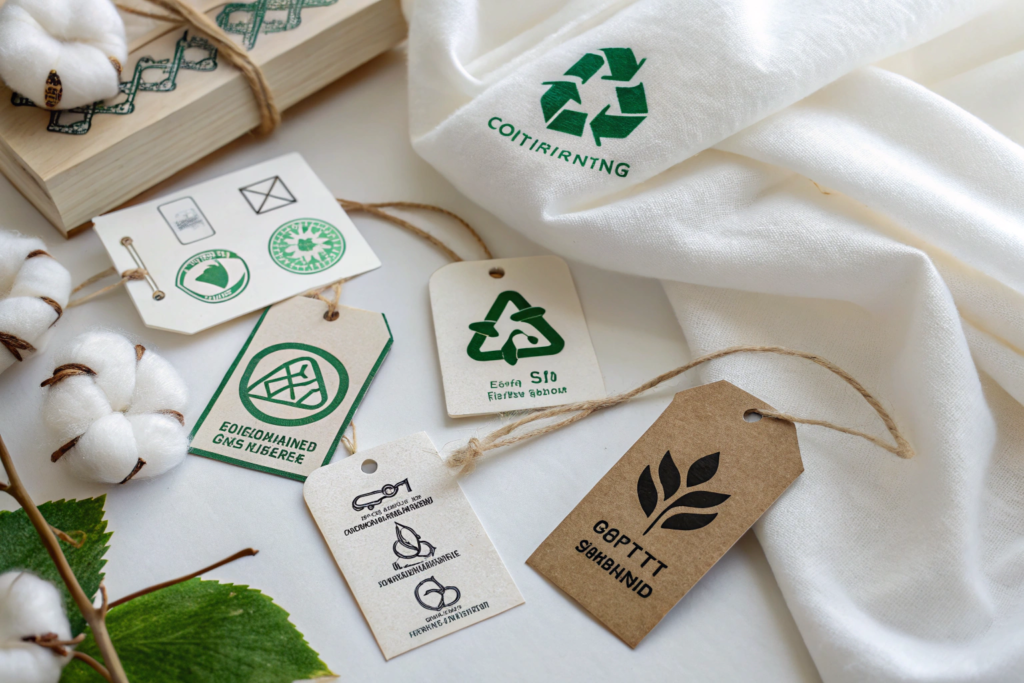
What Is OEKO-TEX Standard 100 and Do US Buyers Really Care?
OEKO-TEX Standard 100 is the global lingua franca of textile safety. It is a certification that the fabric has been tested for over 100 harmful substances and found safe for human contact. There are four product classes:
- Class I: Baby articles (strictest limits).
- Class II: Articles with direct skin contact (underwear, t-shirts, bedsheets).
- Class III: Articles without direct skin contact (jackets, coats).
- Class IV: Decoration materials (curtains, tablecloths).
Do US buyers care? Ten years ago, I’d say "only the crunchy granola brands." Today, in 2026, Yes. Absolutely. They care a lot. Especially the younger, digitally-native vertical brands (DNVBs) selling to Gen Z and Millennials. These consumers read labels. They Google the certifications. They will call a brand out on TikTok if they find a "Made in China" tag without an OEKO-TEX logo.
Here is the business reality for you as an importer. If you buy fabric that is NOT OEKO-TEX certified, you will have to test the finished garment yourself to ensure compliance with US CPSIA requirements (especially for lead content in prints). Garment testing is expensive. It costs about $300 – $500 per style for a full heavy metal and phthalate panel. If you buy fabric that IS OEKO-TEX Standard 100 Class II certified (like all of Shanghai Fumao’s stock service fabrics), you can Exempt that portion of the testing. The lab accepts the mill’s certificate as proof of upstream compliance. This saves you thousands of dollars in third-party lab fees annually.
A case in point: October 2025, a Portland, Oregon-based baby clothing startup placed their first order with us for 500 yards of organic cotton interlock. They were terrified of lead in the snaps and phthalates in the print. We provided our OEKO-TEX Certificate Number and a Batch Specific Test Report showing ND (Non-Detect) for all restricted heavy metals. They uploaded that to their Amazon compliance portal. The listing went live in 24 hours without a hitch. Without that paperwork, their product would have been flagged for "Document Request," stuck in limbo for 2-3 weeks while they scrambled to test. For anyone navigating this for the first time, this guide on how to get OEKO TEX standard 100 certification for textile products and why it matters is the official starting point.
Why Do EU REACH Regulations Require Different Testing Than US CPSIA?
This is where it gets tricky and where a lot of small US brands get burned when they try to expand into Europe. They think, "My fabric is CPSIA compliant, so it’s good anywhere." Wrong. EU REACH (Registration, Evaluation, Authorisation and Restriction of Chemicals) is significantly broader and more stringent than US CPSIA.
The major differences that impact fabric sourcing:
- SVHC List (Substances of Very High Concern): REACH maintains a list of over 200 chemicals. If your product contains more than 0.1% of any SVHC, you have to notify the EU customer and the European Chemicals Agency (ECHA). You cannot just be "below the limit"; you have to Declare it. US law doesn’t require this active declaration.
- Azo Dyes: REACH has a very specific ban on Azo Colorants that can break down into 22 specific aromatic amines. The limit is 30 mg/kg (30 ppm) . CPSIA has limits on lead and phthalates, but the specific Azo amine test is a uniquely European requirement.
- Dimethylfumarate (DMF): This is a biocide used in those little silica gel packets to prevent mold. REACH strictly prohibits it. If your container gets fumigated with the wrong stuff, your fabric fails.
If you ship to Europe without a REACH Certificate of Compliance, you are playing Russian roulette. Customs will hold your container. They will charge you storage fees. They will send a sample to a lab. That test can take 2-3 weeks. By the time it clears, your season is over. We saw this happen to a Dutch importer who used a non-certified Chinese polyester in April 2024. Their 40ft container was held in Rotterdam for 21 days over a Nonylphenol Ethoxylate (NPE) violation. NPEs are surfactants used in scouring. They are banned in EU (limit 100 ppm) but widely used in cheaper mills. Shanghai Fumao uses only NPE-Free Scouring Agents specifically for our EU-bound production. It costs about 5% more per yard, but the container clears customs in 2 days instead of 2 months. For a full breakdown of the requirements, this official resource on understanding the difference between REACH and CPSIA compliance for textile importers is worth bookmarking.
Conclusion
Navigating the world of fabric quality testing can feel like drinking from a firehose. We’ve walked through the four pillars that hold up a successful garment program: the visual inspection of the 4-Point System, the scientific precision of color spectrophotometry, the mechanical resilience tested by shrinkage and seam slippage rigs, and the invisible shield of chemical certifications like OEKO-TEX and REACH. Skipping any one of these pillars leaves your brand vulnerable to a different type of failure—whether it’s a seam that gapes open, a color that bleeds onto the customer’s white couch, or a shipment that gets impounded at customs.
The common thread here is that you cannot manage what you do not measure. Relying on a supplier’s verbal assurance that "the quality is good" is a business model for a flea market, not a scalable apparel brand. You need the data. You need the ASTM and AATCC test reports. You need a partner who owns the equipment and the process, not a middleman who just forwards an email from a subcontracted mill they’ve never visited. At Shanghai Fumao, we’ve invested millions of RMB into our in-house lab and inspection infrastructure precisely because we know that a chargeback costs us as much as it costs you in the long run. We want the fabric to be right the first time, every time.
If you’re tired of the guessing game and want to source fabric that comes with a verifiable, transparent report card attached to every roll, let’s have a specific conversation about your next project. Whether you need 500 yards of OEKO-TEX certified jersey or 5,000 yards of color-critical satin, our team in Keqiao is ready to run the tests that matter to your customer.
You can reach out directly to our Business Director, Elaine, to request a sample testing protocol or a copy of our latest Restricted Substances List. She can walk you through exactly what documentation we provide with every bulk shipment. Email her at elaine@fumaoclothing.com. Let’s make sure your next production run clears inspection with flying colors.








