I've been in this industry for over two decades, and I've seen a lot of "game-changers" come and go. But the laser? This is the real deal. I still remember walking through our denim finishing workshop ten years ago. The air was thick with dust from hand-sanding, the noise from grinding machines was deafening, and the workers were covered in indigo. It was effective, but it was brutal, inefficient, and incredibly inconsistent.
The problem for brands, especially those of you like Ron in the US, has always been this: how do you get that perfectly worn-in, vintage look on denim at scale, without the quality control nightmare? One worker's hand-sanding is different from another's. One batch of pumice stones for stone-washing is coarser than the next. The result? Inconsistent products, high return rates, and a manufacturing process that's tough on both people and the planet.
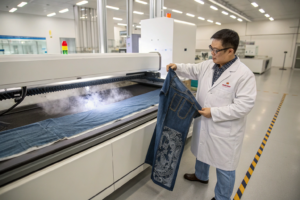
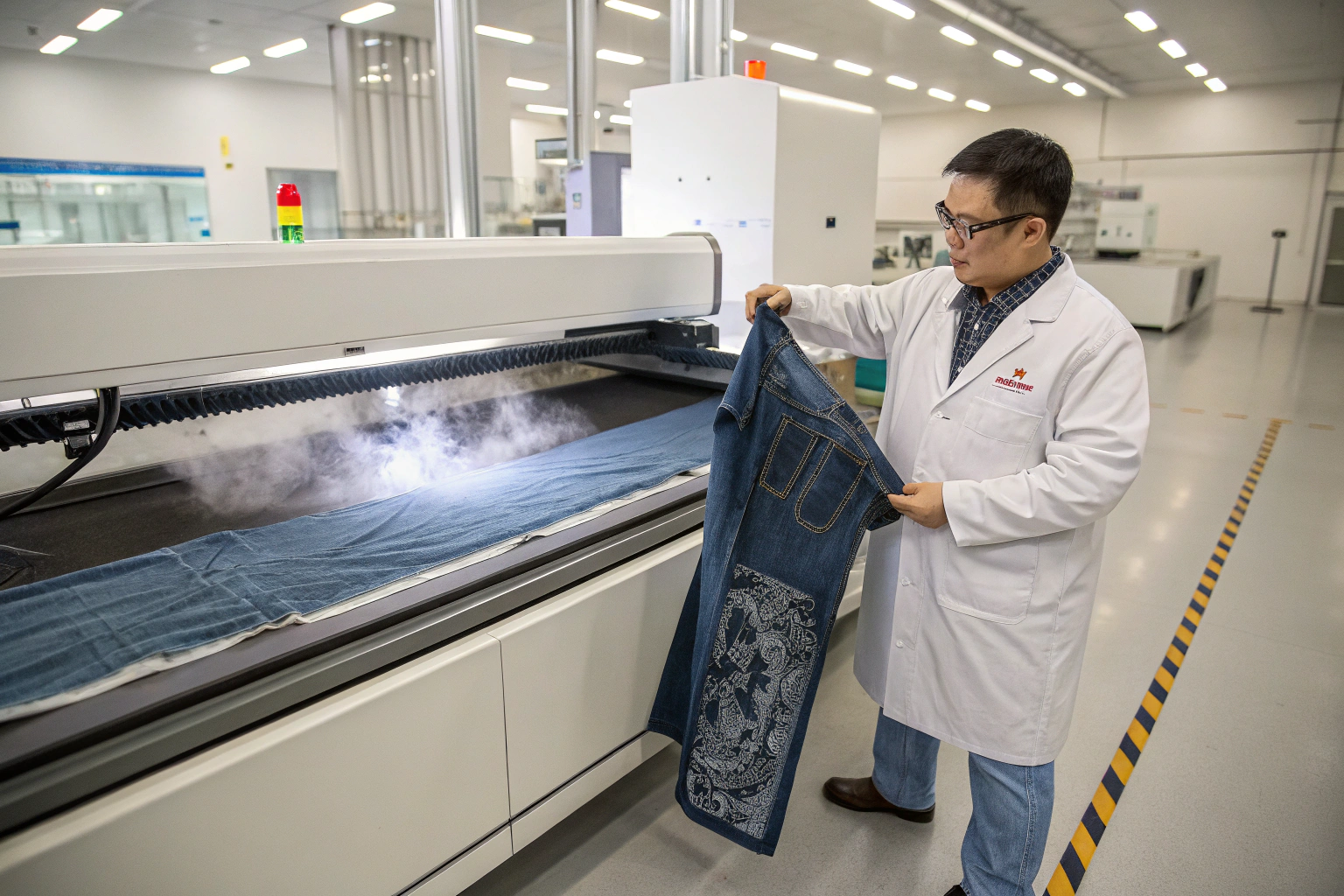
So, what's the solution? Lasers. The role of lasers in denim and fabric finishing is nothing short of revolutionary. It's about taking an artisanal process and making it precise, repeatable, and sustainable. At Shanghai Fumao (shanghai famao), we've invested heavily in this technology. We have a dedicated laser finishing workshop that works alongside our traditional methods. We can now take a digital design and etch it onto denim with microscopic precision, creating everything from subtle whiskers to bold, graphic patterns, all without a drop of water or a single grain of sand.
In this post, I'm going to pull back the curtain on this technology. We'll talk about how lasers actually work on fabric, the specific advantages they offer over old-school methods, the quality standards you need to look for, and why this matters for your bottom line and your brand's sustainability story. By the end, you'll understand why lasers aren't just a cool gadget—they're the future of finishing.
1. How do laser machines actually create fading and whiskers on denim?
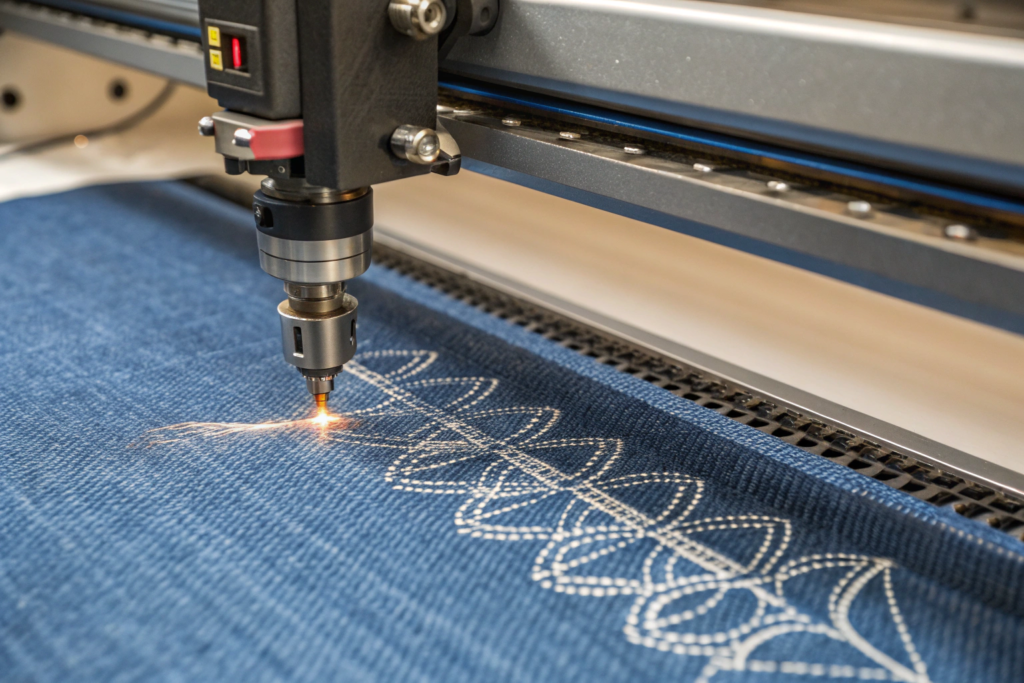
This is where the magic happens, and it's actually simpler than most people think. A laser finisher is essentially a highly precise, computer-controlled beam of light. When we focus that beam onto the surface of indigo-dyed denim, the energy from the light is absorbed by the dye. This energy heats the indigo molecules so rapidly that they sublimate—they turn directly from a solid into a gas. Poof. Gone. The underlying cotton fiber, which is naturally white or off-white, is now exposed.
The result is a permanent, clean fade. The laser doesn't touch the fabric physically, so there's no abrasion or weakening of the fibers if the power settings are correct. We can create any pattern imaginable. Whiskers around the lap area, honeycombs behind the knees, scratches on the thighs, even full back-pocket designs. We just upload a digital design file to the laser's computer, place the garment on the form, and the machine does the rest. It's like a printer for wear patterns. I remember in early 2023, a Swedish brand came to us with a very specific vintage fade pattern from a pair of 1950s Levi's. They had photos, but no physical sample. We scanned the photos, a designer recreated the pattern in our software, and we ran a test on the laser. The first sample was 95% accurate. A tiny tweak to the power on the second pass, and we had a perfect match. That's the kind of precision you just can't get with manual methods.
What is the difference between laser fading and traditional sandblasting?
This is a critical question, especially for worker safety and environmental compliance. Sandblasting, which was common for years, involves firing fine particles of sand or other abrasives at high pressure onto the denim to abrade the surface and remove dye. It's effective, but it's also incredibly dangerous for workers. The dust causes a lung disease called silicosis. It's been banned in many countries for good reason. It's also messy, creates a lot of waste dust, and is very hard to control precisely.
Laser fading, on the other hand, is a clean, dry, and controlled process. There's no physical abrasion, so no dust. The only byproduct is a small amount of vaporized indigo and fiber particles, which are captured by an integrated ventilation and filtration system right in the machine. From a quality perspective, laser is infinitely more consistent. Sandblasting relies on the skill and strength of the worker holding the gun. One worker might hold it closer or longer than another, leading to variations. With a laser, every single pair in a production run is identical. For a brand like Ron's, this means the pair his customer buys in New York will look exactly like the pair sold in Los Angeles. That's brand consistency. For more on the health risks of traditional methods, the Occupational Safety and Health Administration (OSHA) guidelines on silica dust provide a stark contrast to the safety of laser finishing.
Can lasers create realistic "honeycomb" patterns behind the knees?
Absolutely. In fact, this is one of the things lasers do best. Honeycombs, those tight, whisker-like fades that form behind the knee from bending, are a hallmark of well-worn jeans. Replicating them manually with sandpaper is an art form that takes years to master, and it's still easy to make them look fake or too uniform.
With a laser, we can create honeycombs that are incredibly nuanced. Our software allows us to control the depth, spacing, and intensity of each individual "cell" in the honeycomb. We can make them denser in the center and lighter at the edges, just like natural wear. We can even combine different power levels in the same pattern to create a sense of depth—darker fades from low-power passes, and brighter, more worn areas from higher-power passes. At Shanghai Fumao, we have a library of hundreds of different honeycomb patterns, from subtle and natural to bold and stylized. We worked with a Japanese denim brand in 2024 that wanted a "ghost" honeycomb—very faint, almost invisible unless you look closely. We achieved it by using a lower power setting and a wider, defocused beam. It was a subtle effect, but it was the difference between a mass-market jean and an artisanal masterpiece. The level of control is simply unparalleled.
2. Is laser finishing environmentally friendlier than traditional methods?
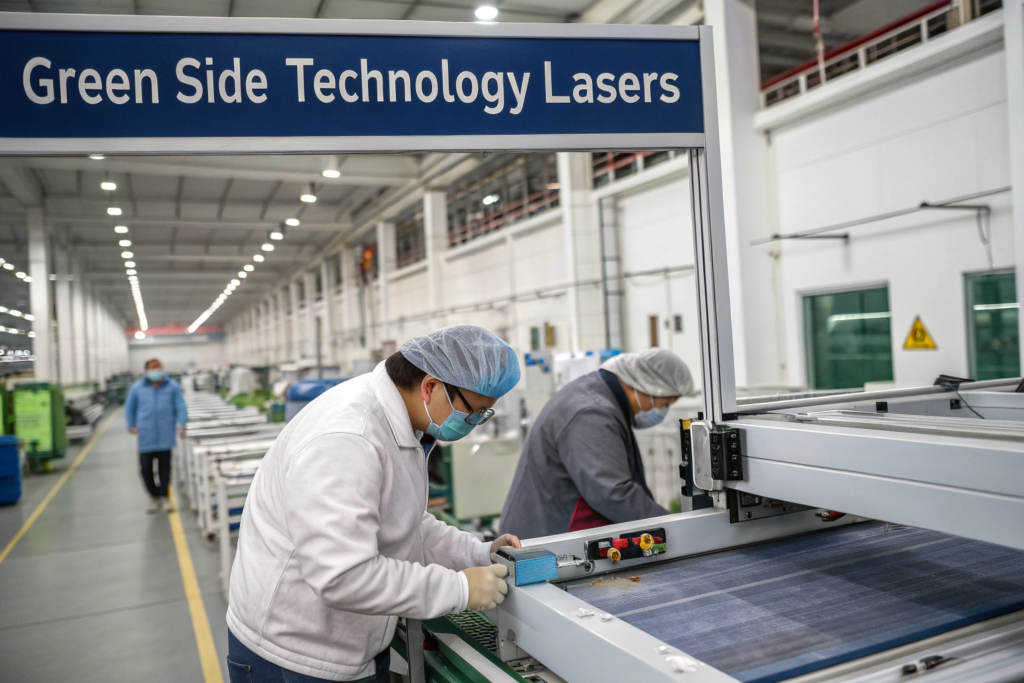
Let's talk about the green side of lasers. And I'm not just talking about marketing hype. I'm talking about hard numbers. The fashion industry, and denim in particular, has a massive environmental footprint. A single pair of jeans can use thousands of liters of water in its lifecycle, much of it in the finishing process. Traditional methods like stone-washing, bleaching, and hand-sanding are resource-intensive and create polluted wastewater.
Laser finishing flips that script. It's a dry process. It uses zero water. Zero. There's no chemical runoff, no sludge to treat. The energy consumption is also significantly lower than running large washing machines full of water and pumice stones. And because it's digital, there's less waste. If we need to make a change to a pattern, we don't have to dump a batch of chemically treated water or throw away mis-processed garments. We just tweak the file and run the next one. For a brand with sustainability goals, this is a no-brainer. We've had European clients come to us specifically because they need to reduce their water footprint. Laser finishing helps them get there. In 2022, we helped a Dutch denim brand reduce the water usage for their flagship jean line by over 60% simply by replacing all their manual abrasion steps with laser and ozone finishing. That's a real, measurable impact.
Does laser finishing eliminate the need for water in denim production?
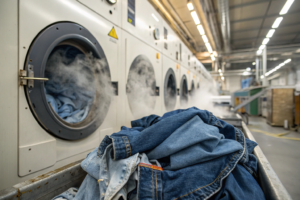
Not entirely, but it dramatically reduces it. To be clear, laser finishing replaces the abrasion steps of the process. A typical "vintage" jean might go through several steps: desizing (removing starch), laser or hand-sanding, enzyme washing, bleaching, stone-washing, rinsing, and softening. The laser replaces the physical abrasion steps like sandblasting and hand-sanding. There are still wet processes involved, like enzyme washing to remove loose fibers and create a softer hand feel, or rinsing to remove any residues.
However, there are complementary technologies, like ozone fading, that work hand-in-hand with lasers to further reduce water usage. Ozone gas can be used in a closed-loop, dry system to bleach or fade garments. We have an ozone chamber in our facility. We can laser a pattern onto a jean, then put it in the ozone chamber to fade the overall base color. The result is a fully faded garment with multiple dimensions of wear, created with minimal water. The only water used is for a final, quick rinse. So, while laser alone doesn't make the process 100% water-free, it's a massive step in the right direction. For more on water-saving technologies, the Water Footprint Network's reports on textiles provide excellent context on the scale of the problem and potential solutions.
What certifications should I look for in sustainable denim finishing?
This is where you need to be a savvy buyer. Anyone can claim to be "green." You need proof. For laser finishing, the key certifications relate to the overall environmental management of the facility and the safety of the final product. We operate our laser workshop under our ISO 14001 (Environmental Management) certification, which means we have systems in place to monitor and reduce our environmental impact. For the fabric itself, if you're using sustainable raw materials like organic cotton or recycled polyester, look for Global Organic Textile Standard (GOTS) or Global Recycled Standard (GRS) certification.
Specifically for the finishing process, the OEKO-TEX® STeP certification is a great one to look for. It assesses factories on their sustainable practices, including chemical management, environmental performance, and social responsibility. It shows that the entire production facility, including the laser finishing department, is operating to a high standard. We've gone through this audit, and it's rigorous. They check everything from our air filtration systems on the lasers to our waste disposal records. For a US brand, using a supplier with these certifications gives you a powerful story to tell your customers and protects you from greenwashing accusations. You can verify a facility's certification on the OEKO-TEX® official website, which is a crucial step in your due diligence.
3. How does laser technology ensure consistent quality across bulk orders?
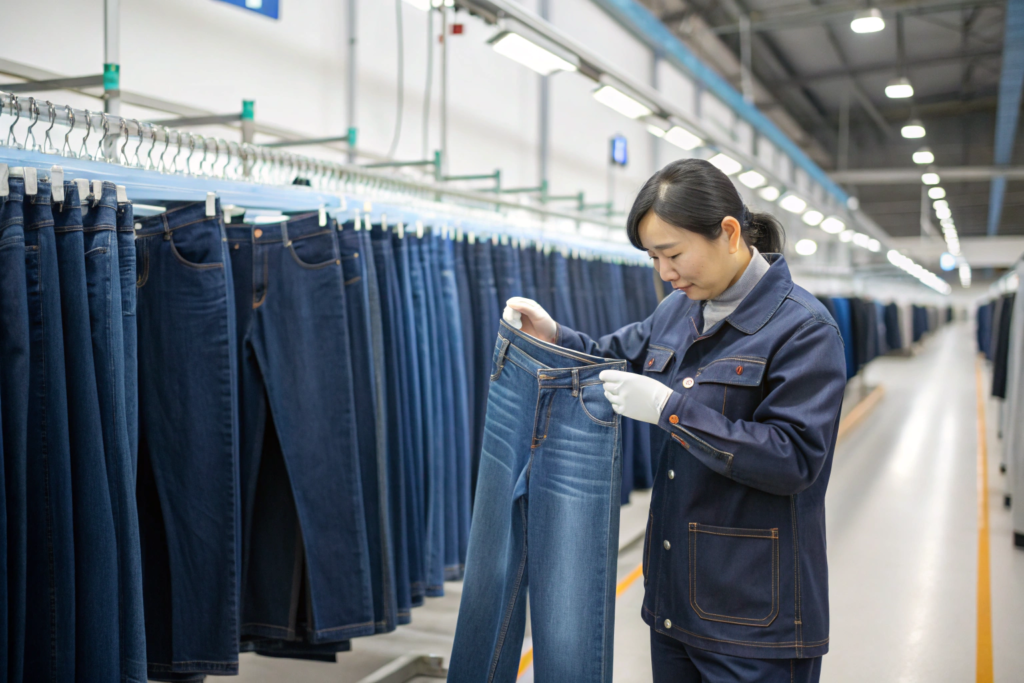
Consistency. That's the word I hear most from our clients, especially those in the US like Ron. They're tired of selling a great product, only to have customers return it because the second pair they bought looks different from the first. With manual finishing, this is inevitable. Human hands get tired. Sandpaper grit changes. Pumice stones wear down. The variation is baked into the process.
With lasers, variation is a choice, not a given. Every single laser machine in our workshop is calibrated to the exact same specifications. We run daily diagnostic tests on each machine using standard materials to ensure the power output is consistent. When we program a pattern for a specific jean, that pattern is saved as a digital file. Whether we run 100 pairs or 10,000 pairs, the laser reads that same file and executes it with the same precision, every single time. The beam doesn't get tired. It doesn't get distracted. It just executes. For a major German workwear brand we supply, this was the deciding factor. They had been plagued by inconsistent fading on their uniform pants from multiple suppliers. We ran a pilot of 500 pairs, and the QC pass rate was 99.5%. They've been with us for three years now.
How do you maintain color consistency from one production batch to the next?
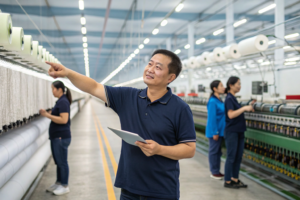
This is a two-part challenge. First, the base fabric itself must be consistent. If the indigo shade or the depth of dye penetration varies from one roll of denim to the next, the laser will react differently. A laser set to the same power will create a lighter fade on a lightly dyed fabric and a darker fade on a heavily dyed one. So, step one is our rigorous fabric inspection. We test every roll of denim for shade, weight, and tensile strength before it ever goes to the laser workshop. We use a spectrophotometer to measure the color numerically, not just visually.
Second, we control the laser environment. Temperature and humidity can slightly affect how the fabric reacts to the laser. Our laser workshop is climate-controlled. We also use a system of reference samples. Before every major production run, we run a test piece on the specific batch of fabric we'll be using. We compare this test piece to the approved master sample, both visually and sometimes using a colorimeter on the faded area. If it's a perfect match, we run the batch. If it's off, we adjust the laser power settings by a fraction of a percent and test again. It's this level of obsessive control that ensures a Ron in the US gets the same product in December as he did in June. For more on color measurement in textiles, the International Commission on Illumination (CIE) standards are the technical foundation we all work from.
What quality control checks are done after laser finishing?
The work isn't done when the laser stops. Our QC team has a multi-step checklist for every laser-finished garment.
- Visual Pattern Check: The first and most obvious check. Is the pattern correctly placed? Are the whiskers symmetrical? Does the honeycomb look right? We have trained inspectors who can spot a misaligned pattern in seconds.
- Fabric Integrity Check: This is crucial. A laser that's too powerful can weaken or even burn the fibers. Our inspectors gently stretch the faded areas. If the fabric feels brittle or if we see any signs of charring (brown or yellow discoloration), the piece is rejected and we recalibrate the machine immediately. We also do periodic tensile strength tests on random samples from the batch, comparing the laser-etched area to an untreated area. The strength loss should be minimal, ideally under 5%.
- Backside Inspection: We flip the garment and check the inside of the fabric. A well-calibrated laser should only affect the surface dye, not penetrate to the back. If we see a pattern on the inside, the power is too high.
- Wash Test: For every new order, we pull a random sample and put it through a standard home laundry wash cycle. This checks if the laser-faded pattern changes or if any latent yellowing appears after washing. It's the ultimate test of durability. We learned this the hard way years ago with a new laser operator who set the power too high. The jeans looked great initially, but after one wash, the faded areas turned slightly brown from the heat-damaged fibers. Now, that post-wash check is non-negotiable.
4. Can lasers create complex designs beyond just fading and whiskers?
Most people think lasers are just for making jeans look old. But honestly, that's just scratching the surface. The laser is an incredibly versatile design tool. Because it's digitally controlled, it can reproduce any pattern you can imagine, from photorealistic images to intricate geometric patterns to your brand's logo. We've moved beyond just "finishing" into the realm of "fabric art."
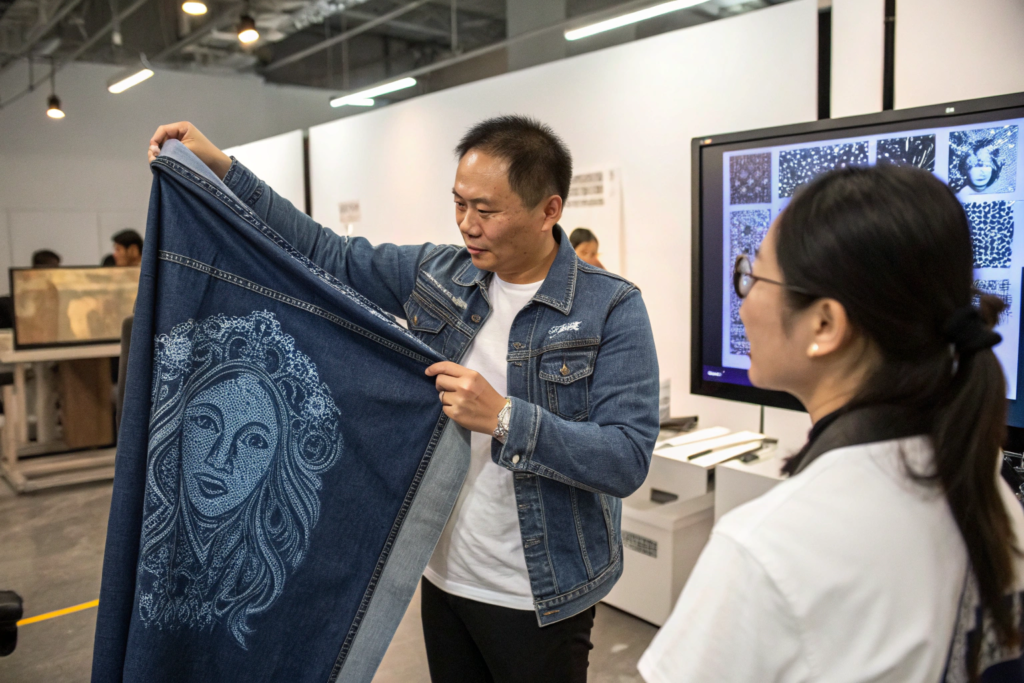
Think about it. The laser removes indigo with pixel-perfect precision. That means we can create tonal images on denim, where the different shades of blue and white come from the density of the laser etching. We've done projects for music bands, creating jackets with laser-etched portraits of their lead singers. We've worked with luxury brands to create all-over patterns that mimic intricate embroidery or jacquard weaves, but with a much lighter, softer hand feel. For a streetwear brand from Los Angeles in 2023, we did a run of jeans with a laser-etched city skyline on the back pockets. The detail was incredible—you could see individual windows on the buildings. This is where laser technology really shines: it allows for mass customization without the cost of traditional printing or embroidery setups.
How detailed can a laser-etched image be on fabric?
The level of detail is determined by the resolution of the laser, measured in DPI (dots per inch). Our industrial laser systems can work at resolutions up to 300 DPI or higher. To put that in perspective, that's approaching the quality of a standard inkjet printer. We can etch incredibly fine lines, subtle shading, and even photographic details.
The key is converting the image into a format the laser understands, usually a grayscale bitmap. The laser reads the different shades of grey in the image and translates them into different power levels and dwell times. Pure white in the image might mean no laser (untreated dark indigo). Pure black might mean full power (bright white cotton). All the greys in between become different shades of faded blue. The challenge is the fabric itself. Denim has a texture. A super-high-resolution image might get lost in the weave. So we often work with designers to "optimize" their artwork for the fabric, finding the sweet spot between detail and clarity. For a museum exhibit reproduction, we once etched a portrait of a historical figure onto a denim jacket based on a 19th-century daguerreotype. The result was hauntingly beautiful. For tips on preparing artwork for textile printing and etching, the Adobe Community forums on textile design can be a surprisingly useful place to learn from other designers.
Can I use laser etching to create my own private label branding?
Absolutely. This is one of the most practical and cost-effective applications. Instead of a woven label or a printed screen, you can laser-etch your brand name or logo directly onto the fabric. It's a very clean, premium look. It's permanent—it won't peel or wash off. And it has a unique texture that feels great.
We do this for many of our clients. You can put a small logo on a button fly, a larger brand mark on a back patch (laser-etched leather or faux leather is very popular), or even a repeating pattern all over the fabric. For a startup brand, this is a fantastic way to build a distinctive identity without the cost of custom hardware like engraved buttons or rivets. We had a client from Australia in 2024 who wanted a very minimalist look. Instead of any physical tags, we laser-etched their logo, the garment size, and the care instructions onto a small piece of faux leather and stitched it onto the waistband. It looked incredibly sophisticated. It saved them money on printing labels, and it reinforced their minimalist brand ethos. The laser doesn't just make clothes look old; it makes them look yours.
Conclusion
The laser is not just a tool in our workshop; it's a partner in innovation. It has allowed us to solve the age-old problems of denim finishing: inconsistency, environmental harm, and the limitation of design. We've moved from a world of grinding dust and chemical runoff to one of precision, sustainability, and infinite creative possibility. For a brand, this means you can offer a product that is not only beautiful and durable but also ethically and consistently produced, at a scale that makes business sense.
At Shanghai Fumao, we've embraced this technology fully. We have a team of designers and technicians who live and breathe laser finishing. We combine this with our in-house weaving, dyeing, and traditional finishing capabilities to offer a truly one-stop solution. Whether you need a classic, vintage wash on 500 pairs of jeans or a completely custom, laser-etched design for a limited-edition runway collection, we have the expertise to make it happen.
If you're ready to move beyond the limitations of traditional finishing and explore what's possible with laser technology, let's talk.
Contact our Business Director, Elaine, directly to discuss your denim or fabric finishing project. She and her team are ready to show you how precision technology can elevate your brand.
Email Elaine at: elaine@fumaoclothing.com
Let's create something perfectly finished together.