
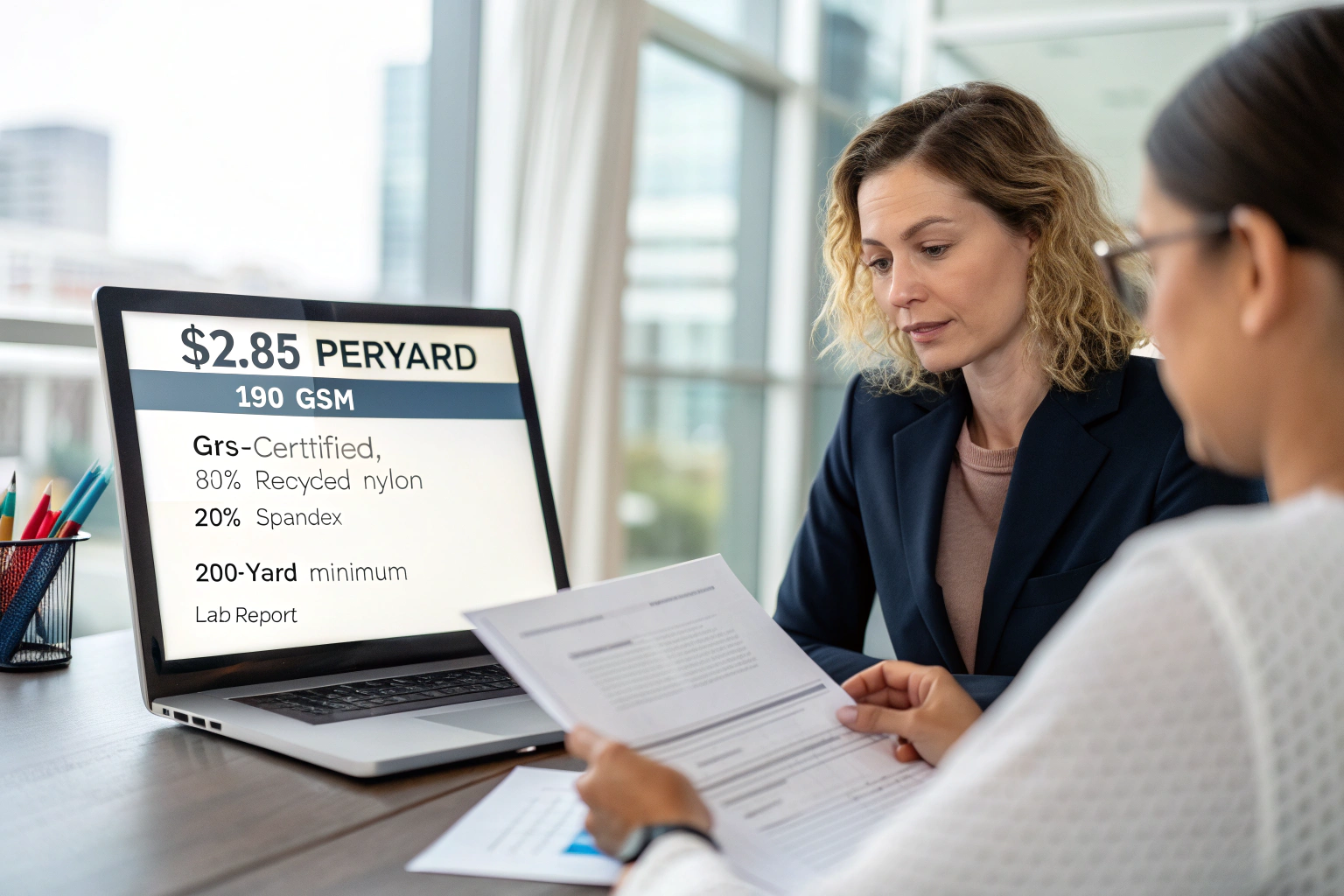
Six months ago, a swimwear startup founder from Miami sent me a frustrated email. She had spent three weeks collecting quotes on a standard recycled nylon spandex jersey. The numbers ranged from $2.10 to $4.80 a yard. No two quotes had the same weight, the same composition, or the same sampling terms. She wrote, “I just want to know the real price. Not the bait price, not the inflated first-quote price. The number I actually wire.” I sent her our stock program price sheet for that exact construction—$2.85 per yard for 190 GSM, GRS-certified, 80% recycled nylon, 20% spandex, with a 200-yard minimum, lab report included. She placed an order for 600 yards the next week. That exchange captures why I am writing this article. The question “what is the real factory price of your best-selling fabric?” is the most honest inquiry a buyer can make. And at Shanghai Fumao, I answer it directly because a transparent price is the first step to a genuine partnership.
The real factory price of our best-selling fabrics depends on three fixed variables: fiber specification, construction, and finishing. It does not depend on how big your order is, what market you sell into, or how skilled you are at negotiating. I will walk you through our actual pricing for our five best-selling qualities, explain exactly what drives each cost component, and give you the framework to compare our numbers honestly against any other quote you receive. If you are tired of opaque pricing games, this is the article I would want to read before emailing a single supplier.
What Is Our Number One Best-Seller and How Is It Priced?
Our number one best-selling fabric, measured by yardage shipped to the US and European markets in the past eighteen months, is our 200 GSM GOTS-certified organic cotton twill. This fabric moves because it sits at the intersection of sustainability demand, durability, and price accessibility. It is the workhorse for contemporary apparel brands making everything from chore jackets to structured dresses to children’s wear bottoms. I have shipped this fabric to over forty countries, and the repeat order rate sits above 80%. When a fabric performs that consistently, the pricing conversation gets very straightforward. You are buying a proven specification, not a prototype.

How Is the Base Greige Cost Calculated for Organic Cotton Twill?
The greige cost starts with the certified organic cotton yarn. As of this writing, GOTS-certified 20s ring-spun organic cotton yarn from our contracted spinning mill in India costs approximately $3.65 per kilogram delivered to Keqiao. We use a 20s warp and a 16s weft for this twill to give it the right drape-to-weight ratio. The yarn consumption at 200 GSM with a 58-inch finished width runs about 0.42 kilograms per linear yard. Raw yarn cost per yard is roughly $1.53. We weave this fabric on our rapier looms at a production cost, including labor, electricity, and overhead amortization, of approximately $0.18 per yard. Add a 2.5% weaving waste allowance, and the greige cost before dyeing and finishing lands at $1.75 per yard. An average wholesaler reselling this greige from an anonymous mill might buy it at $1.45 per yard because they use conventional cotton and a lower twist count. We do not make that substitution. The organic certificate and the compact spinning process add $0.30 to the greige cost, and we absorb the certification audit fee within our operational margin rather than loading it onto the first yard. For readers who want to understand how organic yarn premiums translate into fabric pricing, this breakdown of GOTS yarn raw material costs in textile greige manufacturing explains the global organic cotton market dynamics clearly.
What Finishing Costs Complete the Real FOB Factory Price?
The greige twill then moves to our cooperative dyeing and finishing partner. The cost for a standard reactive dye on organic cotton, including scouring, bleaching, dyeing, and a softening finish, runs $0.48 per yard. If the client requires a specialty finish—for instance, an enzyme wash for a softer hand or a peaching treatment for surface texture—that adds $0.12 to $0.20 per yard. The standard finishing package includes an AATCC 61 colorfastness test and an ASTM D4970 pilling resistance test from our in-house lab. After finishing, our inspection team runs every roll on a motorized 4-point system inspection machine, which adds $0.04 per yard in labor and equipment cost. The fabric is then rolled onto double-wall export-grade tubes and packed in polybags with our QR code traceability tag, costing another $0.06 per yard. The total ex-factory cost for this 200 GSM GOTS organic cotton twill, in a solid reactive dye color, with standard finish and full inspection, is $2.33 per yard. Our FOB factory selling price for this fabric on a 500-yard minimum order quantity is $2.70 per yard. That $0.37 difference covers our continued R&D investment, compliance management, and a fair margin that keeps our 40-plus employees paid and our equipment maintained. When a US buyer compares that $2.70 to a domestic wholesale price of $6.50 to $8.00 for a comparable certified organic twill, the value equation becomes self-evident.
What Are the Real Prices of Our Other Four Core Best-Sellers?
Beyond the organic cotton twill, our Core 300 stock program includes four other fabrics that consistently rank as top sellers for US and European fashion brands. Each one has a transparent FOB price that I will lay out here, along with the key spec that drives its cost. These are not "starting from" teaser rates designed to lure in inquiries. These are the actual prices our repeat clients pay on standard minimums. I publish them here because I believe radical transparency is the only sustainable differentiator in a sourcing market overcrowded with arbitrage traders.

How Much Does Our Bamboo Silk Charmeuse Cost Per Yard?
Our bamboo silk charmeuse, a 19-momme equivalent at 135 GSM, woven from bamboo viscose filament yarn, has become our top-selling dress and blouse fabric. It drapes like sandwashed silk but costs a fraction of the price and carries OEKO-TEX Class I certification for skin-contact safety. The raw bamboo viscose filament yarn costs $4.20 per kilogram, and the fabric consumes roughly 0.18 kilograms per linear yard due to the lighter weight. Yarn cost per yard is $0.76. The weaving cost on our satin-capable water-jet looms runs $0.15 per yard. The greige cost lands at $0.95 per yard including a 2% process waste allowance. The dyeing and finishing process for bamboo viscose charmeuse is more delicate than cotton twill. It requires an open-width jig dyeing machine to prevent crease marks, and the standard sandwash finish for that peach-skin handfeel adds a mechanical tumbling process. The combined dyeing, sandwash, and finishing cost runs $0.55 per yard. Inspection and export packaging add $0.10 per yard. The total ex-factory cost is $1.60 per yard. Our FOB factory selling price on a 300-yard minimum for stock colors is $1.95 per yard. For custom Pantone-matched colors, we add a one-time lab dip and color matching fee of $180, but the per-yard price stays at $1.95.
What Is the Transparent Price of Our Recycled Polyester Mesh?
This fabric is a 120 GSM recycled polyester athletic mesh, GRS-certified, with a wicking finish, widely used for sportswear linings and performance jerseys. The recycled polyester filament yarn from our Taiwanese supplier costs $2.40 per kilogram. At 120 GSM and a 60-inch width, the yarn consumption is 0.16 kilograms per yard, yielding a raw yarn cost of $0.38 per yard. Knitting on our circular machines runs $0.10 per yard. The greige cost, extremely lightweight, is just $0.50 per yard. The dyeing process for recycled polyester mesh uses a high-temperature disperse dye method, which costs $0.22 per yard. The moisture-wicking finish application adds $0.08 per yard, and inspection and export packing adds another $0.05. Total ex-factory cost for this mesh is $0.85 per yard. Our FOB selling price on a 500-yard minimum is $1.10 per yard. This mesh is a volume mover, and frankly, it is one of the most aggressively priced performance fabrics available with full GRS certification and a wicking finish. I have seen trading companies list a visually identical mesh without the GRS certificate at $1.45, and the buyer only discovers the certification gap when a retailer audit requests the transaction certificate.
What Is the Factory Price of Our Heavy Linen Blend Woven?
A 280 GSM linen-viscose blend in a plain weave structure, pre-washed for softness, has become our best-selling fabric for the relaxed tailoring and sustainable resort wear categories. The yarn blend is 55% European flax linen, 45% LENZING™ ECOVERO™ viscose. The linen component drives the cost here. The flax fiber price has been elevated due to a poor 2024 harvest in Western Europe, and we are paying roughly $8.50 per kilogram for the ring-spun linen yarn. The blended yarn cost averages out to $5.80 per kilogram at the required blend ratio. At 280 GSM and a 54-inch finished width, the yarn consumption is 0.52 kilograms per yard. Raw yarn cost is $3.02 per yard. Weaving this heavier plain weave on our rapier looms runs $0.22 per yard, and the greige cost includes a 3% slub-clearing waste allowance for the linen component, bringing the greige cost to $3.34 per yard. The pre-wash and enzyme softening finish is a batch process that adds $0.55 per yard, and inspection and export packing adds another $0.08. The total ex-factory cost is $3.97 per yard. Our FOB selling price on a 250-yard minimum is $4.60 per yard. This is a premium fabric at a price that still undercuts European linen blend equivalents by 40% to 50%. For designers looking to understand linen blend economics better, this article on the true cost of European flax linen in blended fabrics explains why linen-heavy compositions command a higher and more volatile market price.
How Much Does Our Stretch Cotton Denim Cost Per Yard?
Our 340 GSM stretch denim, a 98% cotton, 2% spandex 3/1 twill, fills the premium jeans and structured jacket category. It is a heavy fabric, so the yarn consumption drives the per-yard cost up. The 10s ring-spun cotton warp yarn costs $2.80 per kilogram. The weft is a 10s cotton core-spun spandex yarn at $3.60 per kilogram. The yarn consumption at 340 GSM is 0.78 kilograms per yard. The blended yarn cost per yard is $2.45. The weaving is done on a heavy-duty rapier loom at $0.30 per yard. The greige cost before denim finishing is $2.83 per yard including a 3% process waste allowance. Denim finishing is a specific and more chemical-intensive process than standard piece dyeing. It includes desizing, enzyme stone washing, softening, and an anti-skewing treatment to prevent leg twist on the final garment. The combined finishing cost runs $0.72 per yard. Inspection and bulk export packaging add another $0.10. The total ex-factory cost is $3.65 per yard. Our FOB selling price on a 300-yard minimum is $4.20 per yard. For a stretch denim with this weight and wash-down character, a comparable US domestic wholesale price sits between $9.00 and $12.00 per yard. The differential is entirely the value of having the denim woven, finished, and inspected within the Keqiao denim production zone, which houses specialized denim finishing lines that rival the best in Okayama or Turkey.
Why Are Our Factory Prices Transparent When Other Mills Hide Them?
Most fabric suppliers hide their prices because their pricing model is opportunistic. They quote a number based on your email signature, your brand size, and whether they think you know the market. I have had competitors tell me at trade shows that they “price to the buyer’s budget, not the fabric’s cost.” At Shanghai Fumao, we publish our core pricing openly because we believe opaque pricing destroys trust and ultimately wastes everyone’s time. A buyer who has to negotiate every single PO cannot plan their season with confidence. A supplier who treats every transaction as a margin-maximizing event cannot build the multi-year relationships that sustain a factory through market cycles. Our pricing model is cost-plus, and we are willing to show the cost breakdown because we are proud of where the money goes.

How Does Our Cost-Plus Model Build Long-Term Client Trust?
Our cost-plus model means we calculate the exact material, production, and overhead cost of a fabric, and then we add a fixed margin percentage that sustains our business. When raw material prices increase, we show the client the supplier’s price notification and adjust the FOB price transparently. When we find a process efficiency that lowers cost, we pass a portion of that saving to the client proactively. In November 2024, our recycled polyester yarn supplier dropped their price by 8% due to a PET feedstock surplus. We automatically reduced the FOB price on our recycled polyester mesh from $1.15 to $1.10 per yard for all existing contracts, without a single client having to ask. Our clients’ procurement managers were stunned. That is not a marketing tactic; it is the logical consequence of a cost-plus pricing philosophy. If we treated our pricing as a secret to be hoarded, we would never build the repeat order loyalty that keeps our looms running at capacity.
What Hidden Costs Should You Look for in Other Suppliers’ Quotes?
When a competitor’s quote comes in $0.30 below ours for an apparently identical specification, one of several hidden gaps is almost always present. The first is fiber substitution. A quote for “bamboo silk” might actually be a generic viscose with a different drape and lower wet strength. The second is weight fraud. A fabric quoted at 180 GSM that hits your cutting table at 165 GSM saves the supplier 8% on yarn cost, at your expense. The third is test report absence. A quote without a specific line item for inspection and testing means you are buying uninspected greige, and the cost of the defects you find later is entirely yours. The fourth is certification bluffing. A supplier who claims “we can provide the certificate” but cannot show you the transaction certificate for your specific dye lot is selling you uncertified fabric at a certified price. I tell every new buyer to ask for a detailed cost breakdown sheet. If the supplier refuses, walk away. The thread on identifying hidden markups in textile supplier pricing from China covers the most common tricks in granular detail and should be required reading for any first-time direct importer.
How Can a Buyer Lock In the Best Price Without Compromising Quality?
Getting the best price on high-quality fabric is not about haggling. It is about structuring your purchase in a way that reduces our internal cost to serve you. When a client reduces our cost, we pass that reduction back. The most effective levers a buyer has are order forecasting, production slot timing, and payment terms. I want to share the specific actions that unlock our best pricing without touching the yarn quality, the dye class, or the inspection protocol. These are the techniques our most cost-efficient clients use to keep their margins healthy season after season.

How Does a Rolling 6-Month Forecast Reduce Your Per-Yard Factory Price?
When a client provides us a rolling 6-month forecast, even a non-binding estimate, we can reserve greige capacity on our looms and secure yarn allocations from our spinning partners at negotiated forward prices. This eliminates the spot-market yarn premium that can add 5% to 8% to raw material costs during peak production months. For a 200 GSM organic cotton twill program with a forecast of 3,000 yards over two quarters, the yarn pre-booking alone saves approximately $0.06 per yard. Additionally, the production planning team can schedule the dye lots to run contiguously, which reduces the dyehouse’s machine cleaning downtime between incompatible color lots. That efficiency saves another $0.04 per yard. The combined $0.10 per yard reduction comes entirely from operational predictability, not from any compromise in fiber or process. A client with a rolling forecast also gets priority access to production slots during the pre-Chinese New Year rush, when unplanned orders face surcharges and delays. This strategic approach to how to optimize fabric factory pricing with a rolling forecast strategy explains the planning rhythm that high-performing brands use to keep costs stable.
What Payment Terms Unlock Better Pricing on Bulk Orders?
Our standard payment terms are a 30% deposit to initiate production and a 70% balance before shipment. For clients who have established a six-month payment history with us, we offer a 30% deposit, 70% against scanned copy of bill of lading terms. For our partnership-tier clients with annual volumes above 20,000 yards, we can offer a net-30 open account after a year of consistent business. These favorable payment terms reduce the client’s working capital strain and allow them to place larger, more cost-efficient orders. An order of 2,000 yards versus 500 yards on the same fabric lowers the per-yard fixed cost for packaging, documentation, and logistics coordination by about $0.08 to $0.12 per yard. The client who can finance a larger order through better payment terms captures that scale discount without overleveraging. Additionally, we offer a 3% early settlement discount on net-30 accounts for clients who pay within ten days. That discount directly reduces the effective fabric price without any conversation about the fabric itself.
Conclusion
The real factory price of our best-selling fabrics ranges from $1.10 per yard for a GRS-certified recycled polyester mesh to $4.60 per yard for a 280 GSM European linen blend, with our high-volume 200 GSM organic cotton twill at $2.70 per yard. Every price reflects actual yarn cost, actual weaving or knitting cost, actual finishing and inspection cost, and a transparent, fixed margin. There is no surcharge for small orders on stock qualities, no hidden certification gap, and no bait-and-switch on weight. When a buyer understands those real numbers and compares them to the alternatives—either domestic wholesale at a 2x to 3x premium or opaque trader quotes with hidden substitutions—the value of a transparent direct-mill partnership becomes unmistakable.
If you want a detailed price sheet for our full Core 300 stock program, or a custom costing for a fabric you are developing, I invite you to contact my Business Director, Elaine. She will send you our current price list that includes raw material basis, minimum order quantities, and lead times for every quality. There is no negotiation theater, no hidden fees, and no pressure. Just the real numbers so you can make a confident sourcing decision. You can reach Elaine at elaine@fumaoclothing.com. We have built this company on the belief that an honest price is the foundation of every durable partnership, and we are ready to prove that to you on your first order.








