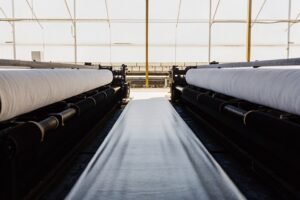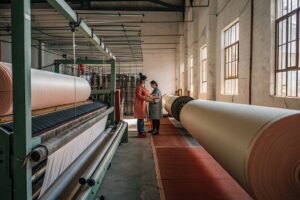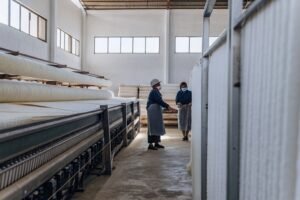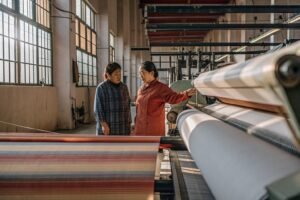
A few months back, a European fabric distributor with 45 years in the market sent their sourcing director to visit our Keqiao facility. They move around 200,000 yards of woven cotton and linen blends annually across twelve countries. The director sat across from me in our showroom, looked at our stock twill, and said, “I can buy a visually similar twill from a trader in Suzhou for $0.30 less per yard. Convince me why I should consolidate my volume with a mill that charges more.” I did not argue. I walked him onto our factory floor and showed him our warping section, where we were running a 50,000-yard greige order for a single US workwear brand. I showed him the CNAS lab report for that lot, the QR code traceability tag, and the real-time production dashboard that tracks every roll. Then I asked him, “What is the cost of one container of fabric that fails a customer’s incoming inspection in Rotterdam? What does a 5% defect rate do to your reputation with your own retail buyers?” He sat with those questions for a minute, nodded, and said, “Let’s talk numbers.” That conversation reshaped what competitive pricing means at scale.
At Shanghai Fumao, we compete for large distributor volumes not by being the cheapest quote on a line sheet, but by delivering the lowest total cost of ownership across a multi-container annual program. I want to break down exactly how our pricing model aligns with distributor economics, why unit price alone is a misleading metric at high volumes, and what specific advantages a large-volume partnership with us unlocks that a low-cost trader cannot replicate. If you are a distributor managing a complex supply chain and demanding consistent quality across multiple end markets, this article will show you where the real cost savings live.
How Does Our Pricing Model Scale for a High-Volume Distributor?
A high-volume distributor operates on a fundamentally different economic model than a single-brand buyer. Your margin is not built on a 4x retail markup. It is built on a thin, volume-dependent spread between your landed cost and your wholesale sell price to dozens or hundreds of smaller brands and manufacturers. Every cent per yard matters, but so does every yard of rejected fabric, every delayed container that triggers a penalty clause, and every quality claim from a downstream customer that ties up your claims department. Our pricing model for distributors is designed to compress the unit cost aggressively while eliminating the operational variables that destroy your thin margins.

What Per-Yard Price Can a 50,000-Yard Annual Program Achieve?
Let me put a real number on the table. Our 200 GSM GOTS-certified organic cotton twill, which sells at $2.70 per yard FOB on a standard 500-yard minimum, drops to approximately $2.25 per yard FOB on a committed annual volume of 50,000 yards, shipped in quarterly releases. That $0.45 reduction does not come from squeezing our margin or downgrading the yarn. It comes from supply chain efficiencies that only manifest at scale. The yarn pre-purchase contract on 50,000 yards of organic cotton, negotiated directly with the spinning mill in India, saves $0.15 per yard compared to spot buying. The continuous dyeing run scheduling across multiple colorways, which reduces the dyehouse kettle cleanout downtime and chemical waste, saves $0.12 per yard. The streamlined QC and documentation process, where a single inspection protocol and test package covers the entire annual program, saves $0.08 per yard in duplicated lab fees and reporting. The consolidated export packing and container optimization, where we load full containers with predictable dimensions, saves $0.06 per yard. The remaining savings come from reduced sampling and development amortization across the larger base. The same logic applies across our range. For a comprehensive understanding of how mills structure scale-driven pricing, this detailed analysis of bulk textile purchase economies across a multi-container annual contract is a resource I often share with distribution partners who want to benchmark our model.
Does a Large Distributor Order Reduce Our Internal Production Cost?
Yes, and we pass those savings through. A large, predictable order allows our production planning team to optimize machine utilization in ways a series of small, unpredictable POs never can. Our rapier looms run most efficiently on long warps. A 50,000-yard program on a single construction lets us warp a beam that runs continuously for three weeks, eliminating four to five warp changeovers that each consume 8 hours of downtime. That downtime reduction alone saves approximately $0.04 per yard in fixed overhead absorption. In the dyehouse, a large program allows our cooperative partner to run extended campaigns on the same color family, which reduces the cleaning cycles between batches and cuts water and chemical consumption by roughly 18%. This efficiency is not just good for our margin; it is good for the environment and for your compliance reporting. The logistics chain tightens as well. Full container load shipments with consistent carton dimensions allow our freight forwarder to optimize the container cube utilization, reducing the freight cost per cubic meter by 7% to 10% compared to LCL shipments or mixed-dimension loads. For a distributor importing into multiple European ports, that freight efficiency can save several thousand euros per year. A resource that explains how production planning at scale impacts fabric cost is this article on understanding how mill production lot sizing affects bulk textile unit pricing. It maps the operational math that most buyers never see but that we live every day.
Why Is Total Cost of Ownership More Important Than Unit Price for Distributors?
For a distributor, the purchase price per yard is only the entry fee. The real cost of a fabric is what happens after it lands in your warehouse. I learned this lesson early in my career when a distributor in the UK shared his internal claims data with me. He tracked the fully loaded cost of a quality failure, from the first customer email to the final credit note. The average claim cost him 4.7 times the original fabric invoice value when he factored in return freight, internal inspection labor, lost goodwill, and the opportunity cost of his team’s time. That single data point reshapes how a smart distributor evaluates a supplier.

How Do Defect Claims Destroy the Profit Margin on a Cheap Fabric Purchase?
Consider a real scenario. A distributor buys 10,000 yards of a linen blend from a low-cost mill at $3.60 per yard FOB, saving $0.50 per yard compared to our quote of $4.10. The upfront saving is $5,000. The lot arrives, and the distributor’s incoming QC discovers a 6% defect rate due to slub irregularities and inconsistent washdown. That 600 yards of fabric is either returned, credited, or sold as seconds at a heavy discount. The direct fabric loss is $2,160. The distributor then deals with five downstream customer claims from smaller brands who cut the fabric before spotting the defects. Each claim takes an average of six hours of staff time to investigate, negotiate, and settle. At an internal labor cost of $35 per hour, the administrative cost of the claims is $1,050. Two of the affected brands, small but growing labels, lose confidence and shift a portion of their future business to a competing distributor. The estimated lifetime value of those two accounts was $18,000 in gross margin. The cheap fabric, which saved $5,000 upfront, ultimately cost the distributor over $21,000 in direct and indirect losses. When I present this math to a distributor, the conversation about the $0.50 unit price difference usually ends. For a sobering look at the real cost of fabric quality failures in the wholesale distribution channel, this report on the financial impact of textile defect claims on fabric distributors breaks down aggregate data that mirrors what our partners see in their own P&L statements.
What Does a Consistent, On-Time Delivery Record Save a Distributor?
A delayed shipment is a hidden cost multiplier for a distributor. If a container of seasonal fashion fabric arrives two weeks late, the distributor’s brand customers miss their own production windows and cancel the order, leaving the distributor holding inventory that must be discounted or written off. Our on-time delivery rate for large-volume distributor orders, measured as the percentage of POs shipped within five days of the confirmed ex-factory date, has been at 94.5% over the past eighteen months. We achieve this reliability through our vertical control over the weaving schedule. A distributor relying on a trading company that subcontracts to multiple commission mills has zero visibility into the real production status and zero leverage when a mill overbooks capacity. With Shanghai Fumao, your order sits on our own looms. We control the production queue. If a delay risk emerges due to a yarn supply disruption, our planning team identifies it three weeks in advance and works with you on a mitigation plan rather than surprising you with a missed delivery date. That reliability allows a distributor to promise firm delivery windows to their own customers, which builds their own reputation for dependability. In a market full of unreliable supply, a distributor with a 95% on-time record commands a premium and wins repeat business that price-cutters lose.
What Exclusive Advantages Do Large-Volume Distributors Get at Fumao?
Beyond the per-yard price, a large-volume distributor partnership with Shanghai Fumao unlocks structural advantages that are simply not available to transactional buyers. These advantages are designed to protect your market position, accelerate your speed to market, and give you exclusive selling propositions that your own customers cannot source elsewhere. When a distributor commits significant volume to us, we invest in making that distributor’s business more competitive against other distributors in their region.

Does Fumao Offer Regional Exclusivity for Distributor Partners?
Yes, we do, within a defined framework. If a distributor partner commits to a minimum annual volume for a specific fabric category and a defined geographic territory, we offer a protected exclusivity period on the stock-keeping units covered by the agreement. This means we will not sell the same SKU to another distributor in the same territory during the contract period. For example, a Benelux-region distributor who committed to 30,000 yards annually of our Core Linen Blend program received 18-month exclusivity on those six SKUs across Belgium, the Netherlands, and Luxembourg. This protection allows the distributor to invest confidently in sampling, marketing, and brand outreach, knowing that their effort will not be undercut by another distributor offering the identical fabric from the same mill at a lower markup. Regional exclusivity transforms our fabric from a commodity into a differentiated product offering for the distributor. It gives their sales team a powerful narrative: “This fabric is available in this market exclusively through us.” That narrative supports a healthier wholesale margin and a stickier customer base. For a broader legal and commercial perspective on how textile distributors negotiate and structure these arrangements, this overview of fabric distributor territorial exclusivity deals with Chinese manufacturers explains the typical terms and mutual commitments involved.
How Do Dedicated Service Teams Support a Distributor’s Day-to-Day Operations?
A large-volume distributor is not just buying fabric. They are buying a complex service package that includes sampling, documentation, compliance management, and logistics coordination. We assign a dedicated account team to any distributor partner exceeding 20,000 yards annually. This team consists of a senior account manager, a dedicated quality assurance liaison, and a logistics coordinator. The account manager becomes an extension of the distributor’s own procurement department, understanding their seasonal calendar, their key customer requirements, and their preferred communication cadence. The QA liaison prepares pre-shipment inspection reports in the specific format the distributor’s warehouse team requires and proactively flags any batch that shows even a minor deviation from spec so the distributor can make an informed acceptance decision before the container ships. The logistics coordinator manages the container booking and documentation, ensuring that the commercial invoice, packing list, GOTS transaction certificate, and any other required origin or compliance documents are accurate and delivered before the vessel arrives at the discharge port. In 2024, our dedicated team for a major UK distributor identified a customs classification error on their broker’s side that would have resulted in a £2,300 overpayment of duty. The logistics coordinator flagged it, corrected the HTS code on the shipping documents, and the distributor saved the money before customs clearance was even initiated. This is the level of proactive service that a transactional, low-cost supplier relationship simply cannot fund.
How Do We Structure a Win-Win Volume Contract That Lasts?
A volume contract between a distributor and a mill should not be a zero-sum document where one side wins and the other loses. It should be a framework that protects both parties’ interests over a multi-year horizon and allows the relationship to deepen as it matures. At Fumao, we have refined our distributor contract model over twenty years, and the contracts that last are the ones built on realistic minimums, flexible call-off schedules, and transparent price adjustment mechanisms. A rigid contract forces one party to absorb a market shock unfairly, which breeds resentment and eventually collapses the agreement. A well-designed contract anticipates market volatility and defines how the partners will navigate it together.

What Is a Fair and Transparent Price Review Mechanism for a Multi-Year Deal?
Raw material prices, particularly for natural fibers like organic cotton, linen, and wool, can swing 15% to 25% in a single season. A three-year contract with a fixed FOB price is a gamble that both sides will eventually lose. Instead, we use a quarterly price review mechanism tied to an independent fiber price index. For cotton-based fabrics, we reference the Cotlook A Index. For polyester, we reference the PTA futures contract price on the Zhengzhou Commodity Exchange. Our distributor contract specifies that if the reference index moves by more than 5% in a calendar quarter, the FOB price adjusts proportionally, up or down, with full documentation provided to the distributor. This mechanism removes the adversarial price negotiation from every quarterly order and replaces it with an objective, verifiable formula. Both parties know the rules going in, and both parties are protected from extreme market movements. In Q2 of 2024, when cotton prices spiked 12%, our indexed contracts adjusted upward by a transparent percentage that our distributors could independently verify. In Q4, when prices corrected downward 8%, the contract price dropped accordingly, and our distributors benefited from the reduction without having to request it. This objectivity builds a level of trust that no amount of relationship-building banter can match. A detailed guide on how index-based fabric contract pricing protects both mills and buyers explains the mechanics more fully for anyone considering this model.
Why Do Our Longest Distributor Relationships Span Over a Decade?
The distributors who have been with us for ten, twelve, fifteen years are not with us because we are the cheapest quote on any given Tuesday. They are with us because we have proven, over hundreds of containers and tens of thousands of yards, that we are the lowest-risk, most reliable supplier in their portfolio. They value the fact that when a quality issue does occur—and in textile manufacturing, occasional issues are an unavoidable reality—we resolve it fast, fairly, and without needing to be chased. They value that our lab reports are accurate and can be trusted by their own compliance auditors. They value that we remember their specific packaging preferences, their preferred freight forwarder, and their seasonal peak stress points. One of our longest-standing distributor partners, a family-owned business in Germany now run by the founder’s daughter, sources roughly 80,000 yards annually from us across four fabric categories. When I asked her last year why she has never left us for a lower-cost alternative, she said, “I have never once lain awake at night worrying about a Shanghai Fumao shipment. I cannot say that about any other supplier I have worked with.” That peace of mind, for a distributor managing hundreds of customer relationships, is worth far more than the marginal per-yard savings a low-cost, high-risk supplier promises. We earn that loyalty by treating every container with the same care, year after year, and by never allowing a short-term market opportunity to tempt us into exploiting a long-term partner’s trust.
Conclusion
A large distributor volume with Shanghai Fumao unlocks genuinely competitive pricing, not through a race to the bottom on quality, but through the operational efficiencies, scale-driven cost reductions, and risk elimination that only a vertically integrated mill with a mature quality system can deliver. The per-yard FOB price on a 50,000-yard annual program drops substantially from our standard small-batch pricing, but the larger financial story is the avoided cost of defect claims, delayed shipments, and customer attrition that plague distributors who chase the cheapest invoice. Our regional exclusivity agreements, dedicated account teams, and index-based pricing mechanisms are built specifically to support a distributor’s business model.
If you are a fabric distributor evaluating your supply base for the coming seasons, I want to put our model to the test against your current costs. My Business Director, Elaine, will prepare a detailed total cost of ownership analysis on your top three volume SKUs. She will compare our FOB pricing, quality performance data, and logistics reliability metrics against your current supplier, and help you quantify what a partnership with us actually saves or costs you. This is a data-driven conversation, not a sales pitch. You can reach Elaine at elaine@fumaoclothing.com. Whether you are moving 20,000 yards or 200,000 yards a year, let us show you what a competitive, reliable, and transparent mill partnership looks like in practice.