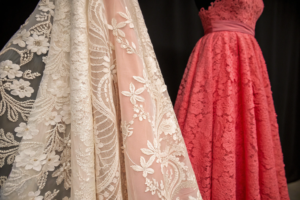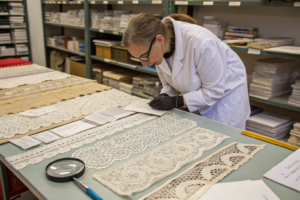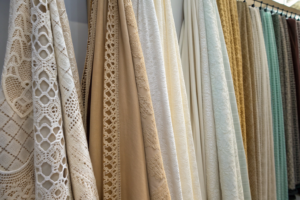
You're sketching a stunning gown or planning a delicate blouse, and you know lace is the key. But when you browse supplier websites, you're hit with a choice: "All-Over Lace" or "Lace Borders/Edgings." The price per meter looks different, the photos look different, and you're left wondering—is this just about where the pattern is placed? Choosing the wrong type can blow your budget, complicate your sewing process, and leave you with awkward seams that ruin the flow of your design. So, what really separates these two lace categories beyond the obvious?
The core difference between all-over lace and lace borders is not just pattern placement, but fundamental structure, production method, and intended use. All-over lace features a continuous, repeating pattern across the entire fabric width and length, designed to be cut and sewn anywhere. Lace borders have a concentrated, often decorative pattern along one or two edges (selvedges), with a plain or simple net ground elsewhere, and are engineered to be applied as trim. Understanding this distinction is crucial for cost control, design efficiency, and achieving a professional finish.
This guide will cut through the confusion. We'll break down the structural secrets of each type, reveal the specific scenarios where one triumphs over the other, expose the hidden cost drivers in production, and provide a clear decision framework for your next project. Let's ensure you select the right lace tool for the job.
How Does the Basic Structure and Production Define Each Type?
At first glance, both are "lace." But under the hood, they are engineered for completely different purposes. Think of all-over lace like wallpaper—it has a uniform pattern meant to cover a large area seamlessly. A lace border is more like a picture frame—it's a finished, decorative element meant to highlight an edge. This fundamental design intent drives how they are made and used.
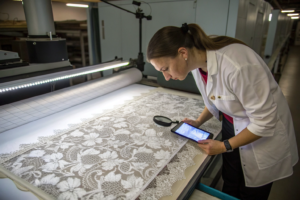
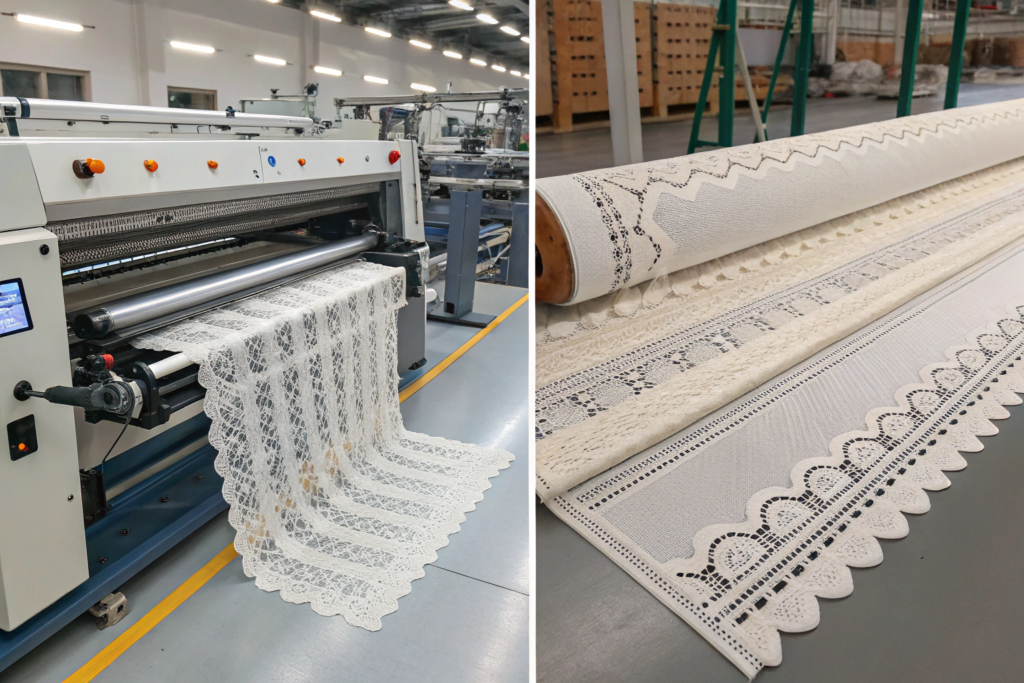
The production divergence is key. All-over lace, whether woven (like Leavers) or embroidered (like Raschel), is produced on wide machines where the pattern is engineered to repeat perfectly across the entire width (often 140cm to 280cm) and along the length. Lace borders are produced on narrower, often specialized trim looms or embroidery machines, where the complex pattern is concentrated on the edge, and the "carrier" or ground is simple and inexpensive. This manufacturing reality directly impacts your cost and usage.
What is the Anatomy of a True All-Over Lace?
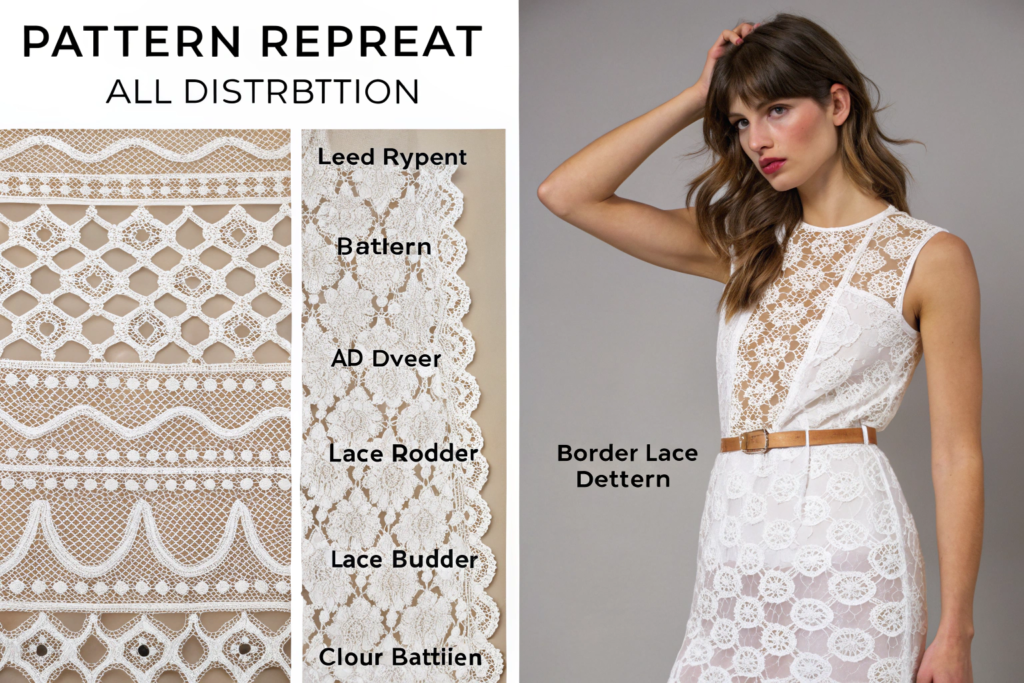
All-over lace is defined by its consistency. Its pattern repeat is distributed evenly, creating a non-directional or evenly directional aesthetic across the whole piece.
- Uniform Pattern Field: The decorative motifs are scattered or connected across the entire width and length. There is no "empty" space designated for cutting—the entire surface is the design. This allows you to cut pattern pieces in any orientation (though you must still match patterns at seams).
- Stable Selvedges: Both edges (selvedges) are typically finished and straight, designed to run parallel along the length of the fabric roll. They are not decorative.
- Common Types: This category includes fabrics often named by their pattern or technique: geometric laces, floral laces, eyelet laces, fishnet laces, and stretch laces. For example, the fabric you'd use for a full lace dress or a lace insert on a sleeve is typically an all-over lace.
Critical Sourcing Insight: The cost of all-over lace is driven by the density and complexity of the pattern across the entire area. A lace with a 10cm intricate repeat is far more expensive to produce than one with a 2cm simple dot pattern. When a client from London wanted a "light" all-over lace for a summer collection but was shocked by the price of a delicate Chantilly, we guided them to a Raschel embroidered lace with a open, geometric pattern. It gave the lace aesthetic at 40% lower cost because the machine time and thread consumption were significantly reduced.
What Makes a Lace Border or Edging Unique?
Lace borders are all about the edge. They are engineered strips where the value and decoration are concentrated on one or two sides.
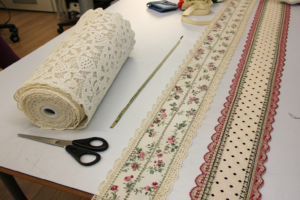
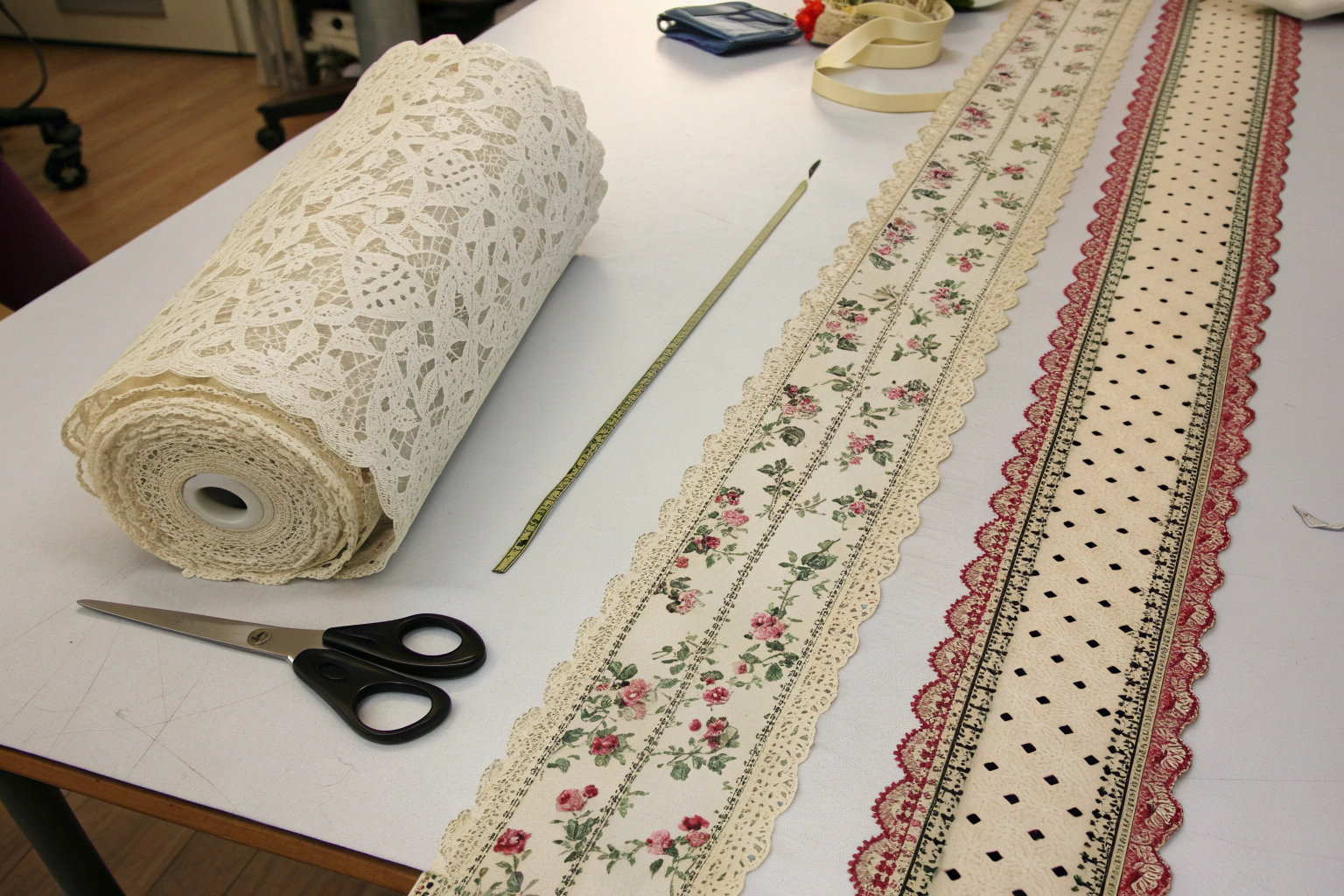
- Defined Decorative Edge: One long edge (and sometimes both) features a dense, often scalloped or pointed decorative pattern. This is the "border" that will be visible on your garment hem, neckline, or sleeve.
- Plain or Simple Ground: The area leading away from the decorative edge is typically a plain net, simple tulle, or a straight edge meant to be concealed in a seam. This "carrier" ground is functionally just a stabilizer to hold the decorative edge.
- Common Types: Scalloped edgings (for hems), insertion laces (decorative strips meant to be sewn between two fabric pieces, often with two finished edges), galloon lace (a border with two decorative edges), and beading lace (with regular holes for threading ribbons).
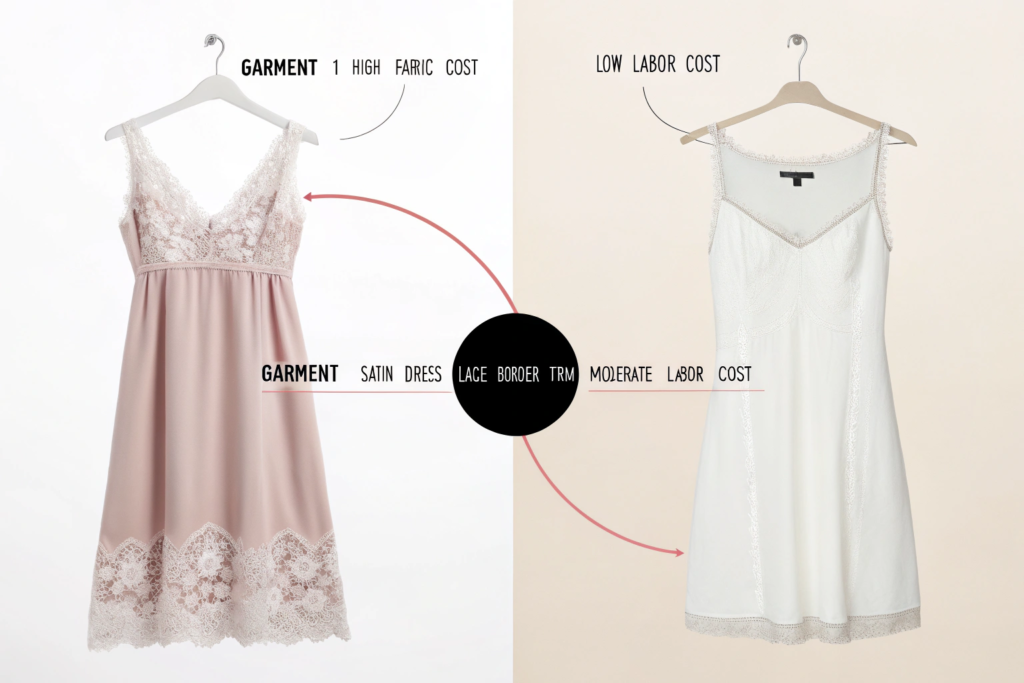
Pro Tip on Usage: Because the beauty is only on the edge, you buy and use lace border by the linear meter/yard, not by the square meter. You're paying for that decorative edge, not the plain ground. This makes it highly cost-effective for trim. We once helped a boutique in Milan optimize costs for a cocktail dress line by switching from an all-over lace skirt to a satin skirt trimmed with a dramatic Italian-style scalloped lace border. The material cost dropped by 60%, and the design became more focused and luxurious.
When Should You Choose One Over the Other in Design?
The choice between all-over and border lace is a strategic design decision. It affects the garment's silhouette, cost structure, sewing complexity, and overall impact. Using an all-over lace as a border is wasteful and difficult. Using a border lace for a full bodice is impossible. Let's match the tool to the task.
A simple rule of thumb: Use all-over lace when you need "area coverage" and border lace when you need "edge definition." But the real-world application has more nuance. It's about the story you want the garment to tell—is the lace the main character, or the exquisite punctuation?
For Which Projects is All-Over Lace Non-Negotiable?
Choose all-over lace when the lace itself is intended to be the dominant, continuous textile of the garment.
- Full-Coverage Garments: Lace dresses, lace tops, lace sleeves, lace overlays. The garment is made of lace.
- Large Insets or Panels: When you want a sizable section of lace, like a lace back panel on a wedding gown or a lace yoke on a blouse. The lace needs to provide both decoration and structural integrity over an area.
- Pattern Matching Designs: For high-end apparel where the lace pattern must flow seamlessly across seams (e.g., a princess seam dress). This requires a predictable, continuous all-over pattern.
- Stretch and Fit: Most stretch laces are all-over. They are used for fitted garments where the lace must provide both aesthetic and elasticity over the entire body area, like in bodysuits or fitted sheaths.
Case in Point: A client in Dubai creating a high-fashion abaya wanted a cohesive, majestic look with a large-scale paisley pattern flowing across the entire garment. Only a wide-width, all-over embroidered lace could achieve this. The key was selecting a pattern with a repeat that was both dramatic and easy to match at seams, which we developed in our studio. The project success hinged on treating the lace as the primary fabric.
When Do Lace Borders Offer a Superior Advantage?
Lace borders shine as an accent or solution-oriented trim. They are the secret weapon for adding luxury details efficiently.
- Hem and Neckline Finishing: This is the classic use. A scalloped lace border provides a beautiful, finished edge to a skirt, sleeve, or neckline without needing to hem the base fabric.
- Cost-Effective Embellishment: Adding a lavish, intricate border to a simple satin, chiffon, or cotton garment creates a high-value look for a fraction of the cost of using all-over lace. The eye is drawn to the detailed edge.
- Historical or Vintage Detailing: Many traditional folk costumes and vintage lingerie designs rely on specific types of insertion lace and edgings. Sourcing authentic cluny lace or broderie anglaise borders can be crucial for period-accurate designs.
- Problem-Solving: Borders (especially insertion laces) can be used to join two pieces of fabric decoratively or to create sheer panels. They can also be used to lengthen a garment in a decorative way.
Real-World Efficiency: For a fast-fashion retailer's spring line, they needed a "lace trend" look on a tight budget. We proposed using a simple polyester georgette for the dress bodies and applying a colorful, trendy floral lace border at the hem and cuffs. The per-unit fabric cost was minimized, the sewing was simplified (applying trim vs. sewing full lace pieces), and the visual impact was maximized. It was a win driven by choosing the right lace type.
What are the Hidden Cost and Sourcing Implications?
The price tag per meter can be misleading. A lace border might have a higher price per linear meter than an all-over lace per running meter, but you use far less of it. The true cost is in the application and yield. Understanding the sourcing nuances prevents budget overruns.
The production minimums (MOQs) also differ drastically. An all-over lace design requires setting up a wide loom or embroidery machine for a single pattern, leading to high minimum yardage (often 500-1000 meters per color). A lace border, being narrower and sometimes produced in multi-strip looms, can have lower MOQs, especially for standard designs.
How Does Waste and Yield Calculation Differ?
This is where the financial reality hits.
- All-Over Lace: You must calculate yield based on the pattern repeat. If your dress pattern pieces are 50cm long and the lace repeat is 30cm, you need to lay out pieces carefully to match patterns, potentially wasting fabric between repeats. The cost is in the square area used, plus waste. A large-scale pattern has higher waste.
- Lace Border: Waste is minimal. You purchase the exact linear length needed for your hems and trims, plus a small allowance for seams. There is no pattern matching across a width. Your cost is linear. However, you must also factor in the cost of the base fabric it attaches to.
Practical Example: For a wedding dress with a full lace skirt, you might need 5 meters of 280cm-wide all-over lace. For the same dress with a satin skirt and a lace hem border, you might need 5 meters of satin and only 5 meters of 10cm-wide border lace. The material mix is almost always cheaper, even if the border lace is premium.
What Should You Know About MOQs and Custom Development?
Your design ambition must meet production reality.
- All-Over Lace Customization: Creating a custom all-over lace design is a major investment. It involves creating a digital "punching" file for the loom, which is costly and time-consuming. The MOQ will be high to amortize this setup cost (often 1,000 meters+). It's only viable for large, confident orders.
- Lace Border Customization: Customizing a border can be more accessible. Modifying an existing scallop shape or motif density on a narrower loom may have a lower setup cost and MOQ (sometimes as low as 100-300 meters). This is great for brands wanting a unique trim signature.
- Stock vs. Custom: Always check a supplier's stock range first. Shanghai Fumao, leveraging the Keqiao cluster, holds stock of hundreds of all-over and border lace designs. Using a stock item slashes MOQ to as low as 100 meters and reduces lead time to days. A Sydney-based bridal designer used our stock Venetian border lace for a collection, achieving a custom look with no development cost and a 3-week lead time.
How Do You Source and Specify Them Correctly?
Clear communication with your supplier is the final, critical step. Using the wrong terminology or providing incomplete specs leads to costly errors. You must specify not just what you want, but how it will be used.
When requesting quotes or samples, your inquiry should instantly signal to the supplier which world you're operating in. This gets you the right information faster and builds your credibility as a knowledgeable buyer.
What are the Key Specification Questions for All-Over Lace?
When sourcing all-over lace, your focus is on the fabric's performance as a primary material.
- Width: What is the full usable width? (e.g., 280cm / 110")
- Pattern Repeat: What is the vertical and horizontal repeat measurement? (Critical for costing and cutting)
- Composition: Fiber content? (e.g., Polyester 92%, Spandex 8%)
- GSM (Grams per Square Meter): Indicates weight and drape.
- Stretch: If applicable, percentage and direction (2-way or 4-way).
- Dyeing: Piece-dyed or yarn-dyed? (Yarn-dyed is more colorfast).
Always request a cutting sample of at least one full pattern repeat. This allows you to check the repeat accuracy and see how the pattern flows.
What are the Vital Details to Specify for Lace Borders?
For borders, you're specifying a component, not a fabric.
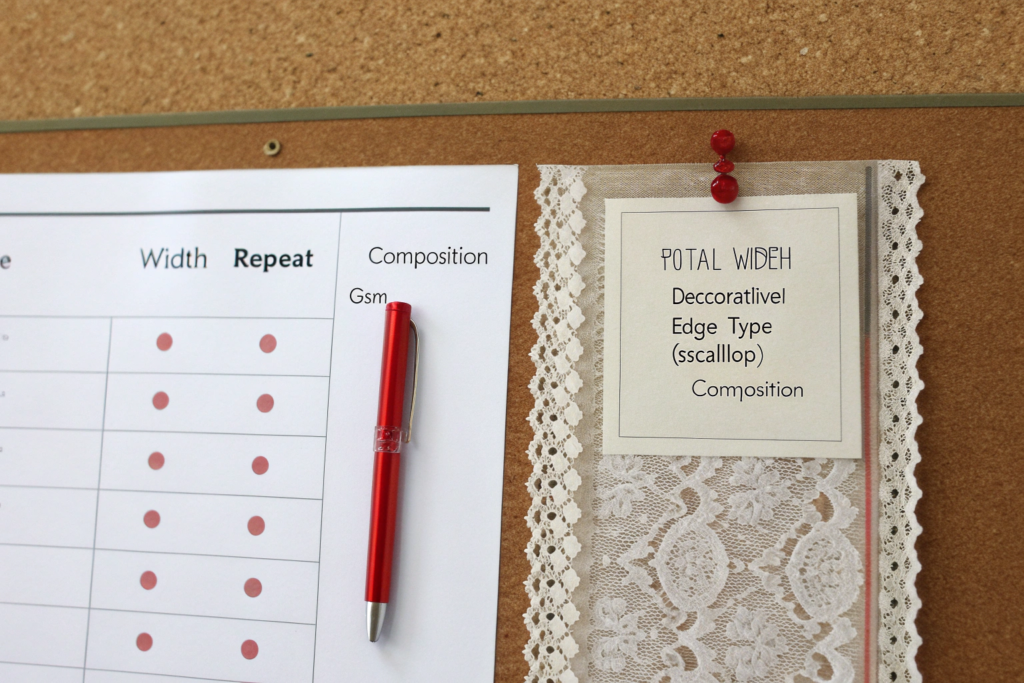
- Total Width: The width from one selvedge to the other (e.g., 10cm).
- Decorative Edge Width/Design: How wide is the ornate part? (e.g., "5cm deep scallop pattern").
- Edge Type: Scalloped, straight, pointed? Include a sketch or photo.
- Attachment Edge: Describe the other edge—is it a straight edge for sewing into a seam, or a simple net for appliqué?
- Composition: Of both the decorative thread and the ground net.
- Supplied Form: On a roll? Pre-cut lengths? On a coned tape for automatic sewing?
Crucial Advice: Provide a technical sketch of how the trim will be applied to your garment. This helps the supplier recommend the most suitable structure. For instance, a border for a curved hem needs more flexibility than one for a straight hem. We saved a client from a major error when they ordered a stiff, non-bias border for a circular skirt. Seeing their sketch, we recommended a softer, more pliable border construction.
Conclusion
The distinction between all-over lace and lace borders is foundational, governing their design application, cost model, and sourcing requirements. All-over lace serves as a primary construction fabric, defined by its continuous, area-covering pattern and priced by area with yield impacted by pattern repeats. Lace borders function as decorative trim, concentrating value on a finished edge and costing by linear length with minimal waste. The optimal choice hinges on your design intent: use all-over lace for garments where lace is the dominant textile, and deploy lace borders for efficient, impactful edge embellishment or historical detailing. Successful sourcing depends on precise specification—focusing on pattern repeat and width for all-over lace, and on edge design and application method for borders.
Mastering this differentiation empowers you to design with purpose and source with precision, unlocking both creative potential and cost control. At Shanghai Fumao, with our vast stock and development capabilities across both categories, we are positioned to be your strategic partner. Whether you need a majestic all-over lace for a collection centerpiece or a unique border to define a silhouette, our expertise ensures you get the right material, specified correctly, delivered reliably. To discuss the perfect lace solution for your next line, contact our Business Director, Elaine, at elaine@fumaoclothing.com.