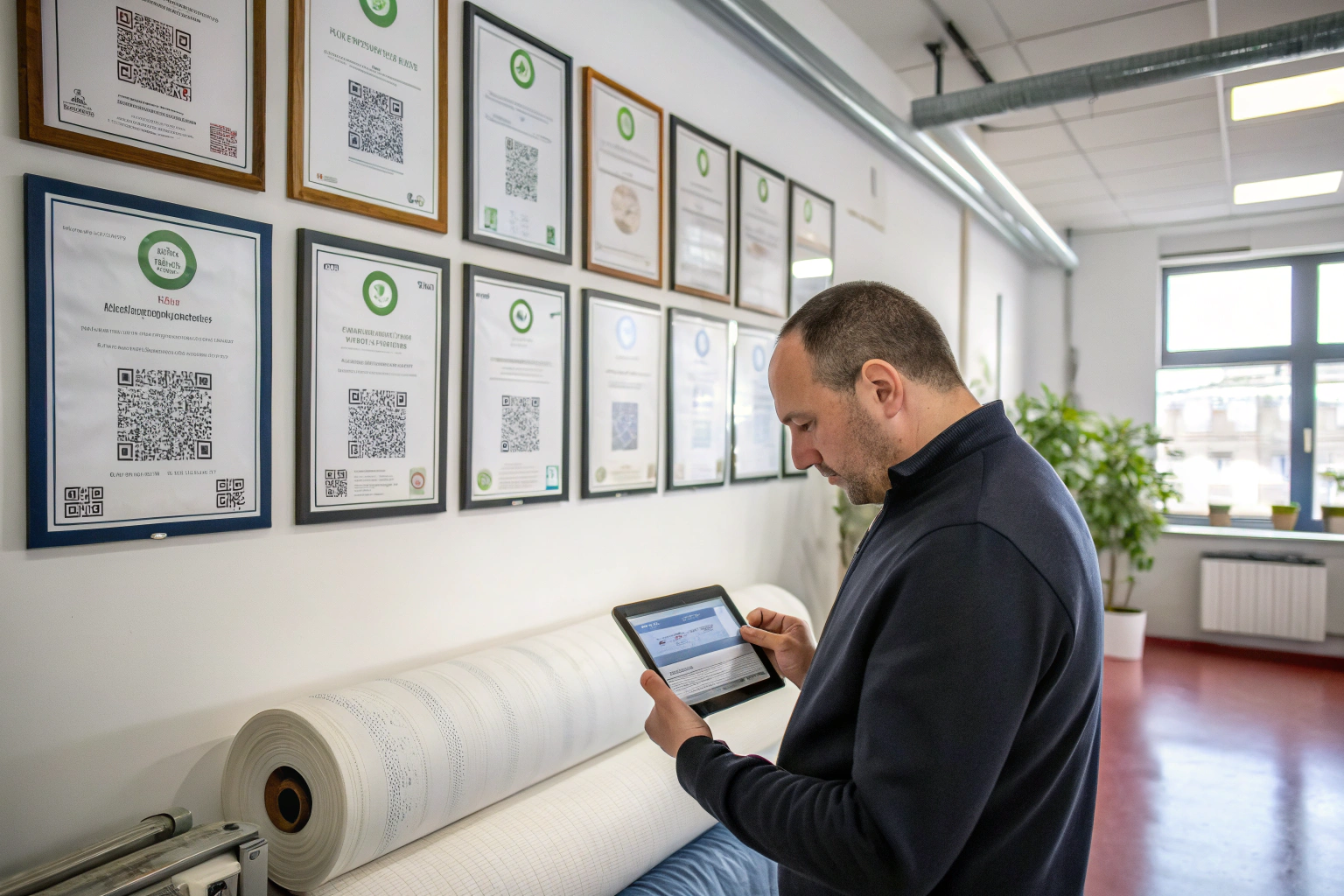
I've been in this industry long enough to remember when a handshake and a sample swatch were all you needed to start a business relationship. Those days are long gone. Last month alone, I had clients from four different countries ask for certification documentation before we even discussed pricing. A buyer from Boston wouldn't place their $200,000 order until we sent them our GOTS certificate, our OEKO-TEX report, and a third-party audit of our dye house. And you know what? They were right to ask.
Here's the reality for 2026: certifications aren't just marketing badges anymore. They're your protection against supply chain disasters, your proof of compliance for increasingly strict global regulations, and your evidence when customers ask "how do I know this fabric is really sustainable?" The right certifications separate professional suppliers from traders who might disappear when problems arise.
Let me walk you through exactly what certifications matter for knitted fabric suppliers in 2026, which ones you should demand based on your market and product type, and how to verify that those certificates actually apply to your order. I'll share real examples of what happens when brands skip this step and how proper certification saves money, reputation, and legal headaches.
What Safety Certifications Are Non-Negotiable for Knitted Fabrics in 2026?
Safety certifications are the absolute minimum requirement for any reputable knitted fabric supplier. If your supplier can't provide these, walk away. It's that simple. The chemicals used in textile production—from fiber processing through dyeing and finishing—can leave residues that harm skin, trigger allergies, or worse. For knitted fabrics that sit directly against skin, this matters even more.
OEKO-TEX Standard 100 is the global baseline for textile safety. It tests for hundreds of harmful substances including heavy metals, formaldehyde, pesticides, phthalates, and allergenic dyes. The certification has four product classes: Class I for babies (strictest), Class II for skin contact (most apparel), Class III for non-skin contact, and Class IV for decoration. For knitted fabrics used in t-shirts, dresses, underwear, or any garment touching skin, you need at least Class II. For children's wear, demand Class I.
Here's what many buyers don't realize: OEKO-TEX certification applies to specific products from specific facilities, not to an entire company. A supplier might have OEKO-TEX for their cotton jersey but not for their polyester fleece. Always ask for the certificate that covers your specific fabric. The certificate number should match your supplier's name and location, and the product scope should include your fabric type.
REACH compliance is essential for anyone selling into the European market. This EU regulation restricts over 200 substances in manufactured products. While OEKO-TEST covers similar ground, REACH is the legal requirement. Your supplier should provide a REACH declaration or, better, test reports showing compliance. A German brand we supply requires REACH documentation with every shipment, and they randomly test fabrics to verify. Those who can't provide it don't get their business.
Why Does CPSIA Matter for Knitted Fabrics Going to the US Market?
If you're shipping knitted fabrics to the United States, CPSIA (Consumer Product Safety Improvement Act) compliance isn't optional—it's the law. This regulation applies to all children's products (ages 12 and under) and includes strict limits on lead and phthalates, plus tracking label requirements.
The lead limit is 100 parts per million (ppm) total lead content in any accessible part of a children's product. Phthalates (plasticizers used in some finishes and prints) are restricted to 0.1% or less for eight specific compounds. These aren't suggestions—they're enforceable limits with serious penalties for non-compliance.
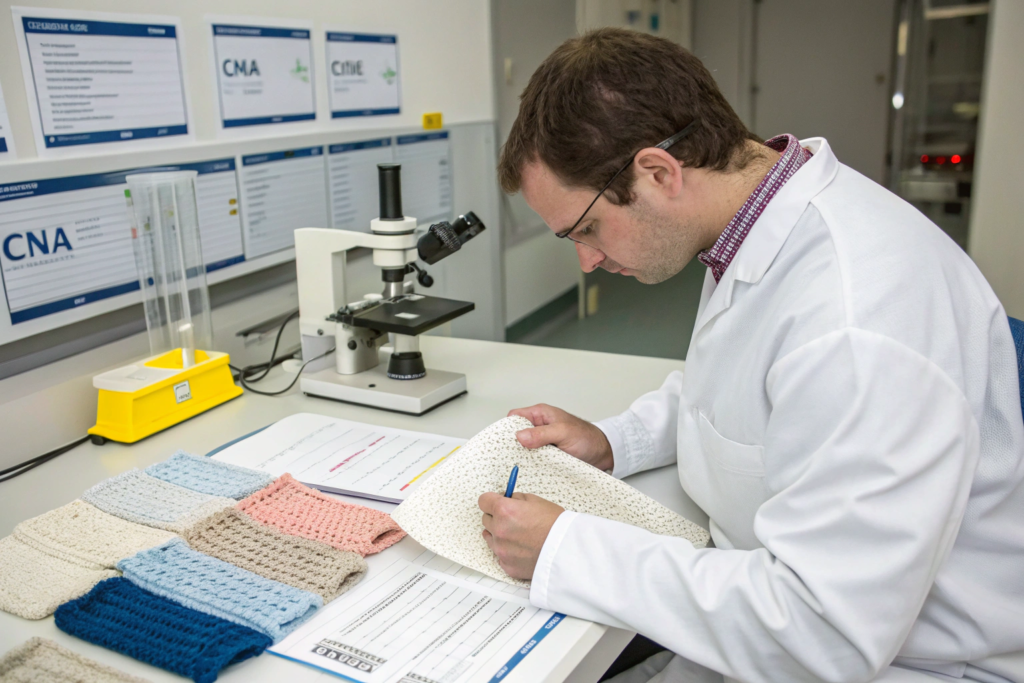
For knitted fabrics, the risk areas are printed designs (inks can contain lead or phthalates), coated finishes (some water-repellent treatments), and certain synthetic fibers where catalysts might remain. A reputable supplier tests their fabrics for CPSIA compliance and provides documentation. We test every children's wear fabric in our CNAS-accredited lab and include CPSIA reports with every relevant shipment.
A California-based children's brand learned this lesson painfully in 2023. Their previous supplier's "CPSIA compliant" fabric failed random testing at US customs, holding an entire season's inventory for six weeks. The delay cost them their retail placements and nearly bankrupted the company. Now they only buy from suppliers who provide third-party test reports with every order.
What Flammability Standards Apply to Different Knit Applications?
Flammability requirements vary by garment type and market, and getting this wrong can stop shipments at the border or worse—cause safety incidents with your customers.
For general apparel in the US, 16 CFR 1610 applies. This standard classifies fabrics as Class 1 (normal flammability), Class 2 (intermediate), or Class 3 (rapid and intense burning). Most knitted fabrics pass Class 1 easily, but certain constructions—especially those with raised surfaces like fleece—require testing to confirm. The surface nap can actually accelerate flame spread by trapping air.
Children's sleepwear faces stricter requirements under 16 CFR 1615 and 1616. These standards require either flame-resistant fabric or tight-fitting styles. Many natural fiber knits (cotton, bamboo) don't pass sleepwear flammability standards without treatment. If you're making children's pajamas from cotton jersey, you need either flame-retardant finishing or a tight-fitting design that meets the standard's exceptions.
European standards (EN 14878) similarly regulate children's sleepwear flammability. The requirements differ from US standards, so multi-market brands need to understand both. We maintain separate test data for US and EU compliance and advise clients on which standard applies to their target market.
A UK brand once shipped cotton knit pajamas to the US assuming they'd pass. They didn't. The shipment was held, the season was lost, and the brand paid thousands in storage and return shipping. All preventable with proper certification upfront.
What Sustainability Certifications Actually Prove Environmental Claims?
Sustainability claims are everywhere in 2026, but certifications separate genuine commitment from marketing fiction. When a supplier says "eco-friendly" without certification, they're selling you a story. When they provide GOTS or GRS certificates, they're selling you proof.
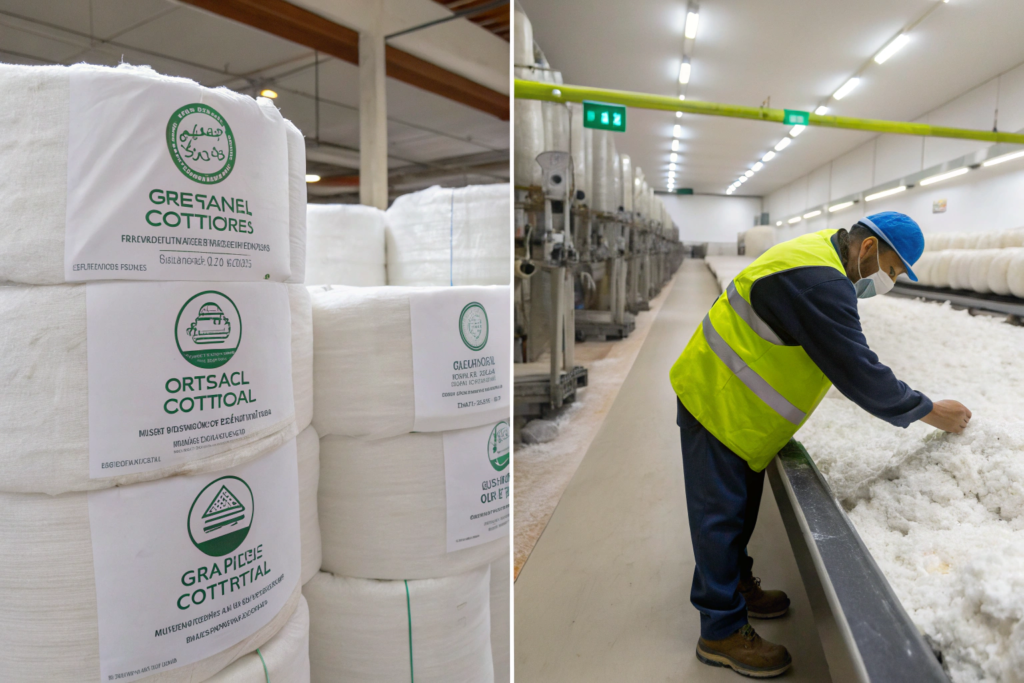
GOTS (Global Organic Textile Standard) is the gold standard for organic natural fibers. It covers the entire supply chain—from field to finished fabric—ensuring organic fiber content, environmental responsibility in processing, and social compliance. For knitted fabrics made from organic cotton, organic wool, or other natural fibers, GOTS certification is the only credential that matters.
Here's what GOTS actually requires: at least 70% organic fibers (95% for "Organic" label, 70-95% for "Made with Organic"), no toxic heavy metals or formaldehyde in dyes, no GMOs, strict wastewater treatment, and social criteria including fair wages and no child labor. It's comprehensive, which is why it's trusted.
For a GOTS-certified knit, you should receive a Scope Certificate showing your supplier's certification and a Transaction Certificate for your specific order. The TC traces your fabric back through the certified supply chain. Without it, you don't have certified organic fabric—you have fabric from a certified supplier, which isn't the same thing.
How Does GRS Certification Verify Recycled Content in Knits?
GRS (Global Recycled Standard) is the leading certification for recycled materials. It applies to both natural and synthetic fibers, verifying recycled content and tracking it through the supply chain. For recycled polyester knits, recycled cotton blends, or any fabric claiming recycled content, GRS is essential.
The standard requires at least 20% recycled content for certification, with stricter requirements for higher percentages. It also includes environmental criteria for processing and social requirements similar to GOTS. A GRS-certified recycled polyester knit has been verified from the bottle or textile waste through to your finished fabric.
The key document is the Transaction Certificate (TC), which shows the recycled content percentage, the input materials, and the chain of custody. We provide TCs for every GRS-certified order, and our clients use them to support their own sustainability claims. A Dutch activewear brand built their entire marketing around "100% GRS-certified recycled polyester" and has the documentation to back it up.
Watch out for suppliers who claim "recycled" without GRS or equivalent certification. Without third-party verification, you have no way to know if the recycled content is real, how much is actually present, or where it came from. In 2026, that's a risk no brand should take.
What About ISO 14001 and Environmental Management Certifications?
ISO 14001 certifies environmental management systems, not specific products. It tells you that a facility has systems in place to manage environmental impact—waste reduction, energy efficiency, regulatory compliance. It doesn't guarantee that a specific fabric is sustainable, but it indicates a supplier who takes environmental responsibility seriously.
For knitted fabric suppliers, ISO 14001 is valuable context. It suggests the supplier has invested in environmental management, which often correlates with better chemical handling, wastewater treatment, and overall responsibility. We maintain ISO 14001 certification because our clients expect it, and because running a clean operation is simply good business.
However, ISO 14001 doesn't replace product-specific certifications. A supplier can have ISO 14001 and still produce conventional fabrics with high environmental impact. Use it as a positive indicator, not as proof of sustainability for specific products.
What Quality Management Certifications Ensure Consistent Knit Fabrics?
Consistency is everything in knitted fabrics. A jersey that varies in weight, shrinkage, or color from roll to roll creates chaos in your cutting room and complaints from your customers. Quality management certifications indicate that a supplier has systems to maintain that consistency.
ISO 9001 is the international standard for quality management systems. It certifies that a company has documented processes, quality control procedures, continuous improvement systems, and customer feedback mechanisms. For knitted fabric suppliers, ISO 9001 suggests they take quality seriously and have systems to catch problems before shipping.
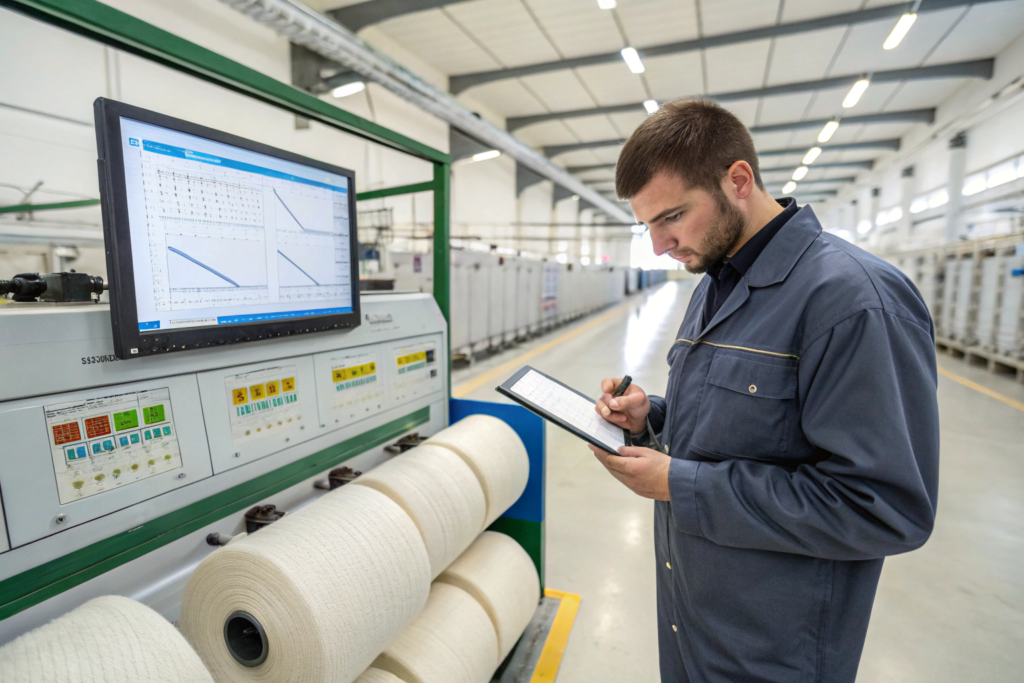
But ISO 9001 alone isn't enough. You need to know what specific quality tests the supplier performs and how they share that data. At Shanghai Fumao, our CNAS-accredited lab tests every production batch for weight, shrinkage, colorfastness, and strength. We provide clients with test reports and QR code access to real-time data. That's the level of quality management that protects your production.
AQL (Acceptable Quality Level) standards matter for fabric inspection. Most reputable suppliers use AQL 2.5 or 4.0 for fabric inspection, meaning they accept a limited number of defects per batch. Ask your supplier what AQL they use and request inspection reports. If they can't tell you, they're not doing systematic quality control.
Why Should You Care About CNAS or ISO 17025 Lab Accreditation?
This is one of the most overlooked details in fabric sourcing. Anyone can set up a testing lab and claim results. CNAS (China National Accreditation Service) or ISO 17025 accreditation means the lab has been audited and meets international standards for competence and impartiality.
When our CNAS-accredited lab provides a test report, that report is recognized globally. It means our testing methods follow ISO/AATCC standards, our equipment is calibrated, and our technicians are qualified. For clients, this means test results they can trust and use for their own compliance documentation.
Without accredited lab testing, you're relying on whatever numbers the supplier chooses to provide. A shrinkage test from an unaccredited lab might be accurate—or it might be whatever the sales team wanted to see. For critical specifications like shrinkage for pattern grading, accredited testing is essential.
A Canadian brand learned this when their "3% shrinkage" fabric actually shrank 8% after garment production. Their supplier's unaccredited lab had reported favorable numbers that didn't match reality. Now they only accept test reports from CNAS or equivalent accredited labs.
What Testing Standards Actually Matter for Knit Performance?
Different knitted fabrics require different tests, but certain standards are universal. Understanding them helps you specify what you need and verify what you receive.
ASTM D2594 is the standard test for knit stretch and recovery. It measures how much a knit stretches under specific force and how well it recovers after release. For activewear, you need both high stretch and high recovery. For casual wear, moderate stretch with good recovery suffices. Ask for D2594 data before ordering.
AATCC 135 measures dimensional changes after home laundering—shrinkage, in plain language. This test simulates five home washings and measures fabric changes. For knits, shrinkage of 3-5% is typical; anything higher will cause fit problems. We provide AATCC 135 data for every knit we produce.
AATCC 61 tests colorfastness to washing. It measures how much dye bleeds or fades during laundering. Ratings of 4.0 or higher (on a 5-point scale) are essential for consumer satisfaction. Lower ratings mean colors will fade quickly or bleed onto other garments.
ASTM D3787 measures bursting strength for knits. Unlike wovens (tested for tensile strength), knits need to resist bursting forces—like a knee pressing against a legging. This test ensures your fabric won't fail during wear.
A French lingerie brand requires all four tests for every knit they order. They've learned that skipping any one leads to complaints. Their return rate is under 0.5%, among the lowest in the industry.
What Social Compliance Certifications Protect Your Brand Reputation?
Your fabric's environmental credentials mean nothing if it was made by exploited workers. Social compliance certifications protect your brand from association with forced labor, child labor, or unsafe working conditions. In 2026, consumers expect this transparency, and regulators are increasingly demanding it.
SA8000 is a global social accountability standard based on international human rights norms. It covers child labor, forced labor, health and safety, freedom of association, discrimination, disciplinary practices, working hours, and compensation. A supplier with SA8000 certification has been audited against these criteria by a third party.
BSCI (Business Social Compliance Initiative) is widely used in European supply chains. It provides a common framework for social compliance auditing, with participating brands sharing audit results. Many European retailers require their suppliers to have BSCI audits with acceptable ratings.
SMETA (Sedex Members Ethical Trade Audit) is another common framework, used by brands participating in the Sedex platform. It covers labor standards, health and safety, environment, and business ethics. A SMETA audit report provides visibility into a supplier's social compliance status.
The key with social compliance is that certification alone isn't enough—you need to know what the audit found. Some suppliers "audit fix" by correcting issues temporarily before audits, then reverting to poor practices. The best protection is ongoing relationship with suppliers who demonstrate genuine commitment to ethical practices.
How Can You Verify That Certifications Apply to Your Actual Production?
This is where many brands get tripped up. A supplier shows you their GOTS certificate, you assume your organic cotton order is covered. But that certificate might expire next month, or cover only their trading office while production happens elsewhere, or exclude the specific fabric you're ordering.
Always check the certificate date. Certifications expire—typically annually for GOTS and GRS. A certificate that expired six months ago means nothing. Ask for the current certificate and verify the dates.
Check the scope. The certificate should specify which facilities are covered and what activities (spinning, knitting, dyeing, finishing) are included. If your supplier's GOTS certificate only covers their warehouse but they're sub-contracting knitting to an uncertified mill, your fabric isn't GOTS-certified.
Request Transaction Certificates for each order. A TC links your specific fabric to the certified supply chain, showing quantities, dates, and the chain of custody. Without a TC, you have certified supplier but not certified product.
A US brand learned this when their "GOTS-certified" organic cotton was rejected by their European retailer. The supplier had a valid GOTS certificate but hadn't provided TCs for the specific order. The brand had to air-freight replacement fabric at enormous cost to meet their delivery deadline.
What Red Flags Indicate Certification Problems?
After two decades, I've seen every certification trick in the book. Here's what should make you suspicious:
Vague claims without documentation. "We're OEKO-TEX certified" without showing the actual certificate. "All our fabrics are sustainable" without specifying which certifications apply. Push for specifics.
Certificates that don't match the company name exactly. A slightly different name might indicate a related company that isn't actually certified. Check the legal entity matches your supplier.
Reluctance to share Transaction Certificates. Some suppliers will provide scope certificates freely but hesitate on TCs. TCs prove your specific order is certified. If they won't provide them, your order probably isn't.
Certificates from obscure, unrecognized bodies. There are dozens of fake certification schemes. Stick with known, credible organizations: GOTS, GRS, OEKO-TEX, ISO, SA8000, BSCI. If you haven't heard of it, research before accepting.
A Swedish brand once accepted a "Green Cotton Certificate" from a supplier, only to discover it was an internal document with no third-party verification. Their marketing claims were based on nothing, and they faced fines from Swedish consumer authorities. Now they only accept internationally recognized certifications.
What Market-Specific Certifications Do You Need for Different Regions?
Global brands need to understand that certifications aren't one-size-fits-all. What satisfies EU regulators may not satisfy US Customs, and Asian markets have their own requirements. Planning for your target markets prevents last-minute compliance crises.
For the European Union, REACH compliance is mandatory, but many retailers go further. OEKO-TEX Standard 100 is widely accepted and often required. The EU's upcoming Digital Product Passport will require detailed sustainability data, making certifications like GOTS and GRS even more valuable as sources of verified information.
For the United States, CPSIA matters for children's products, and California's Proposition 65 adds another layer. Prop 65 requires warnings for products containing listed chemicals, which no fabric supplier wants on their products. Testing against Prop 65 limits is wise for any fabric sold in California.
For Japan, JIS (Japanese Industrial Standards) compliance may be required. Japanese buyers often have specific testing requirements beyond international standards. We work closely with Japanese clients to ensure fabrics meet their precise specifications, including JIS testing where needed.
For Australia and New Zealand, similar standards apply with some local variations. AS/NZS 4399 tests UV protection, which matters for summer fabrics. A Sydney-based swimwear brand requires this test for all their knit cover-ups.
What Certifications Matter for Organic Knits in Different Markets?
Organic certifications vary by region, and understanding the differences prevents confusion.
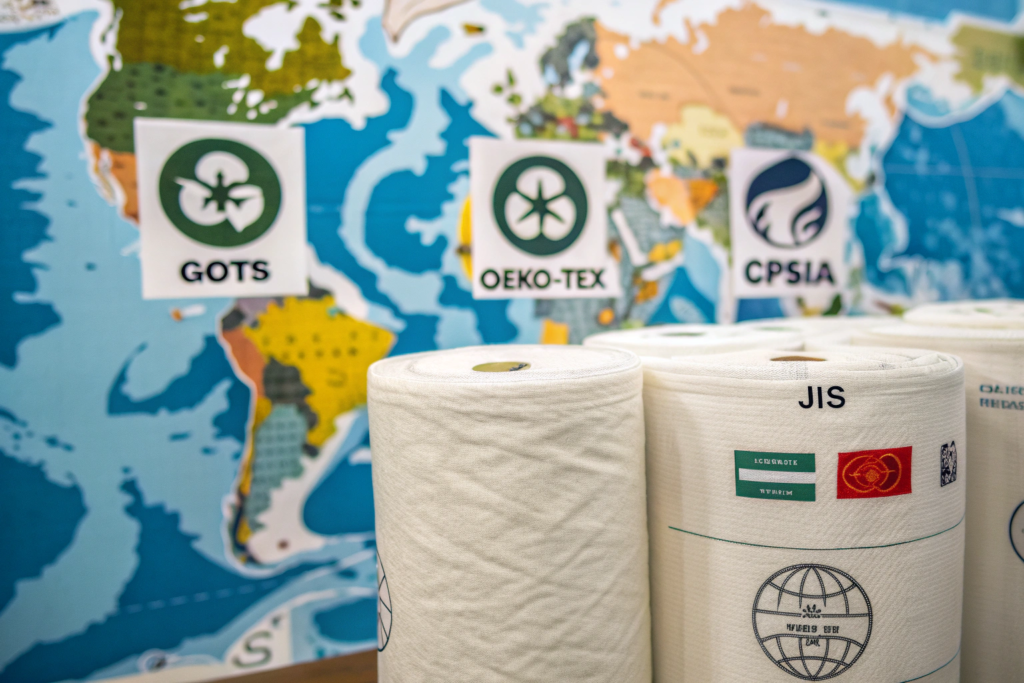
For global organic cotton, GOTS is the most widely accepted. It's recognized in Europe, North America, and increasingly in Asia. If you want one organic certification that works everywhere, GOTS is your best choice.
For the US market, USDA Organic certifies agricultural products but doesn't cover textile processing. Some US brands accept USDA Organic fiber with additional processing certifications. Others require GOTS specifically. Know what your customer demands.
For the Indian market, NPOP (National Programme for Organic Production) certifies organic products. Fabrics certified under NPOP may be accepted in some markets but not all. For international sales, GOTS remains safer.
For the Japanese market, JAS (Japanese Agricultural Standard) certifies organic products. Some Japanese buyers accept GOTS, others require JAS. We maintain both where needed for specific clients.
A multi-national brand we supply maintains separate organic lines for different regions: GOTS-certified for Europe and North America, locally certified for their Asian distribution. It's more complex but ensures compliance everywhere they sell.
How Do You Prepare for Upcoming 2026-2027 Regulatory Changes?
Regulations don't stand still, and 2026-2027 will bring significant changes that affect knitted fabric sourcing.
The EU's Digital Product Passport will require detailed sustainability information for products sold in Europe. This includes carbon footprint, recyclability, supply chain transparency, and certification data. Suppliers who can't provide this data will be locked out of the EU market. We're already preparing clients by documenting everything in formats compatible with upcoming requirements.
PFAS (per- and polyfluoroalkyl substances) restrictions are tightening globally. These "forever chemicals" used in water-repellent finishes are being banned or restricted in multiple jurisdictions. If your knitted fabrics have any water-resistant finish, verify it's PFAS-free and get documentation.
Microplastic shedding from synthetic knits is under increasing scrutiny. France has already announced microfiber filter requirements for washing machines, and the EU is considering labeling requirements for synthetic textiles. For polyester and nylon knits, expect questions about microfiber shedding. We're working with clients on testing and mitigation strategies.
Extended Producer Responsibility (EPR) schemes are expanding. These require brands to fund collection and recycling of their products at end of life. The data required for EPR compliance starts with fabric composition and certifications. The more documented your supply chain, the easier EPR compliance becomes.
A proactive Dutch brand is already requiring all suppliers to provide full material disclosure, certification documentation, and environmental impact data. They're preparing for regulations before they hit, positioning themselves ahead of competitors who wait until compliance is forced.
Conclusion
Certifications aren't just paperwork—they're your protection in an increasingly complex global market. The right certifications verify safety, prove sustainability claims, ensure quality consistency, and document ethical production. They transform supplier promises into verifiable facts that protect your brand and satisfy your customers.
For knitted fabrics in 2026, the essential certifications break down by priority:
Safety first: OEKO-TEX Standard 100 (Class I or II) is non-negotiable for any fabric touching skin. CPSIA compliance is mandatory for US children's products. REACH compliance protects EU market access.
Sustainability when claimed: GOTS for organic natural fibers, GRS for recycled content. These provide third-party verification that your marketing claims are real.
Quality management: ISO 9001 indicates systematic quality control. CNAS/ISO 17025 lab accreditation ensures test results you can trust.
Social compliance: SA8000, BSCI, or SMETA audits protect your brand from association with unethical labor practices.
Market-specific certifications: Know what your target markets require and verify your supplier provides it.
But certifications alone aren't enough. You need to verify they apply to your specific order, check expiration dates, review scope, and request Transaction Certificates. A certified supplier isn't the same as certified product.
At Shanghai Fumao, we've built our reputation on certification integrity. Our GOTS, GRS, OEKO-TEX, and ISO certifications are current and verifiable. Our CNAS-accredited lab provides test data you can trust. Our social compliance audits are transparent and available for review. And our team helps clients navigate the certification landscape, ensuring they have exactly what they need for their markets.
We don't just provide certified fabrics—we provide the documentation that makes those certifications useful for your business. Every shipment includes test reports, transaction certificates, and compliance documentation tailored to your requirements.
Whether you need GOTS-certified organic cotton jersey for European babywear, GRS-certified recycled polyester for US activewear, or OEKO-TEX certified basics for any market, we have the certifications and the expertise to deliver.
Contact our Business Director, Elaine, today to discuss your certification requirements. She and her team will provide the documentation you need, answer your compliance questions, and ensure your knitted fabrics meet every standard your market demands. Email her directly at: elaine@fumaoclothing.com. Let's build your supply chain on verified trust, not empty promises.