You've finalized your design sketch, and the vision is clear: a garment that hinges on the specific light-play of lace. But when you type "lace fabric" into a search, you're bombarded with options where the finishes all blur together. Ordering a shiny lace when you needed a matte one can completely dismantle your design's aesthetic, turning a sophisticated look into something cheap or unintended. This isn't just about preference; it's about precision. The problem is real: the terminology is vague, suppliers often mislabel, and without seeing it in person, how can you be sure?
For over twenty years at Shanghai Fumao, nestled in the global textile hub of Keqiao, we’ve been the bridge between designer visions and factory floors. We’ve seen collections succeed or stumble on this very detail. Let me pull back the curtain on how the pros consistently source the right finish, so you can capture the exact mood, from understated elegance to high-glam drama.
What Fibers and Yarns Create Matte vs. Shiny Lace?
The journey to shine or subdued starts at the molecular level. The inherent properties of the fiber are your foundation. A shiny fiber will almost always yield a lace with some degree of luster, even if subsequent steps tone it down. Conversely, getting a high-shine effect from a naturally matte fiber is an uphill battle. Your first decision isn't about the lace; it's about the yarn.
Think of it like this: you can't paint a glossy finish over burlap and expect it to look like porcelain. The base dictates the potential. Natural fibers and certain man-made fibers have distinct light-reflecting personalities. As a sourcer, you must move beyond just "polyester lace" and dig into the yarn type: is it a bright filament or a spun yarn? This is the first filter in your sourcing checklist.
Which Natural Fibers Give a Naturally Matte Finish?
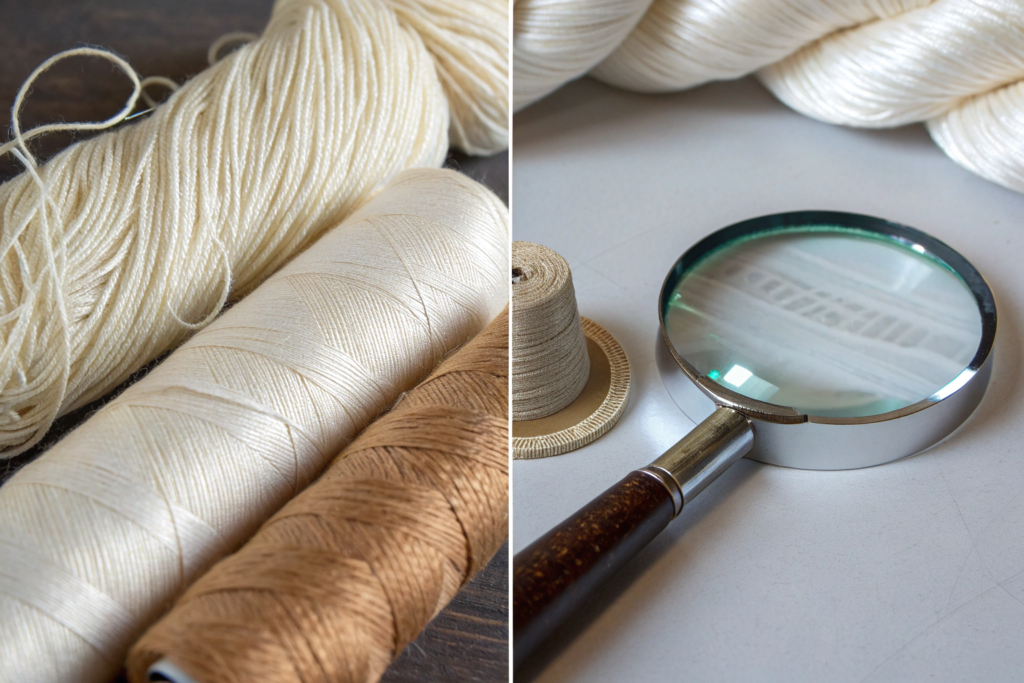
For an inherently soft, non-reflective look, certain natural fibers are your go-to. Their microscopic structure scatters light rather than reflecting it directly.
- Cotton: The king of matte finishes. Cotton lace, especially made from short-staple or matte-finished yarns, has a gentle, dry hand and zero shine. It’s perfect for rustic, romantic, or casual-elegant applications. Think of the beautiful, understated texture of a cotton guipure.
- Linen and Hemp: These plant fibers have even more inherent texture and irregularity, producing a beautifully earthy, matte finish with a distinctive slub.
- Raw Silk/ Dupion Silk: Don't confuse this with the high-shine of mulberry silk. Raw silk retains sericin and has a nubby, irregular texture that gives a rich, pearly-but-matte luster. It's a complex, luxurious matte.
- Matte Viscose/Rayon: While man-made, viscose from bamboo or wood pulp has a cellulose structure that mimics cotton's light-diffusing qualities, offering a soft, matte drape.
A key sourcing tip is to ask for the yarn finish specification. A supplier should be able to tell you if the cotton is mercerized (which adds a slight luster) or in its natural matte state. For a Scandinavian minimalist brand we worked with in 2023, sourcing a truly non-mercerized organic cotton lace was critical for their “no-shine” aesthetic. We had to trace it back to the spinning mill to confirm.
To build foundational knowledge, exploring resources like The Ultimate Guide to Natural Fiber Textile Properties can clarify these inherent characteristics. Furthermore, understanding how yarn spinning techniques affect fabric sheen is crucial for specifying beyond just the fiber name.
Why Do Filament Synthetics Like Polyester Dominate Shiny Lace?
The answer is in the physics. Filament yarns are continuous, smooth strands. Imagine a single, unbroken rod of plastic versus a bundle of short, fuzzy fibers. That smooth surface acts like a tiny mirror, reflecting light directly back to the eye, creating that signature shine.
- Bright Polyester Filament: This is the most common, cost-effective route to high-shine lace. It can be engineered to mimic the look of silk at a fraction of the price and with better wrinkle resistance. Most stretch lace for lingerie uses shiny polyester or nylon filaments combined with elastane.
- Nylon Monofilament: Often used in tulle and illusion lace, it provides a very clear, crisp, and sometimes stiff shine.
- Mulberry Silk: The natural, protein-based filament. It offers a deep, luxurious, and often more nuanced shine than polyester—warmer and less “plastic” to the trained eye. It’s the gold standard for luxury bridal and evening wear laces.
When sourcing shiny lace, always ask: “Is this made from filament or spun yarn?” A “spun polyester” lace will be significantly duller. For a high-volume fast-fashion order last year, the client initially wanted “shiny polyester lace,” but samples were inconsistent. We specified 75D bright polyester filament yarn in our tech pack to all potential suppliers. This objective spec eliminated guesswork and guaranteed the uniform high shine they needed across three different production factories.
How Do Manufacturing Processes Control the Final Sheen?
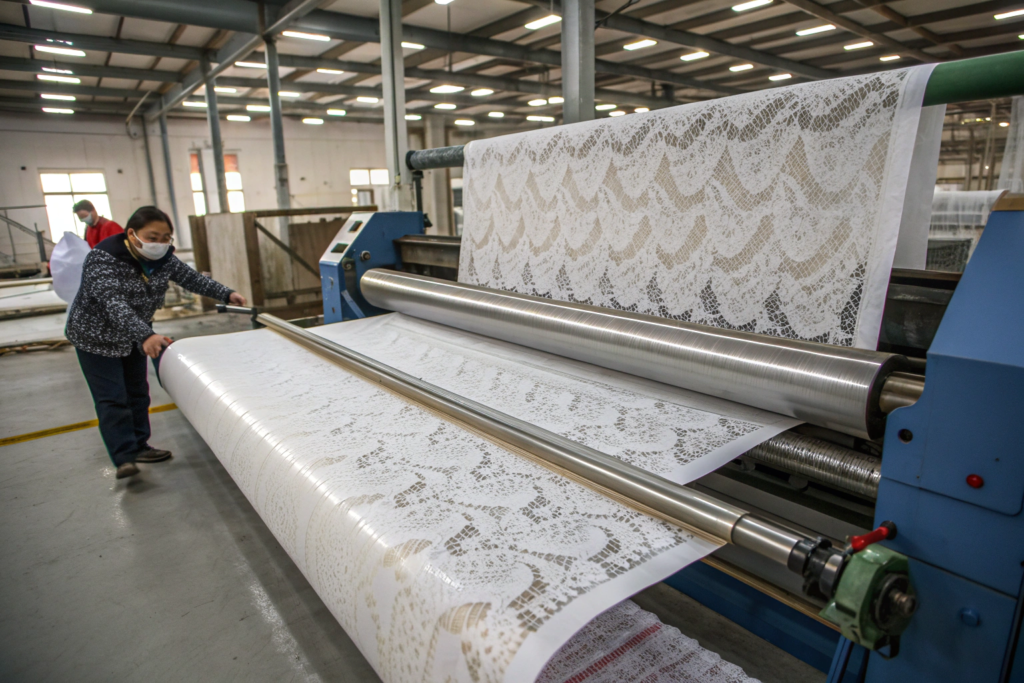
The fiber gives you the starting point, but the factory transforms it. Two laces made from the exact same yarn can end up with radically different finishes based on how they are constructed and treated. This is where sourcing gets technical. You need to understand the processes that enhance, reduce, or manipulate sheen to either achieve your perfect matte or amplify that glossy effect.
Key stages like the type of lace machine, dyeing methods, and most importantly, finishing treatments, are levers that factories pull. A matte yarn can be given a glossy coating, and a shiny filament can be chemically or physically scarred to become matte. As a sourcer, your job is to know which process creates which effect and specify (or veto) accordingly.
Can You Make Shiny Lace Matte? (The Art of De-lustering)
Absolutely. This is a common request for achieving a luxury, vintage, or sophisticated look from affordable synthetic bases. The primary methods are:
- Chemical De-lustering: Adding a matting agent (like titanium dioxide) to the polymer melt before the filament is extruded. This creates a permanently matte fiber from the get-go. This is what you’re buying when you specify “dull” or “matte polyester.”
- Sand-Washing or Enzyme Washing: A mechanical/chemical finishing process that gently abrades the surface of the fabric, breaking up the smooth light-reflecting planes. This gives a soft, worn-in matte feel and is popular for charmeuse laces aiming for a “lived-in” luxury look.
- Textured Yarns: Using crinkled or air-jet textured filament yarns (like Taslan) in the lace construction scatters light due to the yarn’s irregular surface.
A specific case: An Australian resort-wear brand needed a matte finish stretch lace for a high-end line. Shiny nylon-spandex lace was too “lingerie-like.” We connected them with a specialist mill that used sand-washed nylon filaments, which achieved the perfect soft, pebble-matte finish with full stretch recovery. The finish was specified as “sand-wash, 60-minute cycle” in the purchase order.
How is High-Gloss “Wet Look” Lace Achieved?
This is the pinnacle of shine, where the lace looks almost liquid. It’s not just about the yarn; it’s an aggressive finishing treatment:
- Calendering: The most critical step. The lace is passed under extreme pressure between heated, polished steel rollers. This physically flattens the fibers, polishing their surfaces to a mirror-like shine. The higher the pressure and temperature, the more intense the gloss.
- Clear Polyurethane (PU) Coating: A thin layer of clear gloss PU can be applied, which creates a dramatic, almost plastic-like wet look. This is common in faux leather laces or certain theatrical fabrics.
- High-Twist Yarns & Satin Weaves: Within the lace construction itself, using yarns with a very high twist or incorporating areas of satin-weave ground can create intense light reflection in specific patterns.
Sourcing this requires asking direct questions: “Is this lace calendered? If so, what is the roller temperature and pressure spec?” A professional supplier like Shanghai Fumao will have this data from our partner mills. For a stage costume project, we sourced a calendered polyester lace with a clear topcoat that looked spectacular under stage lights, a finish that was non-negotiable for the designer.
What Questions to Ask Suppliers About Finish Consistency?
This is where sourcing rubber meets the road. You’ve found a perfect sample. Now, how do you ensure that the first batch, the re-order six months later, and the production run across 10,000 meters all match that sample’s sheen exactly? Inconsistent finish is a silent killer of production lines, causing color and part mismatches that lead to massive waste.
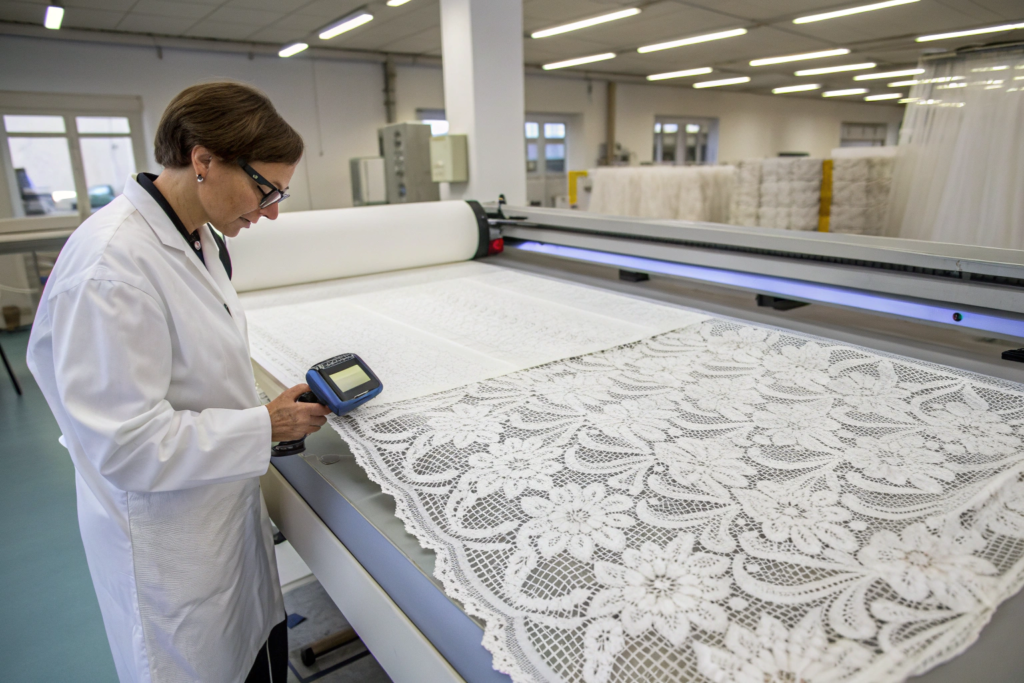
Your supplier relationship must move beyond transactional to technical. The questions you ask separate commodity traders from true technical partners. You’re not just buying “red shiny lace”; you’re buying a product with defined optical specifications that must be controlled and measured.
How Do You Specify Sheen in a Tech Pack?
Vague terms like “matte” or “shiny” are useless. You must use objective, measurable language and reference tools.
- Physical Swatch Attachment: Always attach a signed-off sealed sample to the purchase contract. This is your legal benchmark.
- Quantifiable Metrics: While challenging for small buyers, large brands specify gloss units measured with a gloss meter at a specific angle (e.g., 60°). Ask your supplier if they can provide this data from their mill.
- Detailed Descriptive Specs: Use precise terminology. Instead of “shiny,” write: “Finish: High-gloss calendered. Must match sealed sample S-2024-015 in both color and level of specular reflection under standard D65 light.”
- Process Specifications: Mandate the process. E.g., “Yarn: 100% dull (matte) polyester filament, 50D. Finishing: Sand-wash process, 45 minutes, 40°C.”
We helped a UK-based brand implement a system where every bulk lace order reference included the finishing recipe code from the dyeing and finishing mill. This meant any repeat order, even years later, could be replicated exactly by quoting that code.
What Are the Red Flags for Inconsistent Batch Finishing?
A supplier’s answers (or lack thereof) to these questions reveal their capability:
- Red Flag 1: “The finish might vary a little between batches, it’s normal.” – This is not normal for a professional mill. Run.
- Red Flag 2: Inability to provide details on the yarn source or finishing mill. This indicates they are just traders with no supply chain control.
- Red Flag 3: No in-house lab or partnership with a lab to test finish durability (e.g., will the matte finish wash out?).
- Red Flag 4: Hesitance to provide a bulk approval sample (3-5 meters) before cutting the entire order. This step is non-negotiable. In early 2024, a client avoided a disaster because the bulk sample of a “matte” lace arrived with a 30% higher gloss than the original swatch. We halted production and worked with the mill to re-run the finishing.
Matte vs. Shiny: Which is More Durable in Production?
Aesthetic choice must marry practical reality. That stunning high-gloss lace might scratch easily during cutting and sewing. That beautiful dry-matte finish might show every fingerprint or oil stain in the factory. Durability isn't just about wear and tear; it's about production viability.
You need to forecast how the finish will behave through the entire garment manufacturing process: spreading, cutting, sewing, pressing, and packaging. Each stage presents risks that can degrade the finish, leading to rejects and cost overruns. The more delicate the finish, the more controlled your production environment needs to be.
Is High-Gloss Lace More Prone to Scratching?
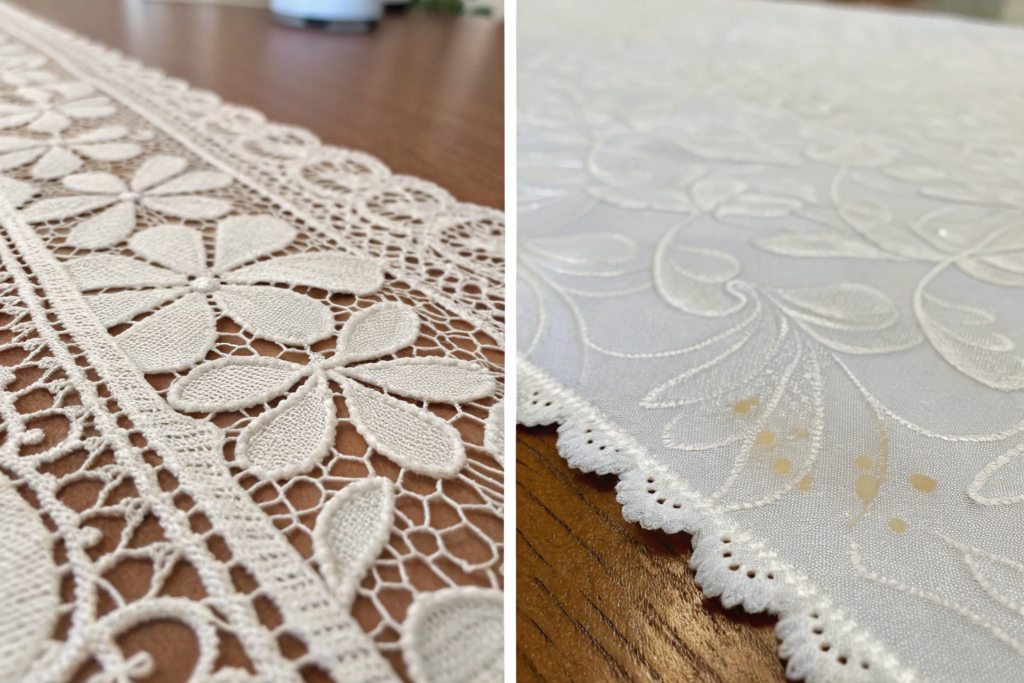
Yes, overwhelmingly so. The polished surface of a calendered or coated lace acts like a clear coat on a car. Abrasion from rough handling, rubbing against other surfaces on the cutting table, or even the wrong type of presser foot can leave permanent, visible scratches that catch the light and look like defects.
- Mitigation Strategy: Use tissue paper or plastic slip sheets between layers when spreading and cutting. Ensure sewing machine beds are smooth and clean. Use Teflon or roller presser feet. Train operators on fabric handling. For a major US brand’s eveningwear line, we included specific handling guidelines for glossy lace in the shipment documentation, which their factory said reduced cutting-floor damage by over 60%.
Does Matte Lace Show Soils and Stains More Easily?
Often, yes. A matte surface, particularly from cotton or raw silk, can be more absorbent. Oils from hands during handling, water spots, or minor stains can be more visible because they change the local light-absorption properties, creating a dark spot.
- Mitigation Strategy: Insist on clean-hand protocols in the sewing room. Use anti-static and lint-free mats on tables. For water-based stains, quick spot cleaning is essential. A good supplier will pre-wash or scour the lace if it’s a natural fiber to remove residual processing oils, which reduces the risk of later yellowing or stain attraction.
The choice often comes down to production environment. If you have a highly controlled, clean-room style factory, you can manage delicate gloss finishes. For a busier, multi-product facility, a more forgiving matte or semi-matte finish might be the pragmatically better choice. At Shanghai Fumao, we guide clients through this decision based on their manufacturer’s known capabilities.
Conclusion
Sourcing matte versus shiny lace is a deliberate science, not a hopeful gamble. It begins with choosing the foundational fiber—matte naturals or dull synthetics versus gleaming filaments. It’s then refined through precise manufacturing processes like sand-washing or calendering. The final, critical step is locking in that finish through unambiguous technical specifications and a supplier relationship built on transparency and measurable quality control.
Mastering this allows you to use finish as a powerful design tool. The right matte lace whispers sophistication and texture; the perfect shiny lace shouts glamour and light. By taking control of the sourcing specifics, you ensure the fabric that arrives in your factory faithfully executes the vision that started in your mind.
Ready to source lace with the exact finish your collection demands, backed by technical specs and consistent bulk quality? Let’s talk. At Shanghai Fumao, we demystify the process. Our team, based in the heart of Keqiao’s textile ecosystem, provides not just lace, but the expertise on how it’s made and how it will perform. For precise samples and technical data sheets on our matte and shiny lace ranges, contact our Business Director, Elaine: elaine@fumaoclothing.com. We’ll help you find the perfect light.