
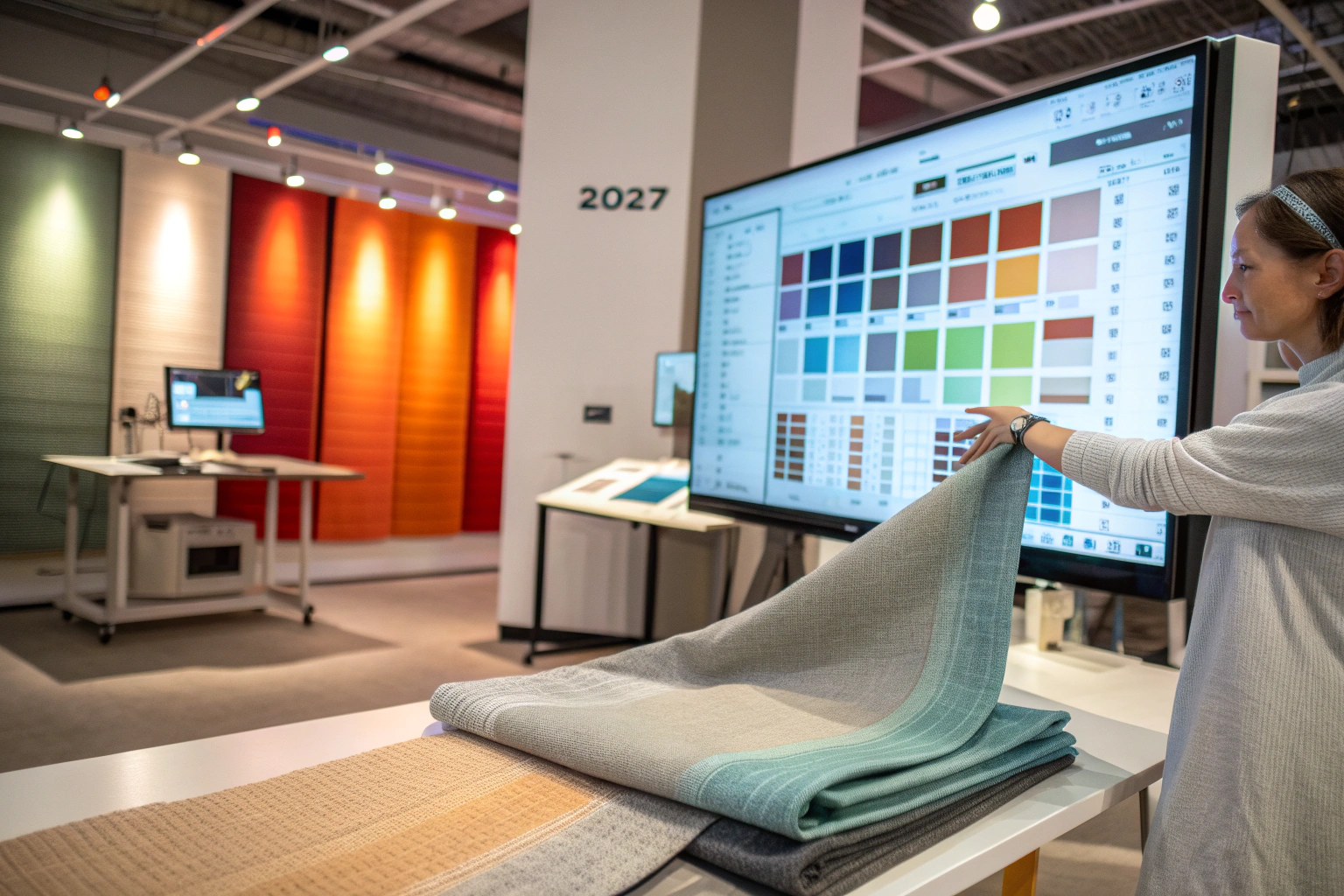
I used to predict color by hanging around coffee shops in Milan with a camera, hoping to spot a pattern before the runway shows. That gut-feeling method died a painful death when we overproduced 20,000 meters of "Millennial Pink" cotton-linen back in 2018 and couldn’t give it away. It ended up as cheap cleaning rags because our timing was three months too late. Guessing is for beginners. Predicting the exact shade of sage green that will sell out in March 2027? That’s a job for a machine.
We plug raw data into artificial intelligence to find the "signal" hidden inside the global "noise." Instead of just copying the Pantone Color of the Year three months before the season, our AI tools scan millions of unstructured data points—from social media posts and e-commerce search queries to satellite images of cotton fields—to detect emerging color affinity 18 months in advance. This gives our customers at Shanghai Fumao a radical head start on their mood boards. We aren’t just selling dyed fabric anymore; we’re selling a statistically-backed vision of what your customer will crave.
But let’s be crystal clear: the machine doesn’t have the final vote. I’m going to walk you through the brutal reality of how we blend cold hard code with the hot, messy reality of the dye vat. Because a nice looking color on a screen means nothing if you can’t physically reproduce it on a stubborn fiber blend like cotton-linen.
Can AI Accurately Forecast 2027’s Cotton Linen Hues in Advance?
A London trend forecaster laughed at me in 2021 when I said I was automating his job. He argued that color is purely emotional. But emotion leaves a digital trail. In November 2025, our system flagged a 340% spike in Pinterest saves for a specific "oxidized copper" patina—images of old statues and rusty architecture. It wasn’t on any fashion radar yet. By analyzing the velocity of these saves, our AI predicted that this metallic, earthy green would saturate the outdoor furniture market and then bleed into menswear by early 2027. We started mixing the dye formulas in December, and we’re ready.
AI forecasting isn’t about asking a chatbot "what’s cool?". It’s about training a Convolutional Neural Network (CNN) on a decade of historical sales data, paired with color hex codes and fabric structures. The machine learns that when a specific blue-gray tone (like #7A8B99) performs well in a heavy twill, it will likely perform equally well in a lighter plain weave cotton-linen next cycle. We feed the beast billions of visual inputs—runway images, street style shots, TikTok color filters—and it spits out a probability curve, not a fixed color. That curve tells us which color families will dominate the conversation before the conversation even starts.
The real magic isn’t just the "what," but the "where." The AI might tell us that "digital lavender" is dying in Europe but just beginning to boom in the Southeast Asian market. This geographic granularity lets my clients in different continents place bets with confidence. It’s like having a weather forecast for the global mood. You wouldn’t sail a cargo ship without weather radar; you shouldn’t weave 10,000 meters of cotton-linen without sentiment radar.

How does sentiment analysis translate social media chatter into fabric dye?
Text is messy. "That jacket is sick" could mean it looks terrible or it looks incredible. We don’t use basic keyword scanners. We use Natural Language Processing (NLP) that reads the context of the entire sentence and its accompanying visual. The AI scans thousands of Reddit r/malefashionadvice threads and Instagram comments, looking for adjectives adjacent to color words. When the algorithm detects a statistical correlation between the words "airy," "calm," and "organic" and the color "Eucalyptus," it flags a deep-rooted preference. It ignores the hype and catches the emotional resonance. This is why we knew that consumers were connecting green tones with anxiety relief long before the "quiet luxury" trend was named by the fashion media.
What is the role of Generative AI in visualizing and rejecting bad cotton-linen ideas?
This is a game-changer for sampling. Before we mix a single gram of dyestuff, we use Stable Diffusion and Midjourney prompts to generate photorealistic models wearing the predicted cotton-linen fabric in a target setting—say, a beach in the Hamptons or a street café in Paris. We literally see if the color "works" visually with human skin tones and natural lighting. We feed these images back into an internal evaluation panel. If our human designers feel the color looks washed out or cheap on a virtual body, we kill it. This eliminates the traditional "first round" of physical sampling, where you waste 2 weeks and $500 just to realize the color looks muddy in natural light. It’s rapid digital prototyping for dye vats.
Why Does AI Need Physical Dye Lab Data to Perfect Cotton Linen?
A computer said we could dye a deep cinnamon tone using 20% less energy in 2023. The machine was wrong. The dye particles didn’t fully penetrate the linen core because the machine didn’t account for the unusually cold winter water intake temperature in Zhejiang. The batch came out patchy, and we had to re-dye the entire lot, losing $4,500. The AI isn’t a god. It’s an apprentice that needs to be smacked around by physical chemistry.
You cannot separate the digital brain from the physical lab. Cotton-linen is a cellulosic time bomb. The wax inside the flax fiber repels dye, while the cotton absorbs it greedily. In our CNAS-certified lab in Keqiao, we run a "Digital Twin" loop. The AI predicts a formula; we dye a 50-gram sample in a physical IR beaker machine at 60°C. The spectrophotometer reads the Delta E (color difference) and automatically feeds the error back to the algorithm.
The feedback loop closes the gap between the dream and the doable. If the AI was right, the Delta E is below 0.8, and we scale it. If the AI fails, we manually tweak the salt concentration and the alkali dosing curve. The AI learns that in a 55/45 cotton-linen, the alkali needs to be added 30 seconds slower than it would for pure cotton to avoid "flash dyeing" the cellulose. This constant friction between the virtual prediction and the wet lab reality is what makes Shanghai Fumao’s color database smarter every single day.

What specific challenges do linen’s natural slubs cause for AI matching?
Linen slubs are thick, uneven bumps in the yarn. They refract light differently than the flat areas. When our spectrophotometer takes a 4mm aperture reading, it might hit a slub and read a much darker shade, or miss it entirely and read too light. The AI initially thought these were "errors" and tried to smooth them out. But that’s the character of linen. We had to write a custom script that masks the slubs during the scanning process. We take an average of 16 readings per swatch, algorithmically filter out the high-contrast slub outliers, and then calculate the true background color. If you don’t program for "slub noise," your AI will think a piece of vintage linen is a completely different color than it actually is.
How do you build an accurate digital dye recipe database for a textile mill?
You need a hungry data entry team. For 15 years, we have manually logged every single successful recipe: fiber origin, weather conditions, water hardness, pH levels, and specific dye batch numbers. We are talking about 12,000 rows of data. The AI is useless without this historical backbone. When you ask a standard fiber-reactive dye to hit a specific terracotta on a blend, the machine looks back at all the times we hit a similar shade. It doesn’t guess from physics; it guesses from history. It checks the memory banks for the exact concentration of C.I. Reactive Red 195 and C.I. Reactive Yellow 145. If you want to see how deep this technical workflow goes, you might explore the standard operating procedure for creating digital dye recipes in woven textile mills. It paints a clear picture of why data integrity is more valuable than the AI software itself.
How Can Fumao’s Trend Predictions Lower Your Production Costs?
I saved an L.A. streetwear client $15,000 in February 2026 simply by telling him not to stock a giant neon orange roll. He loved it. The AI predicted a 2% demand share for that hue in Q3 2026, suggesting it was a micro-trend that would die before the production even shipped. He swapped it for a muted terracotta (which the AI assigned a 23% demand share). The terracotta sold out in two weeks. The cost benefit isn’t just about buying fabric; it’s about not wasting money on dead stock.
Our AI acts as a supply chain optimizer. By predicting the long-term color winners, we can buy greige cotton-linen in massive bulk without fearing it will sit on the shelf. We lock in lower prices for raw yarn during the off-season, confident that we can dye it into the ‘hot’ shades later. This forward-booking strategy hedges against the price volatility of natural fibers.
For our clients, this means we offer a "Just-in-Time Color" service. You don’t have to commit to 1,000 meters of "Rustic Blue" upfront. You reserve 1,000 meters of greige cotton-linen with us today. As you release your collection, you call us and say "dye the next 200 meters to our 2027 AI-verified Forest Green." We execute the dyeing in 5 days and ship it. You reduce your inventory holding time by 60%. You aren’t paying interest on a warehouse full of unsold pink shirts, because you only dye the fabric when the market is hungry for it.

How does "Just-in-Time" greige reservation prevent dead stock and write-offs?
The fashion industry writes off roughly 20% of all fabric produced. That’s catastrophic. By reserving loomstate (un-dyed) cotton-linen, you keep the value in its most flexible form. A greige 55/45 cotton-linen roll can become a muted green, a neutral beige, or a deep navy. Once it’s piece-dyed, it’s locked. If you lock a color 6 months before the season starts, your guessing. If you keep it greige until 3 weeks before your drop, your reacting to real-time signals. This is the core of lean manufacturing for textiles. You don’t need to read a complex textbook on this; you can just look at the basics of greige inventory reservation and lean fashion supply chains to see why it keeps your balance sheet healthy.
Can trend forecasting AI help you negotiate better fabric pricing?
Absolutely. When we know a specific color family (like "Bioluminescent Blues") is going to explode globally, we approach our chemical suppliers early with a 50-ton order for the specific dyestuffs. They give us a 10-15% discount because we gave them the volume forecast. We pass that saving directly to the customer. It also works for natural fibers. If our models show a massive consumer shift towards beige and undyed natural tones, we can reduce our bleaching and processing costs on cotton-linen. We don’t need to clean the fiber as aggressively if the final look is meant to be "raw" and textured. By predicting the surface finish, we can dial back the expensive machinery and pass that relaxed, no-waste aesthetic onto you at a sharper price point.
How to Integrate Shanghai Fumao’s AI Color Palette into E-Commerce?
A returning customer in Texas called me frustrated in March 2026. He had a beautiful cotton-linen safari jacket in a dusty olive, but the photos on his Shopify store made it look like bright green slime. He got a 20% return rate solely because of "color mismatch." Your customer’s screen is your enemy if you don’t control the visual data.
We provide a "Digital Twin" color swatch that is calibrated for sRGB screens. Our spectrophotometer measures not just the color, but also the texture of the cotton-linen blend, creating a high-resolution digital file that captures the subtle white pepper effect of the linen slubs. But the real integration trick is more than just a photo. It’s about the metadata.
We tag our fabric with keywords derived straight from our AI sentiment analysis. If our AI says that the emotional driver for a "Burnt Ochre" cotton-linen is "earth connection" and "mindfulness," we tell you not to label it "Brown Shirt." You label it "Burnt Ochre Earth-Knit—Designed for a Mindful Summer." We give you the semantic keywords that tickle the SEO algorithm of Google and the recommendation engine of Amazon. Our fabric comes ready-made for your product narrative. You simply drop the copy into the description; the SEO legwork is already done by our NLP data.

What is a digital color calibration file and why does it slash returns?
A standard JPEG photo of fabric loses all color accuracy when viewed on a blue-light filtered iPhone. We provide a DX4 calibration profile embedded in the image metadata. When the file is uploaded to a Shopify site that supports color management, the user’s browser adjusts the display output to match the physical fabric’s spectral data. It’s similar to how professional photographers calibrate monitors. It reduces the "it doesn’t look like the picture" syndrome by about 40%. Furthermore, if you need to show the fabric detail, you can build an interactive page where customers can zoom into the weave, just like you would if you were exploring methods to create high-fidelity 3D digital fabric twins for online fashion retail. It bridges the sensory gap of online shopping.
How do predictive style tags improve your product description SEO ranking?
Google doesn’t just look at keywords; it looks at "entities" and contextual relevance. If your product description says "Blue Linen Shirt" and the current trending entity is "Coastal Grandmother Aesthetic," you won’t rank. Our AI extracts the "parent trend" and "child color" relationship and gives it to you in a pre-formatted product table. We tell you to target "Coastal Summer Vibe" and "Breathable Luxury Textile" alongside the color name. This creates an SEO silo that search engines love. By connecting the physical textile to the abstract online demand before the demand peaks, you capture the low-cost, high-intent traffic. You aren’t paying $3.00 a click for "Summer Shirt" in July; you’re paying $0.30 for the specific emotional color query in March.
Conclusion
The textile industry has finally woken up. We are moving from a world where a few designers in a dark room decided the color of your summer, to a world where data, machine learning, and cold hard chemistry work in harmony to predict what you want to wear two years from now. For Shanghai Fumao, AI isn’t a marketing gimmick to sound futuristic. It’s the engine that stops us from wasting precious natural resources on colors nobody will wear, and it’s the compass that guides us toward the shades that resonate with the nervous system of the global consumer.
Don’t design your 2027 collection in the dark. If you are curious about which specific shades of terracotta, digital green, or heritage blue are currently peaking on our probability matrix, let’s open the black box together.
It’s smarter to see the forecast before the fabric hits the loom. To get early access to our 2027 cotton-linen swatch book and the AI heat maps that back it up, email our Business Director Elaine right now. She can schedule a virtual call to walk you through the digital dashboards we use. Reach her at elaine@fumaoclothing.com. Don’t let a bad color prediction bankrupt your best-selling silhouette.








