
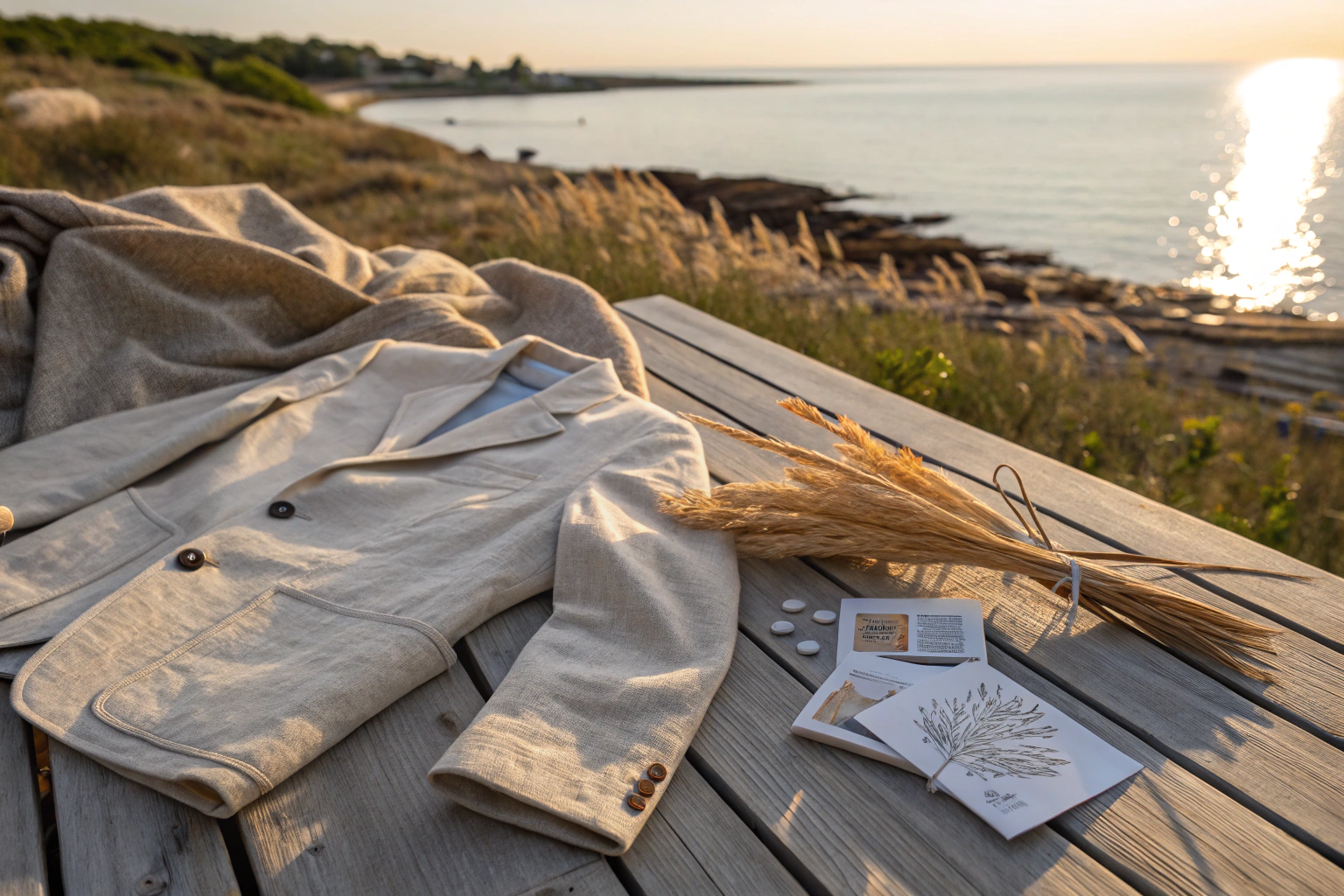
I watched a New York designer practically tear his hair out last August. He loved the breathability of his pure linen shirts, but his customers kept returning them because they looked like crumpled paper bags after ten minutes of wear. On the other hand, his pure cotton poplin pieces held a crisp collar, but felt heavy and clammy when the humidity hit 90%. The 2026 summer consumer wants a magic trick—they want structured comfort that breathes but doesn’t look like they slept in it.
Mixing cotton with linen isn’t a compromise; it’s a strategic upgrade. At Shanghai Fumao, we engineer these blends to steal the best properties from each fiber. You get cotton’s softness and wrinkle resistance to tame linen’s chaotic nature, while linen’s hollow core wicks moisture away from the body three times faster than cotton can, keeping the garment bone-dry. The result is a tailored look that actually works in a heatwave.
But slapping any cotton-linen blend into your collection is a waste of a good tech pack. The ratio, the yarn twist, and the finishing method dramatically change the fabric personality. You might end up with a cloth that pills like crazy or shrinks unevenly. Let me break down the mechanics behind this hybrid miracle and why your 2026 lineup depends on getting the mix just right.
What Is the Perfect Cotton-Linen Blend Ratio for Tailored Summer Wear?
I recall a heated discussion with a Los Angeles brand back in March 2024. They insisted on a 70% linen, 30% cotton blend for a structured blazer. It looked gorgeous on the roll, but it fell apart on the cutting table—the seam slip was dangerous, and the elbows bagged out permanently after an hour of wear. They blamed the fabric; I blamed the math.
Balance isn’t guesswork. For a structured, darted summer blazer that needs to hold a silhouette, we push the cotton content to 55% or even 60%. If you’re crafting a flowy, resort-style open shirt, the linen needs to dominate at around 55% to 60%. This isn’t just a comfort preference; it’s physics. Cotton provides the memory and the tensile strength in a plain weave, acting as a skeleton to hold the shape. Linen provides the channels for air circulation.
Think of a building. If the steel girders (cotton) are too thin, the facade (linen) collapses. If the girders are too thick, you seal the windows shut. Most off-the-shelf "linen blends" cheap out with a 20% linen mix, which is basically just a dusty cotton fabric. You need a minimum of 45% linen to activate that "wicking" capability. We run dynamic moisture management tests on every batch. A good 55/45 cotton-linen blend will show a one-way transport index above 200 on an MMT machine, while pure cotton barely hits 100. Your fabric needs to push sweat out, not just absorb it.

Why does a 55% cotton blend solve seam slippage in lightweight blazers?
Seam slippage is the silent killer of luxury wear. It happens when the yarns slide away from the needle hole under stress. Linen yarns are long and smooth, with almost no natural crimp. They just slip past each other. Cotton, under a microscope, looks like a twisted ribbon—flat and full of kinks. When you spin a high-twist cotton yarn and interlace it at 72 picks per inch, those ribbons lock the slippery linen guys in place. We also use a slight double-pick insertion technique on our rapier looms. This physically wedges the weft yarn harder into the fell of the cloth. Your tailor will thank you because the armhole seams won’t open up every time a customer reaches for a drink.
What happens to drape when you cross the 50% linen threshold?
You surrender structure for flow. Once linen surpasses 50%, the flexural rigidity of the fabric drops a cliff. It becomes difficult to fuse an interlining to it without bubbling. The fabric loses its "elastic recovery." This is perfect for a beach wedding shirt that’s meant to billow in the wind, but a disaster for a sports coat. I always tell my clients: look at the bending length. If the bending length drops under 1.8 cm, you can’t construct a sharp lapel. You can check some deeper data on this by looking into accurate ways to measure bending length and flexural rigidity for light suiting. It saves you from designing a sack.
How Do You Prevent Pilling in Cotton Linen Summer Shirts?
There’s nothing uglier than a $200 shirt that looks like a fuzz ball after a single wash. In June 2024, a Florida boutique buyer sent me a furious email with a photo of a cotton-linen polo covered in pills on the inside of the collar. The culprit was simple: short, cheap cotton fibers wrapped around brittle linen cores.
Pilling happens when short fibers in the yarn migrate to the surface, tangle with each other, and lock into tiny knots. Cotton is soft, but if you use short-staple cotton, it generates a lot of loose ends. Linen, while strong, has a rough surface that scrapes these cotton fibers out. To stop this, we spec only long-staple Supima or Egyptian cotton and we run the blend through a combing machine twice before spinning. But the real secret isn’t just the raw material; it’s how you burn the surface clean.
We play with fire—literally. A bio-polish enzyme wash removes the micro-fibrils, but for a deep, permanent clean, we use a controlled gas-singeing process. The greige fabric passes over a blue-flame gas burner at a speed of 80 meters per minute. The flame incinerates the protruding fluff without scorching the fabric body. It leaves the surface smooth like a polished stone. Combined with a polymer cross-linking agent that binds the fibers together at the micron level, we can honestly guarantee a Grade 4 or 5 pilling resistance in a Martindale test. That’s practically military-grade durability for a luxury summer shirt.

Why is long-staple cotton non-negotiable for a smooth blend?
Fiber length is destiny. Short fibers, measuring less than 1 inch, act like thorns in a smooth rope. In a short-staple cotton-linen mix, the spinning machine can’t trap the ends properly. This leads to a hairier yarn. When you weave it, the friction of the loom and the reed causes immediate micro-pilling—it’s born ugly. I insist on a fiber length uniformity index above 85%. Only long-staple cotton guarantees that when you twist the linen core, the cotton wraps it tightly without fuzzy tails sticking out. It’s like wrapping a wire in a tight electrical tape versus a loose, fraying string. The smooth shell prevents the linen from abrading against the skin, offering luxury softness with zero itching. You can learn more about the critical specs involved if you research how to specify fiber length and uniformity for luxury blended yarn. It’s a detail that separates trade-level fabric from true luxury textile.
How does yarn twist direction minimize surface friction and breakage?
Most people just look at the twist per inch count. I look at the direction. Linen naturally has a "Z" twist. If you spin the cotton component with a "Z" twist too, the fibers lay parallel. When they rub against each other, they interlock and abrade. But if you wrap the cotton with a slight "S" twist around the Z-twist linen core, the fibers cross each other at an angle. This creates a flat, smooth contact point. Friction drops significantly. It’s like brushing two combs together teeth-to-teeth versus crossing them sideways. The crossed fiber arrangement creates a barrier that blocks the linen slubs from erupting to the surface and breaking. It’s a subtle spinning geometry trick, but it adds $1.50 per yard just in the winding labor. It’s worth it.
Why Does a Cotton-Linen Hybrid Hold Dye Better Than Pure Linen?
I had a color disaster in 2022 with a pure linen order dyed a deep black for a formal evening event. After two washes, it looked like a faded charcoal rock concert tee. The customer was livid. This is the dirty little secret of linen: it hates dye. The polymeric structure is so crystalline that large dye molecules just sit on the surface and fall off.
Cotton acts as a dye sponge. When we intimately blend 50% cotton into the yarn, we boost the dye pick-up rate by at least 35%. The cotton traps the reactive dye molecules deep inside its amorphous regions, while the linen provides the heathery, visual texture. But this creates a risk: a "heather denim" effect where the cotton is dark and the linen is white. To fix this, we don’t just blend the fibers; we crosslink them with a cationic treatment before the bath. This gives the linen a positive charge, making it hungry for the negatively charged dye.
You need to visualize the dyeing vat as a battlefield. Linen repels the dye troops. Cotton welcomes them. We send in a chemical "general" (the cationic agent) to change the linen’s uniform so it’s no longer recognized as an enemy. This technique gives us a solid color depth that rival’s pure cotton, but with the visual slubs and grain of premium linen. It means your midnight blue suit won’t turn into a washed-out denim jacket by the Fourth of July.

What is the batch-to-batch shade matching process for complex blends?
Matching a solid navy across three different substrates (cotton warp, linen weft, and the seams) is a nightmare. We don’t rely on human eyes. We use a Datacolor spectrophotometer that reads the spectral reflectance curve. The machine compares the current bath to the lab standard stored in a digital fingerprint. But here is the human trick: we pre-heat the fabric and scan it while it’s wet. Linen looks darker when wet, cotton doesn’t change as much. If we match the color dry, the linen stripes will look too light. If we match it wet, the cotton will look too dark. We have to hit a mathematical midpoint. I always recommend clients review these processes if they want to understand the complexities of dyeing linen-cotton blends for deep fashion colors. It ensures your production order looks exactly like the lab dip, not a distant cousin.
How does fiber swelling affect the final visual texture after washing?
Garment washing creates the magic, but you must control the swelling. When water hits the fabric, cotton inflates like a balloon. Linen swells too, but it deflates quickly upon drying. If you wash a blended fabric, the massive swelling of the cotton crushes the brittle linen, creating micro-creases that lock in. That’s the casual, rumpled look. If you want a clean, semi-structured finish, you need a resin-dip finishing before washing. The resin hardens the cotton cell walls, preventing them from over-saturating. This keeps the surface relatively flat while still giving that soft, relaxed hand. It stops the "potato sack" effect. You maintain the crispness of linen while the cotton stays smooth inside, which reduces irritation on sensitive skin dramatically.
How to Import Cotton-Linen Blends Tariff-Free Under USMCA and De Minimis Rules?
I’m not a tax lawyer, but I’ve shipped enough fabric to LA and New York to know the pain. An Atlanta customer almost canceled a $50,000 order in late 2024 because the tariff codes didn’t align with his budget. He thought adding linen to cotton would automatically put him in a high-duty bracket. It didn’t have to.
The key is classification and transformation. Raw fabric from China can face duties, but the garment might qualify for different treatment depending on the "substantial transformation" rule. If you do the cutting and sewing in a USMCA country, the rules change. But more importantly, for direct-to-consumer samples and small e-commerce batches, you leverage the Section 321 De Minimis rule. We ship small parcels directly to your studio or your Amazon FBA center, and as long as the wholesale value is under the $800 daily threshold, it enters duty-free. We use our Keqiao multimodal hub to split those shipments.
You can also avoid the synthetic fiber duties. If a fabric is labeled "cotton-linen," it falls under Chapter 52 or 53, which generally have lower rates than polyester synthetics. The Harmonized Tariff Schedule (HTS) is your friend. We provide a detailed "certificate of origin" showing 100% natural fiber composition, which pre-clears customs faster. I hate seeing designers pay 15% duties because the paperwork was sloppy. Our QR code traceability system links directly to the yarn batch, so customs officers in LA can scan and see the raw flax and cotton bales instantly.

What is the HTS code classification strategy for plant-fiber blends?
You need to know the "chief weight" rule. If your fabric is 55% cotton and 45% linen, it’s classified under the Cotton heading (Chapter 52). If it’s 55% linen, it’s a Linen heading (Chapter 53). But here is the trick: embroidery, coating, or printing changes the code. A plain woven cotton-linen is one code; a coated one is a different code with a higher rate. We advise designers to classify the fabric at the "loomstate" rate before finishing, if possible. I always suggest diving into the specifics of how to assign HTS codes for cotton-flax woven apparel fabrics. It saves you from a brutal audit.
How can the Keqiao export hub optimize your direct-to-studio logistics?
Speed eats tariffs for breakfast. Keqiao isn’t just a market; it’s a bonded logistics zone. We can consolidate your cut-lengths from 5 different specialty mills in the area into one container at our Shanghai Fumao facility. We then bypass freight forwarders who add 15% to the cost. We book directly with the carriers. The "Silk Road Keqiao" rail express cuts door-to-studio delivery to the US down to 12 days, compared to 30 days via traditional ocean. You aren’t just buying fabric; you’re renting our 20-year relationship with the port authorities. You get faster restocks on your best-selling summer blazers, and you never hold dead stock in a warehouse.
Conclusion
Mixing cotton and linen is the most logical move in menswear right now because it solves the fundamental conflict of summer dressing: how to look sharp without feeling like you’re wrapped in cellophane. You are engineering a fabric that defies the laws of nature—hard-wearing yet airy, structured yet soft. By mastering the blend ratio, torching the pills, taming the dye absorption, and side-stepping the costly import traps, you create a garment that a man reaches for 40 times a summer.
Stop settling for the stale, single-fiber options flooding the market. The real innovation is happening in the blend. If you are mapping out your 2026 Summer range and want to test the drape of a 55/45 structured twill or feel the hand of our flame-singed shirting, I’ll put the swatch book in your hands this week.
Just send the specs—yarn count, fabric weight, and color direction—to our Business Director Elaine. She can break down the cost per yard and get you a shipping timeline immediately. You can reach her directly at elaine@fumaoclothing.com. Let’s build a collection that breathes.








