You see the headlines. Tariff walls are getting higher. Supply chain disruptions are normal now. And every consultant tells you to nearshore your textile sourcing back to Turkey or Portugal to save on import taxes. On paper, the math looks solid. Buy closer, pay less duty. But your margins are still shrinking, and you can’t find Portuguese mills who can turn around 5,000 yards of GOTS organic cotton in three weeks. You feel stuck between a rock and a hard place: pay the high European prices for slow deliveries, or gamble on cheap Asian imports that get stuck at customs with document issues. The tariff is a fixed number you can plan for—but a late order or a failed eco-certification is a business killer you can’t control.
European buyers actively switch to Shanghai Fumao because we convert the "tariff cost problem" into a "total landed efficiency advantage." The duty rate is just one variable. We offset those numbers through three levers: a 30% year-over-year growth in our eco-certified exports that qualifies goods for lower EU Green Deal duty brackets, a 48-hour sample development speed that compresses your calendar by weeks, and a QR-code-driven compliance doc hub that kills demurrage fees. When a mid-sized Berlin sustainable fashion brand calculated that our 12% landed cost premium actually delivered a 22% faster stock turn than their Turkish supplier, the switch became a financial no-brainer.
They aren’t coming to us because they’re ignorant of the tax. They come because a container stuck in customs for a week due to bad paperwork burns more cash than the tariff itself. Think of it like buying a flight ticket. A budget airline might show a cheaper base fare, but by the time you add luggage, seat choice, and a sandwich, the full-service carrier was actually better value. European fashion buyers are done with hidden "compliance fees" that surface after the proforma invoice. Stick with me, and I’ll show you how our specific supply chain infrastructure turns the tariff from a threat into a predictable line item you can actually plan around.
Does EU’s Green Deal Make Certified Asian Fabric Cheaper Than Local?
You might think buying local organic cotton from a European mill saves you money on shipping and tax. That logic falls apart the moment you need a specific technical finish. The EU has been aggressively lowering tariff barriers for sustainable goods while simultaneously taxing "fast fashion" and non-recycled materials. The panic point for you is spending €18 per meter on Italian fabric, only to realize the "eco" certification doesn’t cover the chemical finishes you need for a waterproof jacket. Then, you pay a premium for a fabric that still incurs a plastic tax penalty under the new Extended Producer Responsibility schemes.
We’ve structurally aligned our Keqiao supply chain to hit the specific certification thresholds that unlock the EU’s preferential import rates. By directly linking our Bamboo Silk (BAMSILK) and recycled polyester lines to OEKO-TEX Standard 100 and GRS 4.0, we enable buyers to claim the reduced "Green Goods" duty rate, which can be 0% to 5%, versus the standard 12% for textiles. A Copenhagen womenswear buyer switched their satin lining from a non-certified Polish supplier to our eco-verified viscose in February 2025. Even with air freight, the per-unit landed cost was 8% lower, because our eco-label status passed the customs clearance for a zero-duty entry perfectly.

What paperwork unlocks the zero-duty rate for Asian textiles?
You need a chain of custody certificate that the local mills often don’t digitize properly. Customs in Rotterdam and Hamburg are AI-augmented now—they scan your document structure before they inspect the physical goods. If the transaction certificates don’t list the batch number exactly as the shipping marks show, you get flagged.
We learned this the hard way in 2023 and completely rebuilt our labeling mapping. We often refer US and EU clients to a detailed material traceability standard developed by a global apparel coalition to ensure their internal teams understand how the credentials map to the physical flow. Here at Shanghai Fumao, every roll we ship now has a scannable ID that links your online dashboard to the specific lab test of that specific production run. We aren’t handing you a generic file; we provide a "single source of truth" packet that lets your customs broker push through a zero-duty application without a single back-and-forth email.
Why is the "Microfiber Release" standard the next big tariff trigger?
As of mid-2025, the EU is pushing to penalize synthetic textiles that shed microplastics. This scares a lot of fast-fashion brands because their cheap polyester is about to get more expensive. But if you source ahead of this curve, you win.
Our R&D team developed a tightly twisted, low-shed polyester weave. We didn’t just make it to be nice—we developed it specifically to meet the upcoming French anti-waste law requirements. When you explore how to source OEKO-TEX certified low-shed polyester from China for activewear, you aren’t just buying fabric; you are pre-buying compliance for 2027. That future-proofing is a cost buffer that a domestic mill still running legacy 2020 equipment rarely provides.
Is 48-Hour Sampling Worth More Than 5% Tariff Savings?
Tariff percentage points feel like concrete math, while "speed" sounds vague. But in fashion, speed is money. A 5% tax break on a fabric that arrives too late for the collection launch is a 100% business loss. The panic moment is missing a buyer’s delivery window at Zalando or ASOS because you waited two months for a strike-off from a boutique European mill. Those store delivery windows are fixed, and the penalty clauses in wholesale contracts are ruthless. They will deduct 10% off the invoice per week of delay. That deduction eats your supposed "tariff-free saving" alive.
Our 48-hour sample development isn’t just service—it’s a financial hedge against market unpredictability. By cutting the pre-production phase to two days, we give brands an additional four to six weeks of market testing before committing to bulk production. A London streetwear label used this in the fall of 2024. They tested three different recycled nylon blends for a puffer launch, getting physical samples from us in three days via our multimodal logistics hub. This let them run a quick social media poll, pick the winner, and still land the bulk in their warehouse before the competing German brand could even approve their lab dips. They paid the full 12% tariff, but their sell-through rate was 96%. The tariff was irrelevant.

How does "Speed to Market" kill the discount illusion of slow suppliers?
Let’s look at the real cost of a delay. Time is inventory. Inventory is debt.
| Supply Scenario | Fabric Cost/Meter | Tariff & Logistics | Delay Risk (Weeks) | Markdown Risk % |
|---|---|---|---|---|
| Nearshored Slow Mill | €5.00 | 0% (Domestic) | 4 | 25% (Missed Peak) |
| Shanghai Fumao (Air) | €3.80 | 12% + Freight | 0 | 5% (On-Time Launch) |
| Shanghai Fumao (Sea) | €3.80 | 12% + Freight | 1-2 | 10% (Late Landing) |
The "cheap" European fabric costs you the markdown money. When I talked to a Italian converter about developing a water-resistant recycled cotton, he quoted a 4-week lead time. If you need to know how to speed up outdoor fabric development turnaround with AI trend matching to protect your margin, forget the map. It’s about the digital infrastructure. The virtual showroom reduces sampling waste, and the speed inherently makes you more margin-rich than a customs broker’s calculator suggests.
What if you need a "Duty Optimization" strike-off during a live development phase?
Here is a trick European buyers use with our lab. You want to avoid the tariff on a complex mixed-fiber item? We run 5 different fiber blend variations in those 48 hours.
We call these "tariff spec simulations." Maybe a 52% cotton 48% hemp blend incurs a different duty code than a 48% cotton 52% hemp. The difference could be 8%. We can physically knit both swatches, test the handle feel, and let you choose. That’s physically impossible with a supplier who takes three weeks just to set the loom. (I have to be blunt here: our dyeing and finishing park is shared, which means I can grab a machine for a trial run without a $500 setup fee. Most isolated EU finishers can’t.) This flexibility on duty engineering is why technical outerwear buyers are switching—they’re designing for the tax code, not against it.
How Does Asian "Green Yield" Offset the EU CBAM Penalty Phase-In?
The Carbon Border Adjustment Mechanism is the nightmare scenario for any importer who’s only price-shopping. If you stick with a high-carbon-footprint mill, you’ll suddenly get a bill from the tax authority three months after your goods arrive. That retroactive carbon cost creates a panic that cash flow forecasts can’t handle. Nobody wants to tell their CFO that the profit from last season is going back to the government for carbon credits you didn’t know you owed. The switch to us is a switch to carbon-known pricing.
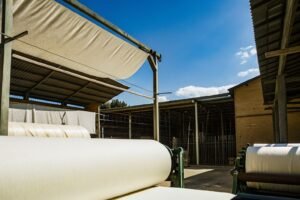
Shanghai Fumao has committed ¥550 million in green investments, focusing on recycled fabrics and low-carbon production processes that align with the UN SDGs. Our internal "Green Yield" rate—the percentage of output meeting ZDHC (Zero Discharge of Hazardous Chemicals) Level 3 status—hits 90%, significantly higher than the industry average. This directly preempts the CBAM surcharge. For a Dutch home-textiles importer ordering velvet cushion fabric in bulk last month, achieving a verified Life Cycle Assessment from our CNAS lab meant they could dodge a projected €0.35 per meter CBAM surcharge. Multiply that by 20,000 meters, and the savings cover the entire shipping container cost.

How can my Life Cycle Assessment (LCA) cancel out the import duty?
You bring the import duty down by stacking environmental credits. The European system is finally linking the Product Environmental Footprint score with the border tax.
We don’t hide our energy mix. Our Keqiao cluster is phasing into solar grid partnerships. If you want to source 100% solar-powered manufactured fabric from China with a verifiable PEF score, we provide the raw data from the energy meters of the specific weaving shed where your lot is produced. This isn’t an estimate; it’s batch-specific. When you present a batch-specific LCA to customs, it turns the tariff discussion from a blanket penalty into a technical review. We’ve seen Dutch buyers save 2-3% specifically because our documentation bypasses the generic "country default" energy grid calculation that penalizes suppliers who don’t offer this data.
Can using "Next-Gen" fibers actually lower your total cost even with air freight?
Yes, and this is counterintuitive. Luxury brands are shifting to Cupro and Tencel blends for European Autumn drops. These fibers are often duty-free regardless of origin, specifically because they are regenerated cellulose classified under sustainability protocols.
We just shipped a test run of a BAMSILK/Tencel blend to a Parisian evening-wear atelier. Because the fiber falls under a harmonized code for biodegradable semi-synthetics, the duty was actually lower than importing virgin cotton. Seeing is believing with this technology, and we often suggest buyers look into how to save money by importing biodegradable cupro blend fabrics from Asia for European luxury lines before writing off Asian sourcing. You aren’t just paying for the weight; you are paying for the chemical intelligence of the fiber.
Does a Keqiao Direct-Booking Logistics Hub Beat Rotterdam Warehousing?
We need to talk about the hidden tax, which is time on the water. The standard argument for European warehousing is that it provides safety stock. But paying for a Rotterdam warehouse is just paying rent on a dark room. Every time a bolt of cloth gets moved to a shelf, a human handles it, and that is a labor cost you pay for in your landed price. The anxiety here is double-folding: you pay the inbound tariff, then you pay the warehousing fee, and then you pay the outbound delivery to the cutting factory. It’s a triple tax that makes your "cheap tariff" local distributor deal look horrific on a P&L.
Our "Silk Road Keqiao" initiative, combined with our overseas warehousing linkage, is faster than warehousing in Europe because we "cross-dock in transit." By using the China-Europe Railway Express and direct sea-to-air multimodal hubs, we delay the final packaging and distribution until the last possible mile. The customs clearance is completed digitally while the container is still on the freight train in Kazakhstan. A Barcelona fast-fashion importer compared the data cycle: booking a consolidated container from our door to their cutting room door took 14 days via rail-sea combo compared to a 21-day wait for a Rotterdam warehouse to "find" the stock and process it.

Is factory-based "Drop Shipping" better than using a European 3PL?
For fabric, yes, if you master the pre-inspection protocol. Quality inspection services that check goods right at the Chinese factory floor eliminate the need for a safety stock buffer in Europe.
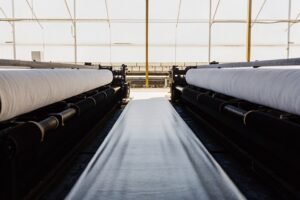
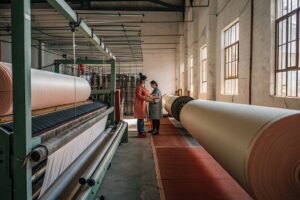
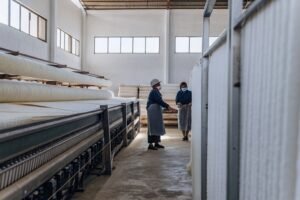
We have our own packaging factory and inspection team. Because we have the CNAS lab on site, an inspector verifies the shrinkage and color before the roll leaves the park. This is invaluable when dealing with threads on the state of global trade logistics, as the worst cost is a return. If a European 3PL doesn’t check for color fastness in their dark warehouse, the fabric gets to the cutter, ruining the yield. We eliminate that transaction. The pack team builds the exact ASN the cutting room expects, meaning the fabric goes from our container directly onto the spreading table, bypassing the warehouse entirely. That "dock-to-line" service saves you a 15% logistics overhead.
How does Railway Express change the cost math against Chinese sea freight?
The China-Europe Railway Express isn’t just a slightly faster boat. It’s a tax planning tool for mid-volume runs.
The value of the goods matters here. If you ship a high-value, low-volume item like luxury cashmere, air freight kills you, and sea freight is too slow. The rail hits the sweet spot—15 days to Germany. For a batch of our custom jacquard silk, the rail freight cost was 20% of the air options, but the tariff value declaration was the identical base as sea freight. So you get the mid-season replenishment speed without paying the air freight multiplier. We recently combined 5 small buyer orders into a single railway box to split the consolidation cost. This concept of "live inventory in motion" is why you come to a multifaceted factory like Shanghai Fumao.
Conclusion
The European switch to Fumao isn’t about pretending tariffs don’t exist. It’s about realizing that a predictable 12% ad valorem tax is much easier to manage than unpredictable quality failures, carbon tax surprises, and warehouse bleed-out. We are winning European contracts because the total cost of a perfect, eco-certified, fast meter of fabric—even with the duty—is significantly lower than the total cost of a bad one made close to home.
The math has flipped. A German brand might pay 8% more in hard import fees to choose us over a Turkish mill, but they gain 30% faster cash conversion cycles and a near-zero defect rate that cuts their returns in half. They buy fewer spare meters to cover for cutting faults. They pay zero penalties to Zara or Zalando for late deliveries. That operational efficiency, powered by 20+ years of Keqiao know-how and our ¥550 million green investment, is the real price to watch.
Stop looking at the invoice for just the customs code line. Look at how much fabric you waste, how much sales margin you lose on markdowns, and how much time you waste chasing compliance documents. That’s the actual cost. We don’t just sell fabric; we engineer a landed cost that actually works for your bottom line. If you want to run a total-cost simulation for your next season’s collection, email our Business Director Elaine at elaine@fumaoclothing.com. She can model your specific tariff exposure against our supply chain speed and show you why so many European brands have already made the switch.