
I used to dread the "status update" email. You know the one. It arrives at 2 a.m. your time, subject line "Checking in on order #4521," and the body text is a polite but clearly anxious request for any scrap of information about where the fabric actually is. For years, my response was the honest but unsatisfying "It’s on schedule." That phrase is a trust killer. It tells you nothing. It gives you zero ability to plan your cutting room staffing, your photoshoot dates, or your launch emails. I realized about five years ago that "on schedule" is effectively a non-answer, and a non-answer is indistinguishable from a lie when a buyer’s cash flow is on the line.
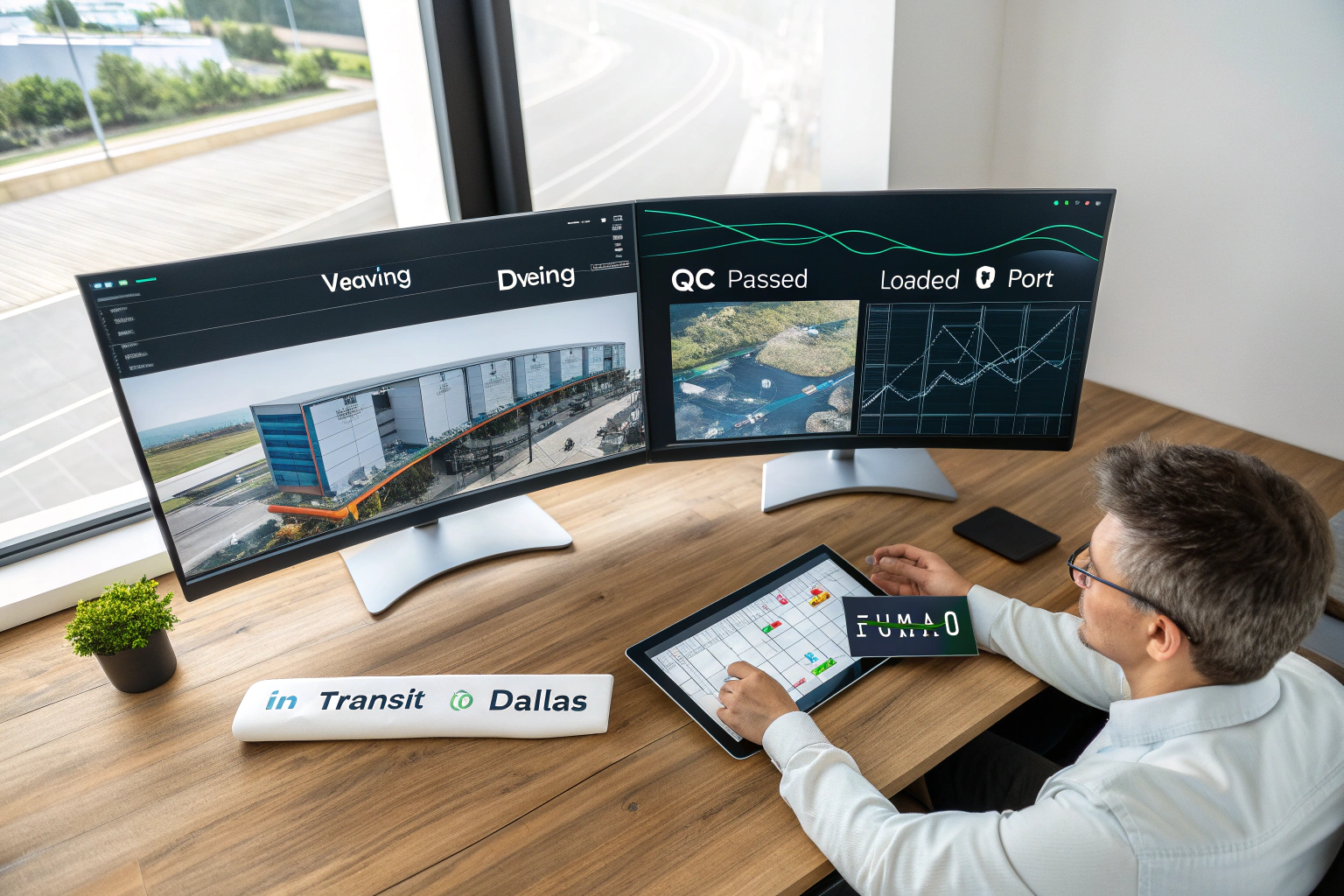
Today, the answer is a definitive yes. Shanghai Fumao provides real-time order tracking that covers every major milestone from greige fabric release to final delivery at your US door. This is not a third-party logistics tracker that updates only when a container hits a port scanner. It is an internally built visibility system anchored to our ERP production database and our QR-code roll-level identification protocol. You can see, at any hour of the day or night, whether your specific lot number is in weaving, in dyeing, in finishing, in inspection, or on the water. The system is accessible via a client-specific dashboard link we provide at order confirmation, and critical milestones trigger automatic email and optional WeChat notifications.
I built this system because I got tired of being the bottleneck in my own company. Clients called me to ask where their fabric was. I called the production manager. The production manager walked to the dyeing floor. Forty-five minutes later, I called the client back. That loop was a waste of three people’s time and a source of constant low-grade anxiety for the buyer. Automating visibility was the single highest-return operational investment I have ever made. Let me show you exactly how it works, what data you actually see, and what to do with the information once you have it.
How Does Fumao’s QR-Code Roll Tracking Work from Factory Floor to Container?
Real-time tracking at Shanghai Fumao is built on a physical foundation: every single roll of fabric that leaves a production machine receives a unique QR-code label. This label is not a generic product tag. It is a specific, database-generated identifier that links that exact roll to its production batch, its dye lot, its inspection report, and its shipping container. The code is printed on a durable, tear-resistant adhesive stock and applied immediately after the final inspection roll-up. It stays on the roll through packing, container loading, ocean transit, customs clearance, and final delivery. When you receive the roll in your warehouse, you can scan that same code and instantly access its full provenance.
The system works by integrating three data layers. The first layer is the production floor data capture. When a weaving machine finishes a batch, the machine operator scans a master barcode that closes the weaving work order in our ERP. When the greige fabric enters the dyeing queue, the batch is scanned again, updating its status to "Dyeing in Progress." The scanning is mandatory—our production tracking system will not allow a batch to advance to the next stage without a scan confirmation. This enforces data discipline across the entire factory floor. The second layer is the quality-control linkage. Every inspection report, every shrinkage test result, every spectrophotometer color-reading is tagged to the same lot number and accessible via the QR code. The third layer is logistics integration. When the forwarder’s truck picks up the container, the driver scans a master pallet code that links all the individual roll QR codes inside to a specific container number and vessel booking.
The result is a single thread of verifiable data running from loom to doorstep. You do not need to trust my word. You scan the code, and the machine tells you what it wove, when it wove it, and how it tested.

What specific data fields can a buyer access by scanning a production QR code?
When you scan one of our QR codes—either with your phone camera or by entering the code on our client portal—you access a structured data page. The fields include: Product SKU and internal lot number; roll length in yards and meters (measured by a calibrated electronic yardage counter, not estimated); roll weight to the nearest 0.1 kilogram; gross and net weight; fabric composition with exact blend percentages; dye lot number and color specification; shrinkage test results with the actual percentage and the test method used (AATCC 135); colorfastness grade for washing, light, and rubbing; inspection grade under AQL 2.5; the inspector’s name; and the date of final inspection. If the fabric is a certified sustainable quality, the certification number—such as the GRS scope certificate number—appears as a verified field.
This is not a marketing brochure converted into a digital format. It is operational data pulled directly from machines and lab instruments. For [how to access detailed roll-level production and test data using a supplier’s QR code tracking system for textile imports], the key is that the data exists independently of the supplier’s narrative. It is raw, timestamped, and traceable to a specific instrument calibration record.
How does QR tracking integrate with the shipment booking and container loading process?
The integration point is the packing list generation. In a traditional factory, a clerk manually types a packing list, and errors are common. In our system, the packing list is auto-generated from the scanned roll data. When the warehouse team scans rolls onto a pallet, the system compiles the pallet manifest. When the pallet is loaded into a container, the final scan links every roll to a specific container number.
That container number is then pushed to our freight forwarder’s system, and the ocean booking confirmation is ingested back into our ERP. The tracking dashboard you see includes the container number, the vessel name, the voyage number, the estimated departure date, and the actual departure date as confirmed by the terminal operator’s EDI message. For [integrating factory-floor QR code roll identification with ocean freight container loading visibility for import supply chains], this electronic handshake between production data and logistics data is what converts an opaque "shipped" status into a precise, verifiable event.
The QR code is the physical backbone of visibility. But the interface you actually use to watch your order move is the client dashboard, and it is designed to answer the questions you actually have, not the ones a software engineer thinks you should have.
What Does the Client Dashboard Show During Each Production Stage?
The dashboard we provide to wholesale clients is designed around a single question: "What should I do right now based on the status of my fabric?" Every status update carries an implied action for you, and we surface that action explicitly rather than forcing you to guess.
When your order is in the "Greige Weaving" stage, the dashboard shows the percentage completion of the weaving run—this updates every 12 hours as production scans progress. The implied action is "No action needed; development phase materials should be prepared." When the status flips to "Lab Dip Pending Approval," the dashboard pushes a notification and attaches a high-resolution digital image of the lab dip against the Pantone standard, along with the Delta E color difference value from our spectrophotometer. The implied action is "Approve or reject within 24 hours to maintain schedule." When the lot enters "Bulk Dyeing," the dashboard shows the scheduled exit date from the dyeing machine and flags whether the exit is "On Track," "At Risk," or "Delayed" based on real-time queue data. When "Final Inspection" begins, you see the AQL sampling plan, the number of rolls inspected, and the pass/fail status—usually within four hours of inspection completion.
This is fundamentally different from a standard track-and-trace system that merely reports location. Our dashboard interprets the meaning of the status for your business calendar. It answers not just "where is my stuff," but "am I still on track for my launch date, and if not, what is the magnitude of the delay and what are my options."

Can customers view pending quality inspection results before shipment approval?
Yes, and this is a feature I specifically insisted on building. In a standard supplier relationship, the buyer sees inspection results only after the container has already shipped—or worse, after it has arrived. By then, disputing a quality issue is a negotiation nightmare. The fabric is already in your country, you have already paid, and the leverage has shifted entirely to the supplier.
Our dashboard posts pre-shipment inspection data while the fabric is still physically sitting in our inspection room in Keqiao. You can see the number of inspected rolls, the number of defects found, the defect classification (critical, major, minor), and the final AQL pass/fail determination. If a lot fails, the shipment does not leave. We re-inspect, re-work, or replace before a single roll enters a container. This is a distinctive approach to [reviewing pre-shipment textile quality inspection results remotely via a factory dashboard before authorizing container dispatch], and it shifts the approval power to you at the point of maximum leverage—when the fabric is still on our floor and the cost of correction is on our books.
How does real-time tracking help with inventory planning at U.S. warehouses?
A US warehouse manager planning labor allocation and racking space needs to know not just the week of arrival, but the specific day. A container arriving on a Friday means weekend receiving surcharges. A container arriving on a Wednesday with 48 hours of notice means the team can schedule a smooth, daytime unload.
Our dashboard displays a truck-level Estimated Time of Arrival at the final delivery address, updated when the vessel docks, when the container clears customs, and when the drayage carrier dispatches the truck. This granularity allows a warehouse team to prepare rack space, print internal barcode labels, and schedule quality-control staff precisely. When tracking [using real-time container-level ETA updates from a textile supplier dashboard to optimize US warehouse receiving labor scheduling], the practical value is avoiding either idle workers waiting for a late container or a panicked scramble when an early container arrives unannounced. Predictability is the difference between a warehouse that runs like a Swiss watch and one that runs like a fire drill.
Visibility into production and logistics is valuable. But there is always a gap—the period when fabric is in a subcontractor’s hands, or on a vessel in the middle of the Pacific, or stuck in a customs examination. How we handle the communication during those dark windows is what separates genuine transparency from performative transparency.
Will Fumao Fabric Update You on Weather, Customs, or Holiday Delays?
A tracking dashboard is only as honest as the data that feeds it. And during a disruption—a typhoon closing the Ningbo port for 36 hours, a US customs exam holding a container at the Long Beach terminal, or a Chinese National Day holiday shutting down trucking services for a week—the raw data from the logistics chain can go dark. The GPS signal from the vessel still shows the ship sitting at anchor, but the dashboard gives no explanation. The buyer refreshes the screen, sees no movement, and assumes the worst. Anxiety spikes. Emails get written.
This is where supplier proactivity matters more than dashboard features. Shanghai Fumao operates a policy I call "Bad News First." The moment we receive confirmation of a disruption that affects an active shipment, a designated logistics coordinator sends a structured notification to the affected client. The notification includes: a description of the disruption, the specific impact on the delivery timeline (ideally a new ETA), the steps we are taking to mitigate the delay, and a commitment to update again within a defined window—usually 24 hours, or immediately if the situation resolves. This notification goes out before you have a chance to notice the dashboard silence and worry.
I learned the value of this policy during the 2021 Ever Given Suez Canal blockage. We had six containers on affected vessels. I personally emailed every single client within three hours of the news breaking, explained the situation, and provided their specific vessel names and positions. Most of them were not even aware of the blockage yet. Several replied not with anger, but with gratitude for the transparency. One told me, "You’re the only supplier who didn’t make me chase you for this information." That is a low bar, but in this industry, clearing it consistently builds an unbreakable loyalty.

What proactive alerts does Fumao send about port congestion or customs holds?
Our logistics team monitors three primary risk feeds daily: the vessel schedule reliability reports from Sea-Intelligence, the Port of Los Angeles and Port of Long Beach container dwell time dashboards, and the CBP ACE system status updates for any regulatory changes or processing delays. When a monitored port exceeds a dwell-time threshold—say, average container dwell at LA/LGB exceeds five days—we trigger a proactive alert to all clients with containers routing through that port.
If a specific container gets flagged for a CBP non-intrusive inspection (NII) or a physical exam, we know within hours because our continuous bond holder receives an electronic notification. We immediately notify the client with the exam type, the typical processing time range for that exam type, and a backup trucking schedule in case the clearance slips. This is a genuine commitment to [receiving proactive delay alerts for US port congestion and customs textile shipment holds from a Chinese fabric supplier], and it transforms a panic-inducing surprise into a managed scheduling adjustment.
How does Fumao handle communication gaps during the Chinese New Year shutdown?
Chinese New Year is a communication black hole for most Chinese suppliers. The factory closes for three to four weeks, emails go unanswered, WeChat messages accumulate unread, and Western buyers are left staring at a silent inbox, unsure if their post-holiday production restart is actually scheduled or merely hoped for.
We handle this by publishing a detailed "Holiday Operating Plan" to every active client no later than four weeks before the shutdown. The plan specifies: the exact dates our physical operations are closed, the dates our client-communication team is available (we maintain a skeleton crew on WeChat and email throughout the holiday for urgent matters), the exact date production restarts for each department, and a prioritized restart sequence showing which orders begin production on Day One and which begin on Day Three. Clients with critical post-holiday deadlines are moved to the front of the restart queue, and this prioritization is confirmed before the holiday begins. For [how a Chinese textile supplier can maintain transparent production communication during the extended multi-week Chinese New Year factory closure], this published plan eliminates the anxious guessing game and gives you a clear date on which to expect the first status update.
All of this talk about dashboards and alerts assumes a certain level of tech comfort. But what if you are not a digital native, or you simply prefer a human conversation over a screen interface?
Is the "Old-School" Phone or Email Follow-Up Still Available?
I love our tracking technology, but I refuse to let it become a wall between me and my clients. Technology should reduce the effort of getting answers, not replace the human relationship that makes sourcing from a factory different from ordering from a vending machine.
If you prefer to pick up the phone and call me directly, you can. My direct line number is shared with every wholesale account holder. If I am in a meeting or on the production floor, I call back within a few hours, usually within 90 minutes if it is during the US-China overlap window. If you prefer email, I maintain a personal inbox separate from the general company mailbox, and I read every message from active clients myself. The tracking dashboard is a tool that makes our conversations more efficient—you have already seen the data before you call, so our phone time is spent on decisions and problem-solving rather than status-reporting. But the tool never replaces the call. Some buyers want to hear a human voice confirm that yes, I personally watched their jacquard rolls being loaded and the container doors being sealed. I understand that need completely, and I honor it.
We also provide a structured weekly summary email for clients who want a scheduled touchpoint without an interface login. Every Friday afternoon China time, which is early Friday morning on the US East Coast, our client-services team sends a one-page PDF to each active wholesale account. The summary includes the current status of every open lot, the number of days ahead or behind the original schedule, a list of pending approvals needed from the client in the coming week, and any logistics updates or disruption alerts. This email is manual, composed by a human who reviews the dashboard data and adds context. It is [maintaining traditional phone and scheduled email communication channels alongside modern online tracking dashboards for fabric import supply relationships], and it reflects our belief that service is not automated—it is personal.

Can you call the factory boss directly if the tracking dashboard shows a problem?
Absolutely, and I encourage it. The dashboard tells you what is happening. A phone call tells you why it is happening and what we are doing about it. If your dashboard shows a lot status flipping from "On Track" to "At Risk," you are welcome—urged, even—to call me and say, "Elaine, what does ‘At Risk’ actually mean for Lot 5512, and should I start working on a Plan B?"
I answer that question truthfully, even when the truth is uncomfortable. "At Risk" might mean a shade correction is taking longer than expected, but we still expect to ship within 48 hours of the original date. Or it might mean the greige fabric had a flaw and we are re-weaving 800 yards, which pushes the schedule by four days. You cannot make an informed business decision without the "why," and the dashboard cannot give you a nuanced "why." Only a human who understands the machinery, the chemistry, and the client’s commercial context can do that. For [calling a Chinese textile factory boss directly to discuss production exceptions flagged in the online tracking portal], the conversation should reference the specific data you see on the dashboard—this grounds the call in observable fact and prevents the abstract, unproductive "how is everything going" exchange.
What weekly summary format helps multi-order wholesale buyers stay organized?
The PDF weekly summary we send is structured around a "Decision-Required" format. At the top is a one-sentence overall status: "All three active lots are on schedule with one lab-dip approval needed by Tuesday." Then a table with columns for Lot Number, Fabric Description, Current Stage, Days to Dispatch, and Status Indicator. A second table lists "Pending Your Approval" items with deadlines. A final section lists logistics milestones with vessel names and ETAs.
This format is designed so a buyer with ten active lots across four fabric types can scan the document in under 60 seconds and know exactly what requires their attention. The document is a PDF, not a web link, so it can be forwarded internally to a design team or a warehouse manager without granting dashboard access. When researching [what structured weekly production status report formats from Chinese textile suppliers help US wholesale buyers track multiple simultaneous fabric orders], a PDF decision-log format is generally the most practical for internal coordination.
Technology makes visibility possible. Human communication makes visibility useful. The goal is not to build a cockpit that looks impressive in a software demo. The goal is to eliminate the uncertainty that forces you to pad your calendar with buffer weeks you cannot afford.
Conclusion
Shanghai Fumao provides real-time order tracking for wholesale fabric orders that spans the entire production and delivery journey—from the moment greige yarn hits the loom to the moment a truck backs into your receiving dock. The system is physically anchored to every roll through a unique QR code that links directly to machine data, lab test results, inspection reports, and shipping-container manifests. Our client dashboard translates raw production status into business guidance, showing you not just where your fabric is, but what action you should take to keep your own calendar on track. Pre-shipment inspection results are published for your approval before the container is sealed, ensuring you never pay for fabric that doesn’t meet your standard.
But the technology serves the relationship, not the other way around. When disruptions strike—weather closures, customs exams, holiday shutdowns—our policy is to notify you before you notice the silence. The Chinese New Year blackout period is managed with a published holiday operating plan and a pre-agreed restart priority list. And for every client who prefers a human voice to a dashboard screen, my direct phone line and a manually composed weekly summary email provide exactly the same information with exactly the same commitment to transparency.
Visibility builds trust. Trust reduces the buffer weeks you need in your sourcing calendar. Reduced buffers mean faster speed-to-market and less working capital tied up in transit inventory. If you want to see what it feels like to know exactly where your fabric is at all times, send me an email at elaine@fumaoclothing.com. I will set up a sample dashboard link with a demonstration lot so you can experience the data environment before you place a single yard. No surprises. No "on schedule" hand-waving. Just the truth, updated in real time, because you deserve to run your business with open eyes.








