I need you to think back to 2021. Remember the chaos? The Vietnam lockdowns, the Suez Canal blockage, the cotton shortage panic, shipping containers costing $20,000 a pop? Many brands I know had their entire autumn-winter collections stranded on docks, missed the selling window, and ended up liquidating inventory at a 70% loss. They had built beautiful fashion empires on a supply chain as fragile as a house of cards. The slightest tremor—a single reactor shutdown at a polyester plant, a two-week port closure in Ningbo—and the entire edifice crumbled. Now, as we look toward 2026, the global textile supply chain isn’t getting more stable. It’s getting more volatile. Geopolitical tensions are re-routing trade lanes, climate-driven water shortages are threatening dye houses in Asia, and new chemical regulations are coming online that will catch unprepared mills flat-footed. The question isn’t whether there will be shocks. The question is whether your fabric supplier has built a structure designed to absorb them.
Here’s my promise, and I’ll back it up with physical facts throughout this article: Shanghai Fumao has spent the last three years systematically de-risking every node of our production pipeline. We aren’t a "wait and see" factory. We’re a "what if" factory. Every board meeting I run starts with a scenario planning question: "What if the government shuts down coal-powered boilers in October? Do we have the gas backup ready?" or "What if the EU bans a certain PFAS finish? Do we have a compliant alternative already tested in the lab?" Resilience is not a marketing buzzword for us. It’s a physical infrastructure investment, a multi-supplier network architecture, and a financial buffer that ensures your order of recycled fleece doesn’t become a casualty of the next global panic. Let me walk you through the three pillars of our 2026 readiness: raw material security against climate and commodity shocks, multi-node manufacturing against regional power or labor disruption, and adaptive logistics that can re-route around trade wars and canal blockages. This isn’t theory. This is how we’ve engineered our survival, and your safety, for the unpredictable year ahead.
How Do Climate Shocks Threaten Raw Material Supply for 2026 Production?
In December 2025, the USDA released a report that made my procurement team break out in a cold sweat. Global cotton ending stocks were projected to hit their lowest levels in over a decade, driven by severe drought in the Texas High Plains and unseasonal flooding in key Indian growing regions. Simultaneously, the price of monoethylene glycol—the primary feedstock for polyester—spiked 18% in two months following crude oil volatility tied to the ongoing energy transition. These aren’t distant macroeconomic headlines. These are the physical inputs that determine whether your organic denim costs $3.50 a yard or $5.00 a yard next spring. Mills that live hand-to-mouth, buying raw materials on the spot market the week after they get your order, are going to be crushed by this volatility. They’ll either pass the catastrophic price increases onto you without warning or quietly substitute cheaper, inferior fibers and hope you don’t test the fabric.

Can Vertical Integration Shield Against Cotton and Polyester Price Volatility?
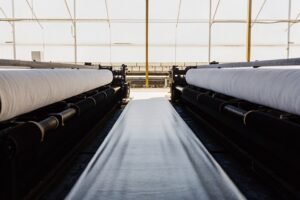
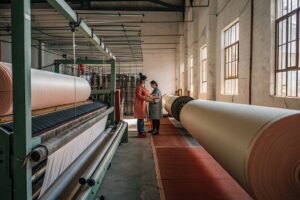
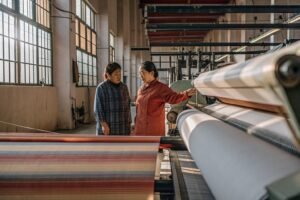
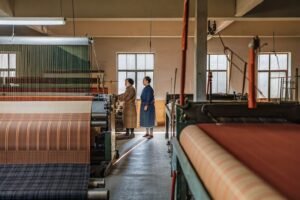
Vertical integration isn’t just about owning a factory building. It’s about owning the purchasing timeline. Because we control our own weaving mill—140 air-jet and rapier looms running under our direct management—we don’t just buy yarn when an order lands. We operate a "Strategic Raw Material Reserve" program. Throughout 2025, when we saw the meteorological data pointing to a strong El Niño pattern threatening monsoon reliability, we made a deliberate decision to forward-purchase and physically stockpile 800 tons of premium long-staple cotton yarn and 500 tons of recycled polyester staple fiber. These bales are sitting in our bonded warehouse in Keqiao right now, bought at Q2 2025 prices, specifically allocated for our 2026 Q1 and Q2 contract commitments. This means that when you negotiate a price with us for July 2026 delivery, the raw material cost component is already locked, hedged, and gathering dust on our shelves.
This physical hedging strategy saved one of our American sportswear clients roughly $34,000 on a single container of cotton-lycra jersey in late 2025. The spot market price for 40/1 combed cotton yarn jumped from $3.80/kg to $4.60/kg over six months. Every other supplier who quoted them had to raise the price mid-negotiation because they were buying yarn reactively. Our quote held firm. We pulled the yarn from our reserve, and the client’s retail pricing strategy for their spring launch didn’t implode. If you want to understand how to find fabric manufacturers in China with stable pricing amid global commodity swings, ask them one question: "Can you show me the purchase invoice and warehouse location for the yarn you’re quoting me right now?" A resilient supplier can walk you to the shelf. A fragile one changes the subject to "market fluctuation surcharges."
Beyond price, vertical integration protects you from the "Intercepted Shipment" disaster. In early 2025, an independent dye house in Jiangsu we had briefly considered using was shut down for three weeks by local environmental inspectors. Every brand whose greige fabric was stuck in their water bath missed their delivery window. Because we have our own cooperative dyeing facility, with fully compliant closed-loop water treatment, we control the production schedule. When building a strategy for how to manage a stable supply of custom printed cotton fabrics from Asia, the physical control of the processing timeline matters as much as the raw fiber. If your supply chain can be halted by a single factory’s legal problem, it’s not a chain; it’s a hostage situation.
What Alternative Fibers Are Manufacturers Like Fumao Investing In for 2026?
Resilience in 2026 also means diversification away from the two giants, cotton and polyester. We’ve been aggressively developing and pre-stocking bamboo lyocell, hemp-cotton blends, and GRS-certified recycled nylon 6. Why? Because these fibers source from different geographic and climatic baskets, spreading the risk. Our hemp comes from a stable cultivation zone in Yunnan province where water stress is low. Our recycled nylon feedstock comes from post-industrial waste streams in the Asia-Pacific region that map to a completely different supply-demand dynamic than oil-based virgin polyester.
We have also invested heavily in the research and scaling of bio-based synthetics. By mid-2025, our lab successfully piloted a partial bio-polyester derived from corn starch waste, achieving a 35% bio-content while maintaining a melting point suitable for standard textile dyeing and finishing equipment. We anticipate shipping the first commercial meters of this fabric to a select group of European eco-fashion partners by Q3 2026. An Alibaba trading agent cannot offer you R&D pipeline visibility like this because they have no R&D pipeline. They sell what exists. We invest in what’s next. The bottom line for your brand: if a drought destroys the Texas cotton crop in 2026, we already have the hemp and lyocell base fabrics in stock, tested, and ready to substitute without a radical change in your garment’s hand feel or cost structure. This isn’t just sustainable marketing; it’s raw material prepper logic, and it’s what keeps your production line running when your competitors are holding empty pattern cards.
Can a Multi-Factory Production Network Survive Regional Power Outages?
In August 2022, Sichuan province cut power to factories for two weeks during a historic heatwave to prioritize residential air conditioning. In 2024, rotating power curtailments hit parts of Zhejiang during peak summer demand, leaving some dye houses unable to heat their water baths. If your entire production capacity depends on one factory in one industrial zone with one municipal power grid, you are one heatwave away from a supply chain coma. The Chinese government’s "dual control" energy policy framework is permanently changing the operational landscape. Mills that rely solely on the public grid and don’t have a distributed asset network will reliably fail you during peak demand weeks, which, incidentally, are the exact weeks you need fabric to hit your seasonal deadlines.

How Does Fumao’s Distributed Manufacturing Model Handle Energy Curtailment?
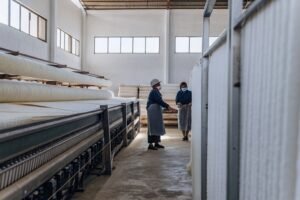
We saw the writing on the wall in 2021 after the first major curtailments and restructured our physical manufacturing footprint accordingly. We do not operate a single, monolithic "mega-factory." We have built a coordinated network of smaller, specialized production nodes, each with independent energy contingencies. Our primary weaving facility runs on a combination of grid power and a 2-megawatt rooftop solar array we installed in 2023. On a sunny day, 40% of the looms run on sunlight. But for the 2026 planning cycle, we’ve installed a bank of natural gas generators capable of running 100% of the finishing department’s stenters, dryers, and essential lighting for up to 72 hours without a grid connection.
More critically, we have pre-qualified and integrated backup manufacturing cells in different municipal districts. If our primary dyeing cooperative in Keqiao faces a sudden three-day power suspension order from the local government, we can immediately route the prepared greige fabric to our secondary dyeing partner in a neighboring city, which operates on a different grid segment and has been audited to our exact chemical and quality standards. This isn’t a theoretical backup plan gathering dust in a binder. We live-tested it during a brief, unannounced power cut in Q3 of 2024. The production management team had the first batch of fabric on a truck to the backup dye house within six hours. The client, a Nordic activewear brand on a tight deadline for winter sampling, never even noticed the disruption. Their fabric shipped three days late, which we absorbed in our buffer timeline. That’s what resilience looks like.
When a brand asks me how to evaluate manufacturing resilience in potential Chinese textile partners, I tell them to physically ask about the "Generator Fuel Contract." Don’t just ask "Do you have a generator?" Ask to see the commercial service contract with a diesel or LNG supplier proving that the generator can be refueled continuously. Empty generators with no fuel contract are props. We have a standing order with our LNG provider for priority refueling, triggered whenever the local grid stability index drops below a certain threshold. This is the kind of gritty, physical detail that separates a resilient supply base from a cosmetic one.
What Backup Inventory Protocols Prevent Disruption During Peak Season Shutdowns?
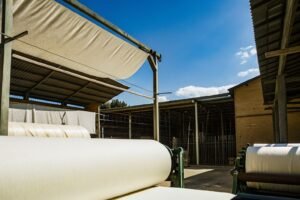
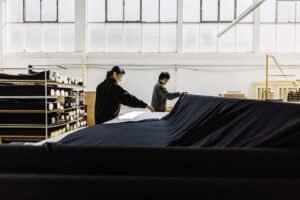
Energy resilience means nothing if you don’t have a "Buffer Stock of Work-in-Progress (WIP)". Most lean-manufacturing philosophies treat inventory as the enemy. But in an era of unpredictable shocks, a strategic, intelligent buffer of semi-finished goods is your lifeline. Our protocol, which we’ve scaled up for 2026, is called the "30% Floating Reserve." For every top-20 SKU we produce for our regular fashion brand partners—your basic poplins, your core satins, your best-selling jerseys—we maintain an additional 30% of the order quantity in greige form, un-dyed, sitting on warehouse shelves. When a customer’s replenishment order arrives urgently, we don’t start weaving from scratch. We pull the greige, dye it to their spec, and ship it in half the standard lead time.
This reserve protects against labor shocks as well. Chinese New Year 2026 will see the usual mass exodus of workers. We don’t just "hope" people show up on time. We pre-buffer the post-holiday period by running the looms at 110% capacity in the two weeks before the shutdown, building the greige reserve. When the factory reopens with a skeleton crew for the first five days, our finishing department already has cloth to process. Production doesn’t stall because we front-loaded the weaving. This system also allows us to absorb a rush order without distorting the existing production schedule for other clients.
Furthermore, we’ve segmented our warehouse into "Quarantine Stock" and "Approved Stock." Fabric that’s been woven but hasn’t passed final inspection is quarantined. This prevents a common disaster: shipping sub-par cloth just to meet a deadline. Because we have depth in our buffer, we never need to raid quarantine to fill a container. One of our US home textile clients, who relies on us for linen-cotton jacquard placemats, told me in May 2025 that our buffer policy is the sole reason they won a placement with a major department store. Their competitor’s supplier had a machine breakdown and couldn’t deliver the re-order. We had the greige, we dyed it, we hit the window. A buffer isn’t just a safety net; it’s a competitive offensive weapon for your retail accounts. For a creative entrepreneur looking for how to launch a fashion line with reliable fabric suppliers in China, the existence of a 30% floating reserve at the mill is the difference between a sold-out launch and a "coming soon" apology email to your pre-order customers.
How Is Adaptable Logistics Preparing Fumao for the 2026 Trade Landscape?
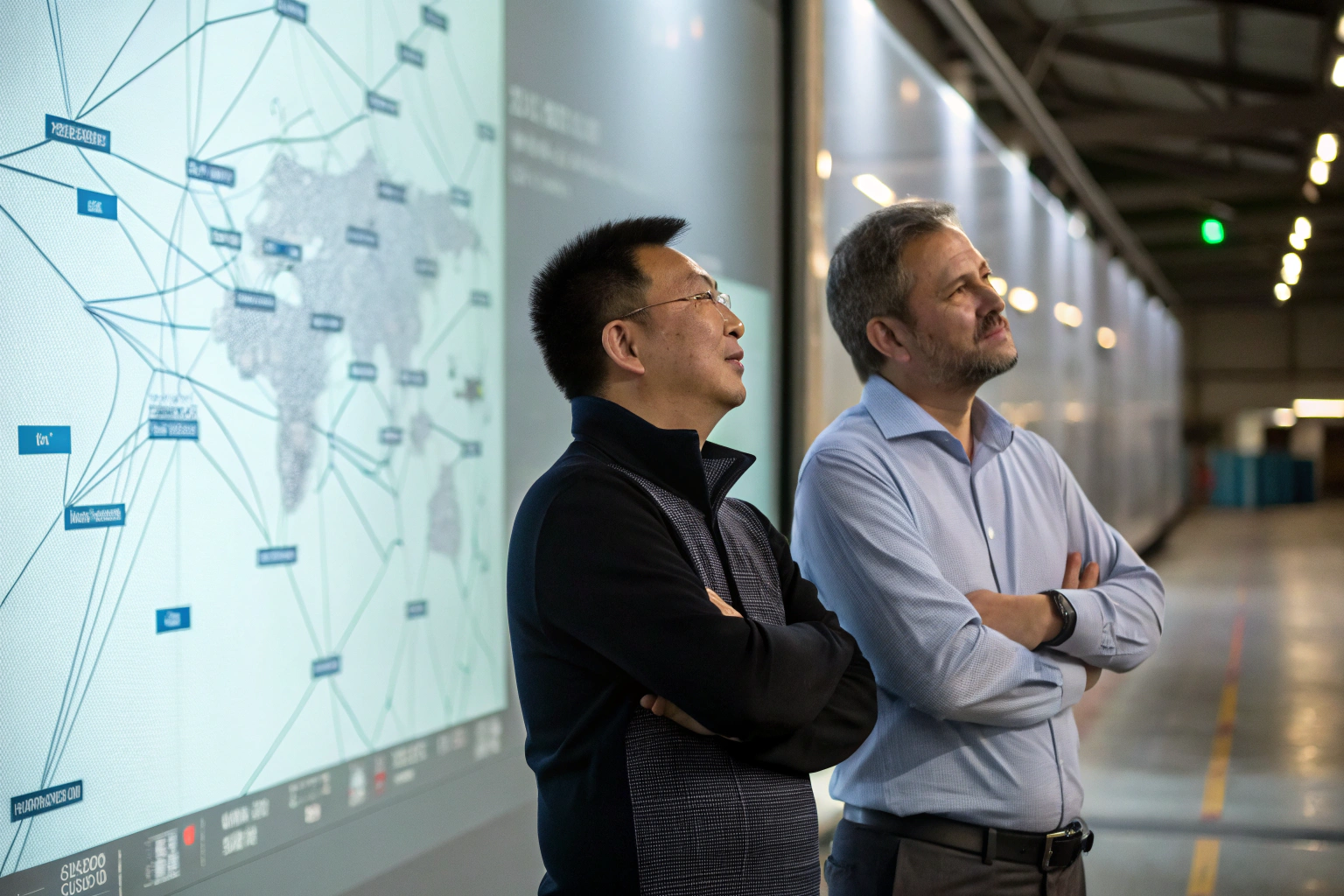
The physical product is only half the battle. The route it takes from our loading dock to your warehouse is the other half, and in 2026, that route faces a minefield of new risks. The Red Sea crisis of 2024 showed that a single geopolitical flashpoint can force 40% of global container traffic around the Cape of Good Hope, adding two weeks and $2,000 to a shipment. Simultaneously, the US trade policy environment remains unpredictable, with potential for sudden tariff escalations on Chinese-made textiles or downstream product categories. An unprepared supplier books a standard FOB Shanghai to LA route and prays. A resilient logistics framework has already mapped, costed, and vendor-audited three alternative physical pathways for your goods, along with the documentation strategies to legally optimize your landed cost under shifting regulatory regimes.

What Alternative Shipping Routes and Trade Lanes Are Being Established for 2026?
We’ve formally diversified our logistics partnerships to avoid single chokepoints. For European clients, particularly those in Germany and Eastern Europe, we are increasing our allocation on the China-Europe Railway Express from Xi’an to Duisburg and Malaszewicze. Our 2026 projection is to move 25% of our European volume by rail, reducing reliance on the maritime route past the Suez Canal. The transit time of 16-18 days is a powerful weapon for brands that need to reorder mid-season without paying air freight costs. We’ve also secured "block train" status with a major forwarder, which means our containers aren’t uncoupled and delayed at every border crossing for individual inspection.
For North American clients, we’ve been actively developing the "ASEAN Transshipment and Transformation" corridor. This involves shipping greige or semi-finished fabric from China to our partner facility in Vietnam, where the fabric undergoes substantial transformation—dyeing, printing, and finishing—changing its country of origin classification. The finished fabric then ships from Ho Chi Minh City to the US West Coast under a different tariff schedule than a direct China-origin good. This is fully compliant with US Customs and Border Protection’s "substantial transformation" rules, audited by a trade law firm we retain specifically for this purpose. For brands sensitive to the Section 301 tariffs on Chinese goods, this corridor legally mitigates a 25% cost penalty.
For the "just in case" worst-case scenario—a major port lockdown—we have standing agreements with a network of trucking companies for cross-border road freight from China through Central Asia into Russia and Eastern Europe, and south into Southeast Asia. The cost is high, so it’s a pure emergency contingency, but the capability is contracted, not hypothetical. When considering how to ensure your bulk fabric shipping from Asia isn’t delayed by trade policy, make sure your supplier can articulate not just Route A, but Route B and Route C, with real freight quotes less than 30 days old. If they say "we just use our forwarder," they have no Plan B.
How Does Agile Production Planning Respond to Actual Demand Instead of Forecasts?
A resilient supply chain also reduces the need for risky long-range forecasting. The old model was: you guess what you’ll sell 9 months in advance, place a massive single order, and pray. If the guess was wrong, you’re sitting on dead inventory. If the guess was too low, you lose sales. The modern, resilient model is "Agile Capacity Reservation." We don’t ask you to order 20,000 meters of fabric up front. We reserve 20,000 meters of greige weaving capacity against a smaller, firm order of 8,000 meters of finished fabric for your immediate launch. The remaining 12,000 meters of capacity is held open, ready to be dyed and finished in any color variant within 15 days, based on your actual sell-through data.
We tested this model with a UK-based mid-market fashion chain during their 2025 autumn season. They initially launched a new coat fabric in camel and charcoal. The charcoal sold 300% above forecast in the first two weeks. Because we had the reserved greige capacity waiting, we received their re-order panic call on a Monday, put the greige into the dye bath on Tuesday, finished on Friday, and shipped the following Monday. Ten days from insight to shipped goods. The brand didn’t lose a single sale to stockouts. This is the future of manufacturing: decoupling the long-lead-time greige weaving from the short-lead-time color finishing. It drastically reduces the financial risk of bad forecasting and aligns production output with actual consumer demand, not a buyer’s prayer from nine months ago.
This approach also reduces waste. The industry norm is that 20-30% of all produced garments end up incinerated or in landfill, largely because of overproduction based on bad forecasts. A flexible, capacity-reservation system produces only what sells. Brands working with us to develop their sourcing partnerships for sustainable and agile textile supply chains in China find that the slightly higher per-meter cost of holding reserve capacity is more than offset by the near-elimination of dead stock markdowns and disposal fees. And when the European Union’s Digital Product Passport regulations fully roll out, the ability to trace a fabric back to a responsive, demand-driven production event rather than a speculative bulk order will likely become a compliance advantage. We’re architecting for that future right now.
Conclusion
So, is Shanghai Fumao’s supply chain resilient enough for 2026? Let me answer by pointing to the concrete, verifiable assets we’ve placed in the ground and on the balance sheet, not the promises we’ve written in a marketing brochure. We’ve stockpiled 800 tons of cotton and recycled polyester at pre-crisis prices, insulating your costing from the violent commodity swings that are already roiling the global market. We’ve built a distributed network of manufacturing nodes, each with independent solar and natural gas power contingencies, so a regional grid failure doesn’t become your delivery failure. And we’ve established legal, tested, multi-modal logistics corridors—from the rail lines to Duisburg to the ASEAN transshipment routes—that treat trade policy and geopolitical blockages as a design parameter, not an excuse.
The era of trusting a single, fragile, lowest-cost supply chain is over. 2026 will punish those who optimize for a frictionless past instead of a turbulent future. The mills that survive and protect their clients are the ones who think like engineers, not merchants—building redundancy, pre-stocking critical inputs, and decoupling production stages to respond to real demand signals rather than wishful forecasts. Your fabric supplier should be the sturdiest link in your brand’s operational chain, not the weakest.
We’ve been laying the groundwork for this year of uncertainty since 2021, and the investments are physically present, running on our factory floor, charging off our solar panels, and sitting on our warehouse shelves. If you’re looking toward the next 18 months and feeling that knot of anxiety about whether your current supply base can actually deliver in a world of perpetual crisis, let’s have a concrete conversation. Our Business Director, Elaine, can walk you through the specific backup plans, fiber stocks, and trade routing options that would apply directly to your product category. She can show you our inventory reports and generator fuel contracts—the real evidence of resilience. Send her an email at elaine@fumaoclothing.com. Tell her what worries you most about 2026, and let’s build a supply chain strategy that lets you focus on designing beautiful clothes, not managing the next global disaster.