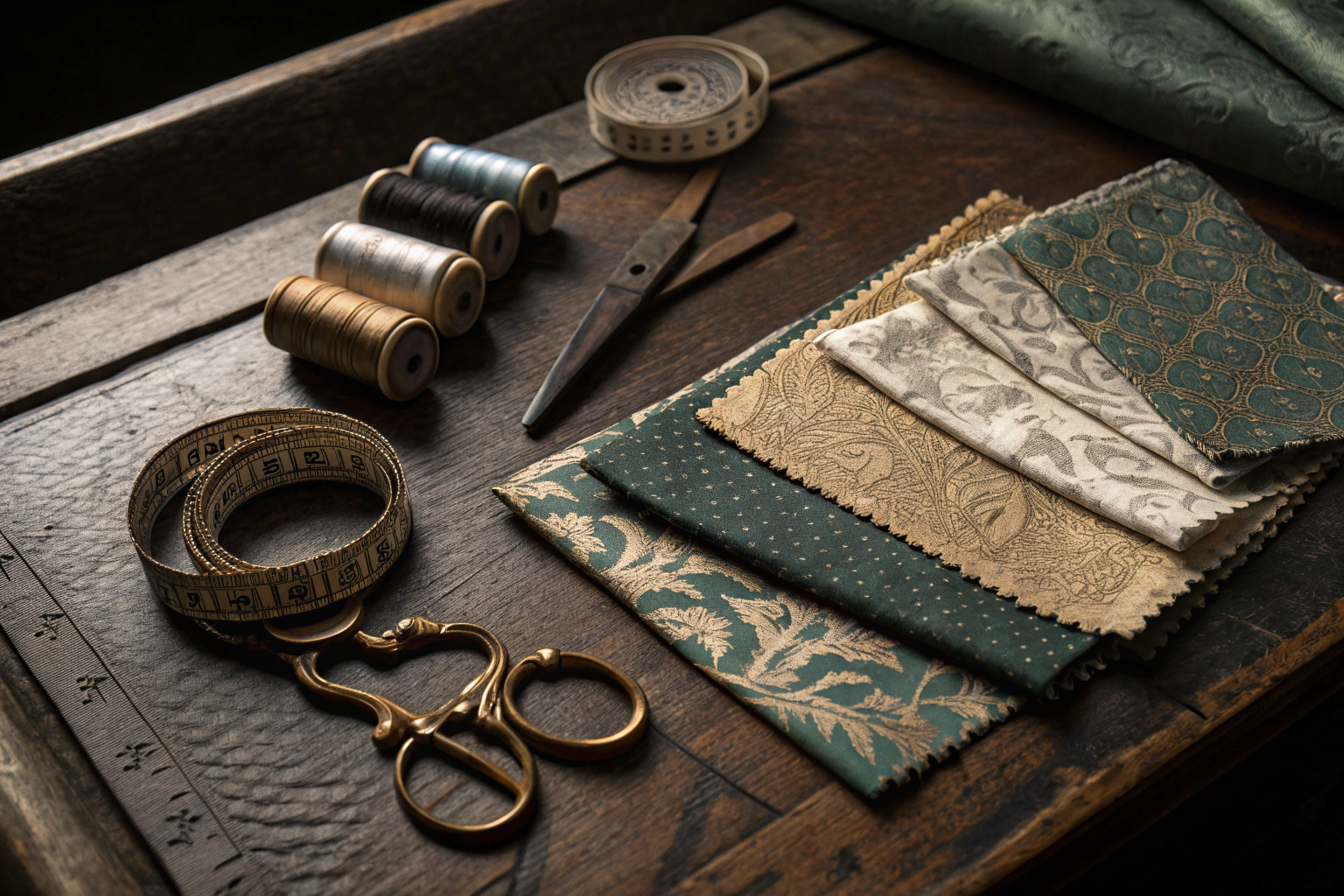
You’ve scrolled through every trade show booth. You’ve clicked through 47 pages of Alibaba listings. You’ve ordered swatch packs from the big mills. And every single one looks the same. The same polyester chiffon. The same basic satin. The same slub jersey that every other mid-tier brand is using. You want to launch a premium line. You want fabrics that tell a story. You want texture, heritage, and exclusivity. But everywhere you turn, you find commodity. You’re terrified that your "luxury" collection will land on the racks looking indistinguishable from the fast fashion knockoffs hanging three feet away. You need fabric that can’t be found with a Google image search.
Sourcing rare fabric styles for premium lines requires moving beyond the public-facing B2B platforms and tapping into the Private Archive Networks of specialized mills and the Deadstock Vaults of luxury production houses. At Shanghai Fumao, we sit at the intersection of these two worlds. As a large-scale manufacturer in Keqiao, we have the buying power and the relationships to commission Small-Batch Artisan Weaves that smaller studios can’t access. At the same time, because we supply major global brands, we have access to Excess Prime Quality Inventory—those 200-yard remnants of a $40/yard Italian-milled wool blend that ZARA didn’t use up. These rare fabrics never make it to Alibaba. They are traded via WeChat, phone calls, and personal relationships. You don’t find them. You have to be connected to them.
This article is going to pull back the curtain on the underground railroad of premium textiles. I’ll show you exactly how we hunt down rare jacquards, specialty laces, and unique blends for our premium clients. We’ll cover the difference between true deadstock and cheap overstock, the specific mills in China and Japan that still do 19th-century style finishing, and how to leverage a partner like Fumao to get 50 yards of something special instead of being laughed at for not meeting the 3,000-yard MOQ. Because in the premium market, the fabric is the product. And if you can’t find the fabric, you don’t have a line.
What Is the Difference Between Deadstock, Overstock, and Custom Mill Runs?
This is the vocabulary lesson you need before you start your hunt. These terms get thrown around by suppliers, often deceptively, to make fabric sound more exclusive (or more affordable) than it actually is. If you don’t know the difference, you’ll pay Deadstock prices for Overstock garbage.
1. Deadstock Fabric.
- Definition: Prime Quality, First-Run fabric that was produced for a specific brand or designer but was Never Used. The brand over-ordered, the style was canceled, or the color was slightly off-spec. It’s not defective. It’s just leftover.
- Characteristics: Often comes with original mill tags (e.g., "Milled in Italy for Brand X"). Available in small, unpredictable quantities (50 – 500 yards). Once it’s gone, it’s gone forever.
- Rarity Level: High. This is the gold standard for premium small-batch lines. You are buying fabric that was spec’d for a $500 dress at a fraction of the cost.
2. Overstock Fabric.
- Definition: Commodity fabric produced in massive quantities for the open market. The mill made too much, or a trading company went bankrupt and dumped inventory.
- Characteristics: Basic qualities (e.g., "Black Poly Crepe," "White Cotton Poplin"). Available in large quantities (5,000+ yards). Replenishable.
- Rarity Level: Low. This is just discounted basic fabric. It’s good for linings or basics, but it’s not "rare."
3. Custom Mill Run.
- Definition: Fabric made Specifically For You. You choose the yarn, the weave, the color, the finish. The mill produces exactly the yardage you need.
- Characteristics: High MOQ (usually 1,000 – 3,000 yards per color). Long lead time (6-12 weeks). Maximum Exclusivity.
- Rarity Level: Absolute. No one else on earth has this fabric. But you pay for the privilege.
At Shanghai Fumao, we maintain a Private Deadstock Library. We have a dedicated sourcing team that buys small lots of high-end deadstock from our network of premium dye houses and weavers in the Yangtze River Delta. We offer these to our premium clients with full transparency: "This is a 100% Linen Jacquard from a canceled European order. We have 320 yards. Price is $X. First come, first served." This is how small luxury brands get their hands on fabric that would normally require a 2,000-yard custom run. For a broader industry perspective, this article on the difference between deadstock fabric, overstock, and sustainable sourcing for fashion brands provides a deep dive into the sustainability and quality angles.
The biggest scam we see in the industry is "Fake Deadstock." A supplier buys cheap, low-quality overstock polyester from a market stall, puts it in a fancy box, and calls it "Deadstock Designer Fabric." They mark it up 300%. How do you spot the difference? The Burn Test and The Hand Feel. Real premium deadstock uses Long-Staple Fibers and High-Twist Yarns. It feels expensive. Cheap overstock feels rough, pills easily, and smells like chemicals. You have to train your hands. Or you have to trust a partner like Fumao who has already vetted the source. (Here I gotta say—I’ve been burned by "Italian deadstock" that turned out to be made in a basement in Shaoxing. It’s a jungle out there).

How Can I Access Small Quantities of High-End European Deadstock in China?
This is one of the best-kept secrets in the global textile trade. A significant portion of European Luxury Deadstock never actually leaves Asia. Here is why: Major European fashion houses (the LVMHs and Kering groups of the world) produce their high-end garments in Chinese and Vietnamese factories. They ship the Italian-milled fabric to Asia. The garment factory cuts the order. There is always 5-10% buffer fabric shipped to account for defects and cutting waste. If the cutting is efficient, that buffer fabric is left over. It’s Prime Italian Silk or French Lace sitting in a warehouse in Suzhou or Shenzhen.
The European brand does not want this fabric. Shipping 80 yards of silk back to Italy costs more than the fabric is worth. They instruct the factory to "Destroy or Dispose." Ethically responsible factories (and we have relationships with many of them) do not destroy it. They sell it through Authorized Deadstock Aggregators (like us). This is how Shanghai Fumao acquires Authentic European-Milled Deadstock in small yardages (50-200 yards).
Here is the Fumao Deadstock Protocol:
- Verification: We require the original mill certificate or the garment factory’s internal lot traceability report. If it says "Ratti S.p.A." or "Becagli," we know it’s real.
- Conditioning: We inspect the rolls on our automated frames to ensure no cutting damage or stains.
- Cataloging: We take high-res photos and videos under 5000K lighting and upload them to a Private Vault accessible only to our vetted premium clients.
For example, in February 2026, we acquired 180 yards of a stunning Silk/Lurex Chiffon from a canceled French Couture order. The fabric was milled in Como, Italy. The original cost was €65/meter. We sold it to a Los Angeles-based evening wear designer for $22/yard. She made 45 limited-edition scarves and sold them out in 48 hours at $295 each. That’s the power of access. For more on this specific supply chain, this report on how European luxury deadstock fabric ends up in Asian markets and how to source it ethically pulls back the curtain on these logistics.
Does Fumao Offer Small-Batch Custom Weaving for Truly Exclusive Fabrics?
Yes. This is the ultimate level of exclusivity. If you can’t find the rare fabric you’re dreaming of in the deadstock market, we will make it for you. And we do it at Lower Minimums than most mills because of our specialized Sample Loom Capabilities.
A standard textile mill in Keqiao has a minimum order of 3,000 yards for a custom weave. Why? Because it takes a full 8-hour shift to "beam" the loom (set up the 5,000 warp yarns). The cost of that setup is fixed. Spreading that cost over 3,000 yards makes sense. Spreading it over 200 yards makes the fabric $200/yard.
Fumao’s Solution: The Sample Loom Program.
We maintain a bank of Hand-Loom and Semi-Automatic Sample Looms. These machines are designed for R&D and Sampling. The beam width is narrow (usually 24-36 inches). The setup time is much faster (2-3 hours). This allows us to economically produce 100 – 500 yards of a custom weave.
Here are the parameters:
- MOQ: 150 yards (for dobby weaves) to 300 yards (for complex jacquards).
- Lead Time: 6-8 weeks.
- Yarn Options: We stock over 200 types of specialty yarns in our library, including Linen/Silk Slub, Recycled Cashmere Blend, and Tencel/Mohair Loop.
- Cost: Expect to pay a 20-30% premium over the bulk rate for the same fabric. You are paying for the flexibility and exclusivity.
A case study: October 2025, a Tokyo-based avant-garde designer wanted a specific Crinkled Ramie/Cotton Gauze that she had seen in a vintage 1920s kimono. No mill had it. She came to us. We sourced the rare Ramie Fiber (a bast fiber similar to linen) from a specialty spinner in Hunan province. We developed the crinkle texture using a Sodium Hydroxide Shrinkage Treatment on our sample line. We produced 220 yards of a fabric that exists nowhere else on Earth. Her collection was featured in Vogue Japan. The fabric was the story. For a deeper understanding of this process, this technical resource on how small batch custom weaving and sample loom development works for independent designers explains the equipment and techniques involved.
Which Specialty Fiber Blends Are Trending for Premium 2026 Collections?
Trends in the premium segment move slower than fast fashion, but they are more impactful. Premium customers buy based on Tactile Experience and Narrative. They want to know why this fabric feels different. In 2026, the trend is moving away from shiny, slick synthetics and toward Dry Hand Feels, Authentic Imperfections, and Performance Naturals.
Based on the sampling requests we’ve seen at Shanghai Fumao over the last six months, and the swatches we presented at Première Vision Paris, here are the three dominant blend directions for premium 2026 lines:
1. The "Quiet Outdoor" Blend: Merino Wool / Tencel / Linen.
- Why it’s trending: Post-pandemic, premium consumers want clothes that are comfortable enough for the home office but polished enough for a dinner meeting. They want natural fibers with Thermal Regulation and Odor Resistance.
- Fumao Development: We’ve perfected a 60% Extrafine Merino / 25% Tencel / 15% Linen jersey. The Merino provides warmth and anti-odor. The Tencel provides drape and moisture management. The Linen provides that slightly crisp, "expensive" dry hand. It’s a knit that looks like a woven. It’s been our #1 sampled fabric for Fall ’26.
2. The "Regenerative" Blend: Recycled Cashmere / Responsible Wool / Hemp.
- Why it’s trending: The narrative of "waste" is over. The new narrative is "regeneration." Consumers want fabrics that tell a story of restoring soil health and animal welfare.
- Fumao Development: We are working with a specialty spinner who processes Post-Consumer Cashmere Sweaters back into virgin-quality fiber. We blend this Recycled Cashmere with NATIVA™ Responsible Wool and a touch of European Hemp for structure. The result is a coating fabric with the softness of cashmere and the rustic texture of a heritage tweed.
3. The "Botanical" Blend: Bamboo Silk / Cupro / Rose Petal Fiber.
- Why it’s trending: The quest for the ultimate "cool to the touch" sustainable fabric continues. Cupro (made from cotton linter waste) is having a massive moment.
- Fumao Development: Our BAMSILK Cupro Satin is a 55% Bamboo Viscose / 45% Cupro blend. It has the liquid drape of silk, the breathability of cotton, and the sheen of polyester. It dyes to incredibly deep, rich jewel tones. We’ve even started experimenting with Micro-Encapsulated Rose Extract finishes that release a subtle floral scent when the fabric moves. It’s wildly popular for premium sleepwear and lingerie.
For a broader market analysis, this trend report on key fabric and fiber blend trends for luxury and premium apparel collections in 2026 aligns with much of what we’re seeing in our lab.

Can You Source Authentic Japanese Selvedge Denim or Irish Linen in Small Batches?
This is the holy grail for heritage menswear and premium womenswear brands. The answer is Yes, but it requires patience and a premium budget. These fabrics are not commodities. They are artisanal products with limited production windows.
Japanese Selvedge Denim:
- The Challenge: The legendary mills in Okayama (like Kuroki, Collect, Japan Blue) work primarily with established Japanese trading houses. They do not sell direct to Chinese mills easily. And they produce on Vintage Toyoda Shuttle Looms that run at a fraction of the speed of modern looms. Output is low.
- Fumao Access: We have a partnership with a Denim Specialty Agent in Osaka. This agent aggregates small-batch orders from various international buyers to meet the mill’s minimum "run" of the shuttle loom. We can piggyback on these runs.
- Availability: We can source 30 – 100 yard rolls of Raw or One-Wash Selvedge in standard weights (13.5oz – 15oz). Lead time is 8-12 weeks.
- Price: Expect to pay $18 – $35 per yard FOB China, depending on the mill and the rarity of the dye (Natural Indigo is significantly more expensive).
Irish Linen:
- The Challenge: True Irish Linen comes almost exclusively from a handful of mills in Northern Ireland (e.g., Baird McNutt, William Clark). It is expensive and supply is tight. There are excellent alternatives, however.
- Fumao Alternative: We offer a "China-Ireland Heritage Linen." This is a fabric woven in China using 100% Imported Belgian Flax Fiber on vintage rapier looms that replicate the Wet Spun process used in Ireland. The hand feel and slub character are virtually identical to authentic Irish Linen at 40-50% of the cost.
- True Irish Linen Sourcing: We can source true mill-certified Irish Linen through our deadstock network or by placing a direct order with the mill’s agent. MOQ is typically 60 meters per color (roughly 65 yards) for stock-supported qualities. Lead time is 4-6 weeks.
In November 2025, a San Francisco menswear brand used our Japan-sourced 14oz Kuroki Selvedge for a limited run of 50 pairs of jeans. They retailed at $425. They sold out in pre-sale alone. The story of "Okayama Denim, sourced via our partner in Keqiao" was a key part of their marketing. For a deeper dive into this world, this guide on how to source authentic Japanese selvedge denim and Irish linen for small batch clothing production is the definitive resource for navigating these niche supply chains.
What Are "Performance Naturals" and Why Are Luxury Brands Demanding Them?
"Performance Naturals" is the term we use internally for fabrics that Look and Feel like 100% Natural Fibers (Cotton, Wool, Linen) but Behave like Technical Synthetics. This is the biggest innovation space in premium textiles right now because it solves the core problem of natural fibers: they wrinkle, they shrink, they fade, and they dry slowly.
The luxury consumer wants the Ethics and Hand Feel of nature. But they also want the Convenience and Durability of their Lululemon pants. You can’t just give them a 100% linen suit that looks like a crumpled napkin after a 20-minute car ride. That’s a return waiting to happen.
Here are the three Fumao "Performance Natural" technologies we are scaling in 2026:
- EZ-Wash Merino: We treat 100% Extrafine Merino Wool with a Chlorine-Free Hercosett Polymer Finish at the fiber level. This smooths the microscopic scales on the wool fiber. Result? Machine Washable Wool that doesn’t felt or shrink. Hand feels exactly like untreated wool. This is the fabric driving the "Washable Suiting" trend.
- No-Iron Linen: We blend Linen with a specific Sorona® Polymer Fiber (bio-based PTT). The Sorona fiber acts like a hidden spring inside the yarn. When you crush the fabric, the Sorona springs back, pulling the linen with it. The fabric looks like 100% rustic linen but has 80% less wrinkle formation.
- Bio-Wick Cotton: We apply a Permanent Hydrophilic Finish to long-staple cotton using Plant-Based Fatty Acids. This changes the surface tension of the cotton fiber. Instead of absorbing sweat and getting heavy, the fabric Spreads the sweat into a micro-thin film that evaporates 40% faster. It’s 100% cotton that wicks like polyester.
A New York-based "quiet luxury" brand adopted our No-Iron Linen for their Spring ’26 travel blazer. Their return rate on linen blazers in 2025 was 18% (mostly due to "wrinkles too easily"). The return rate on the No-Iron Linen blazer in the first two months of 2026 is 4% . That’s a direct impact on their bottom line. For more on this category, this article on the rise of performance natural fabrics and how they are changing the premium apparel market tracks the investment and technology behind these textiles.
How Do I Navigate High Minimum Order Quantities for Rare Embroidered Lace?
This is the single biggest barrier to entry for premium brands wanting to use specialty trims and laces. The mills that make the truly beautiful stuff—the fine Guipure Lace from Shantou, the Chantilly Lace with hand-beading, the intricate Schiffli Embroidery—they are set up for Bridal and Evening Wear Wholesalers who order 3,000 yards per pattern. If you call them and ask for 50 yards, they will politely hang up the phone. They literally cannot stop the giant multi-head Schiffli machine to change the pattern for a 50-yard order. The setup time costs more than the fabric.
So how does a small brand get access to this level of craftsmanship? Through Stock Lace Programs and Consolidation. At Shanghai Fumao, we act as a Lace Aggregator. We place bulk orders for the most timeless, versatile lace patterns—the ones that don’t go out of style—and we hold them in our warehouse. We then Break Bulk for our clients. You can buy 20 yards of a classic Cotton Guipure or 50 yards of a Scalloped Chantilly Edge because we bought the 2,000-yard roll.
Here is the Fumao Lace Library System:
- Tier 1: Stock Laces. We keep 50+ patterns of premium lace in stock at all times. These are classic floral motifs, geometric nets, and basic galloon trims. MOQ: 10 yards.
- Tier 2: Rotating Specialty Laces. These are more fashion-forward patterns that we buy in smaller bulk quantities (500 yards). When it’s gone, it’s gone. MOQ: 30 yards.
- Tier 3: Custom Development. If you want a truly unique lace pattern that no one else has, we can work with our embroidery partners on a Custom Schiffli Run. This requires a MOQ of 1,500 yards per design and a one-time Punching Fee of $600-$1,200 for the digital embroidery file. This is only for brands doing large-scale production or a signature core item.
For a visual guide to these different types of lace, this resource on how to identify and source different types of premium lace including guipure, chantilly, and schiffli embroidery is an excellent primer for understanding what you’re looking at.
The most common mistake we see is brands falling in love with a "Runway Sample" lace. They see a photo on Vogue Runway of a dress with a very specific, quirky 3D floral embroidery. They want that exact lace. The reality is that lace was custom developed for that specific designer at a cost of $15,000 for the pattern development alone, with a 5,000-yard commitment. It is not available for sale. We have to gently redirect them to a similar vibe from our Tier 2 Rotating Stock.

Does Fumao Have In-House Embroidery Capabilities for Custom Lace Designs?
We have Embroidery Partners, not in-house machines. And this distinction is important. A "one-stop shop" that claims to do everything from weaving to lace-making in one building is often a jack of all trades, master of none. True high-end lace embroidery requires Specialized Climate Control (to prevent thread breakage), Dust-Free Environments, and Artisan-Level Finishers who hand-trim the jump stitches.
We partner with two specific factories in the Guangdong province that only do embroidery and lace. They have been doing it for 40 years. Their Schiffli machines are the size of school buses. When you work with Fumao, you are leveraging our Quality Control Team stationed at these partner factories. We manage the communication, the sampling, and the inspection so you don’t have to navigate the technical minefield alone.
Here is the Custom Lace Development Process:
- Artwork Submission: You send us a high-res sketch or a reference photo.
- Digitizing: Our partner creates a Punching File. This converts your art into X/Y coordinates for the 10,000 needles on the Schiffli machine.
- Strike-Off: They run a 1-yard Sample on the actual production machine. This costs $80 – $150 (credited to bulk order).
- Bulk Production: Once you approve the strike-off, we run the bulk yardage. Lead time is 4-6 weeks plus shipping.
A UK-based bridal designer came to us in September 2025 with a sketch of a specific Art Deco sunburst motif. No mill had it. We developed the Schiffli pattern with our partner. The strike-off took two rounds to perfect the stitch density on the scalloped edge. We produced 2,000 yards of custom lace for her signature gown. The lace was exclusive to her brand. That exclusivity allowed her to command a $7,500 retail price point for the dress. For a technical understanding of the machinery, this video on how Schiffli embroidery machines create intricate lace and guipure fabric patterns is mesmerizing to watch.
Can I Order Pre-Embroidered Fabric Panels for Premium Garment Production?
This is a service that saves premium cut-and-sew factories a massive amount of labor and waste. Instead of buying 100 yards of plain fabric and 100 yards of lace trim, cutting them separately, and then paying a sewer to attach the lace to the hem… we do it At the Mill Level.
We offer "Engineered Embroidery Placement." Using our large-format Multi-Head Embroidery Machines, we can embroider directly onto the cut panels of your garment before they are sewn.
Option 1: Border Embroidery.
- You provide the pattern piece shape (e.g., the hem of a sleeve or a skirt panel).
- We hoop the fabric and embroider a Repeating Border Design along the edge.
- Benefit: Perfectly straight embroidery. No human error in placement. Zero labor cost for the sewer to attach trim.
Option 2: Isolated Motif Placement.
- You provide a digital marker layout showing exactly where the logo or floral spray should be on each cut panel.
- We program the multi-head machine to stitch the motif in the Precise X/Y Coordinate on every single panel.
- Benefit: Consistent placement across 1,000 units. No misaligned logos.
Option 3: All-Over Embroidery (Guipure Effect).
- We take your plain fabric (e.g., Cotton Voile) and run it through the Schiffli machine with a Water-Soluble Backing. The machine embroiders an all-over pattern.
- We then dissolve the backing in hot water.
- Result: A stunning "Guipure-Style" Fabric that is lighter and softer than traditional lace.
A Melbourne-based premium childrenswear brand uses our Border Embroidery Service for their signature "Party Dress Collar." We embroider the scalloped edge directly onto the cut collar piece. Their sewer simply sews the collar to the bodice. It saves them 12 minutes of sewing time per dress. At scale, that’s a significant cost saving that justifies the premium fabric. For more on this technique, this industry article on the advantages of engineered embroidery placement and pre-embroidered panels for apparel manufacturing explains the workflow in detail.
What Is the "Fumao Private Archive" and How Can It Elevate My Brand?
This is the secret weapon for our premium clients. The Fumao Private Archive is not on our public website. You can’t Google it. It’s a Physical and Digital Vault of rare, discontinued, and sample-yardage fabrics that we have accumulated over 20 years of servicing global brands.
Think of it as our "Museum of Unused Potential." When a major brand cancels a program, or when we develop a sample that the client didn’t ultimately choose, that fabric doesn’t get thrown away. It gets cataloged and stored. We have fabrics in that archive that are 15 years old—discontinued Japanese crepes, vintage-style European jacquards, and experimental blends that were too expensive for commercial production at the time.
Access to the Private Archive is By Invitation or Application Only. Why? Because the quantities are so small (often 30-80 yards) that we can’t offer them to our mass-market clients. They are reserved for premium designers who need Exclusivity and Narrative.
Here is what you find in the Archive:
- Discontinued Mill Runs: A specific Tencel/Linen Slub that a mill stopped making 5 years ago. We have 65 yards left. It’s one-of-a-kind.
- Sample Yardage (Surplus): We developed a new Recycled Cashmere Coating for a client. We made 100 yards for sampling. They went a different direction. The fabric is exquisite. It’s yours if you want it.
- Vintage Deadstock: We sometimes acquire entire sample rooms of retiring designers. This includes European wools and silks from the 1990s and early 2000s—a golden era of textile quality.
A Copenhagen-based sustainable luxury brand built their entire Fall ’25 capsule collection from our Private Archive. They found 45 yards of a Deadstock Yak/Wool Herringbone, 80 yards of a Discontinued Cupro Twill, and 120 yards of a Surplus Linen Jacquard. They made 15 coats, 20 pairs of trousers, and 25 blouses. Each garment had a hangtag that read: "Made from Rare Fumao Archive Fabric. Edition of X." They sold out the collection in four days. The fabric was the marketing. For a broader perspective on this approach, this article on how deadstock and archive fabric sourcing is fueling the new luxury sustainability movement captures the zeitgeist perfectly.

How Do I Apply for Access to the Fumao Rare Fabric Vault?
It’s not a secret handshake, but it is a Qualification Process. We protect the archive because if we open it to everyone, the best pieces get snapped up by hobbyists making one-off Etsy projects, and our serious premium clients miss out. We need to know that you have the Production Capability and Brand Positioning to do the fabric justice.
Here is the Application Criteria:
- Active Business: You must have a registered business license, a website, or a verifiable social media presence showing a history of selling apparel.
- Premium Positioning: Your retail price points should be in the Mid-to-Premium Tier. The fabrics in the archive are not $2.00/yard basics. They are $8.00 – $30.00/yard specialty goods. If you’re a budget t-shirt brand, the archive isn’t the right fit.
- Project Brief: Tell us what you’re looking for. "I need 50-80 yards of a unique jacquard for a women’s blazer capsule." This helps us curate a selection for you.
How to Apply:
Send an email to our Business Director, Elaine, with the subject line: "Archive Access Request – [Your Brand Name]." Include a brief intro to your brand and your specific fabric needs. Elaine or a member of her team will schedule a 15-minute Video Call to walk you through a curated digital lookbook of current archive highlights.
Once approved, you get:
- Monthly Archive Newsletter: A PDF with high-res photos and yardage updates of new deadstock arrivals.
- Priority Swatch Requests: We can pull up to 5 swatches per month for you to evaluate.
- 24-Hour Holds: You can place a 24-hour hold on a specific roll while you make a decision.
We onboarded a Toronto-based luxury womenswear designer to the Archive in January 2026. She found a roll of Vintage Silk/Linen Noil from a 2018 Fumao development project. She made a run of 12 blazers. She tagged us on Instagram. The post went viral in the slow fashion community. That’s the kind of symbiotic relationship the Archive is designed for. It’s not just about selling fabric; it’s about co-creating stories.
Can Fumao Hold Exclusive Rights to a Rare Fabric for My Brand?
Yes, for a Defined Period and a Defined Volume. This is a service we offer specifically for Private Label and Signature Core Programs. It bridges the gap between "buying deadstock" (no exclusivity) and "custom mill run" (high MOQ).
Here is the Fumao Exclusivity Agreement Framework:
Scenario 1: Exclusivity on Existing Stock.
- You find a fabric in our Private Archive or Deadstock Library that you love. There are 800 yards available.
- You commit to buying at least 500 yards over a 6-month period.
- We Block the Fabric. We remove it from the archive newsletter and from our sales team’s offer sheets. No other Fumao client can buy it.
- Benefit: You secure a unique fabric for your season without committing to a 3,000-yard custom run.
Scenario 2: Exclusivity on Custom Development.
- We develop a custom fabric for you (e.g., a specific print on our BAMSILK base).
- The Standard Agreement: The digital files and screens are yours. We do not sell the fabric to anyone else.
- Fumao "Shared Cost" Option: If you want exclusivity but need to lower the development cost, we can offer a "Timed Exclusivity" deal. You pay 50% of the screen/strike-off fees. You get 12 months of Exclusivity. After 12 months, the design enters the Fumao Open Line Card, and you receive a Royalty Credit (5% of sales) on any yardage we sell to other clients for the next 24 months.
We executed a "Blocked Stock" agreement in December 2025 for a Berlin-based avant-garde label. They found 600 yards of a complex Cotton/Metal Double Cloth in our archive. They committed to buying 450 yards for their Spring/Summer collection. We blocked the remaining 150 yards for them to re-order if needed. They launched the collection. A major department store buyer specifically noted the "unique, hard-to-find fabric." The brand secured a wholesale order. The exclusivity of the textile was a key selling point in their line sheet. For a legal perspective on these types of arrangements, this resource on understanding fabric exclusivity agreements and intellectual property in textile design provides a framework for protecting your creative assets.
Conclusion
Sourcing rare fabric for a premium line is not a transaction; it’s a treasure hunt. It requires moving beyond the search bar and into a world of relationships, archives, and specialized knowledge. Whether you’re hunting for the last 80 yards of a discontinued Japanese jacquard, commissioning a custom lace pattern that no one else on earth will have, or exploring the tactile frontiers of performance naturals, the fabric you choose becomes the soul of your collection. In the premium market, your customer is not just buying a garment; they are buying the story of the material.
At Shanghai Fumao, we have spent two decades building the infrastructure—the deadstock network, the artisan mill partnerships, the Private Archive, and the flexible MOQ programs—to democratize access to these rare materials. We believe that a small brand with a big vision should have the same opportunity to touch a 100-year-old loom selvedge or a whisper-weight Italian silk as the global luxury conglomerates. The difference is that we help you navigate the complexity and the cost so that the fabric elevates your brand, not bankrupts it.
If you’re ready to stop sourcing from the same catalogs as everyone else and start building a collection around truly distinctive textiles, we invite you to explore the Fumao Private Archive and our Specialty Sourcing Services.
To apply for Archive Access, discuss a custom lace development, or inquire about specific rare fibers, please reach out to our Business Director, Elaine. She is the gatekeeper to the vault and can curate a selection of options based on your specific creative direction. Email her at elaine@fumaoclothing.com. Let’s find the fabric that makes your collection unforgettable.