You just closed a deal on 3,000 yards of beautiful custom fleece. The fabric cost is within budget. You pat yourself on the back for negotiating a great price. Then the freight invoice lands in your inbox. Your stomach drops. The shipping cost is nearly 40% of the fabric value. You do the math. Your landed cost per unit just skyrocketed. Your margin is gone. You either raise retail prices and risk slow sales, or you eat the loss and wonder why you’re working so hard for so little profit. This is the hidden trap of sourcing fabric by air or sea without understanding the brutal economics of weight.
Fabric weight, measured in GSM (Grams per Square Meter) or Ounces per Square Yard, is the single biggest variable in your logistics equation after distance. Every gram adds up. A 180 GSM lightweight t-shirt jersey weighs roughly 210 grams per linear yard (at 60" width). A 400 GSM heavyweight fleece weighs roughly 470 grams per linear yard. That’s more than double the weight for the exact same amount of fabric. When you multiply that difference by 3,000 yards, you’re talking about 780 extra kilograms in the container or on the plane. At current air freight rates out of Shanghai (roughly $5.50/kg), that weight difference adds $4,290 to your shipping bill. At sea freight rates (roughly $0.45/kg), it adds $350. The fabric itself might have only cost $1.50 more per yard. You did the math on the fabric. You forgot to do the math on the freight. And that freight cost is non-negotiable. The plane doesn’t care about your margins.
This article is going to give you the exact formulas and real-world benchmarks you need to forecast your total landed cost before you place the purchase order. As the owner of Shanghai Fumao, I’ve seen too many promising brands get crushed by logistics surprises. We’re going to break down the weight math for ocean versus air, show you how to use GSM to calculate your freight down to the dollar, and reveal the specific fabric weights where it becomes cheaper to switch from air to sea. Because in this business, the winners are the ones who know their numbers cold.
How Do I Calculate Freight Cost Based on Fabric GSM and Yardage?
The math isn’t complicated, but most brands never do it. They rely on the supplier to quote a "total price including shipping" and they never see the breakdown. That’s a mistake. When you see the breakdown, you can make strategic decisions. "Should I order 400 GSM or 320 GSM? Should I air freight 500 yards for samples or sea freight 2,000 yards?" You need to own the calculation.
Here is the Universal Fabric Freight Formula that I teach every new client at Shanghai Fumao.
Step 1: Calculate Total Weight in Kilograms.
Formula:
Total KG = (Total Yards) x (Fabric Width in Inches / 36) x (GSM) x 0.00064
Let me explain the 0.00064 constant. It’s a conversion factor that combines square meters to square yards and grams to kilograms. Just trust the number. It works.
Step 2: Multiply by Freight Rate.
Freight Cost = Total KG x Rate per KG
Let’s run a real-world example that I see every week.
- Order: 2,000 yards.
- Fabric Width: 60 inches (Standard roll width).
- Fabric A (Lightweight Linen): 150 GSM.
- Fabric B (Heavy Sweatshirt Fleece): 380 GSM.
Calculation for Fabric A:
- Width in Yards = 60 / 36 = 1.666 yards.
- Weight KG = 2000 yards x 1.666 yards x 150 GSM x 0.00064 = 319 Kilograms.
Calculation for Fabric B:
- Weight KG = 2000 yards x 1.666 yards x 380 GSM x 0.00064 = 810 Kilograms.
The Difference:
- Fabric B weighs 491 KG more than Fabric A.
Cost Impact (April 2026 Estimates):
- Air Freight (Shanghai to LAX): ~$5.50 / KG.
- Difference: 491 KG x $5.50 = $2,700 extra cost.
- Ocean Freight (Shanghai to Long Beach): ~$0.45 / KG.
- Difference: 491 KG x $0.45 = $220 extra cost.
This is why heavy fleece almost never goes by air. The math kills you. For a deeper dive into these calculations, this resource on how to accurately calculate dimensional weight and chargeable weight for international air freight explains how carriers apply the formula in practice.
At Shanghai Fumao, we provide a Freight Estimate Calculator spreadsheet to all our wholesale clients. You plug in the yardage, the fabric width, and the GSM, and it spits out the estimated weight. We update the spot rates for air and sea quarterly. This transparency allows you to make decisions based on Landed Cost per Unit, not just FOB Fabric Price. A supplier who hides the weight breakdown is a supplier who is probably making margin on the shipping, too. (Here I have to be honest—some mills mark up the freight. We don’t. We pass through the carrier rate and show you the bill of lading. It’s just cleaner business).

Why Does Air Freight Punish Heavy GSM Fabrics So Much More Than Sea Freight?
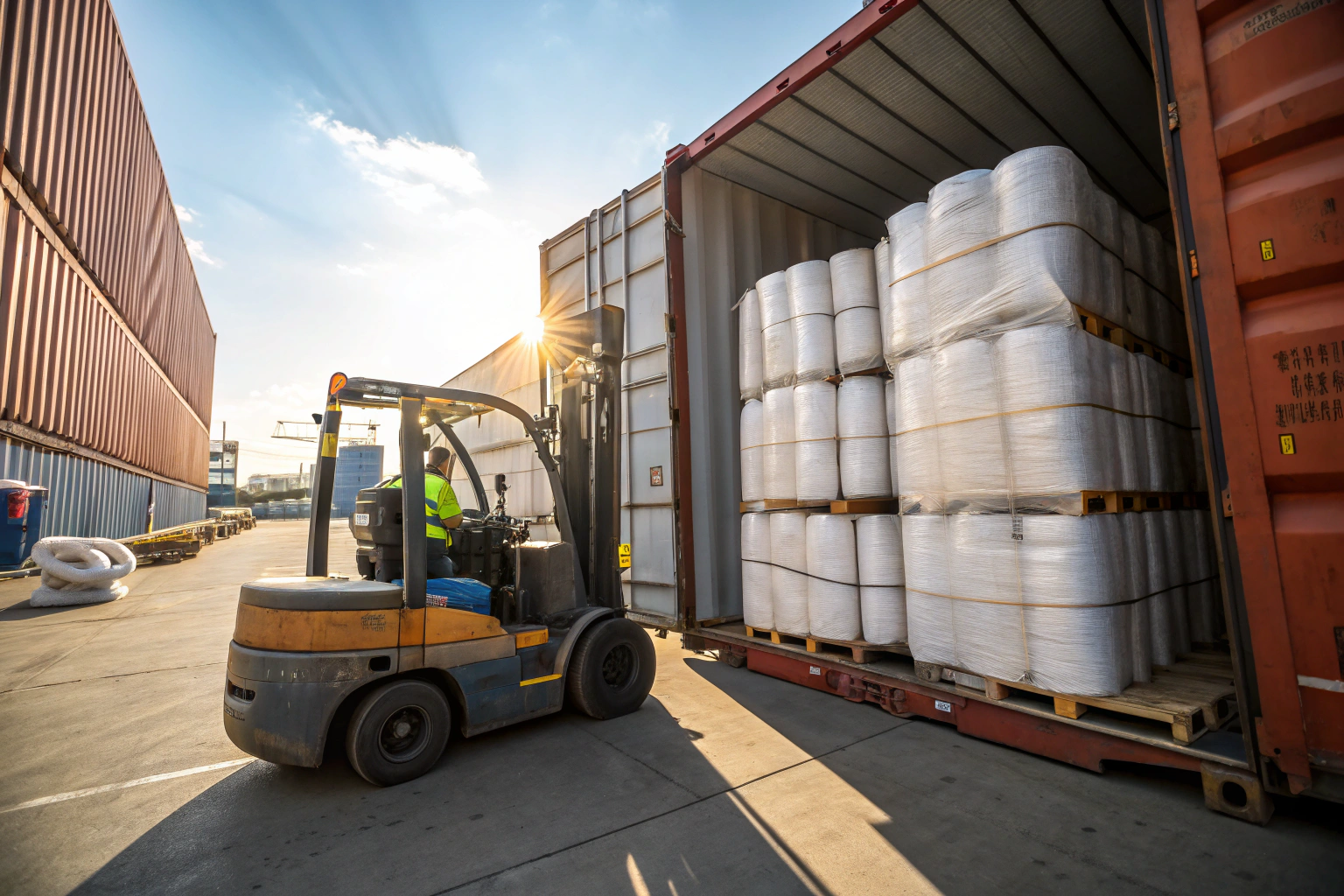
This comes down to the fundamental physics and economics of the two transport modes. Air freight is a scarcity-driven market. The cargo hold of a passenger plane (or a freighter) has limited space and a strict maximum takeoff weight. Every kilogram of cargo burns jet fuel. The airlines charge a premium for weight because weight is the limiting factor.
Sea freight is a space-driven market. A 40-foot container can hold roughly 26,000 – 28,000 kilograms of cargo. The ship is massive. The marginal cost of adding another 500 kilograms of fabric weight is minimal. The fuel consumption of the enormous engine barely changes. The container is moving whether it’s full of 150 GSM chiffon or 400 GSM denim. Therefore, the rate per kilogram is drastically lower for ocean freight.
Let’s look at the Cost Multiple. In April 2026, the ratio of Air Freight to Sea Freight per KG is roughly 12:1. That means air is twelve times more expensive per unit of weight. When you double the weight of your fabric by choosing a heavier GSM, you are multiplying that 12x penalty.
Here is a table that illustrates the pain point:
| Fabric GSM | Order Size (Yards) | Estimated Weight (KG) | Air Freight Cost (Est. $5.50/kg) | Sea Freight Cost (Est. $0.45/kg) | Air vs. Sea Difference |
|---|---|---|---|---|---|
| 180 GSM (Light) | 1,000 | 192 KG | $1,056 | $86 | $970 |
| 280 GSM (Mid) | 1,000 | 299 KG | $1,644 | $135 | $1,509 |
| 380 GSM (Heavy) | 1,000 | 405 KG | $2,227 | $182 | $2,045 |
Notice that as GSM increases, the absolute dollar gap between air and sea widens dramatically. At 180 GSM, the gap is $970. At 380 GSM, the gap is $2,045. This is why we practically beg our clients not to air freight heavy fleece samples unless it’s a fashion emergency (like a Vogue photo shoot or a celebrity seeding deadline). For a broader analysis of this dynamic, this article on comparing air freight and ocean freight costs for ecommerce and wholesale shipments from China breaks down the decision matrix further.
Does Fabric Roll Width Change the Freight Calculation or Just GSM?
Both matter. But Width matters more for Volume than Weight, while GSM matters for Weight. Let me explain the distinction because it trips people up.
Scenario 1: Weight Calculation (The Formula Above).
If you have a 200 GSM fabric that is 44 inches wide vs. 60 inches wide, the 60-inch fabric weighs 36% more per linear yard. Why? Because a linear yard of 60-inch fabric is simply a larger piece of material (5,040 square inches) than a linear yard of 44-inch fabric (3,696 square inches). The GSM is the same, but the area is larger. Therefore, the Weight in KG increases proportionally with width. This affects your Air Freight cost directly.
Scenario 2: Volume Calculation (Container Space).
Sea freight costs are driven by Container Utilization. How many rolls can you fit in a 40ft HQ container?
- Narrow Rolls (44"-48"): Easier to pack tight. You might fit 65,000 yards.
- Wide Rolls (60"-72"): Take up more floor space. You might only fit 50,000 yards.
If you are shipping a full container load (FCL), the ocean freight is a flat rate for the box (e.g., $4,500 for a 40ft to LA). It doesn’t matter if you put 20,000 KG of fabric or 25,000 KG of fabric in that box. The cost is fixed. So, Width affects how many yards you can stuff in the container. If you need 60,000 yards of wide fabric, you might need two containers instead of one. That doubles your freight cost.
At Shanghai Fumao, we optimize roll diameter and width specifically for container packing. We call it "Cube Optimization." We can wind rolls to a specific hardness and diameter to maximize the pieces per pallet. This is the kind of granular detail that saves our high-volume clients thousands of dollars per shipment. For more on this, this guide on how to calculate container loading and optimize fabric roll dimensions for ocean freight provides the technical packing logic.
What Is the Break-Even Point Where Sea Freight Beats Air for Heavy Fabric?
This is the million-dollar question for production managers. You need samples for a sales meeting. You need bulk for a store launch. Do you pay the premium for air and get it in 7 days, or do you save money with sea and wait 35 days? The answer almost always comes down to Weight, Value Density, and Urgency.
There is a mathematical break-even point where the Cost of Capital (the money tied up in inventory on the slow boat) equals the Cost of Air Freight. But for most small to mid-sized brands, the calculation is simpler: Can the product support the air freight cost in its retail price?
Let’s define "Value Density." This is the Retail Value per Kilogram of fabric.
- High Value Density: Silk Charmeuse (Retail $80/meter, Weight 60 GSM). Air freight cost is $0.50 per meter. Negligible. Always ship air.
- Low Value Density: Basic Cotton Fleece (Retail $15/meter, Weight 400 GSM). Air freight cost is $2.50 per meter. That’s 16% of retail price. Insane. Always ship sea.
Here is the Fumao Break-Even Matrix we use internally to advise clients:
| Fabric GSM Category | Order Quantity (Yards) | Recommended Mode | Reasoning |
|---|---|---|---|
| < 200 GSM (Light) | < 300 Yards | Air Freight | Weight is low. Speed justifies cost for samples. |
| < 200 GSM (Light) | > 1,000 Yards | Sea Freight | Economies of scale kick in. |
| 200 – 300 GSM (Mid) | < 200 Yards | Air Freight | Acceptable for urgent photo samples. |
| 200 – 300 GSM (Mid) | > 500 Yards | Sea Freight | Air cost becomes too high a % of landed cost. |
| > 300 GSM (Heavy) | Any Quantity | Sea Freight | Exception: Only air freight if it’s for a celebrity fitting or a trade show deadline. |
A real-world case: December 2025, a UK-based startup ordered 150 yards of our 420 GSM Sherpa Fleece for prototype development. They requested air freight. The fabric cost was $1,200. The air freight quote was $980. I called the client. "Are you sure? This is almost the same cost as the fabric." They were sure. They needed it for a buyer presentation with a major department store. The presentation went well. They got the PO for 5,000 units. That $980 air freight bill was a Marketing Expense, not a Logistics Expense. They understood the game. For a deeper dive into these decision points, this analysis on how to decide between air freight and sea freight for importing goods from China based on product value walks through the financial trade-offs.

How Much Faster Is Air Freight for Fumao Fabric Rolls to the US?
Speed is the only reason to pay the air freight premium. So let’s be precise about what "fast" actually means for a roll of fabric leaving our factory gate in Keqiao.
Air Freight Timeline (Shanghai to Los Angeles):
- Day 1-2: Trucking from Keqiao to Shanghai Pudong Airport (PVG). Export customs clearance.
- Day 3: Flight departure. Flight time ~12 hours.
- Day 4: Arrival LAX. Import customs clearance (assuming docs are perfect).
- Day 5-6: Availability for pick-up or delivery to local warehouse.
- Total Transit Time: 5-7 Days.
Ocean Freight Timeline (Shanghai to Los Angeles):
- Day 1-3: Trucking to Port of Shanghai. Container loading.
- Day 4: Vessel departure.
- Day 5-20: Ocean transit (15-18 days at sea).
- Day 21: Arrival Port of Long Beach. Wait for berth (1-3 days).
- Day 22-25: Unloading, customs clearance, rail/truck drayage to warehouse.
- Total Transit Time: 28-35 Days.
The difference is roughly 4 weeks. That month is the value you are buying with air freight. Is getting your hoodies to market 4 weeks earlier worth $2,000 in extra freight? For a pre-sale campaign that’s about to ship, yes. For a core restock of a basic item that sells year-round, no.
One hidden cost of air freight that surprises clients is Terminal Handling Charges at Origin and Destination. These are fixed fees per shipment (Customs clearance, Airwaybill fee, Security screening). They can add $150 – $300 to a small air shipment regardless of weight. This makes very small air shipments (< 20 KG) disproportionately expensive on a per-kilo basis. We often recommend using a courier consolidator (like DHL or FedEx) for anything under 50 KG. For a more detailed timeline, this resource on current transit times and port congestion updates for Shanghai to US West Coast shipping routes provides real-time data.
Can I Ship a Small Batch of Heavy Fabric by Air Economically?
The short answer is no. The slightly longer answer is: Only if you use an Express Courier service for sample yardage, and you accept the pain.
Here is the reality of air freight pricing. Airlines have a Minimum Chargeable Weight. For loose cargo, it’s often 45 KG or 100 KG. If your shipment weighs 30 KG, the airline will charge you for 45 KG anyway. So your effective rate per kilo is artificially high.
But there is a workaround for Sample Yardage (Under 50 meters) . We can ship via Door-to-Door Express (FedEx, DHL, UPS) . These carriers have their own planes and their own small-package network. They charge a higher rate per kilo than freight forwarders (maybe $8-$12/kg), but they don’t have the 45 KG minimum. If you need 20 meters of 400 GSM fleece (which weighs about 10 KG), the express cost might be $120. Expensive? Yes. But cheaper than paying the 45 KG minimum on air cargo ($250+).
Here is the Fumao Sample Shipping Protocol:
- < 5 KG (Swatches/Color Cards): We use standard post or ePacket. Slow but cheap ($20-$40).
- 5 – 50 KG (Sample Yardage): We use FedEx International Priority. Fast (3-4 days) and transparent tracking.
- > 50 KG (Small Bulk): We get a quote from our Air Freight Forwarder. We compare the 45 KG minimum charge to the FedEx rate and pick the cheaper option.
We shipped a 15-meter roll of 380 GSM Fleece to a client in Texas in January 2026. The roll weighed 8.5 KG.
- Air Cargo Quote (Forwarder): $210 (45 KG minimum).
- FedEx Quote: $105.
We sent it FedEx. It arrived in 4 days. The client was happy. This is the kind of logistics optimization that we handle in-house so you don’t have to learn the arcane rules of IATA air waybills. For a comparison of these services, this guide on how to ship small fabric samples and swatches internationally from China via courier and air freight outlines the options available.
How Can I Use Fabric Weight to Negotiate Better Wholesale Fabric Pricing?
This is an advanced sourcing strategy that separates the amateurs from the pros. Most buyers negotiate on the Price Per Yard. "Can you do $3.80 instead of $4.20?" That’s a zero-sum game. The mill has to cut corners somewhere. But when you understand GSM and Weight, you can negotiate on Value Engineering.
Here is the secret: Fabric cost is 70% Raw Material (Yarn). Yarn is sold by Weight (KG) . Therefore, a 200 GSM fabric consumes exactly twice as much cotton yarn as a 100 GSM fabric of the same construction. The mill’s cost is directly proportional to the GSM. When you understand this, you can have a sophisticated conversation about Target GSM vs. Cost.
Let me give you a specific scenario. You want a "Heavyweight" t-shirt. You see a 240 GSM fabric priced at $4.50/yard. Your budget is $4.00/yard. A rookie asks for a 10% discount. The mill says no, or they say yes and secretly reduce the yarn quality. A pro asks: "What is the price for a 210 GSM version of this same yarn quality?"
Here is the math:
- 240 GSM Cost: $4.50/yard.
- Weight Reduction: 210 / 240 = 12.5% less yarn.
- Theoretical Cost Reduction: $4.50 x 12.5% = $0.56/yard.
- Target Negotiated Price: $4.50 – $0.56 = $3.94/yard.
You just hit your $4.00 budget without asking the mill to cut their margin. You engineered the cost out by adjusting the specification. The mill is happy because their margin percentage stays the same. You are happy because you hit your cost target. The customer is happy because they still get a premium, substantial 210 GSM tee (which is still heavier than the standard 180 GSM fast fashion tee). Everyone wins.
At Shanghai Fumao, we actively help clients do this GSM Value Engineering. We have a chart that shows the price curve for our core yarns. You can slide the GSM scale and see the estimated price change in real-time. This is a partnership approach to costing, not an adversarial one. For more on this technique, this article on how to reduce apparel production costs through fabric weight optimization and value engineering provides a broader view of cost-saving levers.

Does a Lower GSM Always Mean a Cheaper Fabric Price Per Yard?
Yes. With rare exceptions. The raw material (yarn) is the biggest cost driver. Less yarn = lower cost. It’s that simple. However, there is a trap here for the unwary. Knitting Cost and Finishing Cost are relatively fixed per yard, regardless of GSM. They don’t scale down perfectly.
Let me break down a typical cost sheet for a Cotton Jersey:
- Yarn Cost: 65% of total cost. (Scales directly with GSM).
- Knitting Cost: 10% of total cost. (Fixed per yard. Machine runs same speed).
- Dyeing Cost: 15% of total cost. (Fixed per yard. Same water, same chemicals).
- Finishing/Compacting: 10% of total cost. (Fixed per yard).
If you drop GSM from 240 to 210 (12.5% reduction), your Yarn Cost drops 12.5%. But your Total Fabric Cost only drops about 8%. The fixed costs dilute the savings. This is why there is a "Floor Price" for fabric. You can’t make a $1.00/yard cotton jersey no matter how low the GSM goes, because the knitting and dyeing labor costs have a minimum.
The exceptions to "Lower GSM = Cheaper" occur when you switch fiber types. A 100 GSM Silk Charmeuse is astronomically more expensive than a 400 GSM Polyester Fleece. The raw silk filament costs 50 times more than the polyester chip. So while the weight is lower, the value is higher. This is the Value Density concept we discussed earlier.
At Fumao, we always provide a Cost Breakdown upon request. We show you exactly how much of the price is Yarn vs. Processing. This transparency allows you to see where the money is going and make intelligent trade-offs. For a deeper look at textile costing, this resource on understanding the components of fabric cost from yarn to finishing and how GSM affects pricing provides a detailed breakdown of the formulas we use.
Can Fumao Suggest a Slightly Lighter Fabric to Save Me Money on Shipping and Duty?
This is one of the most valuable consulting services we provide, and we do it for free as part of our account management. When a client sends us a target price or a target landed cost, we don’t just say "No." We say, "We can’t hit that price at 300 GSM. But we can hit it at 260 GSM using a slightly tighter yarn twist to maintain the same perceived density and opacity."
This is the art of Textile Substitution. We leverage our 20+ years of experience to find a construction that feels like the target weight to the consumer, but costs less to make and ship.
Here are three specific levers we pull:
- Increase Yarn Twist (TPI): A higher twist makes the yarn more compact and springy. A 260 GSM fabric with high twist can feel just as "substantial" and resistant to stretching as a 300 GSM fabric with low twist. We save 40 grams of cotton per square meter.
- Switch to a Hollow Fiber (e.g., Sorona, Thermolite): These synthetic fibers have air channels inside. A 250 GSM hollow-fiber fleece can be as warm as a 350 GSM cotton fleece. You save 100 GSM of weight, slashing both fabric cost and shipping cost, while maintaining the thermal performance.
- Adjust the Knit Structure (e.g., Interlock vs. Jersey): An Interlock Knit is a double-layer construction. A 200 GSM Interlock feels thick and opaque. A Single Jersey at 200 GSM feels thin and sheer. If you want opacity and structure but need to save weight, we might steer you toward a lighter-weight Interlock instead of a heavier Jersey.
A case study from March 2026: A Canadian outdoor brand wanted our 380 GSM Heavy Fleece for a hoodie. The landed cost was blowing their margin model. We suggested our 320 GSM "High-Twist" Fleece. We sent them a blind hand-feel sample. Their product manager couldn’t tell the difference. The 320 GSM version reduced the fabric cost by 8% and the shipping weight by 16% . The total landed cost per hoodie dropped by $2.15. On an order of 5,000 units, that’s $10,750 in pure profit recovery. That’s the power of having a fabric partner who thinks like a CFO. For more on material substitution, this article on how to select alternative fabrics to reduce weight and shipping costs without compromising garment quality explores similar strategies from a brand perspective.
How Does Fumao Help Me Optimize My Supply Chain Based on Fabric Weight?
Optimizing a supply chain isn’t just about choosing the cheapest carrier. It’s about Synchronizing Fabric Weight, Order Quantity, and Lead Time. A lightweight 120 GSM viscose can move efficiently through air freight for mid-sized orders. A heavy 450 GSM Sherpa must move by ocean, which means you have to plan 45 days in advance. The fabric weight dictates the rhythm of your production calendar.
At Shanghai Fumao, we provide a Tiered Logistics Menu based on the GSM of the fabric you’re ordering. This isn’t a one-size-fits-all "We’ll ship it however you want." This is a strategic recommendation based on what makes financial sense.
Tier 1: Lightweight Fabrics (60 – 180 GSM).
- Logistics Strategy: Flexible. Air freight is viable up to 500 yards. Express courier is viable up to 100 yards.
- Fumao Advantage: We can quickly replenish your stock of linings, chiffons, and lightweight bamboo jerseys with minimal freight penalty. This allows you to run a Lean Inventory model. You don’t need to warehouse 10,000 yards. You can order 1,000 yards and re-order more frequently.
Tier 2: Midweight Fabrics (200 – 300 GSM).
- Logistics Strategy: Sea Freight Preferred. Air freight only for urgent top-up samples.
- Fumao Advantage: This is the sweet spot for Consolidation. We help you combine orders of midweight cottons and French terry into a single LCL (Less than Container Load) shipment. We calculate the optimal cubic meter share to minimize your LCL fees.
Tier 3: Heavyweight Fabrics (320+ GSM).
- Logistics Strategy: Sea Freight Only. Full Container Load (FCL) strongly recommended for orders over 2,000 yards.
- Fumao Advantage: We provide "Container Cube Optimization." We calculate the exact roll diameter and pallet height to maximize the yardage in a 40ft HQ container. For a 400 GSM fabric, fitting an extra 500 yards in the container saves you the cost of a whole second pallet’s worth of LCL fees.
This tiered approach is built into our account management process. When Elaine sends you a quote, she doesn’t just send a price per yard. She sends a Landed Cost Estimate with a note: "Based on the 280 GSM weight, we recommend Sea Freight. If you need 50 yards for a photo shoot, we can split the shipment and send a small roll via FedEx ($85 est.)." That’s the level of proactive thinking that prevents logistics nightmares. For a broader view of these strategies, this resource on how to optimize international supply chain logistics based on product weight and density provides a logistics manager’s perspective.

Does Fumao Offer FOB or CIF Shipping Terms for Heavy Fabric Orders?
Yes, we offer both, and we are fully transparent about the difference. This is a critical distinction that impacts your insurance liability and your control over the shipment.
- FOB (Free on Board): We are responsible for the goods until they are Loaded on the Vessel in Shanghai. We handle the export clearance in China. Once the container is on the ship, You Own the Risk. If the ship sinks in the Pacific, it’s your insurance claim. You also pay the ocean freight directly to your freight forwarder.
- CIF (Cost, Insurance, Freight): We pay for the Ocean Freight and the Insurance to the destination port. We are responsible for the goods until they arrive at the Port of Los Angeles (or New York, etc.). You take ownership once the ship docks.
For heavy fabric orders (high total value), we generally recommend FOB for established importers who have their own freight forwarder relationships and cargo insurance policies. They can often negotiate better ocean freight rates than we can. For smaller brands or first-time importers, we recommend CIF. It’s simpler. You pay one invoice. You know the exact landed cost at the port. You don’t have to figure out how to pay a Chinese shipping line.
Here’s the specific Fumao Heavy Fabric Policy:
- For orders over 5,000 KG (roughly 12,000 yards of 200 GSM fabric) , we provide both FOB and CIF quotes and let you choose.
- We provide the Bill of Lading directly to you or your broker. We don’t hold the documents hostage.
- We include Marine Insurance at 0.3% of invoice value on all CIF shipments.
A client shipping 8,000 yards of 400 GSM Denim in February 2026 opted for CIF. The container value was $42,000. The freight and insurance added $2,800. The client paid one wire transfer, and the goods showed up at their warehouse door in North Carolina (via truck from Charleston port) with zero paperwork hassle on their end. That convenience has value. For a legal explanation of these terms, this guide on understanding FOB and CIF shipping terms for importing goods from China and liability transfer clarifies the exact point of risk transfer.
Can Fumao Store My Bulk Heavy Fabric and Ship It in Smaller Batches?
This is a service we call "Fumao Stock Service" or "Consignment Inventory." It’s a game-changer for brands that sell on a made-to-order or drop-ship model, or for those who don’t have the warehouse space for 10,000 yards of bulky 400 GSM fleece.
Here is how it works:
- You place a Bulk Order for, say, 5,000 yards of Heavyweight Brushed Fleece. This gets you the best bulk pricing and the lowest cost per yard.
- We produce the entire 5,000 yards and store it in our Secure, Climate-Controlled Warehouse in Keqiao.
- You release Partial Shipments as needed. "Fumao, send 200 yards to my LA cutter this week. Next month, send 500 yards to my New Jersey 3PL."
- We pick, pack, and ship the exact yardage you request via Air Courier or LCL Sea Freight, depending on the urgency and weight.
The Financial Benefit:
- Bulk Fabric Price: You lock in the low bulk rate.
- Deferred Shipping Cost: You only pay freight on the fabric as you need it. You don’t tie up $15,000 in inventory sitting on a shelf in a US warehouse costing you $3.00 per pallet per month in storage fees.
- Customs/Tariff Deferral: You only pay US import duties on the specific batches as they enter the country, not on the entire 5,000 yards upfront. This improves your cash flow cycle.
We charge a nominal Storage Fee of $0.15 per roll per week after the first 30 days. This covers our warehousing and inventory management software. We provide a Live Inventory Portal so you can log in and see exactly how many yards of each color are left in your "Virtual Warehouse."
This service is incredibly popular with our Kickstarter and Shopify brands. They do a big production run to get a low unit cost, but they fulfill orders over 6-9 months. They don’t have the infrastructure to manage the logistics. We become their back-end supply chain department. A Portland-based apparel startup has been using this service for 18 months. They’ve shipped 12 partial batches from one single 2024 bulk PO. They estimate it’s saved them $8,000 in US warehousing and double shipping costs. For more on this model, this article on the benefits of supplier-managed inventory and consignment stock for ecommerce apparel brands explains the cash flow advantages.
Conclusion
Fabric weight is the gravitational force of the textile industry. It pulls on everything: the cost of raw materials, the speed of production, the cost of freight, and ultimately, the profitability of your brand. We’ve walked through the exact formulas to calculate shipping weight from GSM, the brutal economics that make air freight a non-starter for heavy fleece, and the smart substitution strategies that can shave thousands of dollars off your landed costs without sacrificing the hand feel your customers love. Ignoring the weight of your fabric is like ignoring the interest rate on a loan—it quietly compounds and eats your margin alive.
At Shanghai Fumao, our goal is to ensure that the number on the freight invoice never comes as a surprise. Whether we’re helping you engineer a 260 GSM fabric that feels like a 300 GSM, storing your bulk inventory in Keqiao for just-in-time shipping, or optimizing the roll diameter to squeeze an extra 500 yards into the container, we treat your logistics costs as if they were our own. Because in a very real sense, they are. When you succeed and re-order, we succeed. It’s a partnership built on transparent numbers and shared goals.
If you’re planning your next production run and want to run a Landed Cost Simulation that includes fabric, freight, and duty based on the specific GSM of your chosen fabric, we’re ready to crunch the numbers with you. Don’t guess. Calculate.
To get a detailed freight estimate or to discuss our Stock Service for heavy fabric storage, please reach out to our Business Director, Elaine. She can provide you with a freight calculator template and walk you through the best shipping strategy for your specific fabric weight and volume. Email her at elaine@fumaoclothing.com. Let’s keep your supply chain lean and your margins healthy.