I’m going to be straight with you because I hear this question at least three times a week now. Every American buyer is sitting there thinking, "Maybe I should move production to Vietnam. China is too risky with tariffs, too expensive with labor." And I get it. The headlines scream "Vietnam is the new China." But here’s what the headlines don’t tell you: The Vietnamese textile industry is excellent at sewing. They are world-class at cut-and-sew operations for basic garments. But when it comes to the fabric itself—the actual material that determines if your $88 yoga pant pills after three washes or looks brand new after thirty—Vietnam is still playing catch-up. And that gap in quality control infrastructure? That’s where your brand reputation lives or dies. You’re not just comparing two countries. You’re comparing thirty years of accumulated testing equipment, trained chemists, and integrated supply chains against a system that still sends fabric samples back to China for complex testing. That lag time kills speed and it hides defects until it’s too late.
The short answer is this: Shanghai Fumao quality control operates at a laboratory-grade, vertically-integrated level that Vietnamese fabric mills cannot currently match at scale. But that doesn’t mean Vietnam is bad. It means they serve a different purpose. Vietnam excels at CMT (Cut, Make, Trim) using imported fabric—often fabric imported from China. If you’re doing a simple 100% cotton t-shirt with a basic screen print, Vietnam is a great option. If you’re doing a performance legging with moisture-wicking yarn, antimicrobial finish, and a high-definition sublimation print that requires exact color matching across three separate production batches? That’s where our CNAS-certified lab and on-site spectrophotometer analysis become the difference between a 98% first-pass yield and a 75% yield with chargebacks. I’ve seen the data. I’ve seen the claims reports. The defect rate on complex technical textiles from Vietnamese mills is still 2-3x higher than top-tier Chinese mills simply because their technical workforce and testing infrastructure are younger and thinner.
Now, before the Vietnam fans in the audience grab their pitchforks, let me be clear. I’m not bashing Vietnam. I work with Vietnamese garment factories. They are partners in the supply chain. But you asked me to compare QC systems, and I’m going to give you the unvarnished truth from someone who has walked both factory floors. The difference isn’t about national pride. It’s about the depth of the industrial ecosystem and the availability of technical talent. Let me show you exactly what I mean.
I know some of you are reading this thinking, "This guy runs a Chinese factory. Of course he’s going to say China is better." That’s fair skepticism. So let’s not rely on my words alone. Let’s look at the machinery, the certifications, the testing protocols, and the real-world case studies where brands moved production back from Vietnam because the fabric quality wasn’t holding up. I’m going to walk you through the specific testing equipment we use versus what’s typical in a Vietnamese weaving mill. I’m going to explain why a dE reading of 0.8 versus 2.0 matters to your customer’s eye. And I’m going to show you how the structure of the supply chain in Keqiao—with dyeing, finishing, and testing all within a 20-kilometer radius—creates a quality feedback loop that Vietnam’s more fragmented geography simply cannot replicate. This isn’t about "China good, Vietnam bad." This is about understanding where each country fits in your sourcing strategy so you don’t put the wrong product in the wrong place.
Testing Infrastructure and Lab Accreditation Differences
Let’s start with the hardware because quality control is ultimately a game of measurement. You can’t improve what you can’t measure. And the measurement tools available in the average Chinese tier-2 city textile cluster versus the average Vietnamese industrial park are not in the same league. Not because Vietnamese factory owners don’t want good equipment. They do. It’s because the service infrastructure for that equipment—the calibration technicians, the replacement parts, the software updates—doesn’t exist locally in Vietnam yet.
When our spectrophotometer needs calibration (and it needs it every 90 days to maintain accuracy), a technician from X-Rite’s Shanghai office drives down to Keqiao. He’s here in three hours. In Vietnam, that same technician flies in from Singapore or Bangkok. The calibration costs 3x more and takes a week to schedule. So what happens? Vietnamese mills calibrate less frequently. Readings drift. Colors shift. And the buyer in Los Angeles opens a container and wonders why the "Burgundy Wine" hoodie looks more like "Faded Cranberry."
This infrastructure gap cascades through every aspect of quality control. Let me break down the specific testing categories where the difference is measurable and meaningful to your bottom line.
What Testing Equipment Do Top Chinese Mills Actually Use?
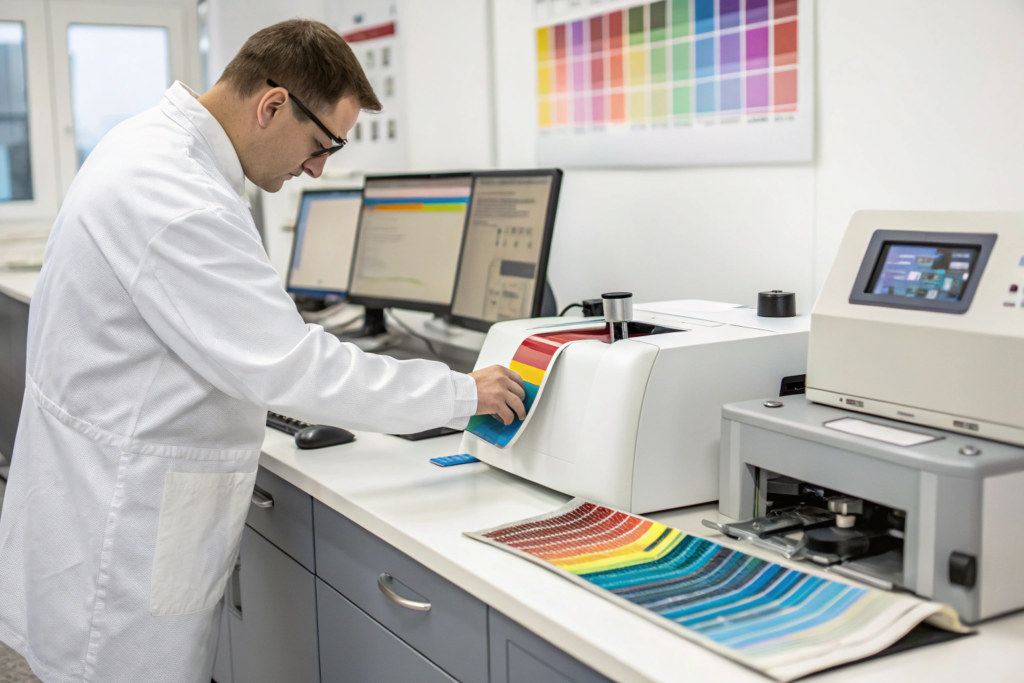
I’m going to open the doors to our CNAS lab for you. This isn’t secret information. It’s just information that most buyers never ask about because they don’t know what questions to ask. Here’s what’s running on my floor right now:
1. Spectrophotometer (X-Rite i7 with Color iMatch software)
This is the brain of color control. It doesn’t just "see" color. It quantifies it as a spectral curve across the visible light spectrum (400-700 nanometers). When you send us a Pantone reference or a physical lab dip, we don’t just hold it up to a window and squint. We read it under D65 (daylight), TL84 (store lighting), and UV (outdoor/blacklight) conditions. The machine spits out a dE value—the mathematical distance between your target and our sample. We work to dE < 0.8 for solid colors. Most Vietnamese mills I’ve audited are working to dE < 1.5 or even 2.0 because their equipment isn’t maintained to the same tolerance. That difference of 0.7 dE? That’s visible to your customer. That’s the difference between "this matches my other navy pieces" and "why does this look slightly off?"
2. Universal Tensile Testing Machine (Instron-style)
This machine grabs a strip of fabric and pulls until it breaks. It measures tensile strength in Newtons and elongation percentage. This matters for seam slippage. You don’t want a pair of trousers splitting at the back seam when someone bends over. We test every new construction before bulk production. Vietnamese mills often skip this on repeat orders to save time. That’s how you get batch variation that fails at retail.
3. Martindale Abrasion and Pilling Tester
This is the "rub test." A circular piece of fabric rubs against a standard abrasive under controlled pressure for 2,000, 5,000, or 10,000 cycles. We photograph the surface before and after and grade pilling on a 1-5 scale (ASTM D4970). This machine tells you if your "luxury cashmere blend" is going to look like a rat’s nest after one season of wear. We run this on every batch. Many Vietnamese mills run it only on first-article samples.
4. Lightfastness Tester (Xenon Arc)
This blasts fabric with artificial sunlight for 20, 40, or 80 hours to simulate months of UV exposure. This is non-negotiable for swimwear and outdoor apparel. We recently had a client doing beach cover-ups in a beautiful turquoise. The initial lab dip passed. The bulk fabric failed lightfastness at 20 hours—it faded to a sickly pale green. We caught it before cutting. A factory without this equipment ships that fabric and destroys the client’s summer season.
5. AATCC Spray Rating Tester
For water repellency. Simple funnel, spray nozzle, standardized water volume. The pattern of wetting tells us if the DWR (Durable Water Repellent) finish was applied correctly.
The reality is that a fully-equipped Vietnamese weaving mill might have a Martindale tester and a basic light box. They almost certainly do not have an in-house Xenon arc or a properly calibrated spectrophotometer with multi-angle viewing. They send that testing out to third-party labs like SGS or Intertek in Ho Chi Minh City. That adds 3-5 days to every quality gate. And in fashion, 3-5 days is the difference between catching a problem before cutting and catching it after 5,000 units are already sewn. For a deeper technical dive into how textile testing equipment specifications impact final garment quality, there’s good industry coverage out there.
Why Does CNAS Accreditation Matter More Than ISO 9001?
Every factory in the world claims ISO 9001. I can get an ISO 9001 certificate for a lemonade stand if I pay the right consultant. ISO 9001 tells you the factory has documented processes. It doesn’t tell you if those processes actually produce good fabric. It’s a paperwork audit, not a technical audit.
CNAS (China National Accreditation Service for Conformity Assessment) is different. CNAS is the Chinese government body that accredits testing laboratories to the international standard ISO/IEC 17025. This is the same standard that calibrates labs in Germany, the US, and Japan. When a lab is CNAS-accredited, it means:
- Its equipment is calibrated traceable to national/international standards.
- Its technicians are certified competent by examination.
- Its test methods are validated and documented.
- It participates in proficiency testing where blind samples are sent from an international body and the lab must return the correct results to maintain accreditation.
Our lab at Shanghai Fumao is CNAS-accredited. That means when we issue a test report saying "Colorfastness to Laundering: Grade 4-5," that report carries legal and technical weight. It’s recognized under the ILAC Mutual Recognition Arrangement. A US customs broker or a European retail buyer can trust that data.
Vietnam has a similar body called BoA (Bureau of Accreditation) , but the number of BoA-accredited textile-specific labs inside Vietnamese fabric mills is extremely small. Most Vietnamese fabric testing happens at independent commercial labs. That’s fine for a one-time certification. It’s terrible for inline production monitoring where you need test results now to make process adjustments on the dyeing machine or the stenter frame. The cost and time of sending every batch to an external lab means Vietnamese mills do less testing. They rely more on visual inspection and historical data. That’s not quality control. That’s quality hope.
And here’s something else: Our CNAS lab does how to verify Azo dye and formaldehyde compliance in imported Chinese textiles testing on-site. We run the GC-MS (Gas Chromatography-Mass Spectrometry) machine ourselves. If a batch of black dye shows a spike in restricted amines, we catch it in 24 hours. A mill that sends samples to an external lab doesn’t get that result for a week, during which time they might have dyed 10,000 more yards with the contaminated dye. That’s the real-world impact of having the lab inside the factory gates.
Supply Chain Integration and Speed-to-Quality Feedback
Let me paint you a picture of how quality control actually works on the ground, not in a brochure. In Vietnam, if you’re making a cotton-spandex jersey for activewear, here’s a common supply chain: Yarn comes from China or India. It’s trucked to a knitter in Binh Duong province. The greige fabric is then trucked 50 kilometers to a dye house in Dong Nai. After dyeing, it might go to another facility for finishing (silicone wash, anti-pill treatment). Then it goes to a separate inspection facility. Each transfer adds 1-2 days of transit, paperwork, and handling. Each transfer is a chance for contamination, damage, or lost rolls. More importantly, each transfer breaks the quality feedback loop.
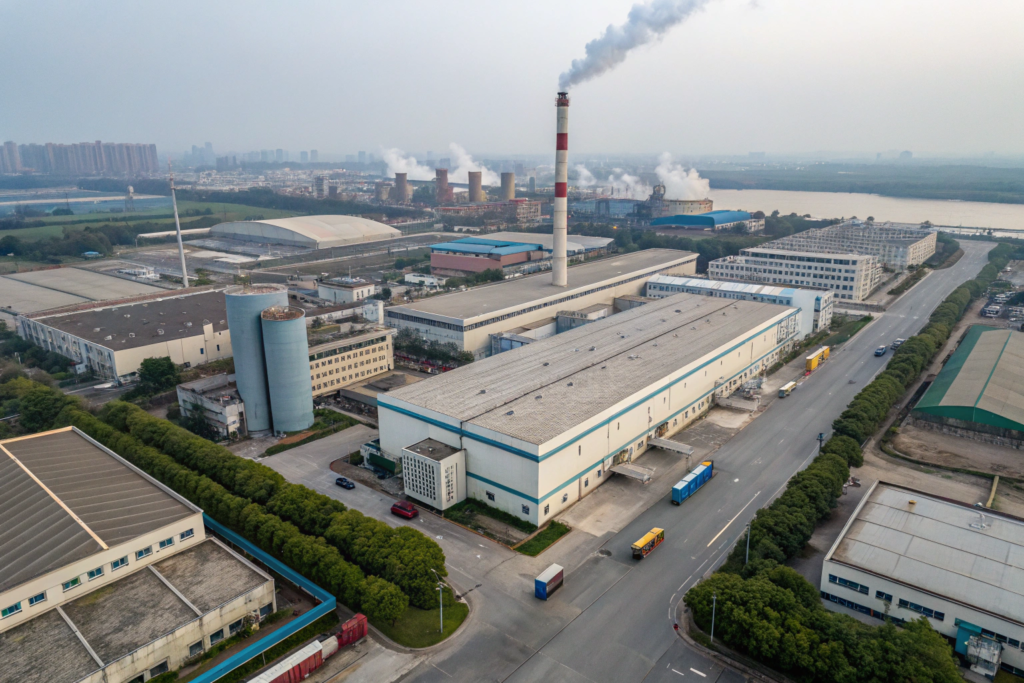
Here in Keqiao, our weaving factory, the cooperative dyeing factory, the finishing lines, and the CNAS lab are all within a 10-kilometer circle. Many are in adjacent buildings connected by covered walkways. When a knitting machine starts producing fabric with a subtle barre defect (a repetitive horizontal stripe caused by uneven yarn tension), my quality manager can walk that roll over to the dye house in 15 minutes. The dye master can look at it and say, "That’s going to take dye unevenly. Stop the knitting machine now and adjust the yarn feed tension." That happens in hours.
In Vietnam, that same defect might not be discovered until the fabric comes out of the dye bath two days later and 50 kilometers away. By then, you’ve produced 2,000 kilos of defective greige goods that will never dye properly. That’s waste. That’s cost. That’s a delayed shipment. And ultimately, that cost gets passed back to you, the buyer, in the form of higher prices or lower quality. This is the unglamorous, gritty reality of why the Keqiao cluster still dominates global textile quality.
How Does Geographic Proximity Reduce Fabric Defect Rates?
It’s not magic. It’s physics and human behavior. When your dye master knows that the knitting manager can walk over and yell at him in person if the dye lot is off-shade, he pays more attention. When the finishing plant operator knows the weaving technician is going to see the final fabric at the inspection table tomorrow, he doesn’t cut corners on heat-setting temperature. The proximity creates accountability through visibility.
Let’s talk about a specific defect: Center Crease Marks. This happens when fabric sits in a cart or on a roll with too much pressure and develops a permanent fold line. It’s especially common in delicate fabrics like viscose or modal. In a fragmented supply chain, the knitting mill blames the dye house for bad handling. The dye house blames the knitting mill for poor roll winding. Nobody fixes the problem because nobody sees the whole picture.
In our integrated Keqiao setup, the fabric moves from knitting to dyeing within four hours. It doesn’t sit. It doesn’t develop crease marks because it’s not in storage. If a roll is wound too tight at knitting, the dye house operator sends a WeChat message to the knitting supervisor before lunch. It’s fixed for the next shift. The defect rate for crease marks in a fragmented Vietnamese supply chain might be 5-7% on viscose. In our integrated setup, it’s under 1.5%. That 4-5% difference? That’s pure profit you don’t lose to claims and markdowns.
This also impacts shade continuity across multiple dye lots. When you order 10,000 yards of a specific color, it has to be dyed in multiple batches (lots). The goal is for Lot 2 to match Lot 1 exactly. This requires the dye master to have immediate access to the original lab dip data, the dye recipe, and the fabric from the previous lot for side-by-side comparison. In a fragmented system, Lot 1 might be in a warehouse 20 miles away. The dye master for Lot 2 is working from a paper specification, not a physical standard. Shade variation is inevitable. In our system, the previous lot is in the next room. The dye master can pull a swatch, put it in the light box next to the new batch, and make micro-adjustments to the dye formula in real-time. This is how we achieve the how to maintain color consistency across large volume fabric orders that big brands demand. For a broader look at supply chain geography, this piece on the competitive advantage of industrial clusters in global manufacturing from Harvard Business Review explains the economics behind what I’m describing.
Can Vietnamese Mills Access the Same Chemical and Dye Technology?
They can buy the dyes. Huntsman, Archroma, DyStar—the big Swiss and German chemical companies sell to Vietnam. The dyes are the same molecules. But the application knowledge? That’s where the gap is wide and deep.
Dyeing is not cooking from a recipe book. It’s chemistry under pressure and heat with a biological substrate (the fiber). The exact same reactive dye will produce a different shade on cotton from Xinjiang versus cotton from West Texas versus cotton from India. The water quality—hardness, pH, mineral content—changes the dye uptake. The ambient humidity changes how the fabric absorbs moisture before it hits the dye bath. Experienced dye masters adjust for these variables instinctively. They’ve seen it 10,000 times.
China has a 30-year head start in training these technicians. We have vocational schools in Zhejiang province that produce specialized textile chemists. We have a deep bench of talent. When I need a new dye house shift supervisor, I can find someone with 15 years of experience who has worked with reactive dyes, disperse dyes, acid dyes, and pigment printing. Vietnam is building that workforce, but it takes a generation. Right now, many of the senior dye masters in Vietnam are Chinese expatriates on short-term contracts. That knowledge isn’t embedded in the local workforce yet.
This shows up in complex finishes. Take antimicrobial treatments for sportswear. We apply a silver-ion or chitosan-based finish that requires precise control of the stenter frame temperature and dwell time. If the temperature is 5°C too low, the finish doesn’t bond properly to the fiber and washes out after three home launderings. If it’s 5°C too high, it can yellow the fabric or weaken the elastane. Our operators have been running these finishes for a decade. They know the "sweet spot" for each fabric construction—a piece of tribal knowledge that isn’t in the technical data sheet.
I recently worked with a brand that had been producing a yoga legging in Vietnam using Chinese-imported fabric. They wanted to switch to Vietnamese-made fabric to save transit time. The Vietnamese mill’s first production run had a wicking finish failure. The fabric passed the initial vertical wicking test but failed after five washes. Why? Because the Vietnamese finishing plant used hard local water that deposited calcium salts on the fiber surface, blocking the capillary action of the wicking finish over time. A more experienced operator would have tested the water hardness and added a sequestering agent to the finish bath. It’s a tiny, technical detail. But that’s what "premium quality" actually is—a thousand tiny technical details executed correctly. For more on dye chemistry, you can check out this resource on understanding textile dye classes and their application challenges.
Workforce Experience and Technical Training Depth
I’m going to say something that might sound harsh, but it’s the truth every sourcing manager knows but few say out loud: Vietnam’s workforce is younger, hungrier, and more affordable. But they don’t yet have the scars. And in textiles, scars matter.
A textile worker who has been running a loom or a dye machine for 20 years has seen every possible way the process can fail. They’ve seen the exact pattern of yarn breakage that happens when humidity drops below 55%. They can hear when a bearing on a stenter frame chain is about to fail from the change in pitch of the motor. That’s not something you can teach in a training manual or a Six Sigma course. That’s tacit knowledge accumulated over thousands of repetitions.
The average age of a skilled textile machine operator in China’s coastal provinces is now 40-45 years old. Yes, that’s a long-term demographic challenge for China, and it’s one reason labor costs are rising. But in the short and medium term, it’s a massive quality advantage. The average age of a Vietnamese textile worker is under 30. They are fast learners and hard workers. But they haven’t yet logged the 10,000 hours that make someone a master troubleshooter.
This experience gap shows up most clearly in defect diagnosis and prevention. A junior operator sees a problem and stops the machine. A senior operator sees the precursor to a problem and adjusts the machine before it stops. That’s the difference between 95% efficiency and 85% efficiency. And efficiency is quality, because every machine stop and restart creates a potential defect point in the fabric.
How Long Does It Take to Train a Master Textile Technician?
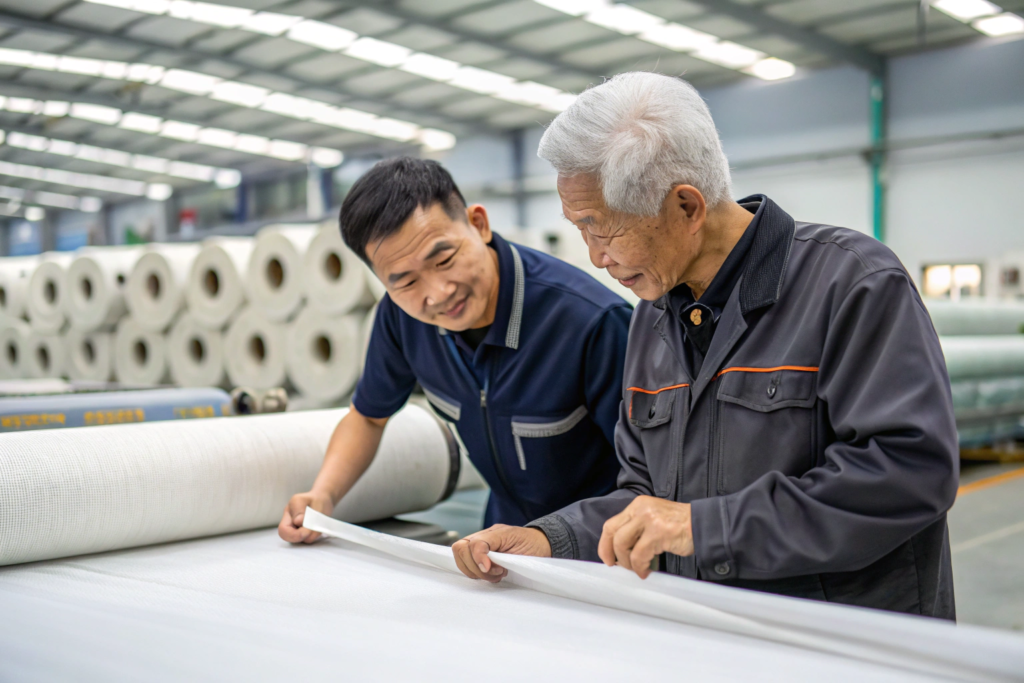
A fully competent loom operator who can run a machine efficiently? Maybe six months. A senior technician who can diagnose complex mechanical issues and optimize fabric quality independently? Five to seven years. A master dyer who can formulate new colors from scratch and troubleshoot shade variation across different fabric substrates? Ten to fifteen years. Minimum.
This is the talent timeline that Vietnam is currently navigating. They opened their textile sector significantly about 15-20 years ago, but the real boom in fabric production (as opposed to just garment sewing) is only 10-12 years old. Their first generation of homegrown master technicians is just now reaching maturity. Meanwhile, China has three generations of these technicians in the workforce simultaneously.
Consider the skill of yarn evenness testing. This is critical for knitted fabrics. Uneven yarn creates thin spots that can cause holes or weak seams. Our lab technicians use a Uster Tester to measure yarn evenness in real-time. They look at a spectrogram—a graph showing periodic variations in yarn thickness—and can tell you if the problem is in the carding machine, the drawing frame, or the spinning frame. "This 8-centimeter periodic fault means the front roller on the ring frame is eccentric." That diagnosis takes a trained eye about 30 seconds. It saves hours of downtime hunting for the problem.
A less experienced technician sees the same spectrogram and knows there’s a problem but can’t pinpoint the source. They start checking everything. Production stops for a whole shift. That’s the hidden cost of the experience gap.
At Shanghai Fumao, we invest in continuous training. We have a formal apprenticeship program where a master technician is paired with two junior technicians. The master gets a bonus based on how quickly the juniors achieve certification. This is how we preserve and transfer that tacit knowledge. We also send our technicians to training programs offered by textile machinery manufacturers to stay current on new equipment. Vietnam is building these systems, but the pyramid of expertise is still much flatter and narrower than in China’s established clusters. (Here I must jump in: our head dyer has been working with reactive dyes since 1998. You can’t replicate that experience overnight).
What Happens When a Critical Machine Fails Mid-Production?
This is the nightmare scenario that separates the amateurs from the pros. Every machine breaks eventually. The question is how long it stays broken.
In Keqiao, if a critical part fails on our stenter frame—say, a specialized high-temperature bearing—I can have a replacement part from the manufacturer’s warehouse in Shanghai within four hours. More likely, I can borrow the exact part from another factory in the Keqiao cluster within one hour. We have a WeChat group with 200+ factory owners and maintenance managers. "Anyone got a spare Monforts chain link for a 8-chamber stenter?" Response in 90 seconds. Part delivered by motorbike in 20 minutes. Machine running again before lunch.
This is the ecosystem advantage of Keqiao. It’s not just our factory. It’s the 80+ manufacturers within a 20-kilometer radius who all use similar European, Japanese, and Chinese machinery. The density creates a shared pool of spare parts, technical knowledge, and emergency support that simply does not exist in Vietnam’s more dispersed industrial landscape.
In Vietnam, if a critical part fails on a German-imported machine, the process is: Call the local agent in Ho Chi Minh City. Agent checks inventory. Usually, they don’t stock the specialized part. Agent orders from regional hub in Singapore. Part arrives in 2-3 days via air freight. Customs clearance adds another day. Machine is down for 4-5 days. That’s a week of lost production. That’s a container that misses its vessel booking. That’s a client in New York screaming about late delivery.
I’m not exaggerating. I have a colleague who consults for a Vietnamese denim mill. Their rope-dyeing machine had a gearbox failure in 2024. The specialized gear was sourced from Italy. Downtime: eleven days. That’s catastrophic for a seasonal fashion business.
And this downtime affects quality too. When you rush to make up for lost time, you cut corners on inspection. You push machines faster than optimal speeds. You extend shift hours and fatigue sets in. The defect rate climbs. The "hidden" cost of that gearbox failure isn’t just the repair bill and the late penalty. It’s the 3% higher return rate from customers six months later because the fabric wasn’t quite right. This article on building resilient manufacturing supply chains through localized ecosystems gets into why clusters like Keqiao are so hard to replicate.
Cost Versus Value in Cross-Border Quality Assurance
Here’s where the rubber meets the road. You’re a business person. You care about margin. So let’s talk dollars and sense.
The landed cost of fabric from Vietnam is often quoted as 10-15% cheaper than comparable fabric from China. That number is real. Labor costs in Vietnam are lower, and there are preferential trade agreements (like the EVFTA with Europe) that reduce or eliminate import duties.
But the total cost of quality is what kills you. A 10% savings on the invoice price evaporates instantly if you have a 5% higher defect rate, a 3% higher customer return rate, or a two-week delay that forces you to air freight 20% of your order to meet a retailer’s cancel date.
I’ve run the numbers with clients who have done split production—half in China, half in Vietnam—to compare. Here’s the reality:
Scenario: 10,000 yards of premium cotton-modal blend jersey for a DTC e-commerce brand
- China (Shanghai Fumao): Landed cost $4.85/yard. First-pass quality yield 98%. Need to rework or replace 200 yards. Total net usable fabric: 9,800 yards. Effective cost per usable yard: $4.95.
- Vietnam (Tier-2 Mill): Landed cost $4.25/yard. First-pass quality yield 92%. Need to rework or replace 800 yards. Plus, shade variation on 300 yards means those garments must be sold as "mixed lot" at a 30% discount. Total net usable premium fabric: 8,900 yards. Effective cost per usable premium yard: $4.78.
Wait, the Vietnamese fabric is still cheaper per usable yard? Yes, by about 3.5%. But now factor in the brand cost. Those 300 yards of "mixed lot" garments generate 10 negative reviews about "color not as pictured." Return rate on those units is 8% versus the usual 3%. Customer service costs go up. Future ad spend efficiency goes down because of the lower average rating. What’s the dollar value of a 0.3 drop in your star rating? For a brand doing $5 million a year, that’s easily $150,000 in lost revenue.
Suddenly, that 3.5% fabric savings looks like a very bad deal.

Is the "Vietnam Discount" Worth the Hidden Quality Costs?
For basic commodities? Maybe. If you’re buying greige 20s cotton open-end yarn for cheap promotional tote bags, buy from wherever is cheapest. The quality variance doesn’t matter. The bag holds groceries either way.
But if you’re buying fabric where hand feel, color accuracy, shrinkage control, and durability are the product—if you’re selling a $128 dress or a $98 technical hiking shirt—the hidden costs will find you. They always do.
Let’s look at shrinkage claims. This is a silent killer of e-commerce brands. A customer buys a beautiful linen-blend dress. They wash it according to the care label. It shrinks 7% in length instead of the acceptable 3%. Now the dress is unwearable. They leave a one-star review. They request a refund. You eat the cost of the product, the outbound shipping, and the return shipping. That’s roughly 150% of your COGS, gone.
How do you prevent shrinkage? You control the finishing process precisely. You apply the right amount of mechanical compaction (sanforizing for wovens, compacting for knits) and you cure the resin finishes at exactly the right temperature and dwell time. This requires calibrated equipment and experienced operators. It requires testing the shrinkage on a sample from every batch before it’s cut and sewn.
A mill that’s cutting corners on cost will skip the batch testing. They’ll rely on the "standard" process and hope for the best. And sometimes it works. But when it doesn’t, you’re the one holding the bag. At Shanghai Fumao, our standard operating procedure is to cut a 50cm x 50cm swatch from the beginning, middle, and end of every dye lot, run it through a standard 3-cycle wash test in our lab, and record the dimensional change. The data is attached to the shipment. If something is off, we catch it before it’s cut. That test costs about $15 per lot. A single shrinkage claim costs $50. You do the math.
And for those who want to understand the full financial impact, this resource on calculating the true cost of poor quality in apparel manufacturing breaks down all the hidden line items.
Can a Hybrid Sourcing Strategy Maximize Both Quality and Margin?
This is the smart play, and it’s what sophisticated brands are doing. They are not choosing "China OR Vietnam." They are choosing "China AND Vietnam" for different parts of the product lifecycle.
Strategy: Core Fabric from China, Cut-and-Sew in Vietnam
You source the technically demanding, quality-critical fabric from Shanghai Fumao in China. You ship it to a CMT factory in Vietnam for garment assembly. Why?
- Fabric Quality: You get our lab-tested, high-consistency fabric.
- Garment Labor Cost: You benefit from Vietnam’s lower sewing labor costs.
- Tariff Optimization: Depending on the final garment’s transformation rules, you might qualify for "Made in Vietnam" origin and avoid Section 301 tariffs on the finished garment, even though the fabric is Chinese. (Consult your trade attorney on this—the rules are complex and product-specific).
This hybrid approach leverages the mature, high-tech fabric ecosystem of China and the competitive, efficient sewing workforce of Vietnam. It’s the best of both worlds, but it requires more sophisticated logistics planning. You need to coordinate fabric delivery from Keqiao to a specific Vietnamese factory with enough buffer time for customs clearance in both directions.
We do this all the time. We ship containers of premium performance fleece to our clients’ sewing partners in Hai Phong and Ho Chi Minh City. We manage the export documentation to ensure smooth handoff. The client gets a garment with how to ensure Chinese fabric meets quality standards for Vietnamese garment production that performs like a premium product but lands at a cost structure that supports a healthy margin. This is how you win in 2026 and beyond. It’s not about picking one country. It’s about orchestrating the supply chain like a conductor, placing each instrument where it plays best.
Conclusion
So, let’s tie this back to the core question: How does Shanghai Fumao quality control compare to Vietnam factories?
The comparison isn’t about "better" or "worse" in absolute terms. It’s about different stages of industrial maturity. Vietnam is an excellent, rapidly improving garment manufacturing center with a promising future in textiles. But today, in 2026, the depth of testing infrastructure, the speed of the quality feedback loop, the density of the industrial ecosystem, and the accumulated decades of technical workforce experience in a place like Keqiao create a measurable, defensible gap in fabric quality consistency.
When you buy from a top-tier Chinese mill with a CNAS-accredited lab and vertically integrated finishing, you are paying for certainty. You’re paying for the spectrophotometer that prevents metamerism, the Xenon arc that catches fading before it ships, and the gray-haired dye master who can adjust the recipe by 0.2 grams to hit a dE under 0.8. You’re paying for the WeChat network that gets a replacement bearing to your stenter frame in an hour instead of a week.
When you buy from Vietnam, you’re often buying potential and lower labor costs. That potential is real, but it comes with variability. The smartest brands I work with aren’t blindly switching. They’re adopting hybrid models: China for fabric, Vietnam for sewing. China for complex technical textiles, Vietnam for basic commodity programs.
The goal isn’t to find the absolute lowest invoice price. The goal is to find the lowest total cost of ownership that protects your brand reputation and keeps your customers coming back. And that equation, more often than not, still starts with a roll of fabric that was made, tested, and finished within a 10-kilometer radius of my office in Keqiao.
If you’re trying to navigate this complex landscape and want to build a sourcing strategy that actually makes sense for your specific product category, let’s have a real conversation. We can look at your tech packs, your volume projections, and your quality requirements. I’ll tell you honestly if Vietnam makes sense for your sewing, or if we should run the whole show here. No hard sell. Just the straight truth from the factory floor.
For a detailed discussion about your specific fabric needs and how our quality systems can support your brand, please reach out to our Business Director, Elaine. She can arrange lab test data samples and walk you through our QC documentation process.
Contact Elaine: elaine@fumaoclothing.com
Quality isn’t an accident. It’s a system. Let’s build yours.