I've lost count of how many times a client has called me, frustrated, holding a sample that looked perfect in the swatch but felt completely wrong in the bulk fabric. They'll say things like, "It's the same cotton, but this one feels flimsy," or "I asked for a heavy fabric, but this is stiff like cardboard." Nine times out of ten, the confusion comes down to two terms that even experienced buyers mix up: yarn count and fabric density.
These are the fundamental building blocks of any textile. Get them right, and you can engineer a fabric to do exactly what you want. Get them wrong, and you'll end up with a dress that doesn't drape, a shirt that feels rough, or a sofa fabric that wears out in a year. At Shanghai Fumao, we deal with these specifications every single day, whether we're weaving a delicate silk chiffon for a European fashion house or a heavy-duty canvas for a US workwear brand.
In this post, I'm going to break down exactly what yarn count and fabric density mean, how they interact, and why you need to specify both when sourcing from China. I'll give you the technical details, but I'll also explain it in plain English so you can walk into your next supplier conversation with confidence. We'll look at real examples from our production lines—like the time in early 2024 when a New York designer's dress fabric was failing because she specified the right count but the wrong density. Let's clear up the confusion once and for all.
What is Yarn Count and Why Does It Matter?
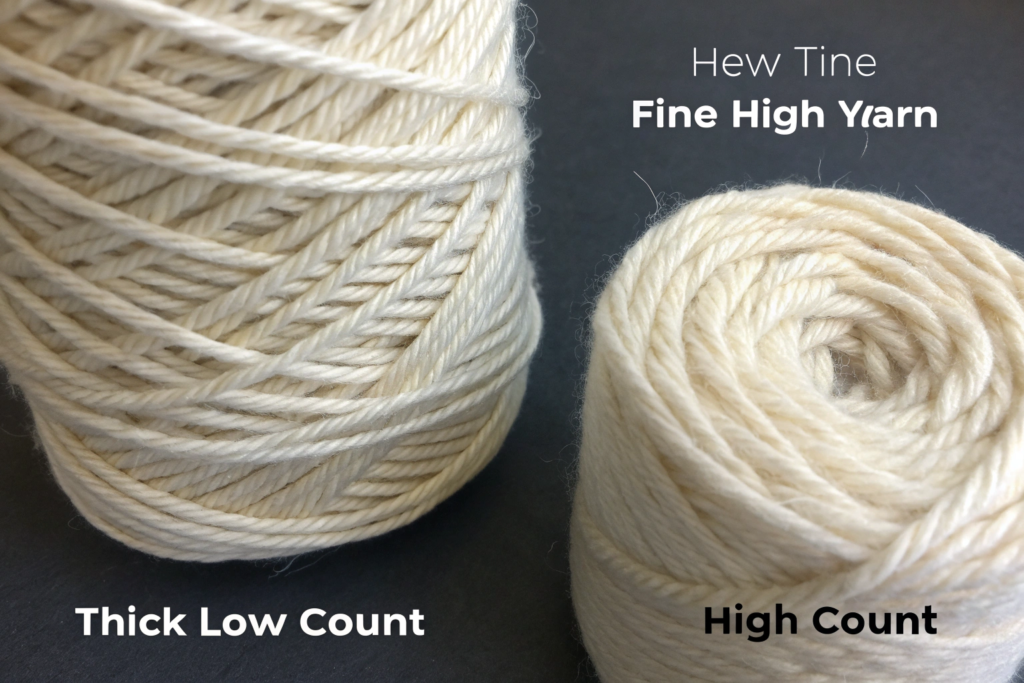
Yarn count is essentially a measure of the thickness or fineness of the yarn. It tells you how much a given length of yarn weighs, or how long a given weight of yarn is. Different fiber types use different systems, which is where most of the confusion starts. But at its core, yarn count is about the individual threads that go into the fabric.
In the cotton world, we mostly use the cotton count system (Ne). This is the number of hanks (each 840 yards long) it takes to make one pound of yarn. So a Ne 20 yarn is relatively thick—you need 20 hanks to make a pound. A Ne 60 yarn is very fine—you need 60 hanks to make a pound. The higher the cotton count number, the finer the yarn. For polyester and filaments, we use denier (D) or decitex (dtex). This is the opposite: it's the weight in grams of 9,000 meters of yarn. So a 150D polyester yarn is thicker than a 50D polyester yarn. Higher denier = thicker yarn.
Why does this matter for your garment? Yarn count directly affects the hand feel, the drape, and the strength. A fine, high-count yarn (like Ne 80/1 for a luxury shirting) will create a fabric that's smooth, soft, and lightweight. A coarse, low-count yarn (like Ne 10/1 for a denim) will create a fabric that's heavy, rugged, and textured. I always tell clients: the yarn count is the starting point. It's the ingredient. In 2023, a client from London came to us wanting a "soft, lightweight" cotton voile for summer blouses. The first sample they sent was made with a Ne 30 yarn, which was too heavy. We re-developed it with a Ne 60 yarn, and the fabric transformed—it became airy, translucent, and soft. Same fiber, same weave, different yarn count. For a deeper dive into the math, this textile engineering forum has a great explainer on all the different systems.
How do we choose the right yarn count for a specific garment?
There's no single "right" answer, but there are guidelines based on the end use. For a flowing dress, you generally want a finer yarn count to allow for better drape. Think Ne 60 to Ne 80 for cotton, or 30D to 50D for polyester or silk. For a structured blazer or a pair of trousers, you need a medium yarn count, maybe Ne 40 to Ne 50, to give the fabric enough body to hold a shape without being stiff.
For heavy-duty applications like workwear or upholstery, you're looking at low yarn counts—Ne 10 to Ne 20, or high deniers like 300D to 600D. These thick yarns provide durability and abrasion resistance. We worked with a Canadian outdoor gear company in 2022 to develop a fabric for backpacks. They needed something incredibly strong but still lightweight. We ended up using a high-tenacity nylon in 420D. That specific denier gave them the strength they needed without the weight of a 600D. The choice of yarn count is always a trade-off between durability, weight, and hand feel. This garment manufacturing blog has a handy chart matching yarn counts to common garment types.
What is Fabric Density and How is It Measured?
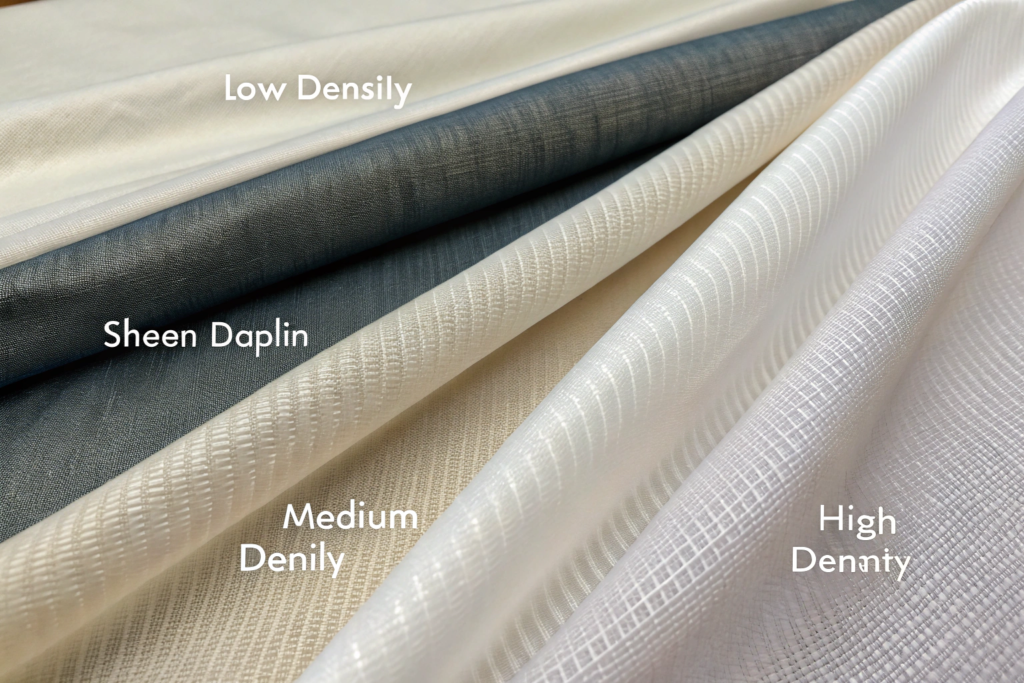
If yarn count is the ingredient, fabric density is the recipe. Density refers to how many yarns per inch (or per centimeter) are packed into the fabric. It's also called thread count, or in technical terms, the number of warp ends and weft picks per unit length. This is what determines how tight or loose the fabric structure is.
We measure density in two directions. The warp density is the number of lengthwise yarns per inch. The weft density is the number of crosswise yarns per inch. On a spec sheet, you'll see something like "133 x 72" for a poplin. That means 133 warp yarns per inch and 72 weft yarns per inch. The higher the numbers, the denser the fabric.
Density dramatically affects the fabric's properties. A high-density fabric (like a high thread count percale sheet) feels smooth and tight, and it's more resistant to wind and wear. A low-density fabric (like a cheesecloth) feels open, loose, and breathable. But density interacts with yarn count. You can have a fabric made with very fine yarns but woven at a low density, and it will be lightweight and open. Or you can have the same fine yarns woven at a very high density, and you'll get a tight, crisp, almost papery fabric (think of a high-quality shirt fabric). In early 2023, a Swedish client wanted a "crisp" organic cotton for shirts. They sent us a sample with a fine Ne 70 yarn, but the density was too low, so the fabric was soft and floppy. We kept the same yarn but increased the warp density from 120 to 150 threads per inch. The result was a perfectly crisp, substantial shirting fabric. This weaving technology blog explains how to calculate and specify density correctly.
What's the relationship between yarn count and fabric density?
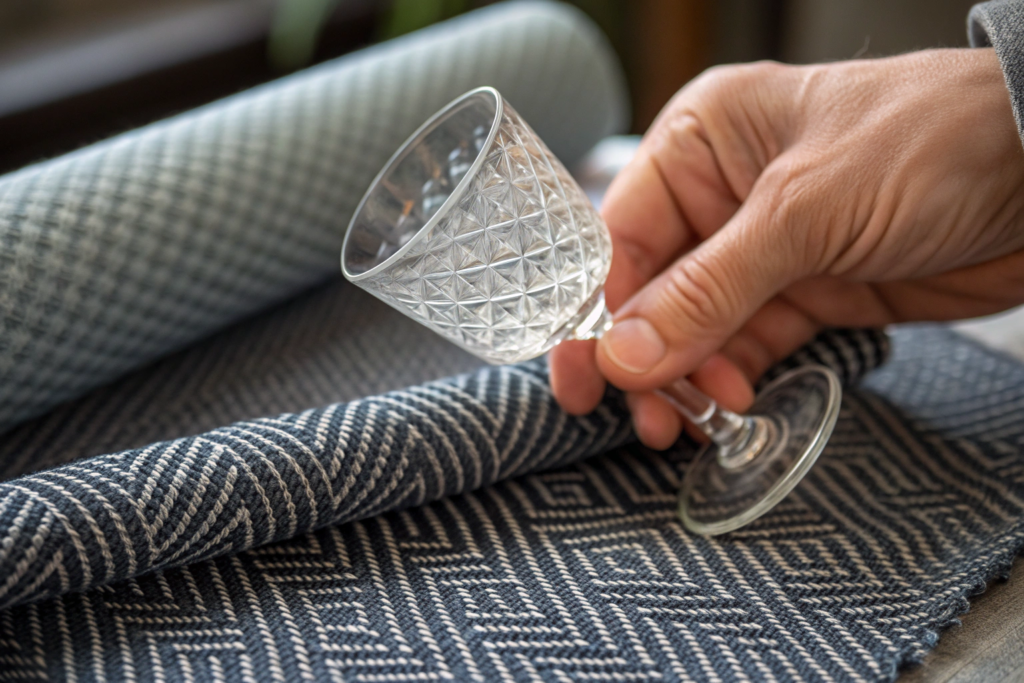
This is the key relationship to understand. They are not independent. For a given yarn count, there is a maximum possible density. You can't pack infinite thick yarns into one inch—they won't fit. And if you try to weave very fine yarns at a very low density, the fabric will be unstable and the yarns will shift.
The industry uses a concept called "cover factor" to describe this relationship. It's a mathematical formula that considers both yarn count and density to determine how much of the fabric surface is actually covered by yarn. A high cover factor means a tight, dense fabric. A low cover factor means an open, sheer fabric.
When you're developing a fabric, you have to balance these two. Let's say you want a heavy fabric for a winter coat. You could use thick yarns (low count) at a medium density, or you could use medium yarns at a very high density. Both will give you a similar weight, but the hand feel will be completely different. The thick yarn option will be more textured and "handmade" feeling. The high-density option with finer yarns will be smoother and more technical. We walked a Danish brand through this choice in 2024 for their new outerwear line. They chose the high-density route because they wanted a smooth surface for printing. Understanding this trade-off is what separates good product development from great product development. This textile physics forum has a detailed discussion on cover factor and how to calculate it for your projects.
How Do Yarn Count and Density Affect Fabric Performance?
Now we get to the practical part. You're not just buying numbers on a page; you're buying performance. The combination of yarn count and density determines how your fabric will behave in the real world—how it will wear, how it will feel, and how it will last.
Let's start with durability. For a fabric to be durable, it needs to resist abrasion and tearing. Tear strength is particularly interesting. A fabric made with thick, strong yarns at a medium density can have excellent tear strength because the yarns can shift and bunch up to resist the tear. A fabric made with fine yarns at a very high density might actually have lower tear strength because the yarns are locked in place and can't move—they just snap one by one. We tested this for a US workwear client in 2023. They wanted a durable fabric but also wanted a smooth, fine hand feel. We developed a fabric using a blend of cotton and nylon, with a relatively high density but using a special weave structure that allowed some yarn movement. The result passed their tear strength tests while feeling much better than standard canvas.
Breathability and moisture management are also controlled by density. A low-density fabric lets air flow through easily. That's great for summer. A high-density fabric can be engineered to be windproof or even water-resistant without any coating, simply by packing the yarns so tightly that water droplets can't penetrate. We do this for clients who need performance outerwear fabrics. In 2022, a German sportswear brand asked us to develop a windproof but breathable fabric for cycling jackets. We used a fine nylon yarn at an extremely high density, creating a "micro-porous" structure that blocked wind but allowed vapor to escape. No membrane, no lamination—just smart engineering of yarn count and density. This technical textiles blog has more case studies on how these parameters affect performance.
Can we achieve a soft hand feel with a high-density fabric?
This is a common challenge, especially for shirting and bedding. People often associate high density with stiffness or paperiness. But it doesn't have to be that way. The key is the finishing process.
We can take a high-density fabric made with fine yarns and make it incredibly soft through mechanical finishing. We use a process called "biopolishing" for cellulosic fibers, which uses enzymes to clean up the fiber surface and reduce pilling while softening the hand feel. For synthetics, we can use a "softening" calendar or add chemical softeners in the final wash.
The most effective technique for high-density fabrics is "sanding" or "peach-skin" finishing that I mentioned in a previous post. This breaks the surface fibers and creates a micro-nap, which feels soft to the touch even though the underlying structure is dense. We did this for a Japanese client in 2023 who wanted a high-density cotton for work shirts that felt soft from day one. We wove a tight construction with a fine Ne 70 yarn, then ran it through our sanding machine. The result was a fabric that had the durability and crisp appearance of a high-end shirt but the softness of a well-worn favorite. It's all about knowing which levers to pull after the weaving is done. This textile finishing blog explains the different mechanical and chemical softening options available.
How Do We Specify Yarn Count and Density to a Chinese Supplier?
This is where the rubber meets the road. You understand the concepts. Now, how do you communicate them to us so you get exactly what you want? Clarity in specifications is the difference between a successful bulk order and a costly mistake.
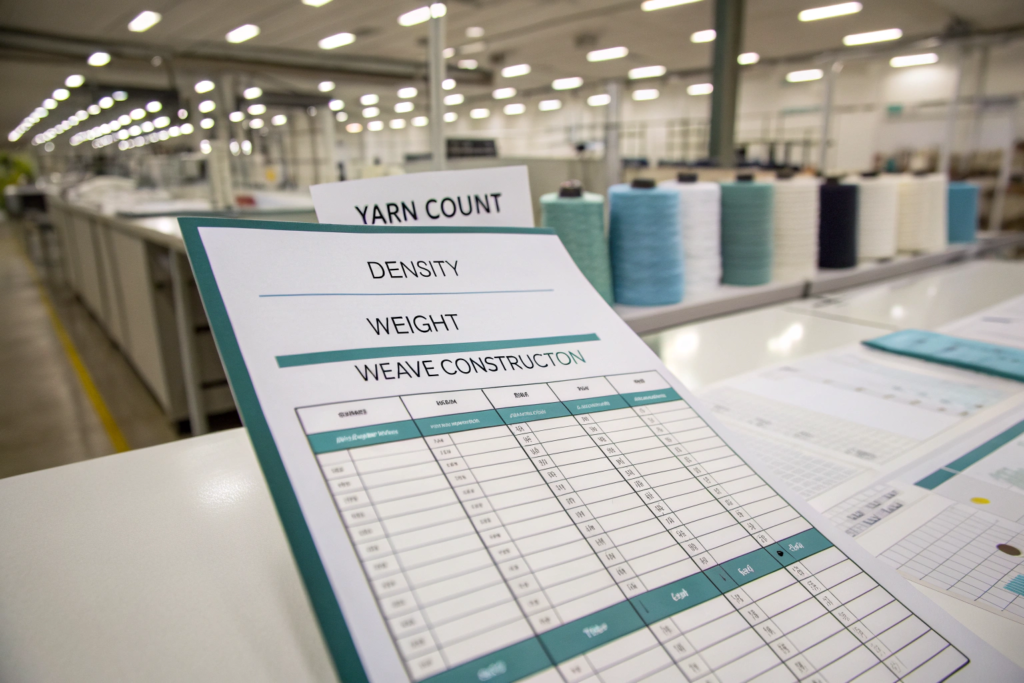
First, always specify both. Don't just say "I want a heavy fabric." Give us numbers. For a cotton poplin, you might say: "Ne 50/1 x Ne 50/1, 144 x 76, 57/58" width." That tells us the warp yarn count (50/1, meaning single 50-count yarn), the weft yarn count (also 50/1), the warp density (144 ends per inch), the weft density (76 picks per inch), and the finished width. That level of detail leaves no room for interpretation.
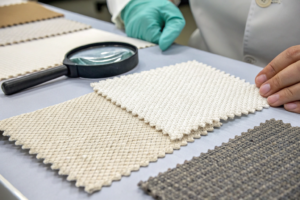
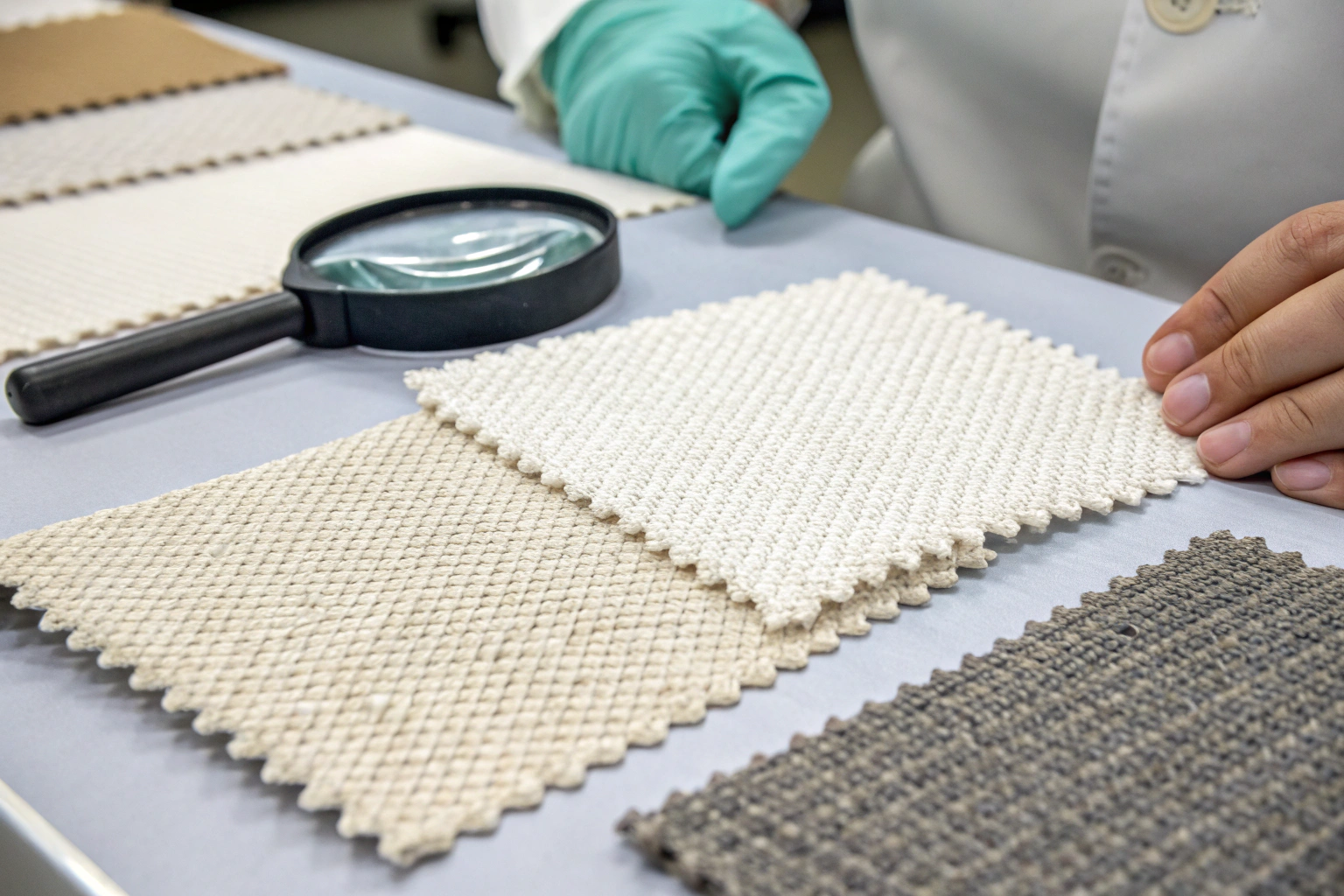
Second, provide a physical reference. Even with numbers, it helps to send us a swatch of what you want. We can then measure the density ourselves with a pick glass and confirm the yarn count by carefully unraveling and measuring. In early 2024, a client from Miami sent us a swatch of a fabric they loved but couldn't source anymore. Our lab analyzed it, determined the yarn count was Ne 40/2 (a two-ply yarn) and the density was 110 x 60. We reproduced it exactly. The client couldn't tell the difference between the original and our version.
Third, understand the tolerances. In bulk production, there will be slight variations. A density of 144 x 76 might vary by ±2% and still be considered acceptable. Yarn count can vary slightly based on the spinning process. A good supplier will tell you their standard tolerances upfront. At Shanghai Fumao, we include these in our QC reports so you know exactly what you're getting. For more on writing effective fabric specs, this sourcing and development blog has a template you can use.
What happens if we get the density wrong in bulk production?
This is a scenario we work hard to avoid, but it can happen if the spec isn't clear or if there's a communication breakdown. Getting the density wrong changes everything.
If the density is too low, the fabric will be lighter weight than intended. It might feel flimsy, have poor coverage (you might see through it), and wear out faster. If it's too high, the fabric will be heavier, stiffer, and you might not have enough fabric to cut your planned number of garments because the yardage weight will be off.
We had a situation in 2022 with a client in the Netherlands. They ordered a canvas fabric for tote bags. The spec called for a certain density. When the bulk fabric arrived at their factory, they measured it and found the weft density was 10% lower than spec. The fabric was slightly lighter weight. They were worried the bags wouldn't be strong enough. We investigated and found the issue was in the finishing—the fabric had been stretched too much widthwise, which reduced the weft density. We negotiated a partial refund and then worked with them to adjust their bag design to use the fabric they had. It was a fixable problem, but it caused delays. Now, we do in-process checks during finishing to ensure the density stays within spec. This quality control in textiles blog has more examples of what can go wrong and how to prevent it.
Conclusion
Yarn count and fabric density are the DNA of any textile. They determine not just how a fabric looks, but how it performs, how it feels, and how long it lasts. Yarn count tells you about the individual threads—are they fine and delicate, or thick and rugged? Fabric density tells you how those threads are packed together—is the structure open and breathable, or tight and protective? Neither one tells the whole story alone. You have to specify both, and you have to understand how they interact.
At Shanghai Fumao, we've spent 20 years mastering these fundamentals. Whether we're developing a new fabric from scratch or reproducing a client's favorite sample, we start with the numbers. Our in-house lab can analyze any fabric and give you the exact yarn count and density, and our production team knows how to hit those targets consistently, roll after roll, container after container.
If you're tired of guessing or dealing with fabrics that don't perform as expected, let's talk. We can help you specify exactly what you need, produce it with precision, and deliver it with confidence. Whether you're designing a high-fashion dress or a rugged work uniform, understanding these basics will save you time, money, and headaches. Please contact our Business Director, Elaine, at elaine@fumaoclothing.com. Let's engineer your next fabric together.