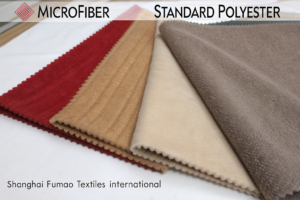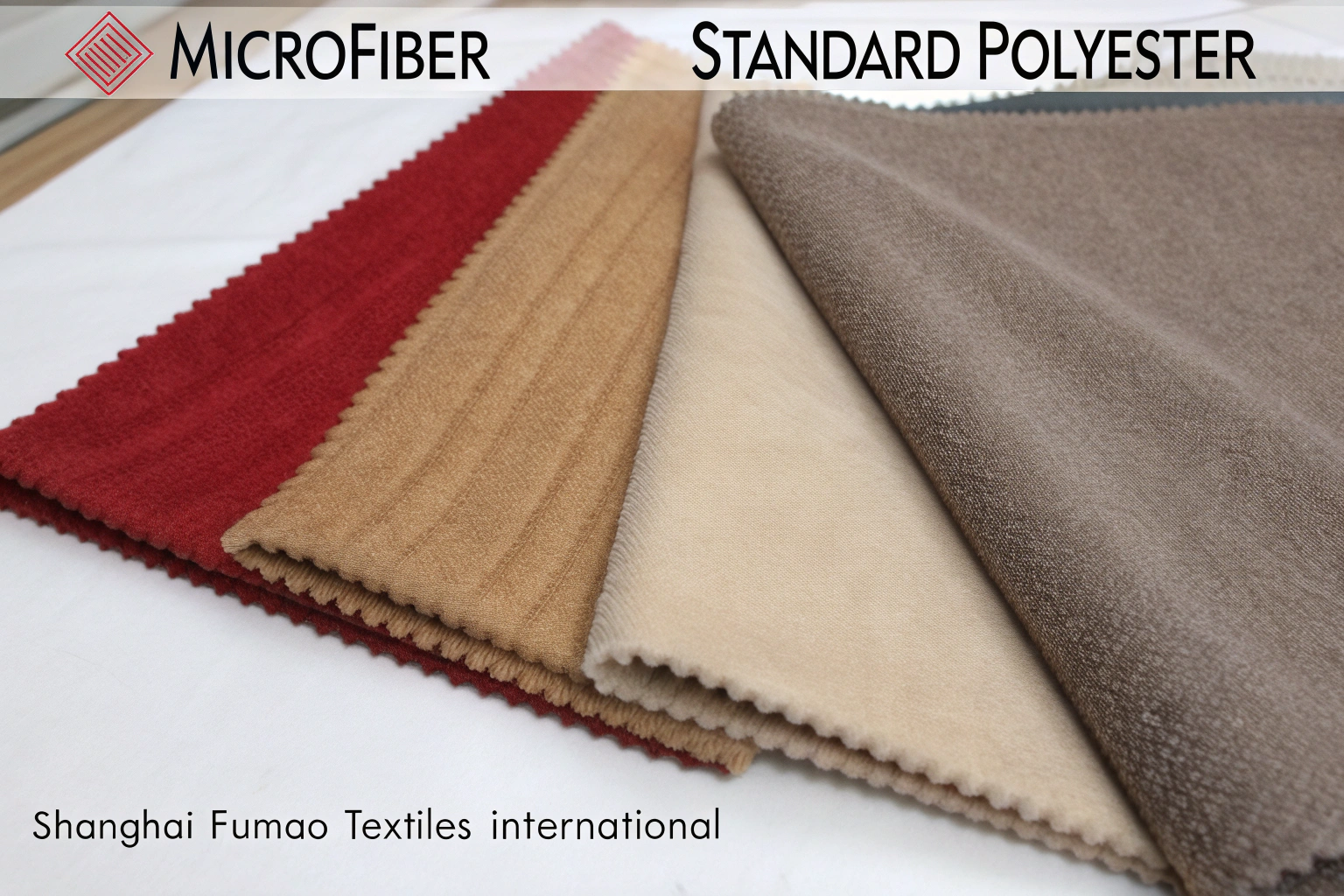
You're standing in a fabric showroom, or maybe scrolling through Alibaba, and you see two swatches that look almost identical. Both are polyester. Both are soft. But one is labeled "microfiber" and costs 30% more. Your first thought: is this a real difference or just marketing hype? Your second thought: if I buy the cheaper one, will my customer notice? Will it perform the same? Will complaints come back to me?
The difference between microfiber and standard polyester isn't just marketing. It's physics. It's engineering at the fiber level that fundamentally changes how the fabric feels, performs, and wears. At Shanghai Fumao Textiles International, we produce both types every single day for clients around the world, and I can tell you: they are not interchangeable. Each has its place, its strengths, and its ideal applications. Understanding the difference is the difference between getting the right fabric for your product and ending up with something that just doesn't work.
Let me break this down in plain terms. Standard polyester is your reliable workhorse. Microfiber is your specialist. One is measured in standard denier—the thickness of the individual fiber. The other is measured in fractions of a denier, with fibers so fine they're measured in microns. And that size difference changes everything: the drape, the hand feel, the durability, the cleaning ability, even the environmental impact. I've been in this industry for over 20 years, and I've watched microfiber transform entire product categories. Let me show you why.
How Do Fiber Diameters Differ Between Microfiber and Standard Polyester?
The name says it all. "Micro" means small. Really small. But until you see the numbers, it's hard to grasp just how big this small difference is. We're talking about fibers so fine that they make standard polyester look like rope by comparison.
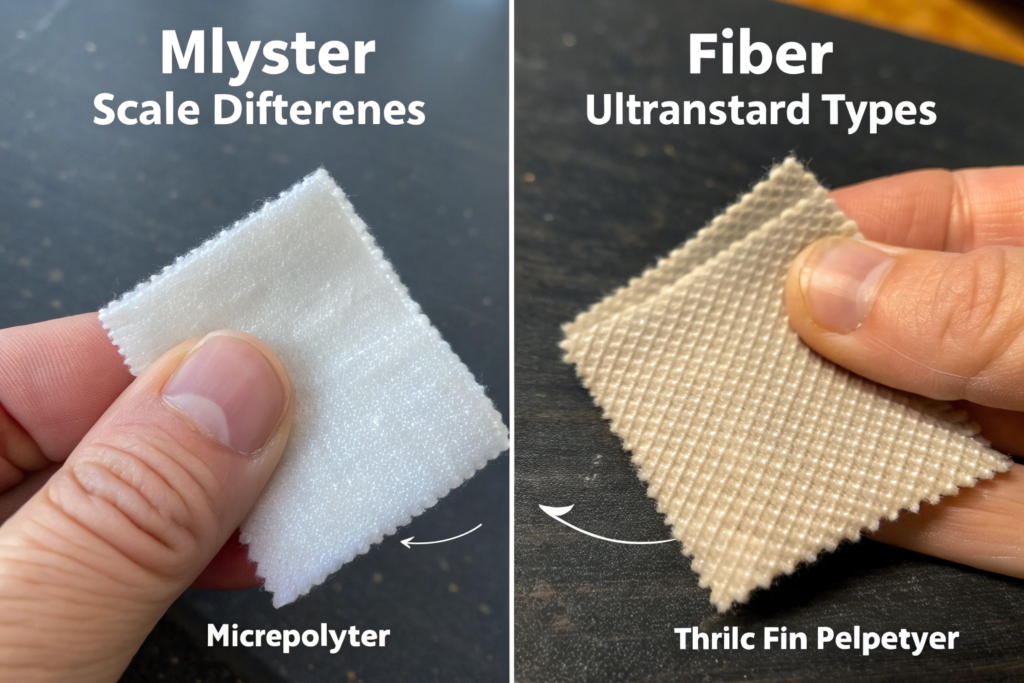
What is denier, and why does it matter for fabric performance?
Denier is the unit of measurement for the linear mass density of fibers. In simple terms: it tells you how thick each individual fiber is. The lower the denier, the finer the fiber. Standard polyester filament yarns typically range from 70 denier to 300 denier or higher, depending on the application. A typical 75D/36F yarn means 75 denier total, made up of 36 individual filaments. Each filament is about 2.08 denier.
Microfiber starts where standard polyester ends. To be classified as microfiber, individual filaments must be less than 1 denier. In many of our microfiber products, we're working with 0.5 denier or even 0.3 denier filaments. A 150D/288F microfiber yarn has 288 individual filaments, each just over 0.5 denier. That's four to eight times more filaments than a standard yarn of the same total denier.
Why does this matter? Because more filaments mean more surface area. More surface area means more softness, better drapability, and completely different performance characteristics. This technical explanation of denier and fiber fineness in textiles is worth reading if you want to geek out on the numbers. But the short version: finer fibers change everything.
How does filament count (filament density) affect fabric hand feel?
This is where the magic happens. Take two fabrics with the exact same total weight and the exact same weave construction. Make one from standard 75D/36F yarn (36 filaments). Make the other from microfiber 75D/144F yarn (144 filaments). The microfiber version will feel dramatically softer, more fluid, and more luxurious.
Why? Because each individual filament is finer and more flexible. When you have 144 tiny fibers instead of 36 thicker ones, they bend and move more easily against each other and against your skin. The fabric has more "give" and a smoother surface. It also has more fibers per square inch, which means more light reflection points—giving the fabric a subtle luster that standard polyester often lacks.
I demonstrated this to a UK-based activewear buyer in 2023. I handed them two black jersey swatches, same weight, same knitting construction. One was standard polyester, one was microfiber. They couldn't believe the difference. They actually asked if the microfiber had some kind of special finish or silicone treatment. Nope. Just finer fibers. They switched their entire base layer line to microfiber that season, and customer complaints about "scratchy" fabric dropped to zero. This guide to understanding filament count and fabric quality explains why more filaments usually mean better quality. It's simple math.
What Performance Differences Matter for Your End Products?
Fiber thickness isn't just about feel. It's about function. Microfiber and standard polyester behave completely differently when it comes to moisture, cleaning, durability, and care. If you're sourcing for a specific application, you need to know which one actually does the job.
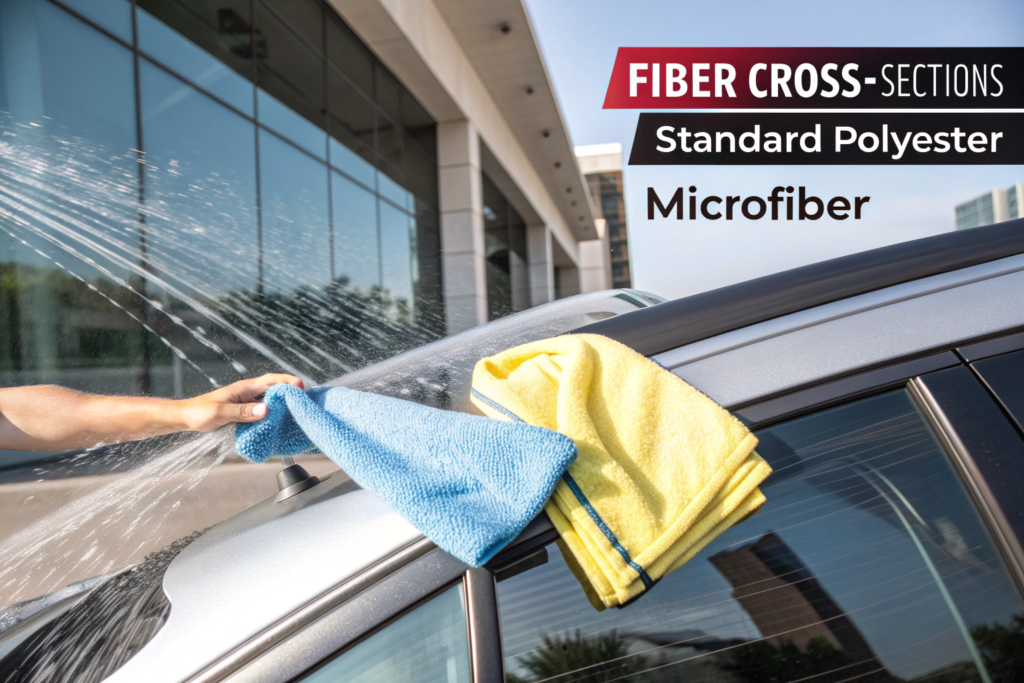
Why is microfiber superior for cleaning and wiping applications?
This is where microfiber has no competition. A standard polyester cloth will push dirt and water around. A microfiber cloth will trap it. The difference is structural.
Microfiber filaments are often split during manufacturing, creating multi-lobed cross-sections with sharp edges and tiny channels between the lobes. When you combine this with the ultra-fine filament size, you get a fiber that acts like thousands of tiny hooks and blades. It physically lifts dirt and grease from surfaces. The channels between the lobes also create capillary action, sucking up water and holding it between the fibers rather than just on the surface. A good microfiber cloth can hold up to seven times its weight in water.
I had a US-based cleaning product distributor visit our facility in 2022. They'd been sourcing from a supplier in another country, but their customers complained that the cloths stopped working after a few washes. We showed them our microfiber construction: 80% polyester, 20% polyamide split microfiber, 300 GSM, with ultrasonic cut edges that wouldn't fray. The polyamide component adds stiffness to the split fiber edges, making them more effective at scrubbing. They switched to our cloths, and their reorder rate doubled. This scientific explanation of how microfiber cleaning works gets into the physics. It's not magic—it's engineering.
How do moisture-wicking properties compare between microfiber and standard polyester?
For activewear and performance apparel, moisture management is everything. Both standard polyester and microfiber can be engineered to wick moisture, but they do it differently.
Standard polyester wicks by capillary action through the spaces between fibers. It's effective, but the larger fibers mean larger spaces, which can sometimes feel "wet" against the skin when saturated. Microfiber, with its much finer fibers and tighter construction, creates more capillary channels and moves moisture more efficiently. It also dries faster because there's more surface area for evaporation.
However—and this is important—microfiber's density can sometimes make it less breathable than a more open standard polyester construction. For high-exertion activities where maximum airflow is needed, a lightweight standard polyester mesh might actually outperform a dense microfiber. It's about matching the fabric to the activity.
We worked with a German cycling apparel brand last year on this exact trade-off. Their summer jerseys needed maximum breathability, so we used a standard polyester mesh with an open structure. Their winter base layers needed warmth without bulk, so we switched to a microfiber jersey knit that trapped air in the fine fiber matrix while still wicking sweat. Same brand, different needs, different fibers. This comparison of moisture management in different polyester constructions explains the trade-offs. Know your end use, then choose your fiber.
Is microfiber more durable than standard polyester? The surprising answer.
You'd think finer fibers would be weaker, right? Not necessarily. Microfiber fabrics can be exceptionally durable, but it depends on construction.
Standard polyester is tough. It's resistant to stretching, shrinking, and most chemicals. It holds up well to abrasion. Microfiber, because of its high filament count, actually distributes stress across more individual fibers. A snag that would break a thick standard polyester filament might just bend a microfiber filament without breaking it.
However, microfiber's softness can be a double-edged sword. In high-abrasion applications like upholstery or heavy workwear, the finer fibers can abrade faster than thicker fibers. The surface can "fuzz" or pill more easily if the construction isn't right.
We test both extensively in our lab. For a Canadian outdoor brand that wanted microfiber for its softness but needed it to survive backpack straps and rough use, we developed a tightly woven microfiber with a higher twist yarn that dramatically improved abrasion resistance. It passed 50,000 double rubs on the Martindale test—well above the standard for heavy-duty upholstery. This guide to textile durability testing and standards shows how we verify performance. Fine fibers don't have to mean fragile fabric.
What Are the Cost and Sustainability Trade-Offs?
Price and sustainability are inseparable from fabric decisions today. Your customers care where their clothes come from and what they're made of. Microfiber and standard polyester have different cost structures and different environmental profiles. Understanding these trade-offs helps you make decisions you can defend to your buyers and your conscience.

Why does microfiber typically cost more than standard polyester?
Simple answer: it's harder to make. Producing ultra-fine filaments requires more sophisticated extrusion equipment, tighter quality control, and often slower production speeds. The spinnerets—the tiny nozzles that molten polymer is pushed through to form fibers—have to be precision-engineered with much smaller holes. The cooling and drawing processes have to be carefully controlled to prevent filament breakage.
For a standard polyester yarn, a spinneret might have 36 holes, each producing a fiber around 2 denier. For a microfiber yarn, that same spinneret might have 144 holes, each producing a fiber under 0.5 denier. The engineering challenge is significant, and that cost shows up in the yarn price.
But here's the nuance: microfiber fabrics often achieve the same performance as heavier standard polyester fabrics with lower weight. A 150 GSM microfiber can feel as substantial as a 200 GSM standard polyester, and can perform better in some applications. So while the per-kilo cost is higher, the per-garment cost might be similar because you use less fabric. We help clients run these calculations all the time. A French lingerie brand found that switching to microfiber for their bralettes actually reduced their total fabric cost because they could use a lighter weight fabric without sacrificing opacity or durability. This analysis of microfiber production costs versus performance benefits breaks down the economics. Higher cost per pound doesn't always mean higher cost per garment.
How does recycled content work in both microfiber and standard polyester?
Sustainability is non-negotiable for most of our clients now. The good news: both standard polyester and microfiber can be made from recycled materials, typically post-consumer PET bottles or post-industrial waste. The technology has advanced dramatically in the last decade.
For standard polyester, recycled content is straightforward. The polymer is melted, filtered, and re-extruded. The quality can be excellent, and many of our standard polyester lines are available with 100% recycled content, certified by GRS (Global Recycled Standard).
Microfiber with recycled content is more challenging. The ultra-fine filaments require extremely clean, consistent polymer. Contaminants that would be acceptable in standard polyester can cause filament breakage in microfiber production. We've invested in advanced filtration and purification systems to overcome this. Today, we offer recycled microfiber in many constructions, though the recycled percentage sometimes maxes out at 70-80% rather than 100%, depending on the application.
A Scandinavian outdoor brand we work with has committed to 100% recycled content across their entire line by 2026. We're developing custom recycled microfiber fabrics for their mid-layer pieces. It's technically challenging, but we're getting there. This guide to recycled polyester and microfiber certification explains the standards and what they mean. If sustainability matters to your customers, it has to matter to your supply chain.
How Should You Choose Between Microfiber and Standard Polyester for Your Product?
So which one should you use? Like most things in textiles, the answer is: it depends. I've seen both fibers fail in the wrong application and excel in the right one. Here's a practical framework for making the choice.

What applications favor microfiber, and what applications favor standard polyester?
Let me give you a cheat sheet based on 20 years of experience.
Choose microfiber when:
- Softness is the priority. For next-to-skin applications like base layers, lingerie, and luxury loungewear, microfiber's hand feel is unmatched.
- Cleaning performance matters. For wipes, towels, and technical cleaning cloths, microfiber is the only choice.
- You need lightweight opacity. Microfiber's density allows lighter fabrics to remain opaque, perfect for white shirts or activewear.
- Drapability matters. For fluid garments like dresses and scarves, microfiber moves like natural fibers but with polyester's performance.
Choose standard polyester when:
- Structure is needed. For outerwear, bags, and upholstery, standard polyester's firmer hand holds shape better.
- Maximum breathability is required. Open constructions with standard polyester allow more airflow.
- Cost is the primary driver. For basic garments where extreme softness isn't required, standard polyester delivers excellent value.
- High-temperature applications. Some industrial and automotive applications require heat resistance that standard polyester handles better.
We had a US-based uniform company in 2023 trying to decide between the two for their new line of hospitality uniforms. The chefs' coats needed structure and durability—standard polyester blend. The front-of-house staff needed softness and drapability for a more elegant look—microfiber. Same client, same end customer, completely different fabric choices. This application guide for polyester fabric selection helps buyers navigate these decisions. There's no universal "better." There's only "better for your specific need."
Can you blend microfiber with other fibers, and why would you?
Absolutely. Some of the most interesting fabrics combine microfiber with other fibers to get the best of both worlds. Microfiber blended with spandex creates incredible stretch recovery with a soft hand. Microfiber blended with cotton gives you natural fiber breathability with synthetic performance. Microfiber blended with nylon—like the 80/20 split we use in cleaning cloths—adds stiffness and durability.
We produce a popular fabric for golf shirts that's 92% microfiber polyester and 8% spandex. It has the softness of microfiber, the stretch and recovery of spandex, and the moisture-wicking of polyester. It feels like performance luxury, and it performs like athletic wear.
For a Japanese workwear brand, we developed a fabric that's 65% standard polyester for durability, 30% microfiber for softness against skin, and 5% conductive fiber for anti-static properties. The layers work together to create something none of them could do alone. This guide to fiber blending strategies for performance textiles shows the possibilities. Blending isn't compromise—it's optimization.
Conclusion
The difference between microfiber and standard polyester comes down to the fiber itself. Microfiber's ultra-fine filaments—under 1 denier—create fabrics that are softer, more drapable, more absorbent, and often more performant in specific applications. Standard polyester's thicker fibers deliver structure, durability, and value. Neither is universally better. Each is a tool for a specific job.
At Shanghai Fumao Textiles International, we make both. We've spent decades engineering fibers, yarns, and fabrics to meet the exact needs of our clients. We know when microfiber is the answer and when standard polyester makes more sense. And we're not afraid to tell you which one fits your product, your budget, and your customers' expectations.
If you're trying to decide between microfiber and standard polyester for your next collection, stop guessing. Talk to someone who actually makes both. Our Business Director, Elaine, has helped hundreds of brands navigate this exact decision. She can walk you through the options, show you samples, and help you make a choice you'll feel confident about. Email her at elaine@fumaoclothing.com. Tell her what you're making. She'll tell you what it should be made of.