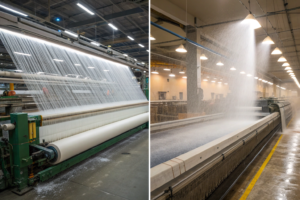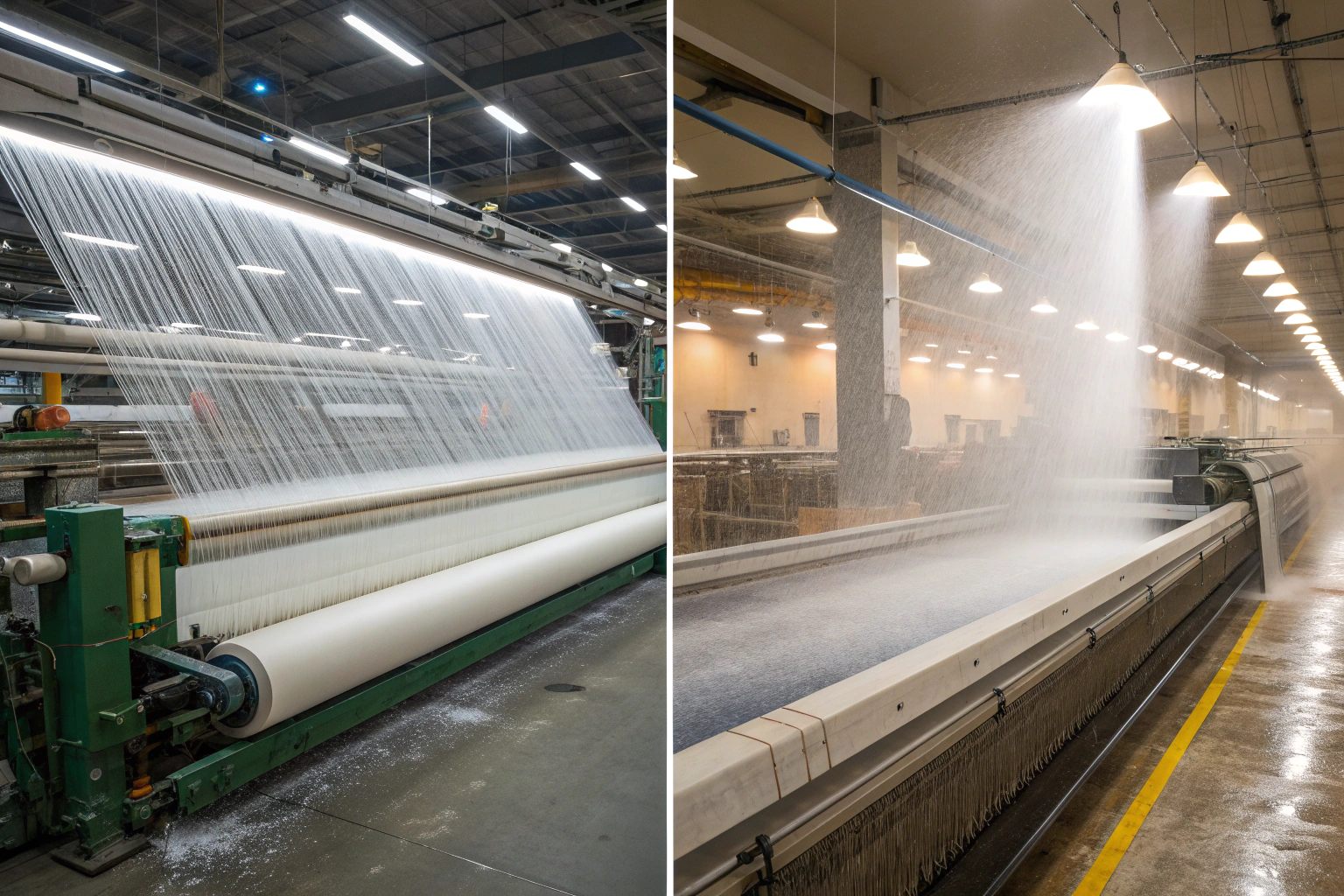
I remember the first time I stood between two rows of looms in a weaving mill in Keqiao. It was 2004. On my left, air-jet looms were running so fast they sounded like jet engines. On my right, water-jet looms hummed quietly, with fine mist spraying across the fabric. I was confused. Why two different machines? Why not just use one? My mentor at the time laughed. He said: "Different fabrics need different tools. Air and water are not the same." That lesson stuck with me. Over the next 20 years, I learned exactly when to use which loom. And it matters. It matters for quality, cost, and even what fabrics you can make.
So, what is the difference between air-jet and water-jet loom woven fabrics? The simple answer: Air-jet looms use compressed air to shoot the weft yarn across the loom. Water-jet looms use high-pressure water. But that difference leads to big differences in the fabrics they produce. Air-jet looms are more versatile. They can weave almost any fiber. But they use more energy. Water-jet looms are faster and cheaper to run, but they only work with hydrophobic fibers—yarns that do not absorb water, like polyester and nylon. In this guide, I will break down everything we have learned running both types of looms in our own factories and partner mills. Because if you are sourcing fabric from China, you need to know what you are getting.
How do air-jet and water-jet looms work differently?
Let me start with the basics. A loom's job is to interlace two sets of yarns: warp (lengthwise) and weft (crosswise). The warp is already tensioned on the loom. The weft needs to be shot across from one side to the other. How you shoot that weft is the main difference between loom types.
Air-jet looms: These use compressed air. A nozzle at one side blasts a jet of air. That air carries the weft yarn across the width of the fabric. Think of it like a really strong leaf blower pushing a thread. The air comes from compressors. It is loud. It uses a lot of electricity. But air does not wet the yarn, so almost any fiber can be woven. We use air-jets for cotton, linen, wool, viscose, and blends. The air also does not need to be dried off, so the fabric comes out dry.
Water-jet looms: These use a high-pressure water jet. A tiny nozzle shoots a stream of water, and that water pulls the weft yarn across. The water acts as both a carrier and a lubricant. It reduces friction. It allows very high speeds. But water soaks the yarn. So the yarn must not absorb water or be damaged by it. That is why water-jets are mainly for synthetic filaments: polyester, nylon, polypropylene. If you try to weave cotton on a water-jet, the cotton absorbs water, swells, and breaks. The fabric also comes out wet and needs drying.
Speed difference: Water-jets are faster. They can insert weft at up to 2,000 meters per minute. Air-jets are slightly slower, around 1,500 meters per minute. But both are much faster than older shuttle looms (which were 300 meters per minute). For production, speed matters. But speed is not everything.
Energy consumption: Air-jets use more energy. Compressing air is inefficient. A typical air-jet loom uses 2 to 3 times more electricity than a water-jet. But water-jets use water, and that water needs to be treated and sometimes heated. So the total cost depends on local utility prices.

What happens to the weft yarn during insertion?
This is where experience matters. On an air-jet, the yarn is pulled by air friction. The air grabs the yarn surface and drags it. If the yarn is fuzzy or hairy (like cotton), the air grabs well. If the yarn is smooth and slippery (like filament polyester), the air might slip. So we use different nozzles and air pressures for different yarns. We have charts for each yarn type.
On a water-jet, the water surrounds the yarn. The yarn is pulled by the water's momentum. Smooth yarns work fine because water grips them. But the yarn must be strong enough to handle the water force without breaking. And it must not absorb water. For polyester filament, it is perfect. For nylon, also good. But for textured yarns (like air-textured polyester), water can penetrate and cause issues.
What fabrics are best made on air-jet looms?
Air-jet looms are the workhorses of the textile industry. They can handle most fabrics. But they excel in certain areas.
Cotton and cotton blends: This is the biggest use. Most of the cotton shirting, poplin, twill, and canvas you see is made on air-jets. The air does not harm the cotton. The yarns are usually spun yarns (not filaments), and the air grabs them well. We produce thousands of meters of cotton poplin every week on air-jets for US and European shirt makers.
Linen and linen blends: Linen yarns are stiff and irregular. Air-jets handle them well. Water-jets would make linen absorb water and become weak. So for linen apparel fabric, air-jet is the choice. A French client of ours makes high-end linen sheets. All air-jet woven.
Viscose and rayon: These are cellulosic fibers. They absorb water. So water-jets are out. Air-jets work perfectly. Viscose challis for dresses, viscose lining fabric—all air-jet. We supply a UK brand with viscose fabric for summer dresses. Air-jet woven, soft and drapey.
Wool and wool blends: Wool absorbs moisture. It felts with water and agitation. So definitely air-jet. Worsted wool suiting fabric is typically air-jet woven. We have a partner in Italy (yes, we supply them with greige fabric) who uses air-jets for high-end suiting.
Blends of natural and synthetic: Cotton-poly, linen-viscose, wool-nylon. Air-jets handle blends easily. The air treats all fibers the same.
Spun yarns in general: If the yarn is made from staple fibers (short fibers twisted together), air-jet is usually best. The hairy surface helps the air grip.

What are the limitations of air-jet looms?
Air-jets are not perfect. Here are the downsides.
Higher energy cost: As I said, air compression is expensive. In factories where electricity is costly, this matters. We monitor our energy use closely. For some cheap fabrics, the energy cost can be 10% of the total.
Noise: Air-jets are loud. Really loud. Workers need ear protection. It is not pleasant to be near them all day. We rotate staff and provide good protection.
Limited for very heavy fabrics: For extremely heavy denim or thick industrial fabrics, air-jets might struggle. The air might not have enough force to carry a thick, heavy weft yarn across. Sometimes we use projectile looms for those.
Weft yarn tension control: Air can be turbulent. If the air flow is not perfect, the weft yarn can get tangled or break. We spend a lot of time tuning air pressure and nozzle position for each fabric.
What fabrics are best made on water-jet looms?
Water-jet looms are specialists. They do one thing extremely well: weave synthetic filament yarns. Here is what they excel at.
Polyester filament fabrics: This is the bread and butter. Polyester taffeta, polyester lining, polyester satin, polyester microfiber. All can be woven on water-jets. The water lubricates the smooth filaments, allowing high speed without friction damage. We produce millions of meters of polyester lining fabric annually on water-jets. A US client uses it for garment bags and linings.
Nylon filament fabrics: Nylon is also hydrophobic. It works perfectly. Nylon ripstop for outerwear, nylon taffeta for jackets, nylon satin for activewear. Water-jets give a clean, even fabric. A Canadian outdoor brand buys nylon fabric from us, water-jet woven.
Polypropylene fabrics: Polypropylene floats. It is lighter than water. But water-jets still work because the water pushes the yarn. We weave polypropylene for industrial uses like filtration and geotextiles.
Microfiber fabrics: Very fine denier polyester or nylon. Water-jets handle these delicate yarns gently because the water supports them. Air-jets might break them with turbulence.
Textured synthetic yarns: Even if the yarn is textured (air-textured or false-twist textured), water-jets can work. But the texture can trap water, so we need to dry thoroughly afterwards.
What are the advantages and limitations of water-jet looms?
Water-jets have clear advantages, but also strict limits.
Advantages:
- Faster speeds. Higher productivity.
- Lower energy cost (no air compression).
- Less lint and fly waste (water suppresses dust).
- Better for very fine filaments (water supports them).
- The fabric is cleaner because water washes it slightly during weaving.
Limitations:
- Only for hydrophobic fibers. No cotton, linen, wool, viscose.
- Water treatment needed. The water must be clean and sometimes softened. Disposal is an issue.
- Fabric comes out wet. Need drying ovens. That adds cost and space.
- Can cause water spots or stains if not dried properly.
- Yarn must have some strength. Very weak yarns might break.
In 2017, a client asked us to weave a cotton-like polyester fabric on water-jet. The yarn was textured to feel like cotton. It worked, but we had to adjust drying because the textured yarn held water. We figured it out. Now it is routine.
How do the fabric qualities differ between the two?
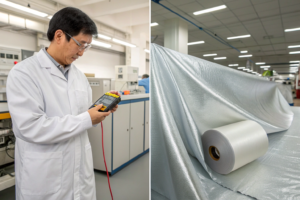
Even if the same yarn is used, the weaving method can affect the final fabric. Here is what we see in our quality control lab.
Surface appearance: Water-jet fabrics often have a cleaner, smoother surface. The water acts as a lubricant, so the yarns slide into place with less friction. Air-jet fabrics can have a slightly more "lively" surface because the air causes some fiber disturbance. For formalwear, water-jet polyester satin looks glossy and smooth. For casual cotton, air-jet gives a natural softness.
Hairiness: Air-jet weaving can increase fabric hairiness (fibers sticking out). The air blast can lift loose fibers. For cotton, this is normal. For synthetic filaments, air-jets can create fuzz if the yarn is not well-made. Water-jets suppress hairiness because the water weighs down loose fibers.
Strength: In theory, both can produce equally strong fabric. But water-jet weaving can sometimes weaken yarns if they absorb water (for hydrophilic yarns). For hydrophobic yarns, water-jet is gentle. Air-jet can stress yarns with turbulence if not tuned correctly.
Evenness: Water-jets often produce more even fabric because the water flow is consistent. Air flow can be affected by room conditions (temperature, humidity). We control our mill environment carefully for air-jets.
Abrasion resistance: No inherent difference. It depends on the yarn and finish.
Dyeing behavior: This is interesting. Water-jet fabrics might have fewer weaving oils or sizing agents because the water washes some away. That can affect dyeing. Air-jet fabrics might need more scouring before dyeing. We adjust our finishing processes accordingly.
What defects are common to each?
Every loom type has its own failure modes. We train our QC team to spot these.
Air-jet common defects:
- Missing picks: Air pressure too low, weft did not make it across.
- Tucked selvedges: Air turbulence at edges.
- Fuzz balls: Loose fibers accumulating from air blast.
- Uneven beat-up: Air pressure variation.
Water-jet common defects:
- Water spots: If not dried evenly.
- Stretch marks: If water pressure too high, it stretches the weft.
- Corrosion: If water treatment fails, metal parts corrode and stain fabric.
- Incomplete wet-out: If yarn is slightly hydrophilic, uneven water absorption.
We check for these at every stage. A German client once rejected a batch for tiny water spots we missed. Now we use UV light inspection to catch them.
How do cost and efficiency compare for sourcing?
When clients ask me which loom is better, I say: "It depends on what you are making." But for cost, here is the reality.
For synthetic filament fabrics: Water-jet is almost always cheaper. Lower energy, higher speed, less waste. If you are sourcing polyester lining, it is almost certainly water-jet woven. We price water-jet fabrics 10% to 20% lower than equivalent air-jet for synthetics.
For natural fiber fabrics: Air-jet is the only option. So you pay for the versatility. But air-jet technology has improved. Modern air-jets are more efficient than older ones. We have invested in new machines that reduce energy use by 30% compared to 10 years ago.
For blends: If the blend has any natural fiber, you must use air-jet. So a cotton-poly blend is air-jet.
MOQ considerations: Both have similar minimums. Usually 3,000 to 5,000 meters per color for custom orders. But for stock fabrics, we offer as low as 100 meters.
Lead times: Both are similar. 6 to 8 weeks for custom production. Stock ships in 1 week.

How do we decide which loom to use at Fumao?
In our partner mills, we have both types. Here is our decision tree:
Step 1: Fiber content.
- If 100% synthetic filament → water-jet (faster, cheaper).
- If any natural fiber, viscose, or spun yarn → air-jet.
Step 2: Fabric weight.
- Very heavy fabrics (over 400gsm) → sometimes air-jet, sometimes projectile.
- Light to medium weights → air-jet or water-jet as per fiber.
Step 3: Finish requirements.
- If fabric needs to be extremely clean and lint-free (for printing) → water-jet for synthetics.
- If fabric needs natural hand feel → air-jet.
Step 4: Client budget.
- For cost-sensitive synthetic orders → water-jet.
- For premium natural fabrics → air-jet.
A Turkish client once asked for a polyester fabric that looked like linen. We used water-jet for the base, then textured finishing. It looked like linen, cost like polyester. They loved it.
Conclusion
The difference between air-jet and water-jet looms is not just technical. It is fundamental to what fabrics you can make, how much they cost, and how they perform. Air-jets are the generalists. They handle the world's most common fabrics: cotton, linen, viscose, wool. Water-jets are the specialists. They excel at synthetics: polyester, nylon, polypropylene. Neither is better. They are different tools for different jobs.
At Shanghai Fumao, we work with both. We have partner mills with hundreds of air-jets and water-jets. We know which to use for your fabric. We know the tuning, the defects, and the costs. We have been doing this for 20 years. We have made the mistakes so you do not have to.
If you are sourcing woven fabric, whether it is cotton shirting from air-jets or polyester lining from water-jets, we can help. Contact our Business Director, Elaine, directly. She knows our mill partners and can guide you to the right loom type for your project. Email her at elaine@fumaoclothing.com. Tell her what fabric you need, your quantities, and your timeline. She will get you samples, pricing, and honest advice. And with our logistics support, shipping to the US, Europe, or anywhere else is smooth, even with current tariffs. Because at Shanghai Fumao, we believe in matching the right tool to the right job. Every time.