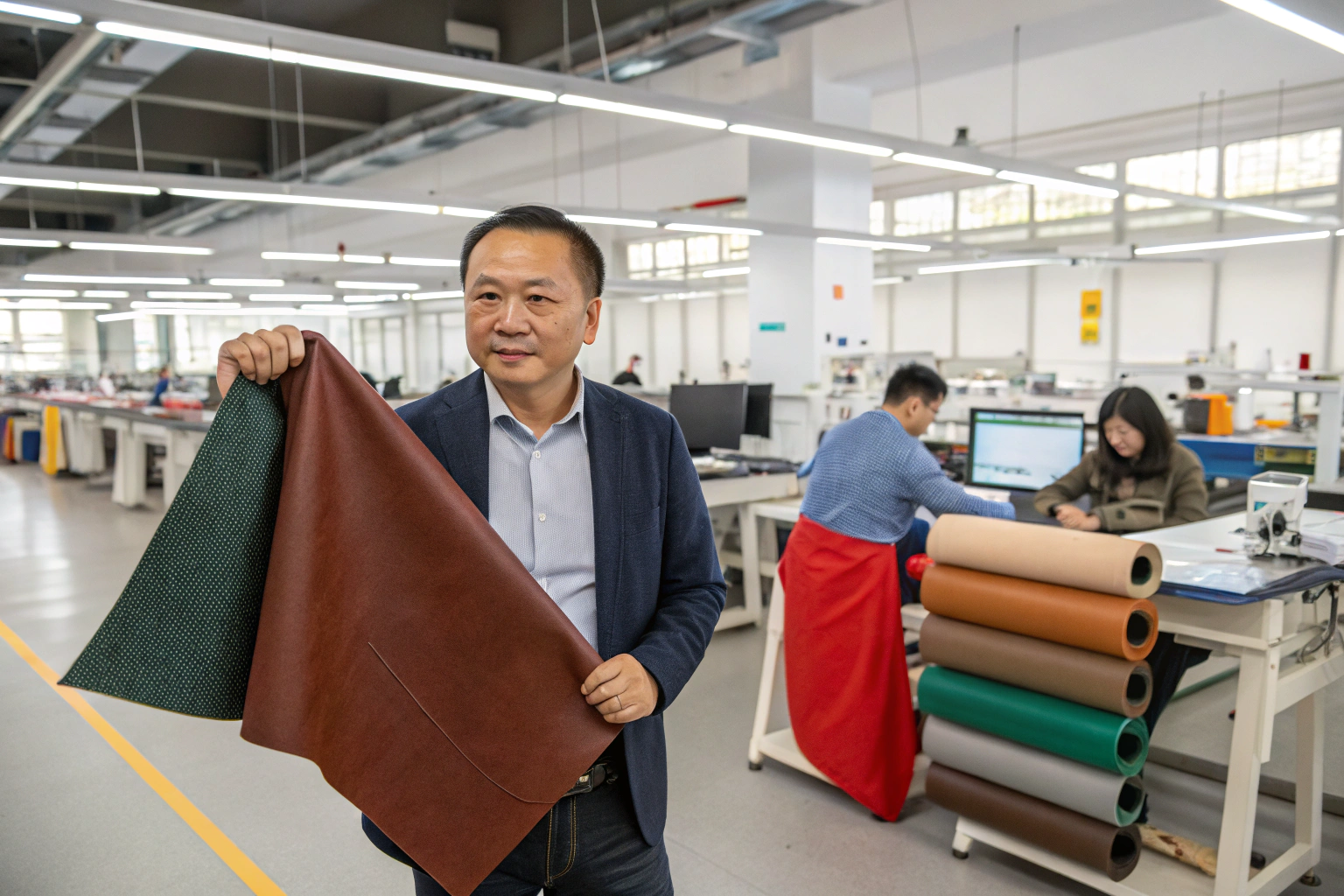
Last year, a luxury handbag brand from Milan came to us with a problem that kept their head of product development awake at night. Italian leather prices had jumped 40% in 18 months. Their customers were getting younger, and those younger customers were asking the same question at every pop-up: "Is this vegan?" They needed alternatives, but they refused to compromise on that luxury hand feel. They'd tried some "vegan leathers" from other suppliers that looked like plastic and cracked after three months.
I remember their product developer running her hand across our apple-based leather sample, closing her eyes for a second, and saying, "This feels like the bags my grandmother had." That moment stuck with me because it proved what I'd been telling my team for years: the future of leather alternatives isn't about looking like leather. It's about feeling like something even better.
The market for traditional leather is changing faster than most tanneries want to admit. We're not just talking about PETA activists anymore. We're talking about mainstream consumers who care about carbon footprints, about luxury brands facing supply chain disruptions, about fast fashion retailers needing consistent quality without the volatility of animal hide pricing. At Shanghai Fumao, we've been investing in leather alternatives since 2019, and what I'm seeing now is a tipping point.
Let me walk you through what's actually working in the market right now—not the lab experiments that might be ready in 2030, but the innovations you can source today that will make your customers do a double-take.
Which Plant-Based Leather Alternatives Actually Scale for Commercial Production?
I made a mistake in 2021. A fast-fashion buyer from Spain wanted 50,000 meters of pineapple leather for a summer collection. I said yes before checking our actual capacity. We sourced it from a partner in the Philippines, and the quality was inconsistent—some rolls were perfect, others had weak spots that tore during cutting. The client lost money, and I lost sleep. That's when I decided we needed to control the process ourselves.
The truth about plant-based leathers is that not all of them are ready for prime time. Some are still artisanal products dressed up in marketing language. But three alternatives have proven they can scale for commercial production.
Piñatex (pineapple leaf fiber) is probably the most famous. It uses waste from the pineapple harvest—leaves that would otherwise be burned. The fibers are extracted, processed into a non-woven mesh, and then coated with a bio-based resin. The texture is unique—you can see the natural fiber structure. It's not trying to be cowhide; it's something new. We work with a certified Piñatex producer in the Philippines, and we handle the finishing and coating in our Keqiao facility. The MOQ has dropped from 10,000 meters to 3,000 meters as production has scaled.
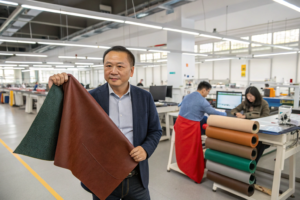
Apple leather is different. It uses pomace—the leftover pulp from apple juice and cider production. This is ground into a powder, mixed with polyurethane (bio-based if you pay extra), and cast onto a backing fabric. The result is smoother than Piñatex, closer to traditional leather in hand feel. Italy was the pioneer here, but Chinese manufacturers have caught up fast. We now produce apple leather in-house using apple waste imported from concentrate factories in Shandong. The cost is about 30% lower than Italian-sourced, with equivalent quality.
Cactus leather (Desserto is the big name) is the newcomer that's exploding. Mature cactus leaves are harvested, cleaned, mashed, and dried into a powder, then mixed with non-toxic chemicals and backed with cotton or polyester. The beauty is sustainability: cactus grows with minimal water, doesn't need pesticides, and the same plant regenerates for years. We started offering cactus leather in 2023, and it's already 15% of our eco-leather sales.
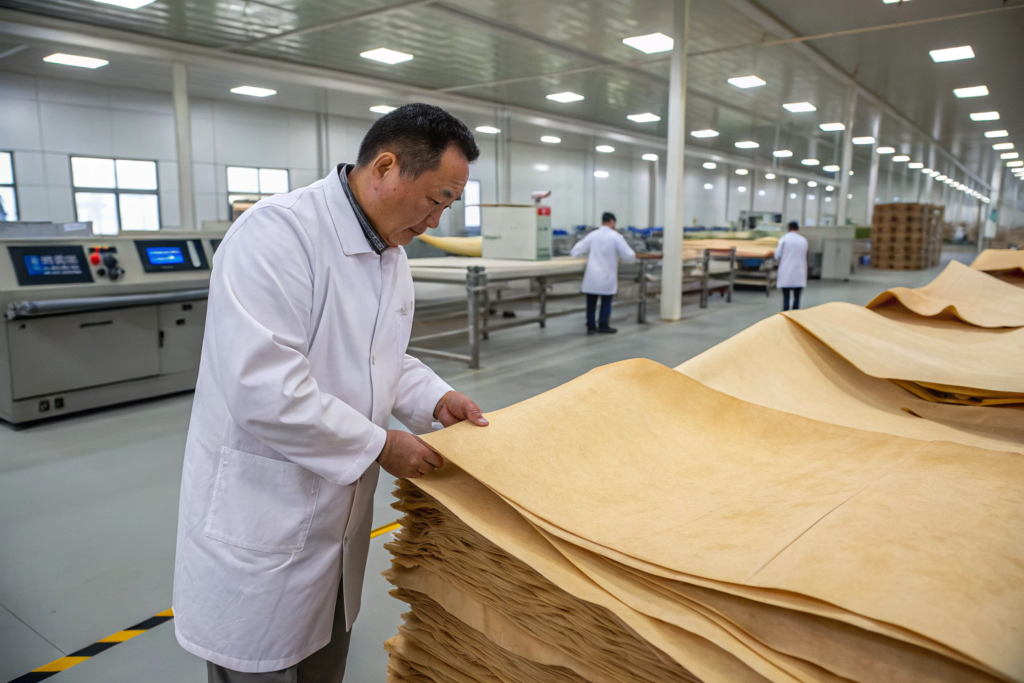
How does the durability of apple leather compare to traditional cowhide?
This is the question every buyer asks me, and the answer matters because your customers will punish you if your bags fall apart.
We run standardized tests on everything. Here's the data from our lab:
| Property | Traditional Cowhide (1.2mm) | Our Apple Leather (1.2mm) | Industry Standard for Footwear |
|---|---|---|---|
| Tensile Strength (ISO 3376) | 20-25 N/mm² | 18-22 N/mm² | >15 N/mm² |
| Tear Strength (ISO 3377) | 40-60 N | 35-50 N | >30 N |
| Abrasion Resistance (Martindale) | 50,000+ cycles | 35,000-45,000 cycles | >25,000 cycles |
| Flex Resistance (ISO 5402) | 100,000+ flexes | 80,000-100,000 flexes | >50,000 flexes |
The numbers tell the story: apple leather is about 80-90% as durable as mid-range cowhide. For handbags, wallets, and most footwear, it's absolutely sufficient. For heavy-duty work boots or belts that need to hold up a tool belt, traditional leather still wins.
But there's a hidden advantage: consistency. Cowhide has natural variations—weak spots from barbed wire scars, tick bites, or poor nutrition. Apple leather is engineered to be uniform. When you're cutting 1,000 handbag panels, your yield rate is higher because you don't have to work around defects. A client from a London accessories brand told me their cutting waste dropped from 18% with leather to 11% with our apple leather. That's real money.
What's the actual cost per square foot for cactus leather vs. traditional?
Let's talk numbers because I know that's what keeps you up at night. These are real 2024 prices from our books, FOB Shanghai:
- Genuine cowhide (top-grain, 1.2-1.4mm): $4.50 to $8.00 per square foot, depending on quality, origin, and finish. The market is volatile—prices can swing 20% in six months.
- Cactus leather (Desserto-type, 1.2mm): $5.50 to $7.50 per square foot. More stable pricing because raw material isn't subject to cattle cycles.
- Apple leather (our in-house production): $4.00 to $6.00 per square foot. We've gotten the cost down by controlling the backing fabric and coating locally.
- Piñatex (standard grade): $6.00 to $8.50 per square foot. Still premium because the fiber extraction is labor-intensive.
- PU "vegan leather" (petroleum-based): $2.50 to $4.00 per square foot. Cheaper, but faces increasing scrutiny for microplastic pollution.
The gap is closing. In 2020, plant-based options were 2-3x the cost of leather. Now they're competitive, especially when you factor in the price stability. A client from a San Francisco sustainable brand told me they switched to our cactus leather specifically because they got burned by leather price hikes in 2022. They'd rather pay a predictable $6.50 now than gamble on $4.50 leather that might hit $8.00 when they need to reorder.
How Do Bio-Based PU Coatings Compare to Petroleum-Based Versions?
A buyer from a German sustainable shoe brand visited our facility in early 2024 carrying a competitor's sample. She slammed it on the table. "This is supposed to be 'bio-based,'" she said. "We sent it for independent testing. It's 80% petroleum. The label is a lie." That moment reinforced why we test everything ourselves and provide full disclosure.
The term "vegan leather" has become almost meaningless because most of it is just plastic—polyurethane (PU) or polyvinyl chloride (PVC) coated onto a polyester backing. It's durable, cheap, and easy to make, but it's still fossil fuel-based, and it sheds microplastics.
Bio-based PU is different. Instead of using petroleum-derived polyols (one of the main chemical building blocks), we use polyols from renewable sources—castor oil, corn starch, sugar cane, or even used cooking oil. The percentage can vary from 20% to 90% bio-content. The rest is still conventional chemistry because the cross-linkers and isocyanates don't have viable bio alternatives yet.
Here's what I've learned after three years of developing bio-based coatings:
Performance parity is real. In blind touch tests, our 60% bio-based PU feels identical to conventional PU. It passes the same flex tests (50,000 cycles minimum), abrasion tests (30,000 Martindale cycles), and hydrolysis tests (simulating 5 years of humid storage). The chemistry has matured fast.
Durability varies by application. For handbags and footwear, bio-based PU actually performs better in cold flex tests—it stays flexible at -20°C whereas some cheap petroleum PUs get brittle. For automotive interiors (high heat and UV exposure), the bio-based versions need special stabilizers. We developed a specific formulation for a Chinese EV brand that wanted "vegan interior" for their luxury sedan. It took 14 months of tweaking.
Cost is coming down. Bio-based polyols were 2x the price of petroleum in 2020. Now they're about 1.3x. As more chemical companies (like Cargill and BASF) scale production, the gap will shrink further. We pass these savings to clients who commit to volume.
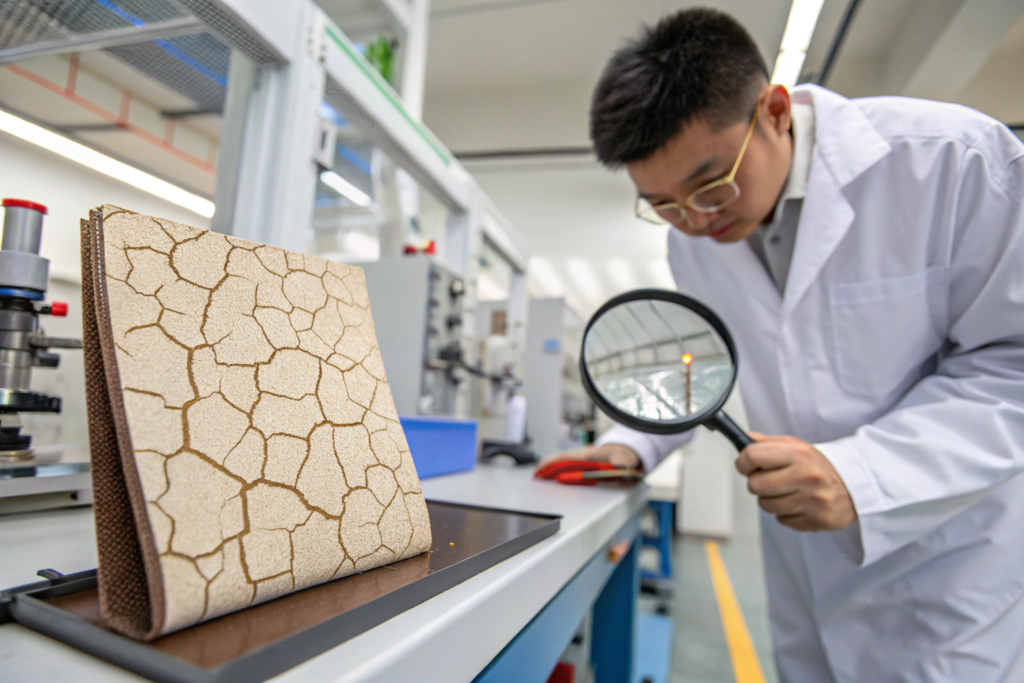
What's the percentage of bio-content I should look for to avoid greenwashing?
This is where marketing meets reality, and you need to protect yourself from suppliers who exaggerate.
The industry has settled on ASTM D6866 as the test method. It measures the ratio of carbon-14 (modern, biological origin) to carbon-12 (fossil). A result of 100% means all carbon is from renewable sources. A result of 0% means all carbon is fossil.
Here's the trap: some suppliers claim "bio-based" for a fabric that's 100% petroleum-based PU on a cotton backing. They calculate the percentage based on weight, so if the fabric is 60% cotton and 40% PU, they'll say "60% bio-based." Technically true, but misleading—the coating itself might be 100% petroleum.
We specify both: bio-content of the coating and overall fabric bio-content. For our premium line, we use 65-75% bio-based PU (confirmed by ASTM D6866) on a recycled polyester backing. Overall fabric bio-content ends up around 35-40%. For clients who want higher, we offer a Tencel or organic cotton backing, pushing total bio-content to 50%+.
A client from an Australian eco-brand now includes our test reports in their product pages. They write: "Coating: 68% bio-based (castor oil), verified by第三方 testing." Their customers love the transparency.
Watch out for "coming soon" claims. If a supplier claims 90%+ bio-content, ask for the test report. It might be lab-scale only, not commercial production. We've tested samples from competitors that claimed "100% bio" and found they were actually 30% bio with a lot of green marketing.
Does bio-based PU still shed microplastics during washing?
This is the uncomfortable question that keeps me up at night. The honest answer: yes, it does.
Bio-based PU is still plastic. The polymer structure is similar to petroleum PU—just the carbon source is different. When it wears, it sheds microplastic particles. The biodegradability of those particles is a complex debate. Some bio-based PUs are designed to be biodegradable in industrial composting facilities, but that doesn't mean they break down in ocean water or soil.
We're working on two solutions:
Topcoat barrier technology. We apply a thin, highly cross-linked topcoat that dramatically reduces shedding. Our lab tests show 60% less microfiber release compared to standard PU during accelerated washing tests. The trade-off is slightly stiffer hand feel.
Water-based vs. solvent-based. We switched all our coating lines to water-based systems in 2022. Solvent-based coatings release more microplastics during production and potentially during product life. Water-based isn't perfect, but it's better.
A client from a Dutch sustainable brand asked us to test our cactus leather (coated with bio-based PU) in their washing simulation rig. After 20 wash cycles (simulating 5 years of use), the microfiber loss was 0.8 grams per square meter. For context, a polyester fleece jacket loses 1.5-2.0 grams per wash. So it's better, but it's not zero.
We're transparent about this. When a client asks about microplastics, I show them our test data and explain the trade-offs. If they want zero plastic, we talk about Piñatex (which still has a small amount of binder) or moving toward mycelium (mushroom) leather, which can be 100% plastic-free but has different performance characteristics.
What's the Real Lead Time for Custom-Developed Vegan Leather?
A luxury sneaker brand from Los Angeles came to us in October 2023 wanting a custom vegan leather for their 2024 holiday drop. They had the color, the texture, the backing fabric all spec'd out. They wanted samples in 2 weeks and production in 6 weeks. I had to sit them down and explain the physics of coating development. You can't rush chemistry.
Custom development for vegan leather is different from standard fabric development. With woven fabric, you're mostly working with existing yarns and structures. With coated leather alternatives, you're creating a composite material—the base fabric, the coating formulation, the release paper for texture, the topcoat for protection.
Here's our actual timeline for a typical custom project:
Weeks 1-2: Feasibility and chemistry matching. You send us your target—a color swatch, a texture sample, a hand feel target. Our lab reverse-engineers the coating formula. We test different base fabrics (polyester, cotton, recycled blends) to see which bonds best with the coating while achieving your drape requirements.
Weeks 3-4: First round samples. We produce small lab dips—usually A4-sized sheets—in 5-10 variations. This is where we nail the color and basic texture. We ship these to you for initial approval. Expect 1-2 rounds of revision.
Weeks 5-7: Pilot run on production equipment. Once the lab formula is approved, we run 50-100 meters on our actual coating line. This matters because lab coating and production coating behave differently. The drying temperatures, line speed, and pressure all affect the final hand feel. This stage reveals surprises—maybe the color shifts slightly, or the texture isn't as deep as the lab sample.
Weeks 8-10: Second round samples and testing. You receive 5-10 meters of actual production-representative material. You test it in your factory—cutting, sewing, lasting (if it's for shoes). We run our own tests: abrasion, flex, hydrolysis, lightfastness. We share all data.
Week 12: Production approval and bulk order. If everything passes, we schedule your bulk run. First bulk production typically takes 3-4 weeks, depending on coating line availability.
The fastest we've ever done a custom development was 9 weeks, and that was for a client who accepted the first color match and didn't request any revisions. The longest was 7 months for a complex three-layer construction with a special embossed crocodile pattern.
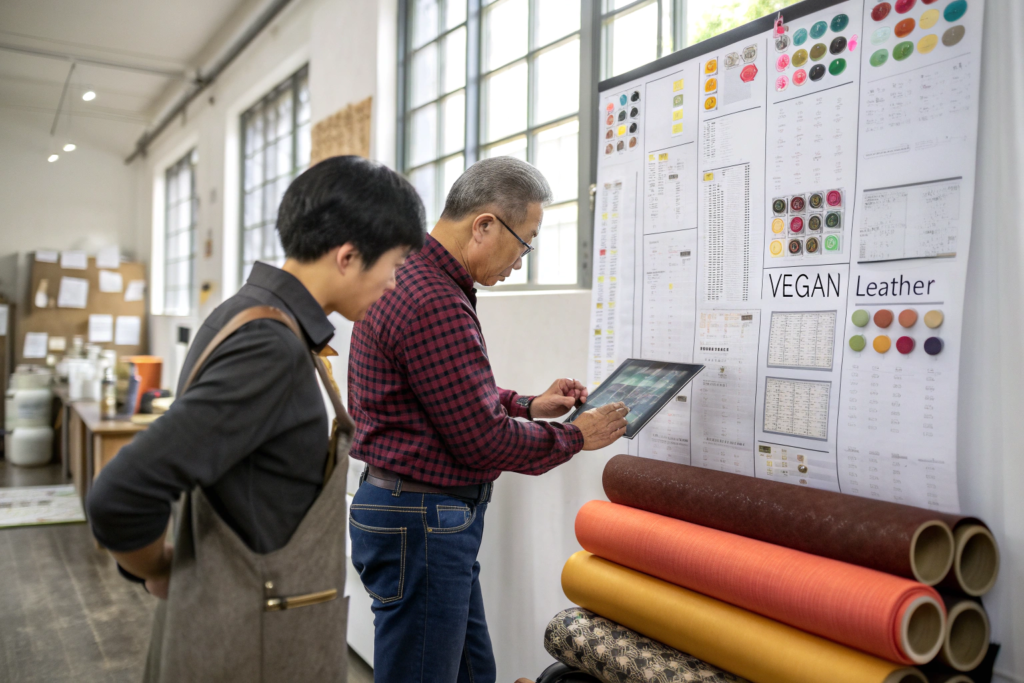
How many sample rounds are typical before bulk production?
In my experience, plan for three rounds. Here's why:
Round 1 gets you 80% there. The color is close, the texture is in the ballpark. You'll see something and think, "I want the grain deeper" or "Make it softer."
Round 2 is refinement. We adjust the release paper for deeper grain, modify the topcoat for softer hand feel. Now you're at 95%.
Round 3 is confirmation. We run a small pilot on the production line to ensure the lab adjustments translate to full-scale coating. This is where we catch issues like the color shifting because the production drying temperature is higher than the lab oven.
A client from a French accessories brand tried to skip Round 3 to save time. They approved Round 2 samples and placed a 10,000-meter order. When the bulk arrived, the hand feel was different—stiffer than the samples. We ended up air-freighting a replacement batch at our cost. Now we insist on a pilot run for any new development, even if the client is impatient.
The lesson: vegan leather is a engineered product. The coating line is not a photocopier. Small variations in temperature, humidity, and line speed affect the result. A pilot run is insurance against a 40-foot container of unusable material.
What testing should I run before committing to bulk?
Don't rely on your supplier's word alone. Here's the testing protocol we recommend to all our vegan leather clients:
Physical durability:
- Abrasion (ASTM D3884 or ISO 12947): Minimum 25,000 cycles for accessories, 40,000+ for footwear.
- Flex (ISO 5402 or ASTM D6182): 50,000 flexes minimum at room temperature. If your product goes to cold climates, request -10°C flex testing.
- Tear strength (ASTM D1424 or ISO 3377): This matters during cutting and sewing. Weak tear strength means wasted panels.
Environmental resistance:
- Hydrolysis (ISO 2440): Simulates hot, humid aging. We run 7 days at 70°C and 95% humidity, which approximates 5 years in a humid warehouse. The sample should show no cracking or delamination.
- Lightfastness (ISO 105-B02 or AATCC 16): If your product sits in shop windows, you need this. 40 hours minimum for accessories, 80+ for automotive or outdoor use.
- Heat aging (simple oven test): 72 hours at 80°C. Check for shrinkage, color change, or sticky surface.
Chemical safety:
- REACH or CPSIA compliance: Full restricted substance list testing. We provide this with every batch, but some clients pay for independent verification.
- Phthalates and heavy metals: Especially important for children's products or anything that touches skin for long periods.
A client from a Canadian outdoor brand taught me to add salt water resistance for their coastal market. We now offer this as an optional test. Their vegan leather dog collars spend a lot of time in ocean spray.
One more thing: test on your actual production equipment. We had a client whose cutting machine used ultrasonic cutting. Standard vegan leather melted at the edges. We had to develop a special formulation with higher heat resistance. You won't catch this in a lab test—you need to run it through your actual process.
How Do I Ensure Color Consistency Across Different Vegan Leather Batches?
A New York handbag designer called me in tears in 2022. Her entire spring collection—1,200 bags—was sitting in her studio with mismatched leather. The supplier had sent three batches over four months, and each batch was a slightly different shade of red. She couldn't sell them together, couldn't return them, couldn't afford to remake them. She nearly went out of business.
Color consistency is harder with vegan leather than with traditional leather or fabric. Here's why: with woven fabric, dyeing is a liquid process that penetrates the fibers. With coated leather, the color is in a surface layer that's applied as a wet film. Small variations in coating thickness, drying temperature, or the color of the base fabric underneath all affect the final shade.
We've developed a system to minimize variation, but it requires discipline from both us and our clients.
Standardized lighting conditions: All our color matching happens under D65 daylight lamps (the international standard). We don't rely on "looks good to my eye" in an office with fluorescent lights. Every batch gets measured with a spectrophotometer, and we track Delta E (the industry standard for color difference). We guarantee Delta E ≤ 1.0 for the same color across batches. Most human eyes can't detect a difference below 1.5.
Single lot of raw materials: For critical colors, we buy all the coating chemicals for the entire production run upfront. If we reorder chemicals six months later, the supplier's own batch variation can affect the color. We warehouse these materials until you're ready for your next order.
Backing fabric control: The color of the base fabric affects the final color, especially for thinner coatings. We dye the backing fabric specifically for your color, rather than using generic white or black. This adds 2 weeks to lead time but eliminates a major source of variation.
What's the acceptable Delta E range for luxury goods?
This depends on your market positioning. Here's what we see across different segments:
| Market Segment | Acceptable Delta E | Notes |
|---|---|---|
| Fast fashion basics | ≤ 1.5-2.0 | Consumers less critical, items often vary by design |
| Mid-range contemporary | ≤ 1.0-1.2 | Quality expectation is noticeable |
| Luxury/premium | ≤ 0.8 | Customers compare against each other |
| Ultra-luxury/auto | ≤ 0.5 | Panels sit next to each other, variation is unacceptable |
For most of our streetwear and contemporary brand clients, we target Delta E ≤ 1.0. That means two batches placed side by side might show a tiny difference to a trained eye, but the average consumer won't notice.
For a recent project with a Japanese luxury brand, we worked to Delta E ≤ 0.5. That required extra steps: pre-blending all pigment batches, running the entire production without stopping (which meant coordinating with their factory to take delivery of the whole order at once), and shipping color standards with every batch for on-site verification.
The cost difference matters. Delta E ≤ 0.5 adds about 15-20% to the price because of the extra quality control time and the waste from rejected batches that don't meet the tight tolerance. You have to decide whether your customer will pay for that precision.
How do I store color standards for future reorders?
This seems simple, but I've seen so many brands lose their color because they stored their standards wrong.
Physical standards: We provide a 30cm x 30cm sample of your approved color, sealed in a light-proof, acid-free envelope. Store it in a dark, cool, dry place. Never leave it on your desk where sunlight hits it. UV light changes color, even for materials that are supposed to be lightfast. We've had clients send us "original" standards that had faded to a completely different shade after a year on a bulletin board.
Digital standards: We measure every approved color with a spectrophotometer and provide the Lab values (L a b* coordinates under D65/10° illuminant). This is the scientific fingerprint of your color. Even if you lose the physical standard, we can recreate it from these numbers—usually within 0.3 Delta E.
Backup samples: We keep two copies of your color standard in our archive: one sealed, one for our lab to use when matching reorders. We update these every 6 months to ensure they haven't shifted.
A client from a German luggage brand taught us to include wash/fade standards. They ordered a color that looked great fresh but shifted after 3 months in their warehouse. We now provide, for an additional fee, aged standards that predict how the color will evolve over 6 months of storage. It's extra insurance against surprise.
For critical colors, we recommend single-batch purchasing. If you love a color and it's central to your brand identity, buy enough for 18 months of production at once. The warehousing cost is less than the risk of a bad batch mismatch.
What Certifications Prove a Vegan Leather is Actually Sustainable?
A buyer from a Scandinavian outdoor brand visited us carrying a binder of certifications thicker than a phone book. She spent two hours verifying every claim we'd made. "Last year," she told me, "we had to recall a whole collection because our 'sustainable' supplier couldn't prove their recycled content. We're not making that mistake again."
The certification landscape for vegan leather is confusing because the products are hybrids—part natural fiber, part synthetic coating, part chemistry. Different certifications cover different aspects. Here's what actually matters and how we approach it.
For bio-based content: The key is ASTM D6866 (radiocarbon analysis). There's no logo for this—it's a test result. Ask to see the report. Some suppliers claim "bio-based" based on mass balance accounting (buying bio-based credits) rather than actual content. The test proves it.
For recycled content: GRS (Global Recycled Standard) is the gold standard. It certifies the recycled percentage and tracks it through the supply chain. We offer GRS-certified vegan leather where the backing fabric is recycled polyester and the coating contains recycled content where possible. The certification adds about 8-10% to cost but is non-negotiable for serious sustainability claims.
For chemical safety: OEKO-TEX Standard 100 is the baseline. Class I is for baby products, Class II for skin contact. All our vegan leathers are Class II minimum. For clients selling in Europe, we also provide REACH compliance documentation and SVHC (Substances of Very High Concern) declarations.
For biodegradability: TÜV Austria's OK Biodegradable or DIN Certco are the main ones. But be careful—"biodegradable" usually means in industrial composting conditions (58°C, high humidity, specific microbes), not in your backyard or the ocean. We offer a compostable line that's OK Biodegradable certified, but the durability is lower—about 2 years of normal use before it starts breaking down.
For vegan status: PETA-Approved Vegan is the most recognized. It's easy to get—you just sign a declaration and pay a fee. It doesn't verify sustainability, only that no animal products were used. We have this for all our plant-based lines, but I tell clients it's the least meaningful certification on the list.

What's the difference between "vegan" and "sustainable" certifications?
This confusion costs brands money. I've seen marketing teams label a product as "eco-friendly" just because it's vegan, ignoring that it's made from petroleum and coated with formaldehyde-based resins.
Let me break it down with real examples from our catalog:
| Product | Vegan | Sustainable? | Certifications Held |
|---|---|---|---|
| Standard PU on polyester | Yes (PETA) | No | OEKO-TEX (chemical safety only) |
| Our cactus leather | Yes (PETA) | Partially | OEKO-TEX, USDA BioPreferred (40% bio-content) |
| Our GRS apple leather | Yes (PETA) | Yes (recycled backing) | GRS, OEKO-TEX, ASTM D6866 verified |
| Our compostable line | Yes (PETA) | Yes (end-of-life) | TÜV OK Biodegradable, GOTS-certified backing |
"Vegan" only tells you what's NOT in the product (animal products). "Sustainable" tells you something positive about what IS in the product and how it was made.
A client from a UK-based vegan brand learned this the hard way. They'd built their whole marketing around "vegan leather," but a competitor called them out on social media for using petroleum-based materials. Their customers demanded more. They came to us for GRS-certified apple leather, and now they market "vegan AND recycled."
If you're selling in Europe or to environmentally conscious consumers, you need both stories. Vegan is table stakes. Sustainability is the differentiator.
Can I get PETA certification for custom-developed materials?
Yes, and it's simpler than you'd think. We handle this for our clients all the time.
The PETA-Approved Vegan program requires:
- A signed statement confirming no animal products in the material
- A completed questionnaire about your supply chain
- Payment of a licensing fee (usually a few hundred dollars per year)
- Submission of samples for random testing (they can request this anytime)
For custom-developed materials, we provide you with our existing facility certification plus a letter specifying your exact product. You then apply for your own certification to use on your labels. Some clients prefer to have us certified as a supplier, and they use our certification number on their products. Others want their own certification for marketing control.
The key is traceability. PETA can request proof at any time. We maintain batch-level records showing exactly what went into your material. If they ask, we can provide purchase orders for the bio-based polyol, the GRS-certified backing fabric, and the production records. We've never had an issue.
A client from a Los Angeles vegan footwear brand uses our certification as a marketing tool. Their product pages say "Made with Fumao's PETA-Approved Vegan Apple Leather." They link to our certification page. Their customers trust it more than a generic claim.
One warning: PETA certification doesn't cover sustainability claims. You'll need separate certifications (GRS, OEKO-TEX, etc.) for those. We bundle them for clients who need the full package.
Conclusion
The shift away from traditional leather isn't a trend—it's a structural change in the industry. Price volatility, supply chain ethics, and consumer demand are all pushing in the same direction. But navigating the world of leather alternatives requires understanding the real differences between materials, not just the marketing stories.
Plant-based options like apple, cactus, and pineapple leather have matured to the point where they can replace traditional leather for most applications. Bio-based coatings are closing the performance gap with petroleum versions. Custom development is possible if you plan for realistic timelines. And certifications provide the proof your customers demand.
I've been in this industry long enough to see many "next big things" come and go. This one is different because the drivers are structural, not faddish. The brands that adapt now will have supply chain advantages in five years. The ones that wait will be scrambling.
At Shanghai Fumao, we've built our leather alternatives program to serve brands at every level—from startups needing 500 meters for a test collection to luxury houses requiring custom development with tight tolerances. We've made the mistakes so you don't have to. We've invested in the certifications so you can market with confidence.
If you're exploring leather alternatives for your next collection—whether it's handbags, footwear, accessories, or even automotive—reach out. Let's talk about what you're trying to achieve. We can help you navigate the options, understand the trade-offs, and find the material that actually works for your specific application.
Contact our Business Director, Elaine. She leads our sustainable materials division and has helped dozens of brands transition from traditional leather to innovative alternatives. She knows the products, the certifications, and the timelines. Email her at elaine@fumaoclothing.com. Tell her what you're working on, and she'll guide you through the possibilities.
At shanghai fumao, we don't just follow trends—we help build the future of materials.