I learned the lethal cost of static electricity in a cleanroom in Suzhou in 2019. I was not there for textiles. I was there for my son, who was undergoing eye surgery at a specialist hospital. I noticed the surgical team's gowns—a pale blue, almost gray fabric. I asked the head nurse about it after the procedure. She told me: "This is our anti-static surgical wear. One static discharge near an open wound can cause electrostatic damage to tissue or ignite flammable anesthetics. We test every gown before sterilization." I had been selling fabric for 18 years and had never considered this. I went back to Keqiao and told our development team: we need to understand this market.
Today, anti-static fabrics are a significant and growing part of our business. Not just for cleanrooms and surgical suites, but for oil and gas, munitions handling, data centers, electronics manufacturing, and even everyday workwear for mechanics and technicians. The technology is not complicated—conductive fibers, surface resistivity targets, grounding pathways—but the consequences of failure are catastrophic. A single static spark in a grain silo can level a building. A single discharge into a hard drive assembly line can scrap an entire batch of $50,000 drives.
This article is written from the perspective of a supplier who has made mistakes and learned from them. I will explain the different types of anti-static fabrics, how to specify them correctly, which international standards actually matter, and why cheap "anti-static" finishes are often worthless. If you are sourcing workwear for any environment where static is a risk, read this before you place your next order.
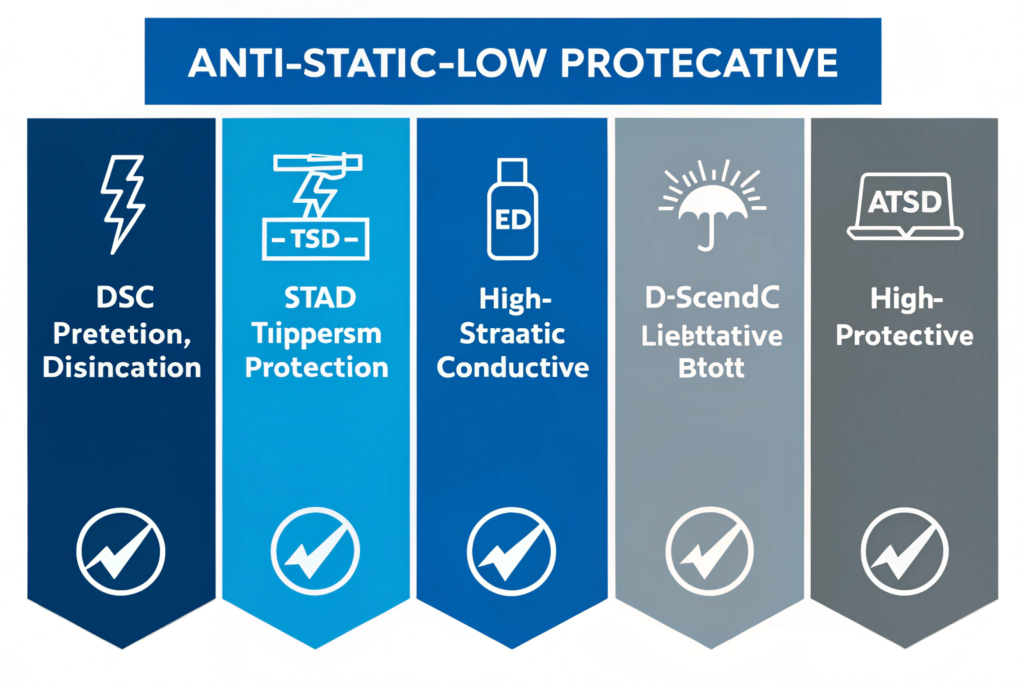
What Is the Difference Between Anti-Static, Static Dissipative, and Conductive Fabrics?
This is the most common source of confusion and mis-specification. These terms are not interchangeable. They describe distinct levels of electrical performance with different test methods and different end-use applications.
Anti-Static (or Static Resistant):
This is the lowest level of protection. It means the fabric has been treated or constructed to reduce the generation of static electricity. It does not mean the fabric will remove static charge that is already present. Typically achieved by:
- Incorporating carbon-loaded fibers into the yarn.
- Applying a topical antistatic finish (often quaternary ammonium compounds).
- Using hydrophilic fibers (cotton, viscose) that increase surface moisture content.
Typical application: General workwear, cleanrooms ISO Class 7-8, environments where static is a nuisance but not a hazard.
Target spec: Surface resistivity < 1 x 10^11 ohms per square (often higher). Decay time < 2 seconds.
Static Dissipative:
This is a higher level of protection. The fabric allows static charge to flow across its surface or through its body to a ground point at a controlled, moderate rate. It does not conduct electricity rapidly enough to be a shock hazard, but it dissipates charge quickly enough to prevent sparking. Achieved by:
- Higher density of conductive fibers (usually carbon or metal-coated).
- Engineered conductive grids or stripes at defined intervals.
- Intrinsically dissipative polymers (some nylons and polyesters).
Typical application: Electronics assembly, munitions handling, petrochemical environments, ISO Class 5-6 cleanrooms.
Target spec: Surface resistivity 1 x 10^5 to 1 x 10^11 ohms per square. Decay time < 0.5 seconds. Point-to-point resistance < 1 x 10^9 ohms.
Conductive:
This is the highest level. The fabric is designed to conduct electricity readily. It provides a path for charge to flow rapidly to ground. It can also provide electromagnetic shielding. Achieved by:
- High-density conductive fiber grids (carbon, copper, silver, nickel).
- Metalized coatings or laminates.
- Stainless steel or copper filament yarns.
Typical application: Explosive environments (Zone 0/1), high-precision electronics, EMI/RFI shielding, medical devices.
Target spec: Surface resistivity < 1 x 10^5 ohms per square. Volume resistivity < 1 x 10^3 ohm-cm.
The critical mistake: We see buyers specifying "anti-static" for an electronics cleanroom when they actually need "static dissipative" or "conductive." The fabric arrives, passes the buyer's in-house "rub on hair" test, but fails the ESD association's garment system test because the charge does not dissipate quickly enough. The shipment is rejected. The production line is delayed.
Our recommendation: Do not use generic terms. Specify the test method and the target value. "Surface resistivity per AATCC 76, maximum 1 x 10^9 ohms per square." "Static decay per FTMS 101C, 99% decay in <0.5 seconds." This removes ambiguity. The ESD Association Standard ANSI/ESD STM2.1 is the definitive reference for garment testing, and we require our workwear clients to specify which standard they are using.
What is surface resistivity and why is it the wrong spec for finished garments?
Surface resistivity (ohms per square) measures the resistance to charge flow across the surface of the fabric. It is measured using a concentric ring electrode under controlled temperature and humidity (typically 23°C, 25% RH for ESD testing).
The problem: Surface resistivity is a material property. It tells you about the fabric itself. It does not tell you how the fabric will perform as a garment system. The seams, the closure methods (zippers, snaps), the contact with skin or undergarments, the grounding connection—all of these affect the garment's ability to dissipate charge from the wearer's body.
The correct spec for finished garments is either:
- Vertical resistance (ANSI/ESD STM2.1): Measures the resistance from the garment material to ground through a grounded wrist strap or alligator clip.
- System resistance (ANSI/ESD SP15.1): Measures the resistance from the wearer's hand, through the garment, to ground.
- Static decay (FTMS 101C, Method 4046): Measures the time required for a charged fabric to dissipate 99% or 90% of its induced charge.
Our protocol: For critical ESD applications, we do not certify fabrics based on surface resistivity alone. We require the client to send us their actual garment pattern, or a representative panel construction. We fabricate a sample garment, test it according to ANSI/ESD STM2.1, and provide a report. We have seen fabrics that test beautifully at 1 x 10^7 ohms/square fail the garment system test at 1 x 10^11 ohms because the conductive grid was interrupted by a non-conductive seam.
In 2022, a medical device manufacturer rejected an entire shipment of anti-static lab coats because the garment system test showed resistance exceeding 1 x 10^10 ohms. The fabric itself was within spec. The problem was the thread. The client's specification did not require conductive thread in the seams. The standard polyester thread created an insulating barrier between the conductive fabric panels. We now include a clause in our ESD garment specifications: "All seams must be sewn with carbon-loaded or metal-coated conductive thread, or the garment must be tested and certified as a complete system." The ESD TR20.20 technical report provides detailed guidance on the interaction between materials and construction.
Can I use a topical anti-static spray or finish instead of buying engineered fabric?
You can, but you should not rely on it for any application where failure has safety or financial consequences.
Topical anti-static finishes are typically humectants. They attract moisture from the air to the fabric surface. Moisture conducts electricity. The finish works well at high humidity (>50% RH) and fails completely at low humidity (<30% RH). They also wash off. Most commercial anti-static sprays survive 1-5 launderings before performance degrades below usable levels.
Inherently anti-static fibers (carbon-loaded, metal-coated, intrinsically conductive polymers) are permanent. They do not depend on humidity. They survive 50+ industrial launderings with minimal degradation. They are also significantly more expensive.
Our position: We offer topical anti-static finishes for clients who need a low-cost, short-term solution for non-critical applications. We disclose the wash durability data. We do not recommend these finishes for cleanrooms, electronics assembly, or hazardous environments. For those applications, you must specify conductive fibers.
The exception: Some high-end topical finishes based on polyaniline or PEDOT/PSS (conductive polymers) are being developed. These are not humectants; they are inherently conductive. They are expensive, difficult to apply uniformly, and not yet widely available in commercial textile finishing. We are monitoring this technology but have not qualified any suppliers.
What Conductive Fibers and Yarns Are Used in Anti-Static Fabrics?
The conductive element is not the base fiber. Polyester and cotton are insulators. To make them anti-static, you must introduce a conductive pathway. There are several methods, each with different performance characteristics and cost structures.
1. Carbon-loaded synthetic fibers.
- Construction: Carbon black particles are compounded into nylon or polyester melt, then extruded into fiber. The fiber is not conductive throughout; the carbon particles create a percolation network.
- Properties: Semi-conductive. Resistivity typically 1 x 10^5 to 1 x 10^9 ohms/cm. Black or dark gray color (carbon is black). Can be blended with natural fibers or used as a filament.
- Durability: Excellent. The conductivity is inherent to the fiber; it does not wash off.
- Cost: Moderate.
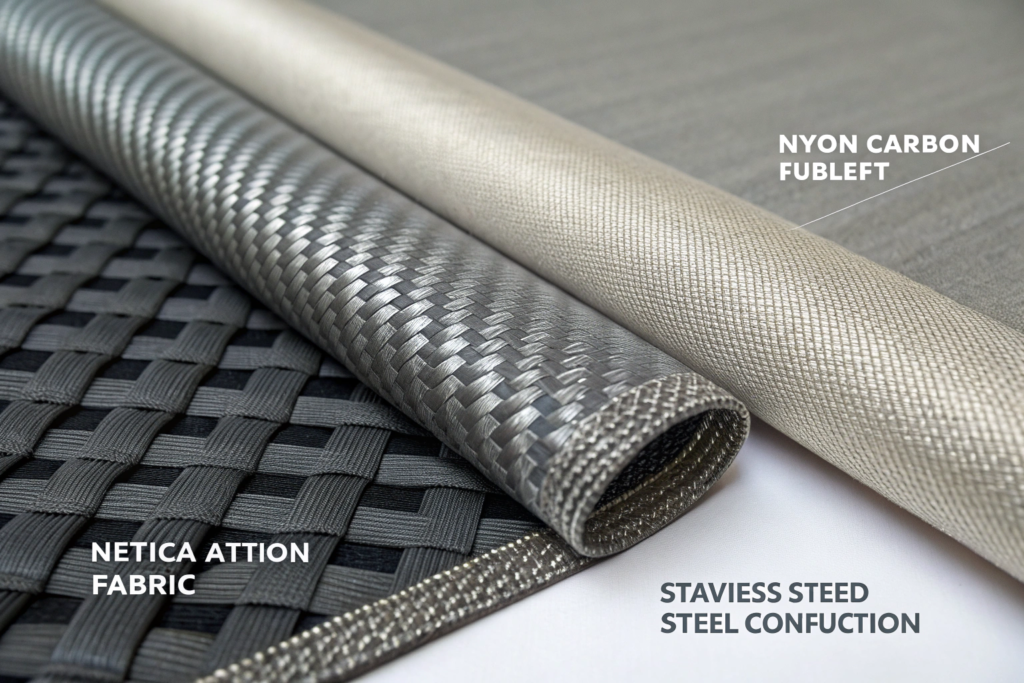
- Our use: Most common anti-static fiber for general workwear. We use 20D/30D carbon-loaded nylon filaments woven into a grid pattern at 5mm, 10mm, or 20mm intervals.
2. Metal-coated synthetic fibers.
- Construction: Nylon or polyester filament is coated with silver, copper, nickel, or gold via electroless plating. Silver-coated nylon is the most common.
- Properties: Highly conductive. Resistivity < 1 x 10^2 ohms/cm. Excellent EMI shielding properties. Silver has natural antimicrobial properties.
- Durability: Good, but the metal coating can abrade over time, especially in high-friction applications. The fiber itself is conductive; the coating enhances conductivity.
- Cost: High (silver is expensive).
- Our use: High-end ESD garments, cleanrooms, medical devices, and applications requiring both anti-static and antimicrobial properties.
3. Stainless steel filaments.
- Construction: Ultra-fine stainless steel wires (typically 8-12 micron diameter) are wrapped with or co-mingled with synthetic fibers.
- Properties: Highly conductive. Extremely durable. Does not degrade with washing. Difficult to dye (steel is visible as a metallic sheen or dark filament).
- Cost: High, and processing is difficult (steel filaments break more easily than synthetics).
- Our use: Heavy-duty industrial workwear, oil and gas, mining. Not suitable for light-colored garments where the black carbon fiber or metallic sheen is visible.
4. Intrinsically conductive polymers.
- Construction: Specialty polymers (polyaniline, PEDOT) that are inherently conductive without carbon or metal additives.
- Properties: Variable. Can be formulated in various colors. Still expensive and difficult to process at scale.
- Cost: Very high. Limited commercial availability.
- Our use: Niche. We have supplied this for specialized military and aerospace applications.
5. Hybrid yarns.
- Construction: Conductive fibers are wrapped around a non-conductive core, or non-conductive fibers are wrapped around a conductive core.
- Properties: Tunable. Allows optimization of conductivity, strength, and aesthetics.
- Cost: Moderate to high.
- Our use: Often used in conveyor belts and industrial textiles, less common in apparel.
Our specification guide:
- For general workwear, light color: Carbon-loaded nylon grid. Accept that the conductive yarn will be visible as a dark or gray stripe. This is normal. Do not ask for "invisible" anti-static unless you are willing to pay for silver-coated fibers and accept lower wash durability.
- For cleanrooms, dark color: Silver-coated nylon or high-density carbon grid. The higher conductivity provides faster decay times required for sensitive environments.
- For explosive atmospheres: Stainless steel or high-density silver. The margin for error is zero.
In 2023, we developed a custom anti-static fabric for a European munitions disposal team. The requirement was extreme: surface resistivity < 1 x 10^4 ohms/square, even after 100 industrial wash cycles. We used a 2.5cm grid of 100% stainless steel filament, woven into a 250gsm cotton-nylon base fabric. The fabric is heavy, stiff, and expensive. It also saved lives. The National Fire Protection Association (NFPA) 2112 and 2113 standards for flash fire and arc flash protection often include static dissipative requirements, and we reference these for industrial safety clients.
Why is the carbon grid visible, and can I hide it?
The short answer: You cannot hide carbon fiber. It is black. If you weave a black yarn into a white or pastel fabric, it will be visible. This is not a defect; it is a feature. The visible grid allows quality control inspectors to verify that the conductive fibers are present and properly spaced.
If you need invisible anti-static protection:
- Use silver-coated fibers. The silver coating gives the yarn a gray, metallic appearance, which is less conspicuous than black carbon. On light colors, it still shows, but it blends better.
- Use finer denier conductive fibers. We can supply 15D carbon-loaded nylon, which is significantly less visible than 30D. It is also more expensive and more prone to breakage.
- Accept lower conductivity. Some clients choose to omit the visible grid and rely on topical anti-static finishes or blend very low percentages of conductive staple fibers into the spun yarn. The performance is significantly lower. We do not recommend this for any application with actual ESD risk.
Our labeling: We advise clients to include an educational hang tag: "The visible grid in this garment is a carbon fiber conductive pathway that safely dissipates static electricity. It is an essential safety feature, not a flaw."
What is the difference between 'grid' and 'intimate blend' construction?
Grid construction:
Conductive yarns are woven or knitted into the fabric at regular intervals, typically 5mm, 10mm, or 20mm spacing. This creates a visible matrix of conductive pathways. The conductive fibers carry charge to ground points (cuffs, hems, etc.).
Advantages: Highly effective. Predictable performance. Easily verified by visual inspection. Lower cost (less conductive fiber used).
Disadvantages: Visible. Charge dissipation is not uniform across the entire fabric surface; it must travel to the nearest grid line.
Intimate blend construction:
Conductive staple fibers (carbon-loaded nylon, stainless steel) are blended with non-conductive fibers (cotton, polyester) during the spinning process. The conductive fibers are distributed randomly throughout the yarn.
Advantages: Invisible or nearly invisible. Uniform charge dissipation across entire fabric surface. Softer hand feel.
Disadvantages: Higher cost. More difficult to control consistency. Cannot be visually verified; requires electrical testing.
Our recommendation:
- Grid: For most industrial and cleanroom applications. The performance is reliable and the cost is manageable.
- Intimate blend: For high-end corporate workwear, customer-facing uniforms, and applications where aesthetics are paramount. Be prepared to pay a premium and conduct rigorous testing.
What International Standards Apply to Anti-Static Workwear?
This is a complex landscape, and the wrong standard can leave you with non-compliant garments. Different industries and different countries mandate different test methods and performance requirements. You must know which standard applies to your specific end use.
IEC 61340-5-1 (International):
This is the dominant global standard for ESD protective garments in electronics manufacturing. It specifies:
- Garment system resistance (point-to-point, point-to-ground) < 1 x 10^10 ohms.
- Triboelectric charge generation < 100V (or < 200V for less sensitive environments).
- Test methods per IEC 61340-4-9 and IEC 61340-2-3.
Our use: Required by nearly all electronics brands and contract manufacturers. We certify fabrics to this standard for clients supplying Foxconn, Samsung, Intel, etc.
EN 1149 (European Union):
This is the standard for electrostatic properties of protective clothing. It has multiple parts:
- EN 1149-1: Surface resistivity test method.
- EN 1149-2: Vertical resistance test method (withdrawn).
- EN 1149-3: Charge decay test method.
- EN 1149-5: Performance requirements for material and design.
Our use: Required for PPE certified to EU regulations. Common in oil and gas, chemical, and general industrial workwear.
ASTM F1506 (USA):
This is the standard for arc flash protective clothing. It includes performance requirements for flame resistance and electrostatic dissipation. It references ASTM D257 (resistivity) and FTMS 101C (static decay).
Our use: Required for electrical utility workers, electricians, and any personnel exposed to arc flash hazards.
NFPA 77 (USA):
Recommended practice for static electricity. Not a product standard, but it provides guidance on hazard assessment. Often referenced by safety engineers when specifying workwear for hazardous locations.
JIS T 8118 (Japan):
Japanese standard for electrostatic protective clothing. Similar to IEC 61340-5-1 but with some differences in test methods and requirements. Required for clients selling into the Japanese market.
GB 12014 (China):
Chinese national standard for anti-static workwear. Specifies fabric point-to-point resistance and charge decay. Required for PPE certified for the Chinese domestic market.
The compliance trap: A fabric that passes EN 11495 may not pass IEC 61340-5-1. A garment that passes ASTM F1506 may not pass JIS T 8118. If you are sourcing workwear for a global workforce, you may need multiple certifications or a fabric that meets the strictest of all applicable standards.
Our certification strategy: We maintain a matrix of test results for each anti-static fabric construction. We can provide reports from multiple accredited laboratories (SGS, BV, TÜV) for different standards. We do not assume that one test report is sufficient for all markets. When a client tells us "I need anti-static workwear," our first question is: "Which standard applies to your end use and your destination market?" The ESD Association's global standards comparison chart is a useful starting point for navigating this complexity.
What is 'triboelectric charging' and why is it harder to control than surface resistivity?
Triboelectric charging is the generation of static electricity through friction—fabric rubbing against fabric, fabric against skin, fabric against chair upholstery. This is the primary mechanism by which workwear becomes charged in real-world use.
Surface resistivity is a material property. Triboelectric charging is a system behavior. A fabric with excellent surface resistivity can still generate high triboelectric charges if it is prone to donating or accepting electrons when rubbed against common materials.
The triboelectric series ranks materials by their tendency to gain or lose electrons. Materials at one end of the series (PTFE, silicone) tend to gain electrons (become negative). Materials at the other end (human skin, glass, nylon) tend to lose electrons (become positive). When two materials from opposite ends of the series rub together, high static charges are generated.
Our challenge: Many anti-static fabrics use carbon-loaded nylon as the conductive fiber. Nylon is near the positive end of the triboelectric series. If the wearer's undergarment is polyester (negative end), the friction between the anti-static workwear and the undergarment can generate significant charge, even if the workwear itself is conductive.
The solution:
- System testing. Test the complete garment system, including representative undergarments, per ANSI/ESD STM2.1.
- Material selection. Choose conductive fibers and base fabrics that are triboelectrically neutral, or match the triboelectric properties of the expected undergarments.
- Grounding. Ensure the garment provides a reliable path to ground through wrist straps, heel grounders, or conductive flooring.
Our data: In 2024, we tested 12 different anti-static fabric constructions against a standard polyester/cotton undershirt. The peak triboelectric charge ranged from 12V to 380V. The lowest-charging fabric was a cotton-rich intimate blend with carbon fibers; the highest was a nylon-rich grid construction. Both fabrics passed surface resistivity requirements. Only one passed the <100V requirement of IEC 61340-5-1. The Electrostatic Discharge Association's Triboelectric Charging Technical Report provides detailed guidance on this phenomenon.
What is the wash durability requirement for anti-static workwear?
This depends entirely on the industry and the garment's expected lifespan.
Electronics manufacturing: Typically 50-100 industrial launderings. Garments are often leased from industrial laundry services and replaced on a schedule. We certify our ESD fabrics for 100 washes minimum, with surface resistivity remaining below 1 x 10^10 ohms after 100 cycles.
Oil and gas / heavy industry: 25-50 washes. These garments are subjected to harsher conditions and are often replaced more frequently due to physical wear.
Cleanrooms: 50-100 washes, but the primary failure mode is particle shedding, not ESD degradation. Anti-static properties typically outlast cleanroom integrity.
General workwear: 25-50 washes. Many companies replace uniforms annually regardless of condition.
The failure mechanisms:
- Conductive fiber breakage. Carbon-loaded nylon filaments are fine (20-30D) and can break under mechanical stress. This breaks the conductive pathway.
- Coating abrasion. Silver-coated fibers lose conductivity as the silver layer wears away. This is accelerated by harsh detergents and high drying temperatures.
- Fabric shrinkage. Shrinkage changes the spacing of the conductive grid. If the grid spacing exceeds the design specification, charge dissipation becomes less effective.
Our wash testing protocol: We use ISO 6330 (6A, 60°C, tumble dry) for industrial wash simulation. We test surface resistivity and vertical resistance at 0, 25, 50, 75, and 100 cycles. We provide the client with a wash durability curve, not a single pass/fail result. This allows them to set their own replacement schedule.
How Do You Specify Anti-Static Fabrics for Electronics vs. Explosive Environments?
The physics are similar, but the performance requirements and regulatory frameworks are different.
For electronics manufacturing (ISO Class 5-8 cleanrooms, assembly lines):
Primary risk: Electrostatic discharge damaging sensitive components. The threshold for damage is decreasing as components shrink. Modern semiconductors can be damaged by discharges as low as 30-50V, well below human perception (3,000V+).
Key standard: IEC 61340-5-1.
Critical specifications:
- Garment system resistance < 1 x 10^10 ohms.
- Triboelectric charge generation < 100V (preferably < 50V for Class 0 sensitive devices).
- Particle shedding (for cleanrooms). Test per IEST-RP-CC003.3. Maximum 3.0 class for ISO Class 5.
Fabric recommendations:
- 100% polyester with carbon grid or silver-coated grid.
- Taffeta or ripstop weave for low particle shedding.
- Seamless or bound seams to minimize edge fraying.
- Conductive thread in all seams.
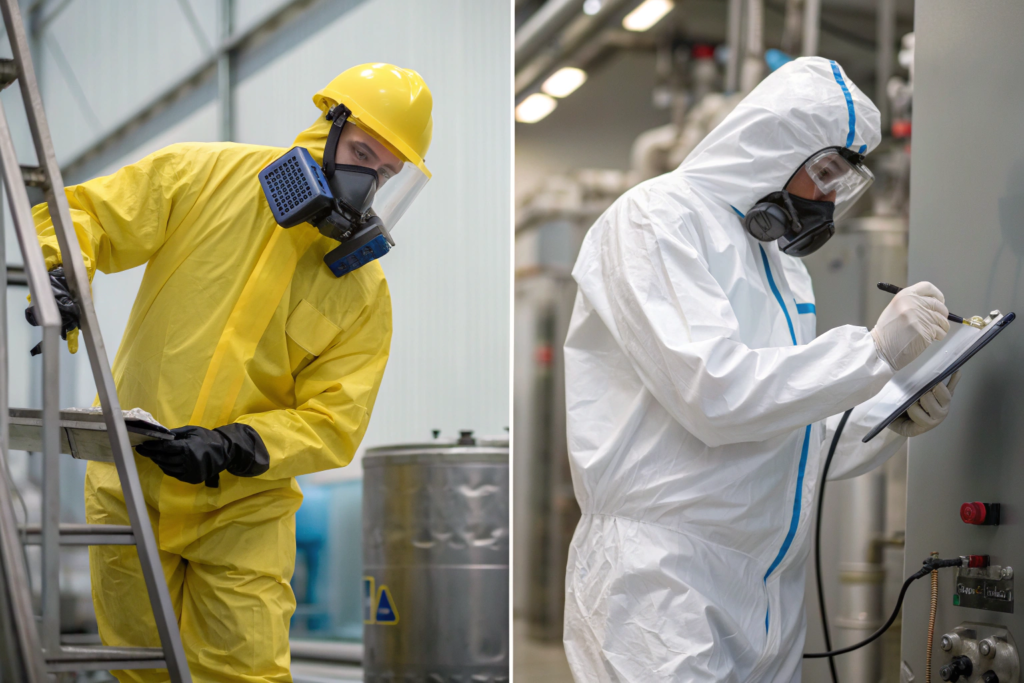
For explosive environments (oil refineries, chemical plants, grain elevators, munitions):
Primary risk: Static spark igniting flammable gas, vapor, or dust. The ignition energy of many hydrocarbons is 0.25 mJ or less. A static discharge from a charged human body can exceed 20 mJ.
Key standards: EN 1149-5, NFPA 77, API RP 2003.
Critical specifications:
- Surface resistivity < 1 x 10^9 ohms (often stricter than electronics).
- Charge decay time < 0.5 seconds (50% RH) or < 4 seconds (12% RH) per EN 1149-3.
- Flame resistance (often required in conjunction with anti-static). NFPA 2112, EN ISO 11612.
Fabric recommendations:
- Cotton/nylon blends with carbon grid or stainless steel grid.
- Heavier weight (200-300 gsm) for durability and FR performance.
- FR-treated or inherently FR fibers (modacrylic, aramid) if flame resistance is required.
- Dissipative properties must be maintained after FR treatment (some FR chemicals leave insulating residues).
The critical distinction: In electronics, you are protecting the product. In explosive environments, you are protecting human life. The consequences of failure are fundamentally different. Do not use a fabric certified for electronics manufacturing in a petrochemical facility unless it also meets EN 1149-5 and any applicable flame resistance standards.
In 2020, we supplied 15,000 meters of anti-static fabric to a client who did not disclose the end use. The fabric met IEC 61340-5-1. The client used it for uniforms in a grain processing facility. Six months later, we received an urgent call. The uniforms were sparking when workers walked across concrete floors in low humidity. The fabric passed surface resistivity but had very fast charge decay—which is good for electronics—but also had high triboelectric charging propensity against common undergarments. In the grain facility, this combination created frequent, visible sparks. No explosion occurred, but the risk was unacceptable. We replaced the entire order with a different fabric construction at our cost. We now require end-use disclosure for all anti-static fabric orders. The API RP 2003 standard for protection against ignitions arising out of static electricity is the definitive reference for petrochemical applications, and we require our sales team to be familiar with it.
Can I use the same anti-static fabric for both electronics and explosive environments?
Rarely. The requirements are different and sometimes conflicting.
Conflict 1: Particle shedding. Electronics cleanrooms require low particle shedding. Many durable, heavy-weight fabrics used in explosive environments shed significant particles.
Conflict 2: Flame resistance. Explosive environments often require flame-resistant (FR) clothing. Electronics cleanrooms do not. FR treatments can affect conductivity and triboelectric properties.
Conflict 3: Color. Electronics cleanrooms typically use pale colors (white, blue, gray) for visibility and contamination control. Industrial workwear often uses high-visibility colors (orange, yellow) or corporate colors.
Conflict 4: Comfort. Cleanroom garments are designed to be lightweight and breathable. Industrial FR/ESD garments are often heavier and less breathable.
The exception: Some high-end dual-certified fabrics exist. We have developed a 180gsm modacrylic/cotton/nylon blend with stainless steel grid that meets both NFPA 2112 (flash fire) and IEC 61340-5-1 (ESD). It is expensive, heavy, and not suitable for cleanrooms, but it works for refineries and chemical plants that also require ESD protection. This fabric is not a compromise; it is a specialized solution for a specific risk profile.
What is 'ESD-safe' footwear and how does it interact with anti-static garments?
ESD footwear is part of the total grounding system. An anti-static garment cannot dissipate charge if the wearer is isolated from ground. The garment must be in contact with the wearer's skin or with a grounding strap, and the wearer must be grounded through conductive footwear and flooring.
Key points:
- Garment-to-skin contact is essential. Loose-fitting garments that do not touch the skin cannot dissipate charge from the body.
- Conductive thread in garment cuffs and hems improves contact with wrist straps or grounding points.
- ESD footwear must have resistance to ground of < 1 x 10^9 ohms (per ANSI/ESD STM97.1).
Our recommendation: Specify anti-static garments as part of a total ESD control program, not as a standalone product. Coordinate with the ESD footwear and flooring specifications. Test the entire system, not just the fabric.
Conclusion
Anti-static fabrics are not a commodity. They are engineered safety products. The difference between a fabric that passes and a fabric that fails is often invisible—a broken conductive filament, an interrupted grid, an incompatible undergarment. The consequences of failure range from scrapped circuit boards to catastrophic industrial accidents.
At Shanghai Fumao, we treat anti-static fabrics as a distinct product category with dedicated engineering support. We do not offer a generic "anti-static finish" and call it a day. We maintain inventories of carbon-loaded, silver-coated, and stainless steel conductive yarns. We have qualified multiple grid densities and blend ratios. We test every production lot for surface resistivity and, where required, garment system resistance. We provide wash durability data, not just a single snapshot.
We also tell clients when they are over-specifying. If you are sourcing uniforms for a warehouse where the only static risk is discomfort when touching a doorknob, you do not need IEC 61340-5-1 certification. You need a basic anti-static grid or even a topical finish. We will tell you this. We will not sell you a $12/meter silver-coated fabric when a $4/meter carbon grid will suffice.
If you are sourcing workwear for any environment where static electricity is a safety or quality risk, I invite you to contact us. Send us your end-use description, your applicable standards, and your wash durability requirements. We will recommend the appropriate fabric construction and provide supporting test data.
Contact Elaine, our Business Director, to discuss your anti-static workwear requirements. Elaine manages our technical textiles division and has overseen ESD garment programs for Fortune 500 electronics manufacturers, petrochemical companies, and cleanroom operators. Elaine’s email is: elaine@fumaoclothing.com. Tell her what you need to protect.