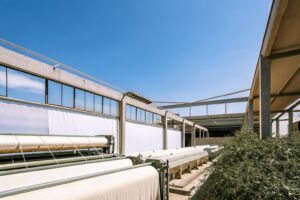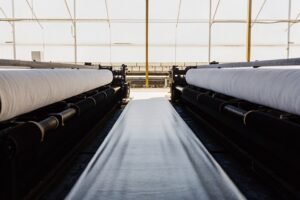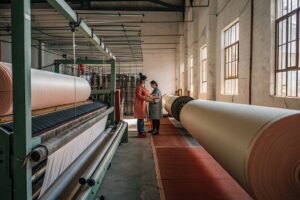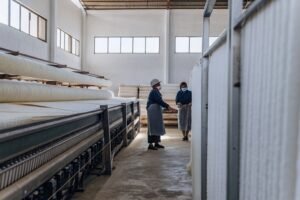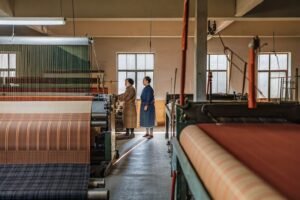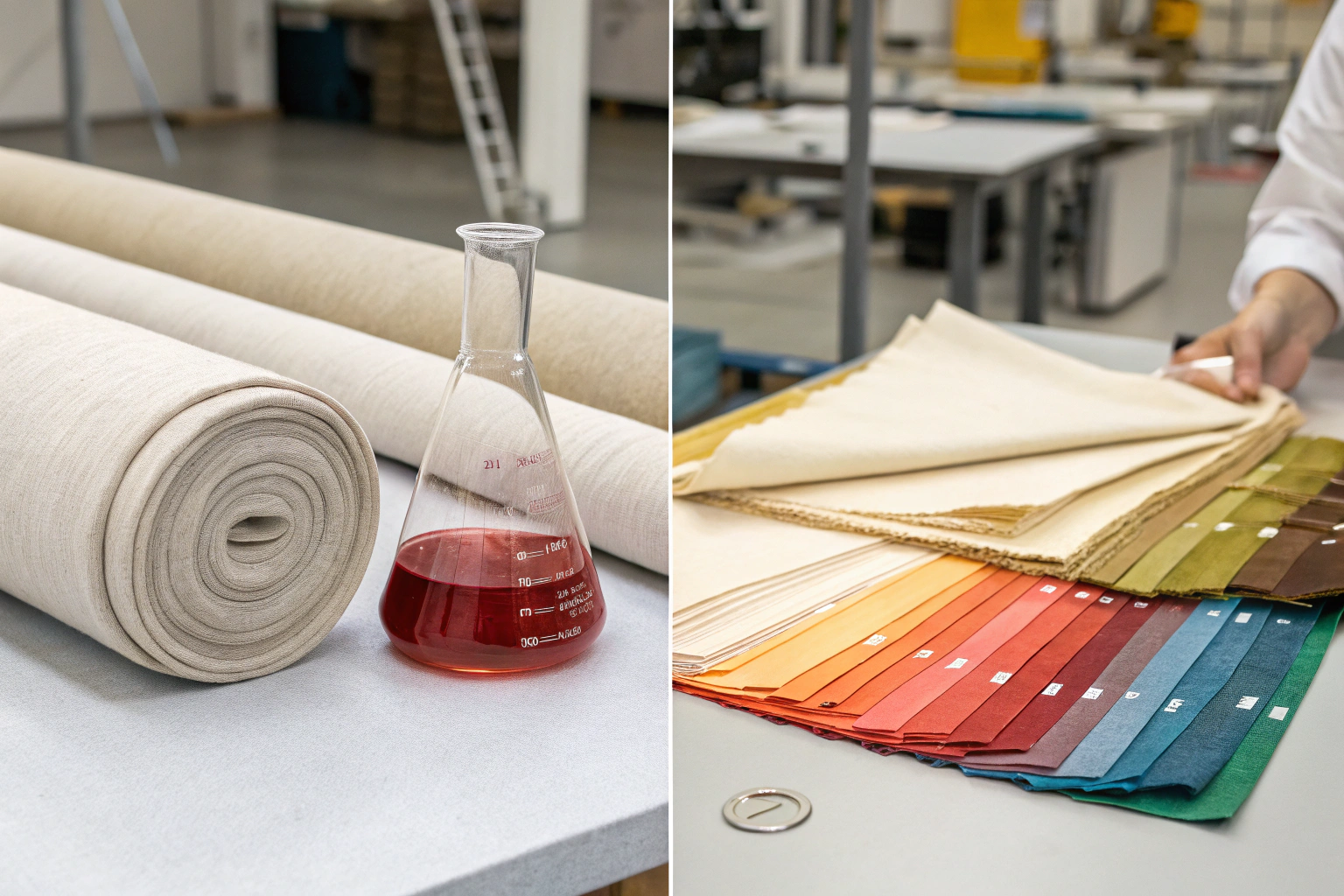
Every meter of fabric you buy is a decision about risk. You might think buying greige fabric and dyeing it locally is the smart way to save money and control color. But I’ve watched that strategy backfire spectacularly for American brands who underestimate the chemistry. They think they’re saving $1.50 per yard. Instead, they end up with 500 meters of patchy, bleeding, or shrinkage-prone fabric that no local dyehouse can fix. The real cost isn’t the dyeing fee. The real cost is the ruined brand reputation when a customer washes a $98 linen shirt and the color runs down their washing machine.
The better choice, in nine out of ten cases, is to let us handle the dyeing right here in our Keqiao partner dyeing factories. When we control the dyeing, we own the outcome. Our lab-tested, finished fabric comes to you ready-to-cut, with shrinkage already controlled and colorfastness already certified. You just open the roll and feed it to your cutting table. But—and this is a big but—there is one specific scenario where buying our greige fabric makes brilliant strategic sense: when you are producing a small-batch, hyper-local capsule collection and you want to market a "Made in USA" story with a specific, non-repeatable color palette. Even then, you need a strict protocol to avoid disaster.
I’ve been in the textile game for over 20 years, and I’ve seen the good, the bad, and the ugly of both approaches. The decision hinges on your volume, your tolerance for technical headaches, and how much you value the "locally dyed" narrative. Think of it like buying a car. You can buy it fully assembled and tested, or you can buy the chassis and engine separately and hire a local mechanic to finish it. The second option might give you a custom paint job, but it might also void the warranty and leave you stranded on the highway. Let me walk you through the real trade-offs so you can make the right call for your business.
What Exactly Is Greige Cotton Linen and How Does It Behave?
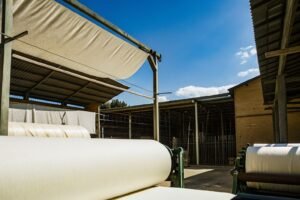
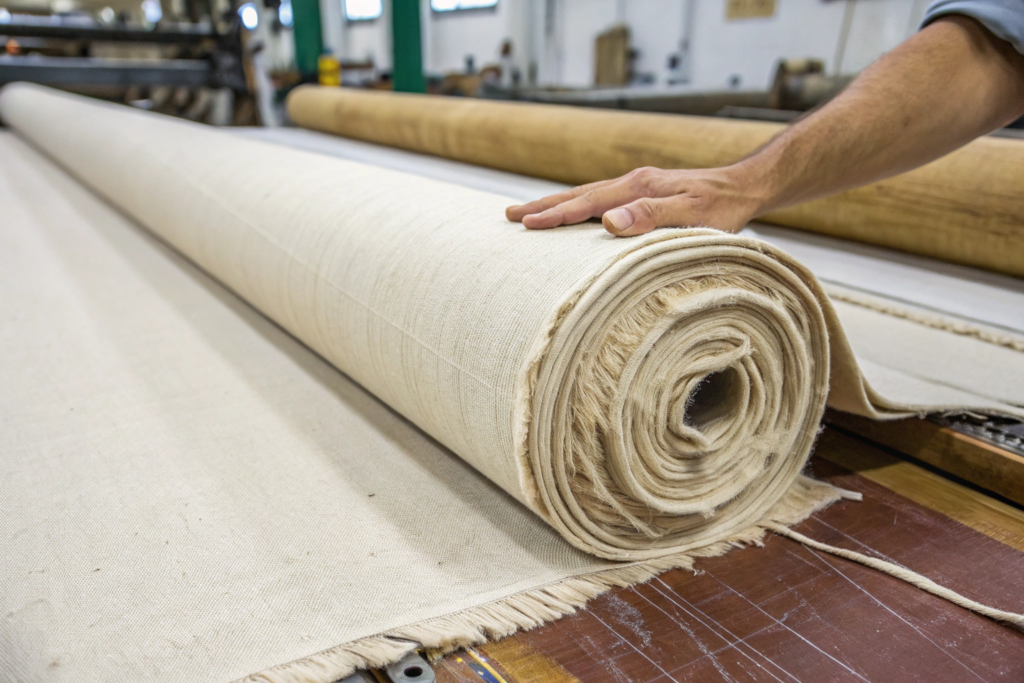
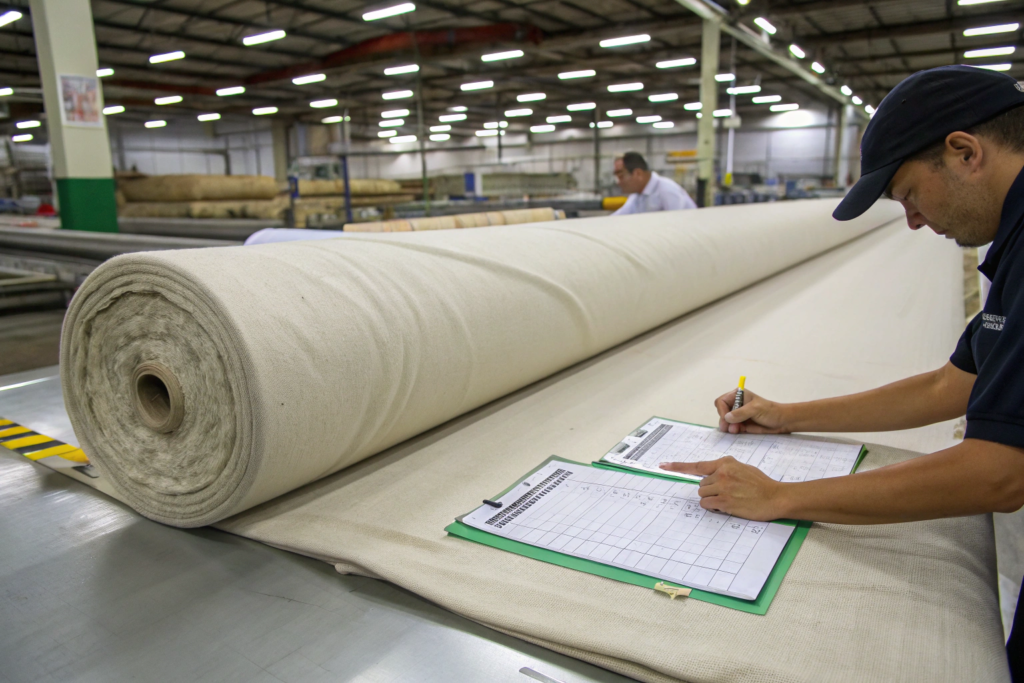
Greige fabric is not just "white fabric waiting for color." It’s a completely different animal from a finished textile. When we weave a cotton-linen blend, the greige goods come off the loom with a stiff, boardy hand-feel. This stiffness comes from the sizing agents—starch, PVA, or acrylic binders—that we apply to the warp yarns to help them survive the high-speed friction of the weaving process. Without sizing, those fine linen warp yarns would shred into a thousand pieces on our rapier looms. That sizing is critical for production, but it’s a nightmare for dyeing. It acts as a barrier. If you try to dye over it, the color will sit on top like paint on a greasy wall instead of penetrating the fiber core.
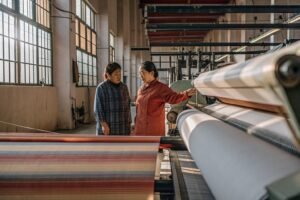
Beyond the sizing, the greige fabric is also dimensionally unstable. The cotton and linen fibers have been under tremendous tension during weaving. They’re stretched out like a rubber band. The moment you introduce water and heat in a dye bath, those fibers relax. They contract. The fabric shrinks. If you dye greige fabric, you will see 8% to 12% shrinkage in length, and the width will pull in significantly. If you cut your pattern before that shrinkage happens, you just ruined your entire production. At Shanghai Fumao, we process greige fabric through a full preparation line—desizing, scouring, and bleaching—before a single drop of dye touches it. This "prep" process is the secret to why our finished fabric delivers a consistent yield and a soft hand. Skipping it is like baking a cake without preheating the oven; you’ll get a result, but it won’t be edible.
How Does Sizing Residue on Greige Fabric Affect Your Local Dyeing Results?
Sizing is the silent killer of local dyeing projects. I can’t tell you how many times a small brand owner has called me in a panic. "The fabric won’t take the color!" they say. "There are streaks everywhere!" The first question I ask is, "Did you desize it?" Usually, there’s a long silence on the other end of the line. Most local dye houses in the USA that work with small fashion brands are set up for garment dyeing of finished knits, not piece dyeing of greige woven fabrics. They might not have an efficient desizing protocol in their standard operating procedure.
Here’s the technical reality. The starch or PVA sizing on the warp yarns has a different refractive index and a different surface charge than the cellulose fibers of cotton and linen. When you put that fabric into a reactive dye bath, the dye molecules have a strong affinity for the cellulose, but they can’t reach it because the sizing is in the way. The dye instead reacts with the sizing itself, forming a weak, superficial bond. This bond breaks the moment you wash the finished garment. You end up with "frosting," where the color sits only on the surface and cracks or washes off at the seams and creases.
To properly desize, you need a continuous wash range with high-temperature enzymatic treatments or oxidative boiling. Amylase enzymes eat the starch, but they need a specific temperature (usually 70-80°C) and pH to activate. If your local dyehouse just does a quick rinse in cold water, you’re wasting your time. I remember a client from Austin, Texas, in March 2023 who insisted on buying our greige linen to support a local artisan dyer. The dyer was a genius with natural indigo but had no enzyme bath. The sizing partially blocked the indigo uptake. The "faded vintage look" they wanted turned into a blotchy, uneven mess. He had to sell the entire batch as a "limited edition defect" at a loss. A quick search on an industry forum for how to properly desize woven greige fabrics before home dyeing will show you that even experienced DIYers struggle with this, let alone when you’re trying to scale a commercial clothing line.
Why Does the Dye Uptake of Greige vs. Prepared-for-Dye Fabric Differ?
Even after you remove the sizing, the raw greige fabric doesn’t absorb dye like our PFD (Prepared for Dye) fabric does. This is where cotton linen blends get tricky. Cotton and linen are both cellulose fibers, so you’d think they’d behave the same way. But they don’t. Linen has a higher crystallinity index. Its polymer chains are packed tighter. This makes it harder for large dye molecules to penetrate the fiber core. In greige form, the linen component also still has a significant amount of natural waxes and pectins left over from the flax plant. These hydrophobic impurities repel the water-based dye solution.
In our dye preparation process, we subject the cotton-linen blend to a heavy-duty scouring process. We use a combination of sodium hydroxide (caustic soda) and a specialized wetting agent at near-boiling temperatures. This "scouring" saponifies the natural waxes on the linen, turning them into soluble soaps that wash away. It also opens up the crystalline structure of the linen, making it more amorphous and more accessible to dye molecules. We then do a bleaching process to ensure a uniform white base. This isn’t just for looks; it’s for color accuracy. If your base fabric has a yellowish natural tint from the flax, any pastel or bright color you dye on top will be dull and muddy.
When you buy our PFD fabric, you’re buying a chemically optimized canvas. It’s hydrophilic. It has a uniform "water drop" absorption time across the entire width. A drop of water placed on our PFD linen sinks in within one second. On greige fabric, a water drop might just bead up and sit there. That simple test predicts exactly how well your dye will spread and level. I often point my technically-minded clients toward scientific resources explaining the effect of scouring on dye uptake uniformity in cotton-linen blends, which confirms that this preparation step is the single biggest determinant of a Level 4 or 5 dye rating. Skipping it just because you can’t see it with your naked eye doesn’t mean the chemistry isn’t working against you.
When Does Local Dyeing of Fumao Fabric Actually Make Economic Sense?
Let’s talk money. The reason you’re even considering buying greige goods is the spreadsheet. You look at our finished fabric price, say $6.80 per meter for a custom color, and you look at our greige price of $4.20 per meter, and you think you’re saving $2.60. That math is a fantasy. You have to plug in the local dyeing cost, the finishing cost, the shipping cost for small batches, and the most brutal line item of all: the process loss. When you dye locally, you will lose a percentage of the fabric to damage, misdyeing, and shrinkage. If you don’t account for that loss, your margin is a lie.
Local dyeing only makes economic sense under a very specific set of conditions. First, your order volume needs to be tiny—under 200 meters per color. Most of our partner dyeing factories in China have a minimum order quantity (MOQ) of 300 to 500 meters per shade for a custom Pantone match. If you need just 100 meters of a specific lavender for a limited-edition run of dresses, our MOQ might be too high. In that case, buying our greige and working with a local sample dyer makes sense. Second, you need to be targeting a market segment that actively pays a premium for "locally dyed" or "artisanal" production. The local dyeing doesn’t just add cost; it adds a marketable story. If you can charge $220 for a locally dyed linen dress instead of $180 for an imported one, the local dyeing premium pays for itself. If you’re just trying to compete with Zara on price, the local route will bankrupt you.

What Is the Break-Even Volume for Shipping Greige vs. Finished Fabric?
I’ve built a mental calculator for this over the years. Let’s run a real simulation. Imagine you need 500 meters of a specific navy blue cotton-linen fabric.
Scenario A: Buy Greige and Dye Locally.
Greige cost FOB Shanghai: $4.20/meter. Freight, duty, and logistics to your US warehouse: $0.80/meter. Landed greige cost: $5.00/meter. You then send this to a reputable US commission dyer. They charge $2.50 per meter for piece dyeing, including a basic desizing and finishing pass. But here’s the hidden cost: the process loss. A good US dyer might still return 90% of the fabric as first quality. 10% is lost to shrinkage, end-of-roll defects, or shading. Your effective cost per usable meter is ($5.00 + $2.50) / 0.90 = $8.33 per meter.
Scenario B: Buy Finished from Fumao.
Finished fabric FOB Shanghai, dyed to your exact color with our CNAS-certified colorfastness guarantee: $6.80/meter. Freight and duty: $0.80/meter. Landed finished cost: $7.60/meter. The process loss is our problem, not yours. You pay for what you receive. Usable cost: $7.60 per meter.
In this head-to-head comparison, local dyeing actually costs you $0.73 more per meter. You paid more money for more headaches. The break-even point where local dyeing might start to win is only when your total volume is so small that our dyeing MOQ forces you to buy deadstock that you’ll never use. If we require a 500-meter dye lot, and you only need 200 meters, you’ve paid for 300 meters of garbage. But even then, a smart solution is to ask us about our PFD stock service or smaller lab dyeing options. We often have solutions for smaller brands that don’t require you to gamble with greige goods. You can also look at cost-per-usable-yard calculators for fabric sourcing and dyeing decisions provided by textile consulting firms; they almost always show that integrated dyeing wins above a 300-yard threshold.
Can the “Made in USA” Tag Actually Triple Your Retail Markup on Linen?
The only reason to ignore the math I just showed you is the marketing multiplier. The "Made in USA" label has real, documented pricing power in the American consumer market. If you are selling a "100% Linen Blazer, Cut and Sewn in Los Angeles, Locally Garment Dyed," you are no longer competing in the commodity fashion space. You are selling a piece of American craft. Consumers, especially the "American Revivalist" segment I mentioned in the previous article, will pay a substantial premium for this provenance.
Let’s look at the perceived value. A finished linen blazer made with our imported finished fabric might retail for $295. That same blazer, cut and sewn locally, and dyed by a named artisan in the USA, can easily retail for $425 to $495. The "locally dyed" story generates a unique, imperfect, authentic character. You can market the slight variations in shade not as a defect, but as "proof of the handmade process." This is the strategy that cult brands like older iterations of American Apparel or current small-batch workwear brands use.
However, this only works if you are vertically integrated or partnering with a local dye house that is part of your brand’s narrative. You must name them. You must film them. You must put their story on your hangtag. If you just buy greige fabric, dye it in a generic industrial park in New Jersey, and slap a "Made in USA" tag on it, you’re not capturing the premium; you’re just adding cost. The premium comes from the narrative, not the geography. I had a client in San Francisco in late 2023 who did this brilliantly. She used our greige hemp-linen blend, partnered with a local natural dyer using food waste (avocado pits, onion skins), and documented the entire process on Instagram. Her $88 cost-per-unit supported a $325 retail price, and she sold out her small runs instantly. Her success was an example of the financial model for vertically integrated locally dyed fashion brands, which many in the slow fashion community are now trying to replicate.
How Do You Avoid Colorfastness Disasters When Dyeing Cotton Linen Yourself?
Colorfastness is not a luxury. It’s a legal requirement. The Federal Trade Commission (FTC) in the USA doesn’t just care about what you say on the care label; they care that your fabric doesn’t bleed dye all over a customer’s white leather couch. If you take our greige fabric and dye it locally, you are the manufacturer of record for that color. The legal liability shifts from our shoulders onto yours. If that red linen dress bleeds in the wash and ruins a customer’s $200 laundry load, they sue you, not the dyer, and certainly not us.
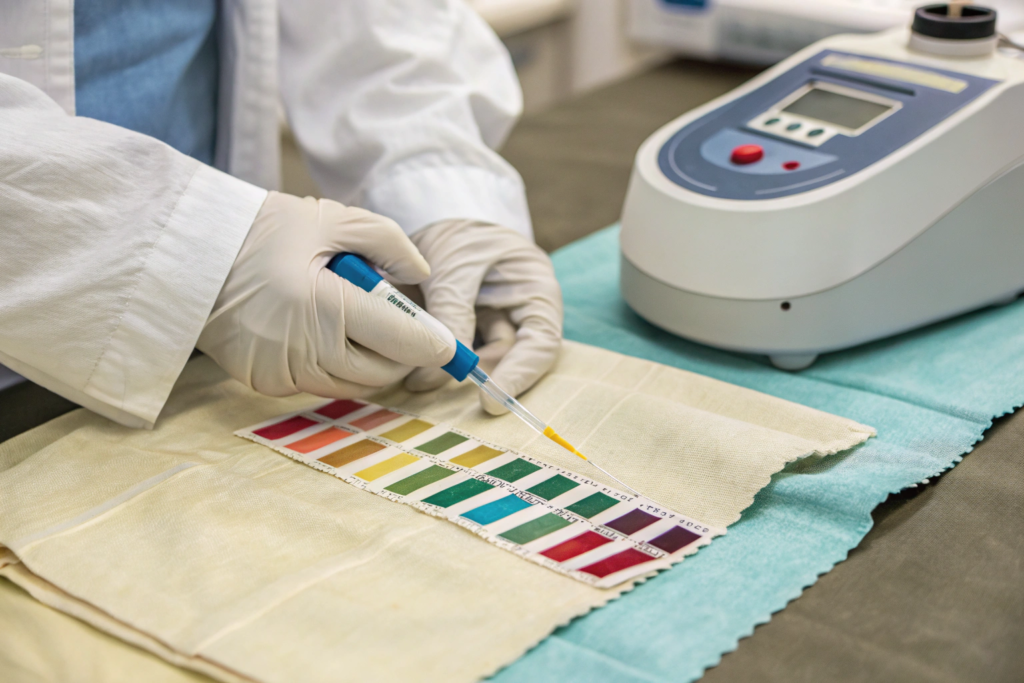
At Shanghai Fumao, we solve this with chemistry and testing before the fabric ever leaves our warehouse. We use high-fixation reactive dyes that form a covalent bond with the cellulose fiber. It’s not a stain; it’s a permanent molecular change. After dyeing, we run the fabric through a continuous washing range with a cationic fixing agent. This "soaping" process removes any unreacted, unfixed dye molecules that are just sitting loosely on the fiber surface. Then, our CNAS-accredited lab tests that fabric against ISO 105-C06 standards, which are the global benchmarks for domestic laundering colorfastness. We physically wash the dyed fabric at 40°C with soap and a multi-fiber witness strip. If the witness strip picks up any stain, the batch is failed, and we re-wash or re-dye it. If you dye locally, you must replicate this exact workflow.
What Fixative Agents Are Essential for Homegrown Cotton Linen Dyeing?
If you’re committed to the local route, you cannot skip the fixative. For cellulose fibers like cotton and linen dyed with fiber-reactive dyes (like Procion MX, which is common for artisan dyeing), the dye-fiber bond is created with an alkali fixative—typically soda ash (sodium carbonate). This is Dye Chemistry 101. The soda ash raises the pH of the dye bath to around 10.5-11. This high pH ionizes the cellulose, turning the hydroxyl groups (-OH) of the cotton and linen into cellulosate ions, which are highly attractive to the reactive dye molecules. Without this alkaline shock, the dye just swirls around and washes off.
But the soda ash step is just the start. After you fix the dye, you have to remove the unreacted dye. You can’t just rinse it until the water runs clear. You need a specific detergent that acts as a sequestering agent, preventing the loose dye from redepositing onto the white parts of your garment. We use a high-temperature soaping agent that breaks the loose dye molecules down. For the natural dyer, a professional textile detergent is a must, not just dish soap.
Finally, you should apply an after-treatment fixative, especially for deep shades like navy, black, or bright red. These are often cationic polymers that form a large molecular film over the dyed fiber, physically locking the dye inside. Think of it as a microscopic ziplock bag around the color. This is extra work, but it’s the difference between a washfast rating of 2 (which bleeds like crazy) and a 4 (which bleeds minimally). I’ve seen some good practical guides on a textile crafts forum for using professional cationic fixing agents to improve washfastness of hand-dyed cellulose fabrics, and they stress that skipping this step for commercial production is professional negligence.
How Can You Run a Reliable “Crocking” Test Without a Corporate Lab?
You don’t need a $50,000 spectrophotometer, but you do need a standard procedure. Crocking is the industry term for color transfer through rubbing—dry rubbing and wet rubbing. A customer wearing a white leather crossbody bag over a new navy linen dress is the classic crocking disaster scenario. You can simulate this in your studio with a very simple protocol, and you must do it on every single dye lot.
Here’s your DIY crocking test kit. You need a piece of clean, dry white cotton lawn fabric, a piece of the same fabric wetted out with distilled water, and a 1kg weight. Place your dyed fabric sample flat on a table. Place the dry white test cloth on top, put the 1kg weight on top of that, and then pull the test cloth across the dyed sample in a straight line. Do this 10 times in the same spot. Remove the weight and look at the white cloth. Any visible transfer of color, any staining at all, is a fail for dry crocking. Repeat the test with a freshly wetted white test cloth.
A passing grade is a stain rating of 4 or higher on the AATCC chromatic transference scale (a simple grey scale you can buy online). If you see a pale shadow, you have a problem. You must re-wash the fabric to remove more surface dye. If you ship a garment with a poor crocking score, you are 100% guaranteed to get a return. I remember a designer in Seattle in 2022 who dyed our greige linen a beautiful mustard yellow for a jacket. It passed her visual inspection. But she didn’t crock test it. A customer wore it with a white Marc Jacobs handbag, and the color rubbed off. The customer demanded a refund for the jacket and the bag. That one skipped test cost her $3,500. There’s a detailed home lab guide for performing AATCC crocking test standards for small brands that I recommend every local dyer to print out and tape to their wall. It’s the cheapest insurance policy you’ll ever buy.
What Quality Control Standards Should You Negotiate for Greige Purchases?
If you decide to buy greige from us, you cannot just say "send me the good stuff." You need a specific, written, measurable quality standard that we both agree on before the proforma invoice is signed. The responsibility for a successful dye job is now shared between us as the weaver and you as the finisher. If my greige fabric has hidden weaving defects or an uneven yarn tension that only reveals itself after you remove the sizing, that’s not your fault, but it becomes your problem. You paid to dye it, and you paid for the ruined result.
I actually prefer my clients who buy greige to be even more demanding than my finished fabric clients. I need them to understand the ASTM or ISO standard we are grading against. For our standard greige cotton-linen, we adopt the four-point system for fabric inspection, which is the universal language of the textile trade. This system assigns penalty points to defects based on their size: 1 point for defects up to 3 inches, 2 points for 3 to 6 inches, 3 points for 6 to 9 inches, and 4 points for defects over 9 inches or any hole. We then calculate the points per 100 square yards. A standard acceptable score for first-quality greige goods is 40 points or less per 100 square yards. If you require a 20-point standard, that’s a premium grade that costs more. You must know this number and put it in your purchase order, because understanding how to negotiate fabric defects tolerance using the 4-point system for your woven textile purchase agreement is essential. Also, you should always request a sample of the greige fabric roll header specification sheet before shipment, which details the actual width, weight, and construction of that specific batch.
How Do You Specify the "Prepared for Dye" Standard to Avoid Shrinkage Shock?
If you are dyeing locally, you should not be buying raw greige. You should be buying PFD (Prepared for Dye) fabric from us. This is a specific grade. PFD means the fabric has already been desized, scoured, and bleached at our facility. It’s not just a greige fabric that’s been rinsed; it’s been fully processed to remove any hydrophobic impurities and to pre-shrink the fabric width. When you buy true PFD, the residual shrinkage should be minimal—under 3%.
The specification you need to write into your contract is the "Maximum Residual Shrinkage." I always recommend specifying a maximum of 3% in the warp and 3% in the weft, tested according to AATCC 135. This is a standard home laundry simulation test. By specifying this, you force the mill (even me) to ensure the fabric has been properly sanforized or compressively shrunk. If you just buy generic greige, the shrinkage is 10% or more, and your local dyer will be the one who has to pull that shrinkage out. Most local dyers cannot sanforize fabric. They don’t have the massive, expensive compressive shrinking machines. If they try to relax the fabric through simple wet processing, they’ll get uneven relaxation, leading to a "wavy" selvedge that makes spreading and cutting a nightmare.
I had a client from Vancouver in early 2024 who ordered our greige linen specifically because he thought "PFD was an upcharge gimmick." He asked his local dyer to handle the prep. The dyer did a basic hot wash. The fabric shrank 9% in length and the width went from 58" to 52". He had ordered his pattern markers at 56" width assumptions. The entire fabric bolt was useless for his production. He saved $1.10 per meter on the PFD upcharge and lost $2,400 worth of fabric. For him, a quick read of any technical textile forum thread on residual shrinkage problems in cotton-linen blends would have saved his season.
What Legal Protections Should Your Purchase Order Include for a Bad Batch?
This is the unsexy paperwork that separates a professional brand from a hobbyist. When you buy greige fabric with the intention of dyeing it, you have a "latent defect" clause problem. A latent defect is a problem that isn’t visible in the greige state but reveals itself after wet processing. Maybe there is a barre mark from inconsistent tension that only absorbs dye differently once the fabric is wet. Maybe there’s a hidden chemical stain that resists dye. Our standard trade terms might not cover latent defects in the same way as an obvious hole.
Your purchase order must explicitly state: "Latent dye-affecting defects discovered during wet processing are the responsibility of the seller for a period of up to 90 days after delivery." This clause gives you time to actually sample the fabric in a dye bath before you run a full production. You need to negotiate this upfront. Don’t just rely on an invoice. We are a reasonable partner, and at Shanghai Fumao, we absolutely stand behind our weaving quality. But in the textile world, standard international trading terms often say "claims must be made within 15 days of receipt." You can’t even get a dye slot booked in 15 days. Fix the terms.
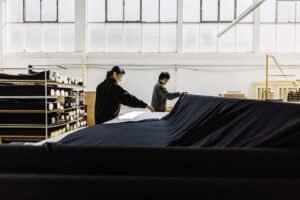
You also need a "yield guarantee" for the width. As I mentioned, the width shrinks during preparation. If we ship you a 58" greige width and specify a target of 55" after normal prep, and your dyer only gets 52", that’s a claim on us if the contract covers it. Finally, you need a "piece length tolerance." If you order rolls of 50 meters, and we ship a roll that is 25 meters plus a joined piece of 25 meters with a visible seam, that seam will likely snap open during dyeing tension. Specify in your PO: "No piece length under 30 meters. No internal joins accepted." These are small legal shields that can save you a massive financial hit when you’re playing the game of finishing the fabric yourself.
Conclusion
Buying greige cotton linen from us and dyeing it locally is a high-risk, high-reward strategy. It’s a financial loser if you’re chasing a cheap alternative to our finished fabric; the hidden costs of process loss, shrinkage, and failed dye lots will almost always erase the apparent savings. But it can be a brilliant branding move if you are a small, premium brand selling a "locally dyed, artisanal" story to a customer who actively seeks out that narrative and is willing to pay a significant markup for it.
The decision comes down to your core competency. Are you a fabric chemist and a quality control expert, or are you a designer and a marketer? If you want to focus on building your brand, selling your collection, and sleeping soundly knowing your fabric won’t bleed or shrink, let us handle the dyeing. Our integrated supply chain, our CNAS-certified colorfastness, and our shrinkage control are a safety net that lets you scale without a chemical engineering degree. If you have an authentic, passionate relationship with a local dye house and a customer base that celebrates imperfection as a feature, then our PFD fabric is your perfect blank canvas.
You don’t have to figure out this chemistry alone. Whether you want a finished fabric that arrives ready-to-cut, or a PFD greige fabric shipped with a full technical data sheet guaranteeing its dyeability, my team can walk you through the exact specs. Talk to our Business Director, Elaine, and tell her exactly what you’re trying to achieve with your color story. She’ll send you a hand-feel comparison of our finished versus greige options so you can assess the tactile difference yourself. Reach out to elaine@fumaoclothing.com and let’s map out a strategy that protects your quality and your margins.