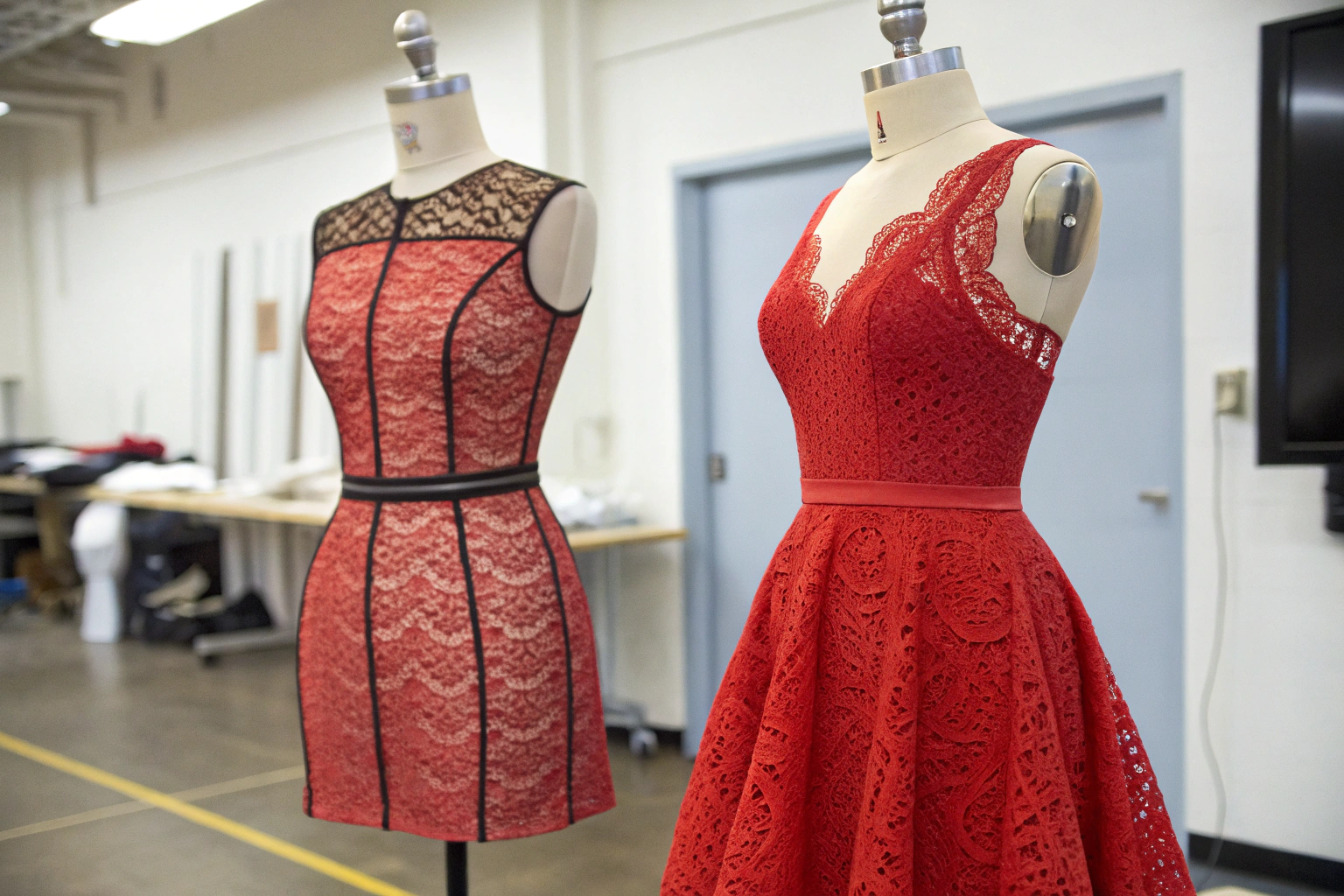
You've sketched the perfect dress: a silhouette that clings and flows in all the right places. But when you source a standard lace, you hit a wall. It's either too stiff, refusing to mold to the body, or it lacks recovery, bagging out after one wear. For bodycon and fit-and-flare designs, the wrong lace doesn't just look bad—it fails functionally. So how do you find the lace that offers both intricate beauty and the mechanical performance of activewear?
Sourcing stretch lace for these demanding silhouettes requires targeting specific constructions and performance metrics, not just aesthetics. The key is to source Raschel or Tricot knitted lace with a spandex (elastane) content of 10-20%, engineered for 4-way stretch and high recovery. Success hinges on moving beyond simple composition to vetting the lace's power net backing, testing its stretch-to-recovery ratio under load, and ensuring its pattern scale complements the garment's stress points. It's a search for a hybrid material that is part decoration, part engineered second-skin.
This guide will decode the technical specifications. We'll break down the must-have properties for each dress type, reveal how to interpret supplier tech sheets, provide real-world testing methods, and show you how to avoid the common pitfalls that leave designers with rolls of beautiful but unusable fabric. Let's find the lace that moves as beautifully as your design.
What Makes a Stretch Lace Suitable for Bodycon vs. Fit-and-Flare?
The first decision is acknowledging that "stretch lace" is a vast category. A lace perfect for a tight bandage dress would be disastrous for a flowing skater skirt, and vice versa. The distinction lies in three interlinked factors: Stretch Power, Drape, and Pattern Density.
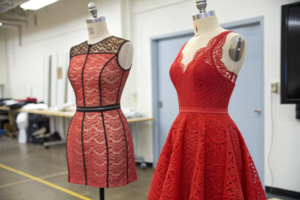
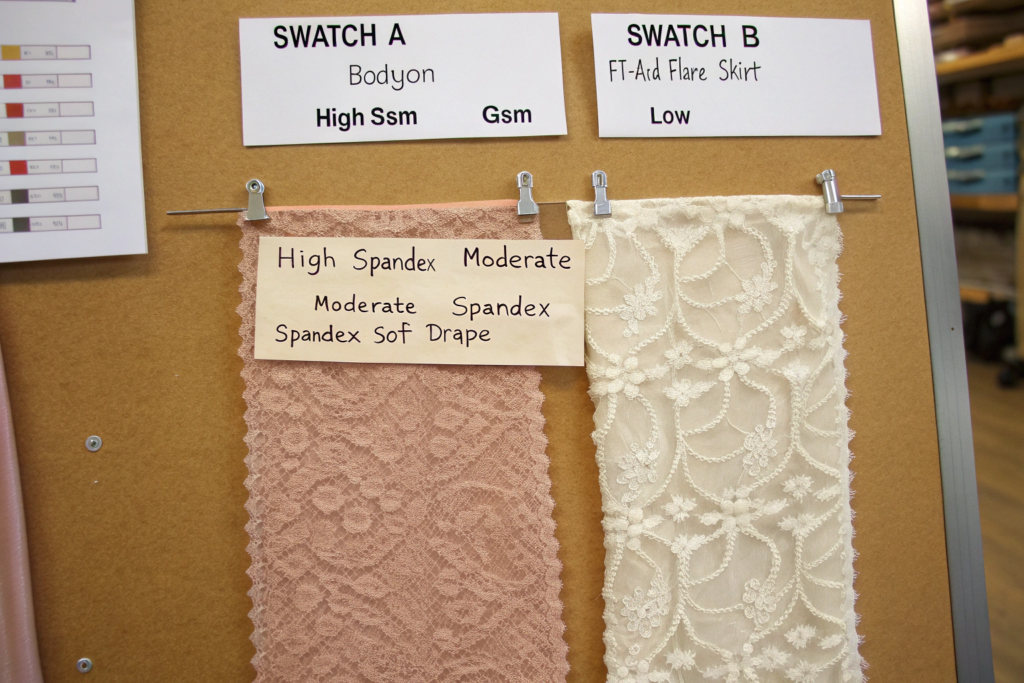
Think of it like this: Bodycon lace needs the assertive hold of compression gear, while fit-and-flare lace needs the graceful yield of a ballet skirt—with a firmly supportive bodice. In 2023, we developed a capsule collection for a Miami-based brand where this distinction was critical. The bodycon dresses used a 180gsm lace with 18% spandex and a tight power net base. The fit-and-flare dresses used a two-piece construction: the same firm lace for the bodice, but a 95gsm, 12% spandex lace with a hexagonal net ground for the skirt to achieve volume without weight. The project's success was rooted in this deliberate, split specification.
What are the Non-Negotiable Specs for Bodycon Dress Lace?
A bodycon dress is an exercise in controlled tension. The lace must be an active partner in maintaining the silhouette.
- High Spandex Content & 4-Way Stretch: Target 15-20% elastane content. This is not the 5-8% found in casual knits. It must stretch both widthwise (weft) and lengthwise (warp)—true 4-way stretch—to conform seamlessly over curves without buckling.
- Firm Hand and High GSM: The fabric should have a substantial feel. Look for a Grammage (GSM) of 160-220. This weight provides the necessary opacity and control, preventing the lace from becoming see-through when stretched.
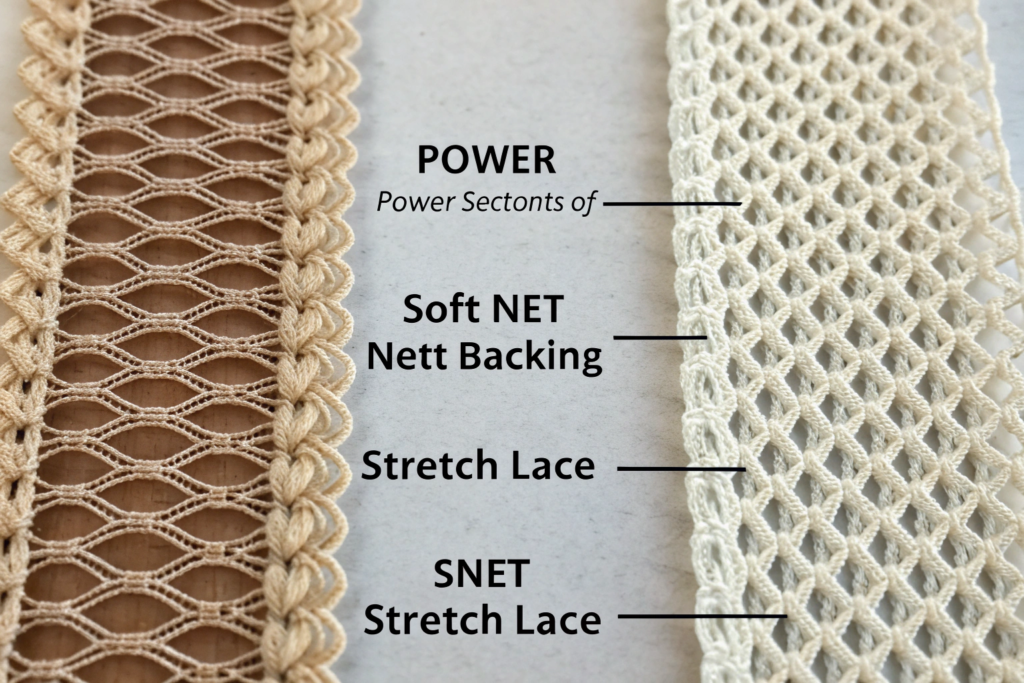
- Stable, Dense Power Net Backing: The most critical hidden feature. The lace pattern should be knitted onto a power net or dense tricot ground. This ground provides the actual compressive force and recovery. Ask suppliers: "What is the base knit structure?" A flimsy net will fail.
- Small to Medium Pattern Scale: Large, rigid motifs will distort when stretched over hips or bust, creating odd shapes. A smaller, all-over pattern or a geometric design stretches more uniformly.
Performance Test: Execute the "Knee Simulator" test. Stretch a swatch over a rounded surface (like a water bottle) to simulate a knee or elbow. Hold it stretched for 60 seconds, then release. Does it spring back immediately to its original shape and size, or does it remain baggy? For bodycon, it must snap back perfectly. We rejected three samples for a Los Angeles activewear line using this test before finding a lace that passed.
How to Choose Lace for a Fit-and-Flare Silhouette?
A fit-and-flare dress has two functional zones, often requiring two different lace types.
- For the Fitted Bodice: Follow the bodycon guidelines above—firm, higher spandex content, power net backing. This ensures the top stays put without riding up.
- For the Flared Skirt: Here, the priority shifts from compression to drape and volume. You need a lace with:
- Lower GSM (100-150): For lightweight flow.
- Moderate Spandex (8-12%): Enough to allow movement and comfort at the waistband, but not so much that it clings to the legs.
- Open Net Ground or Softer Knit: A hexagonal net or a loose tricot allows for better drape. The lace should fall in soft folds, not stiff peaks.
- Larger, More Fluid Patterns: These can be used here as the fabric is not under high tension.
Sourcing Strategy: You may need to source two different laces. When a UK brand wanted a monochromatic look, we helped them source a matching color palette across different lace constructions—a 200gsm bodice lace and a 120gsm skirt lace from the same dye lot. This maintained visual cohesion while delivering tailored performance for each pattern piece.
How to Decode Supplier Listings and Test Samples Like a Pro?
Online listings are full of vague terms like "stretchy lace" and "elastic lace." Your job is to cut through the marketing to find the technical truth. The sample stage is where you separate viable options from costly mistakes.
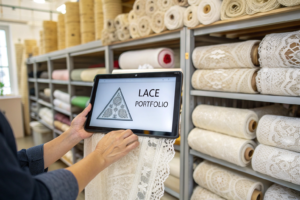
Never, ever skip physical testing. A beautiful digital photo tells you nothing about recovery or hand-feel. We maintain a "stretch lace library" with hundreds of tagged samples—each with its GSM, composition, and recovery notes—because real-world testing is irreplaceable.
What Hidden Clues in a Listing Signal Quality?
Look past the main image. Scrutinize the description and details.
- Specific Composition: "Polyester/Spandex" is okay; "85% Polyester, 15% Elastane" is better. If only "Elastic" is listed, be skeptical.
- GSM or Oz/Yd² Listed: This is a huge green flag. A supplier who provides weight is thinking technically.
- Width & Stretch Direction: "Width: 150cm, 4-Way Stretch" is professional. "One size fits all" phrasing is amateur.
- Base Fabric Mention: Phrases like "Tricot backing," "Power net base," or "Soft mesh ground" indicate a deeper understanding of the product.
- Intended Use: Listings that say "For sportswear, dancewear, lingerie" are more likely to have tested performance than those just saying "For dress."
Red Flag: Listings with only one stock image and no close-ups of the fabric structure. Always request real, current photos of the lace on the roll and a close-up of the reverse side (the net ground).
What are the 4 Essential Physical Tests for a Sample?
When you receive a sample swatch (minimum 30x30cm), conduct this battery of tests:
- The Recovery Test (The Most Important): Mark a 10cm square on the lace. Stretch it widthwise to its comfortable limit (not to tearing). Hold for 30 seconds. Release. Measure immediately and again after 5 minutes. A quality lace will return to within 0.5cm of 10cm. Any permanent deformation above 1cm fails for bodycon use.
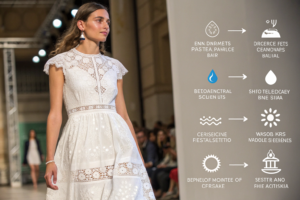
- The Drape Test: Hold the center of the swatch and let it drape over your hand. Does it form stiff, angular folds (good for structured bodices) or soft, cascading rolls (good for skirts)? This visual tells you everything about its suitability for flare.
- The Opacity Test: Stretch the lace over a dark, patterned surface. Can you see the pattern clearly through it? If yes, it will likely be too sheer when worn tightly over skin or a lining, requiring double layers—adding cost and weight.
- The Scratch Test: Gently run a fingernail or a smooth plastic edge across the surface. Does it snag easily? Poor-quality embroidery threads or a loose knit will snag, leading to damaged garments after minimal wear.
From Our Lab: We built a simple repeatability test jig for fabric recovery that applies a standardized 30% stretch. It's used on every inbound stretch lace shipment. In one instance, it caught a 15% batch-to-batch variance in recovery between a approval sample and bulk production. We worked with the mill to adjust the heat-setting process before shipping, saving the client from a production halt.
What are the Cost Drivers and Sourcing Channels for Performance Lace?
Stretch lace with true performance characteristics commands a higher price. Understanding what you're paying for allows you to make smart trade-offs and identify false economies. A cheaper lace that bags out will cost you more in returns and damaged brand reputation.
The sourcing channels also differ. The lace for a fast-fashion fit-and-flare dress and that for a high-end bodycon gown may come from entirely different tiers of suppliers.
Why is Performance Stretch Lace More Expensive?
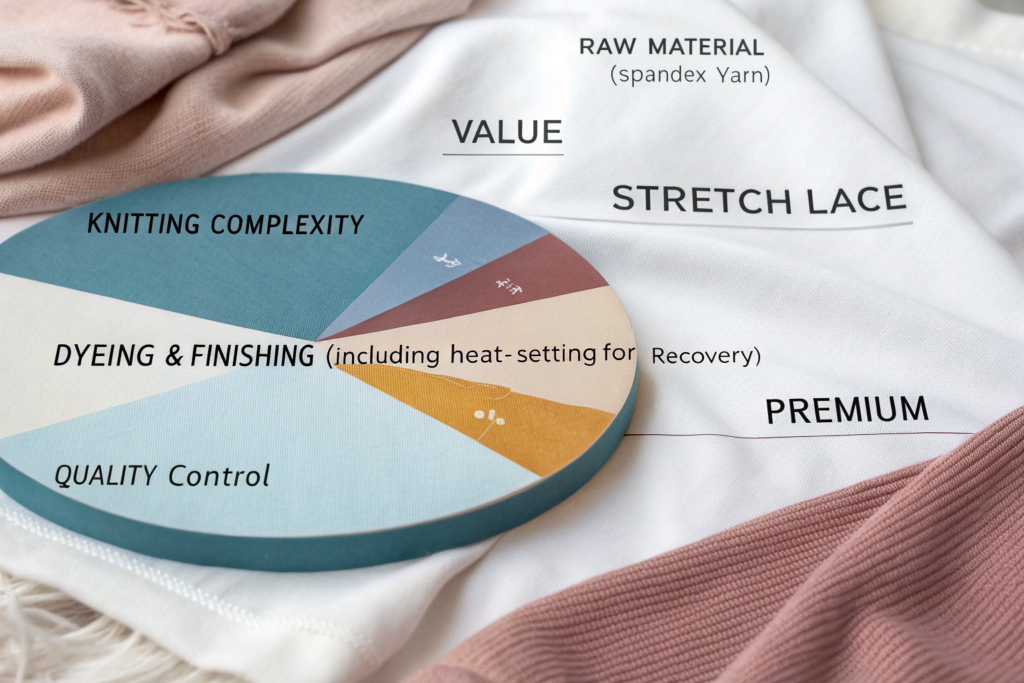
The premium is in the yarns, the knitting technology, and the finishing.
- Spandex Cost: High-quality, consistent elastane yarn (like Lycra® or Creora®) is a significant cost driver. Cheaper lace often uses generic, lower-recovery spandex.
- Knitting Complexity: Integrating a complex lace pattern with a stable power net requires advanced Raschel or Jacquard knitting machines and skilled technicians. More machine heads and slower speeds mean higher production cost.
- Crucial Finishing: Heat-Setting: This is the magical step that "locks in" the recovery. The fabric is heated under tension to stabilize the spandex. Poor or inconsistent heat-setting leads to poor recovery and shrinkage. This process adds cost but is non-negotiable.
- Dyeing Challenges: Achieving level, colorfast dyes on a fabric with two different fiber types (polyester and spandex) requires expertise and specific dyes.
The Trade-Off: You can find cheaper stretch lace by compromising on spandex content, using a simpler (less stable) net, or skipping rigorous finishing. For a fit-and-flare skirt where extreme recovery isn't critical, this might be acceptable. For a bodycon dress, it is not.
Where Should You Source (Alibaba, Specialized Mills, or Agents)?
- Alibaba/General B2B Platforms: Best for standard, light to medium stretch laces for fit-and-flare skirts or casual wear. MOQs are lower, prices are competitive, but quality variance is high. Due diligence and sampling are absolutely critical. Use keywords like "4 way stretch lace fabric," "power net lace," or "Raschel elastic lace."
- Specialized Knitting Mills: For high-performance, custom, or premium laces. These are often found in clusters like Keqiao (China), Como (Italy), or specific Korean mills. They can engineer to your exact GSM, stretch percentage, and pattern. MOQs are higher (500-1000kg per design), but consistency and technical support are superior. This is the source for bodycon-grade material.
- Sourcing Agents or Integrated Suppliers (Like Fumao): Agents provide a valuable bridge. They have pre-vetted relationships with mills, can consolidate orders, handle quality control, and navigate logistics. For designers who lack the volume for direct mill access or the time for intense supplier vetting, a reliable agent is worth their commission. Our role at Shanghai Fumao is often to be this technical partner, translating design needs into mill specifications and managing the production.
A Client's Journey: A startup in Berlin needed a custom geometric stretch lace for a bodycon line but had an MOQ of only 300 meters. No mill would touch it. Through our network, we matched her design with a mill's existing pattern that was similar, and worked with the mill to modify the color and scale to her needs, using a shared "stock drum" of yarn to meet the mill's minimum. She got her custom lace at a viable cost.
How to Ensure Success in Bulk Production and Garment Making?
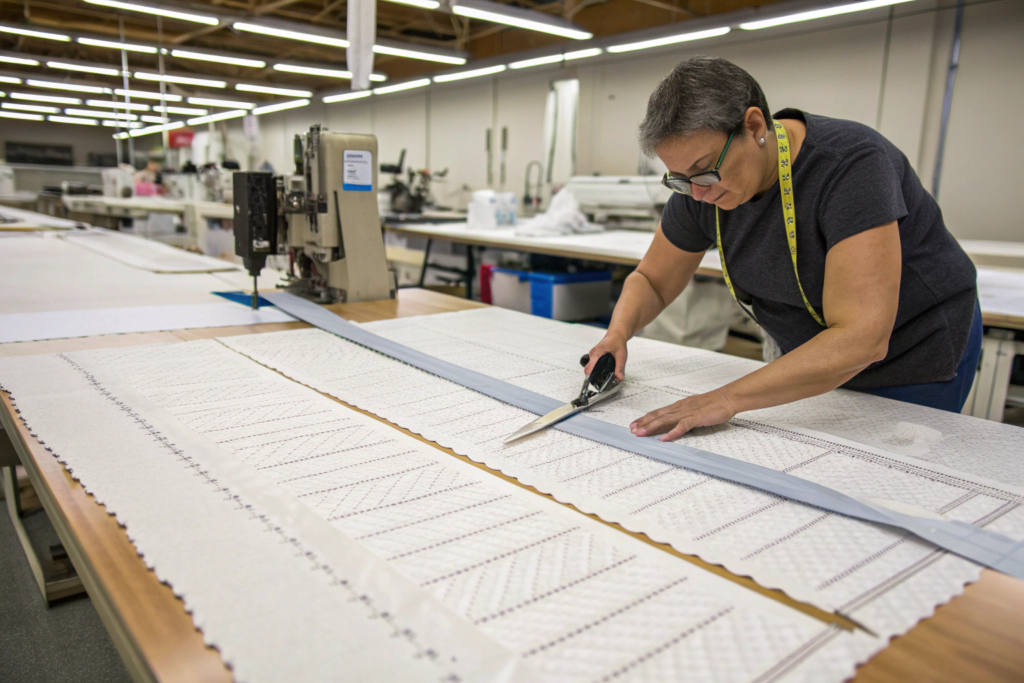
Sourcing the perfect sample is only half the battle. The bulk must match, and your factory must know how to handle it. Stretch lace behaves differently from woven lace in cutting and sewing.
What Checks are Vital for Bulk Order Consistency?
Your pre-shipment inspection must include stretch-specific criteria.
- GSM Check: Weigh samples from the beginning, middle, and end of multiple rolls. Variance should be within ±5%.
- Stretch & Recovery Verification: Perform the recovery test on bulk rolls. This is non-negotiable.
- Shrinkage Test: Wash or steam a sample according to your care label instructions. Measure shrinkage in both length and width. Inform your pattern maker so they can pre-shrink patterns if necessary.
- Color Consistency: Check rolls against the approved lab dip under standard lighting. Stretch fabrics can have "barre" (subtle horizontal stripes) if yarn tension varied during knitting.
What are Key Construction Tips for Sewing Stretch Lace?
Educate your factory or prepare yourself:
- Cutting: Lay the lace fully relaxed on the cutting table. Never stretch it while cutting, or the pieces will shrink back and be smaller than the pattern. Use weights or very sharp rotary cutters to prevent shifting.
- Needles & Thread: Use ballpoint or stretch needles (size 70/10 or 75/11) to avoid punching and damaging the elastane threads. Use polyester or woolly nylon thread for its elasticity.
- Stitch Type: Use a narrow zigzag stitch, a stretch straight stitch, or a coverstitch (for hems). A standard straight stitch will pop when the fabric stretches.
- Linings: The lining must have equal or greater stretch than the lace. Use a stretch mesh or power net lining. Attach it using the same stretch stitches.
Pro Tip from Production: For bodycon dresses, we often recommend a two-step bonding process for lace and lining using a lightweight, stretch fusible web or a heat-bonding technique. This creates a single, stable fabric layer that behaves predictably during sewing and wear, preventing the lining from rolling or twisting inside.
Conclusion
Sourcing the right stretch lace for bodycon and fit-and-flare dresses is a technical pursuit that balances aesthetic design with textile engineering. It requires targeting specific constructions—like Raschel knits with substantial spandex content and power net backing for bodycon, and lighter, drapier laces for flare—and rigorously testing for recovery, opacity, and durability. Success depends on decoding supplier listings for technical clues, understanding the cost drivers behind performance, and choosing the right sourcing channel for your quality and volume needs. Ultimately, securing a consistent bulk order and guiding proper garment construction are the final, critical steps to transform a perfect sample into a flawless collection.
Mastering this process allows you to create dresses that are as comfortable and functional as they are stunning. If you are looking for a partner with the technical expertise and supply chain depth to navigate this complex sourcing landscape, Shanghai Fumao can help. From matching performance specs to managing bulk production QC, we ensure your stretch lace delivers on its promise. Contact our Business Director, Elaine, at elaine@fumaoclothing.com to begin developing your perfect stretch lace application.