You've found the perfect fabric swatch—the color, the hand feel, it's exactly what your collection needs. You send it to your supplier with a note saying "make it like this." Weeks later, the bulk fabric arrives, and something's off. The color is a shade different, the weight feels heavier, the finish isn't quite right. This costly mismatch happens every day, and the root cause is almost always the same: a missing, incomplete, or misunderstood Fabric Tech Pack. It's the single most important document in your sourcing process, yet it's often treated as an afterthought.
Think of a Fabric Tech Pack as the DNA blueprint or the recipe for your fabric. It's not just a swatch; it's a comprehensive, technical document that communicates every single specification required to replicate your fabric perfectly, at scale. A complete tech pack bridges the gap between your creative vision and the factory floor, eliminating guesswork and ensuring consistency. It's what turns "make it like this" into precise, measurable instructions that any qualified mill can follow. For suppliers like us at Shanghai Fumao, a clear tech pack is the fastest route to accurate sampling and trouble-free bulk production.
This guide will demystify every section of a professional Fabric Tech Pack. You'll learn what each term means, why it's critical, and how small errors can lead to big problems. More than just reading one, you'll understand how to use it as a tool to communicate effectively with your supplier, protect your quality standards, and ultimately, safeguard your brand's reputation. Let's decode the document that can make or break your order.
What is a Fabric Tech Pack and Why is it Non-Negotiable?
In its simplest form, a Fabric Tech Pack is the master instruction manual for manufacturing your fabric. It translates subjective descriptions like "a heavy, rustic linen" into objective, testable data: "100% linen, 340 GSM +/- 5%, dry-spun with a pronounced but even slub, in a plain weave, finished with a light enzyme wash for softness." It aligns you and your supplier on the same page—literally—before a single meter is produced.
Why is it non-negotiable? Because without it, you are relying on verbal descriptions and memory, which are flawed and open to interpretation. The tech pack serves as the legal and quality benchmark for your order. It protects you by providing clear grounds for rejecting non-conforming goods, and it protects the supplier by giving them a clear target to hit. For international sourcing, where you're not on the factory floor, it is your primary quality control tool. A European client of ours once had a dispute with a previous supplier over "pilling." Because their tech pack only said "anti-pill finish," there was no agreed test method. Our tech pack now specifies "Anti-pilling finish, tested to Martindale >20,000 cycles (ISO 12945-2)," leaving no room for argument.

How Does a Tech Pack Prevent Costly Mistakes and Delays?
Every vague instruction is a risk. Let's break down how specifics prevent disasters:
- Vague: "Dark Navy Blue."
- Specific in Tech Pack: "Pantone 19-3922 TCX (Classic Blue). Match to approved lab dip #234. Colorfastness to washing: Grade 4 (AATCC 61)."
- The Risk Prevented: The factory uses a cheaper dye stock that fades to purple after one wash. With your tech pack specifying the Pantone and fastness grade, you have a clear, objective basis to reject the batch, saving you from customer returns.
In 2023, we worked with a US-based activewear brand sourcing a custom recycled polyester. Their initial brief said "moisture-wicking." Our technical team asked for their target AATCC 195 moisture management test result to include in the tech pack. By defining the exact performance metric, the bulk fabric performed identically to the sample, and the brand avoided a potential performance failure in the market. The tech pack turns subjective expectations into verifiable quality benchmarks for fabric sourcing.
What Are the Core Components of Every Tech Pack?
While formats vary, any comprehensive Fabric Tech Pack must include these five pillars:
- Identification & Summary: Basic info like Style Name/Number, Season, Supplier Contact, and Key Dates.
- Physical Reference: The Golden Sample (a signed and sealed swatch from the approved development sample) is physically attached or referenced.
- Detailed Specifications Table: The heart of the document (we'll dive deep into this next).
- Testing Standards & Requirements: A list of mandatory physical and chemical tests (e.g., shrinkage, colorfastness, pH).
- Appearance & Packaging Details: How the fabric should look on the roll, how it's packaged (e.g., rolled on tubes, polybagged), and labeling instructions.
Missing any of these is like building a house without part of the blueprint. (Here's a reality check from our QC head: "If a client sends a tech pack without a testing requirements section, we know they've been burned before and will likely be burned again.").
How to Decode the Fabric Specifications Table?
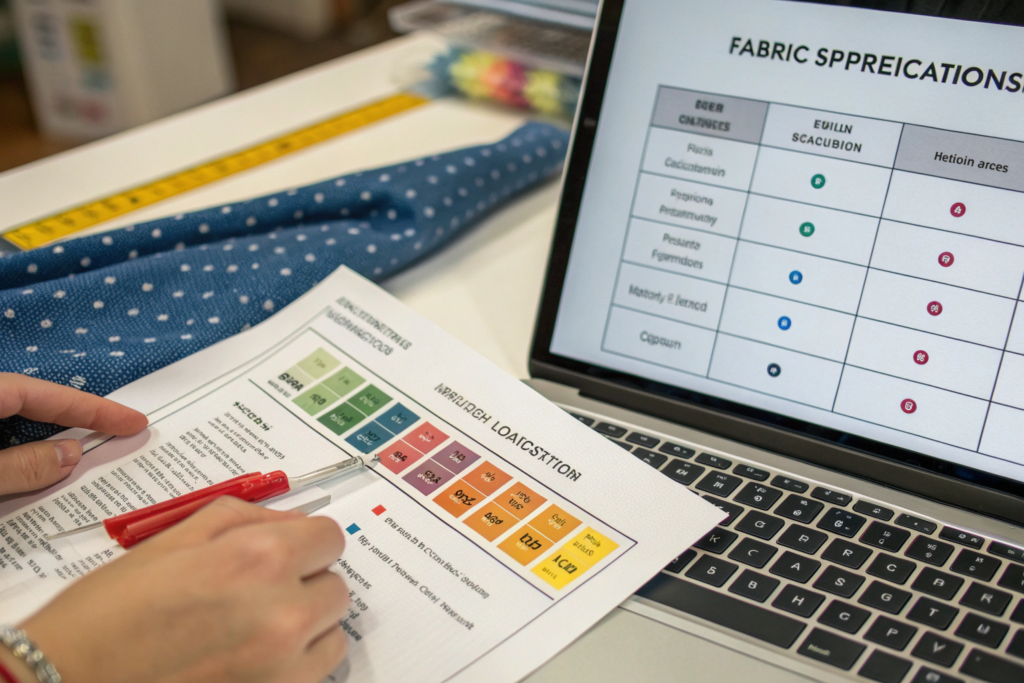
This is the spreadsheet or table that holds the quantifiable soul of your fabric. It looks technical, but each line item directly controls an attribute you can see and feel. Reading it isn't about being a textile engineer; it's about understanding what each parameter means for your final product. Let's walk through the critical rows.
Think of it as the fabric's ID card. It answers the questions: What is it made of? How is it built? How heavy is it? How wide is it? What color is it? Errors here are the most expensive to fix. A 2% error in fiber blend can affect dye uptake. A 5 cm error in width can waste thousands of dollars in fabric yield when cutting garments.
What Do Composition, Weight (GSM), and Width Really Mean?
These three are the foundational trinity. Getting them wrong guarantees failure.
- Composition: Lists the percentage of each fiber (e.g., "65% Recycled Polyester, 35% Cotton"). This dictates care, dyeing behavior, and performance. Always specify tolerance (e.g., +/- 1.5%). A common pitfall is not specifying the type of fiber, like "Tencel™ lyocell" vs. generic "rayon," which have different sustainability profiles and costs.
- Weight (GSM - Grams per Square Meter): This is the fabric's density, not its thickness. A 200 GSM cotton twill is substantial and durable, ideal for trousers. A 130 GSM version of the same weave is lightweight, perfect for a summer shirt. Tolerances are crucial here (e.g., 200 GSM +/- 5%). Use a professional GSM cutter and scale to verify samples.
- Width (or Cuttable Width): The usable width of the fabric after all finishing, measured in inches or centimeters. A 1-inch (2.54 cm) discrepancy can massively impact marker efficiency and fabric consumption. Always specify "Finished Width: 58/59"" with the understanding that it may have a slight variance.
A client of Shanghai Fumao from Australia once received a "cotton" fabric that pilled excessively. The tech pack only said "100% Cotton." When we analyzed it, it contained a percentage of short-staple, low-grade cotton not suitable for the intended use. We now help clients build tech packs that specify "100% Combed Cotton, Uster 5% level" to ensure fiber quality, which solves the problem at its root.
Why are Weave, Construction, and Finish Details Critical?
This is where you define the fabric's architecture and personality.
- Weave/Construction: Plain, Twill, Satin, etc. For knits, this would be Jersey, Rib, etc. Be as specific as possible: "2x1 Right-Hand Twill" or "Single Jersey."
- Thread Count/Stitch Density: For wovens, this is often expressed as the number of warp and weft threads per inch (e.g., 120x80). For knits, it's the number of courses and wales per inch. Higher counts generally mean a smoother, denser, and more durable fabric.
- Finish: This is the magic. Is it mercerized (for sheen and strength), brushed (for softness), enzyme-washed (for a broken-in feel), or coated (e.g., waterproof)? The finish must be explicitly named.
For example, a "soft finish" is meaningless. "Bio-polishing enzyme wash with silicone-based softener for a 3.5-4.0 hand feel rating (on our internal scale)" is actionable. This level of detail, often found in technical fashion design resources, empowers your supplier to deliver exactly what you envision.
What Testing Requirements Should You Always Include?
The testing section is your quality insurance policy. It moves the conversation from "It looks good" to "It passes these internationally recognized tests." By defining the tests and acceptable results upfront, you make quality control objective and enforceable. This section tells your supplier: "This fabric must prove it can perform in the real world."
Different markets and products have different legal and performance requirements. Children's sleepwear may require a Flame Retardant (FR) test. EU-bound goods may require proof of compliance with REACH regulations on harmful substances. Activewear needs moisture-wicking and odor resistance tests. Omitting this section shifts all the quality risk onto you, the buyer.

Which Physical Tests Guarantee Durability and Performance?
These tests simulate wear and tear. The most common ones you should consider are:
- Martindale Abrasion / Wyzenbeek Test: Measures fabric resistance to rubbing. Crucial for upholstery and high-wear apparel like trousers. Specify the minimum cycles (e.g., >30,000 for heavy-duty upholstery).
- Tensile & Tear Strength: Measures how much force is needed to break or tear the fabric. Important for technical gear and workwear.
- Pilling Test: Evaluates the fabric's tendency to form pills (little balls of fiber) on the surface. A rating of 4-5 (on a 1-5 scale, where 5 is best) is typically desired.
- Dimensional Stability (Shrinkage): The most critical test for apparel. Specifies the maximum allowable shrinkage after washing (e.g., "Shrinkage: ≤3% after 1 home wash AATCC 135").
We include a standard battery of physical performance tests for wholesale fabric in our proposals, but we always tailor it based on the client's tech pack. For a series of performance knits for a yoga brand, we specified and verified "pilling resistance of Grade 4+ after 5,000 cycles" to ensure the fabrics maintained a clean look.
Why are Chemical and Safety Tests Legally Mandatory?
These tests are often non-negotiable for market access and protect consumers from harm.
- pH Value: Fabric must be in a neutral pH range (often 4.0-7.5) to avoid skin irritation.
- Colorfastness: To washing, rubbing (dry/wet), perspiration, and light. Prevents color from running or fading.
- Formaldehyde & AZO Dyes: Restricted substances in many regions (EU, US, Japan). Testing proves the fabric is free of these harmful chemicals.
- Heavy Metals & PFAS: Increasingly regulated, especially in the EU and California.
Your tech pack should list the specific test methods and pass/fail criteria. Don't just write "OEKO-TEX certified." Write: "Must pass OEKO-TEX Standard 100 Class I (for infants) or Class II (for skin contact). Certificate to be provided prior to shipment." This makes compliance a clear deliverable. For complex regulations, consulting specialist publications on textile regulatory compliance is wise.
How to Use a Tech Pack for Effective Supplier Communication?
A tech pack isn't a one-way document you fire off and forget. It's the centerpiece of an ongoing dialogue with your supplier. A professional supplier will review your tech pack, ask clarifying questions, and may suggest optimizations for cost or production. This collaborative review is a green flag—it shows they are engaged and technically competent.
Use the tech pack to structure your communications. Reference specific line items in emails: "Regarding the tech pack for Style F23-105, please confirm the shrinkage test will follow AATCC 135." This eliminates confusion and creates a clear paper trail. The goal is to have zero ambiguity by the time production starts.

What Questions Should a Good Supplier Ask About Your Tech Pack?
If your supplier just says "OK, we can do it" without any questions, be wary. Here are questions you want to hear:
- "Can you clarify the test method for the shrinkage? AATCC 135 or ISO 6330?"
- "The GSM tolerance is listed as +/-3%. Is this acceptable for the entire roll, or per meter?"
- "For the 'peach skin finish,' do you have a physical reference for the exact hand feel level?"
- "The fabric composition is 97% Cotton, 3% Spandex. Is the spandex wrapped or bare? This affects the dyeing process."
- "Your color standard is a Pantone cotton chip. For this polyester blend, we will create a lab dip on the actual fabric. Is that acceptable?"
When a client provides a tech pack for a complex jacquard with a specific float pattern to avoid snagging, our production team will immediately ask about the intended end-use and might suggest a slight yarn adjustment to improve durability without changing the look. This proactive dialogue, initiated by the tech pack, adds immense value.
How Does the Tech Pack Drive the Sampling Process?
The tech pack is the roadmap for sampling. The process should be:
- Initial Tech Pack Submission from you.
- Supplier Review & Quotation based on the tech pack.
- Development of First Sample (Proto Sample) made according to the tech pack.
- Your Evaluation: Compare the sample against the tech pack specs. Measure the GSM, check the width, test the color under standard light.
- Feedback & Revision: Mark any deviations on the tech pack itself (e.g., "Color is too red, please adjust to lab dip #2." "GSM is 210, target is 200. Please correct.").
- Golden Sample Approval: Once perfect, you sign off a swatch as the "Golden Sample" and attach it to the final, corrected tech pack. This locked document now governs bulk production.
At Shanghai Fumao, we treat the tech pack as a living document during sampling. We provide measured data (actual GSM, width, shrinkage test result) with each sample, so the client can see exactly how close we are to their target. This data-driven approach builds trust and gets us to a perfect sample faster.
Conclusion
A Fabric Tech Pack is far more than a formality—it is the essential framework for successful, stress-free sourcing. It transforms your vision into a clear, actionable, and defendable set of instructions. By mastering how to read, create, and use one, you take control of your quality, your timelines, and your costs. You move from being at the mercy of interpretations to being the director of your production.
Remember, the most expensive fabric is the one you can't use. Investing time in a meticulous tech pack is the cheapest insurance you can buy. It fosters professional, transparent partnerships with suppliers and is the hallmark of a serious, scalable brand.
If the process of creating a bulletproof tech pack feels daunting, you don't have to do it alone. The team at Shanghai Fumao has decades of experience in translating design concepts into perfect technical specifications. Let us help you build the foundation for flawless fabric. For expert guidance and to discuss how we can partner on your next development, contact our Business Director Elaine at elaine@fumaoclothing.com. Send us your inspiration, and we'll help you build the tech pack to realize it.