I remember a negotiation I had about six years ago with a buyer from a large American sportswear brand. He wanted 50,000 meters of a custom-knit performance fabric. The price was agreed. The quality was set. Then we got to payment terms. He wanted 90 days after delivery. I wanted 30% deposit and balance before shipment. We went back and forth for two weeks. He told me his company's policy was net 90. I told him my factory couldn't finance a 50,000-meter order for three months. We almost lost the deal. In the end, we compromised: 30% deposit, 30% at shipment, 40% net 60.
That negotiation taught me something important: payment terms are not just about cash flow. They're about trust. They're about risk. They're about the relationship between buyer and supplier. And they're almost always negotiable, if you understand what the other side needs and what you can offer in return.
Over twenty years in this business, I've negotiated payment terms with hundreds of clients. I've seen what works and what doesn't. I've learned that the key is to understand the supplier's perspective—why they need certain terms—and to structure your offer so that it meets their needs while protecting your own interests.
At Shanghai Fumao, we've developed a flexible approach to payment terms. We work with clients from startups to global brands, and we understand that different clients have different needs. In this article, I'm going to share what I've learned about negotiating payment terms for bulk knitted fabric—the standard terms, what suppliers are looking for, and how you can structure an offer that gets you better terms.
What Are the Standard Payment Terms in the Textile Industry?
Before you start negotiating, you need to understand what's normal. The standard payment terms in the Chinese textile industry have evolved over the years. They're based on the realities of our business: long supply chains, significant raw material costs, and the need to manage risk.
What Is the Typical Deposit Percentage?
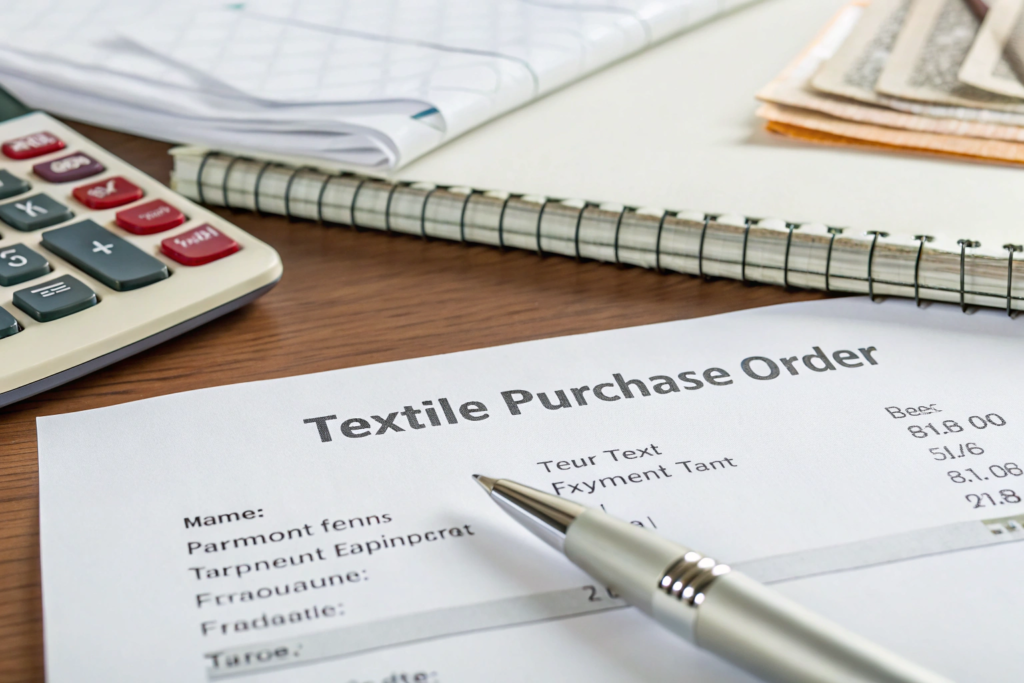
The standard deposit for a custom fabric order is 30% to 50%. This deposit covers the cost of raw materials. For a knitted fabric, the raw materials—yarn, dyes, chemicals—can represent 60% to 70% of the total cost. The supplier needs that deposit to purchase those materials. Without it, they're financing your order out of their own cash flow, which most small and medium factories cannot do.
For stock fabrics—fabrics that are already woven and ready to ship—the deposit is often lower, sometimes 0% to 30%. Because the supplier already has the inventory, they don't need upfront cash to buy raw materials.
I had a client from a UK startup who didn't understand this. He wanted to order a custom-knit fabric with no deposit. He said his previous supplier had given him net 30 terms. I explained that the previous supplier had probably sold him stock fabric, not custom. For custom, we needed to buy the yarn specifically for his order. Without a deposit, we couldn't buy the yarn. He eventually agreed to 30% deposit, and we placed the yarn order the next day.
For a detailed explanation of why deposits are necessary, this sourcing guide offers a breakdown of textile supply chain financing.
What Is the Typical Balance Payment Structure?
The balance payment is usually due before shipment. This is called "balance before shipment" or "BBS." For most textile suppliers, the standard is 30% deposit, 70% balance before shipment. Sometimes it's 50% deposit, 50% before shipment. The logic is simple: once the fabric is on the ship, the supplier has no recourse if the buyer doesn't pay. So they want to be paid before the fabric leaves their control.
Some larger buyers with established relationships can get "net 30" or "net 60" terms, meaning they pay 30 or 60 days after shipment. But these terms are usually reserved for clients who have a long history of on-time payments and high volume. For a first-time buyer, net terms are rare.
I remember a negotiation with a German brand that was buying from us for the first time. They wanted net 60. We explained that we didn't know them yet, and we couldn't take that risk on a 100,000-euro order. We offered 30% deposit, 70% before shipment for the first order, with a promise to revisit the terms after three successful orders. They agreed. After three orders with no issues, we moved them to 30% deposit, 40% at shipment, 30% net 30. Now, after five years, they're on net 60. Trust is earned over time.
For a discussion of how payment terms evolve with relationships, this industry article covers building trust through payment history.
What Do Suppliers Consider When Setting Payment Terms?
If you want to negotiate better terms, you need to understand what the supplier is thinking. We're not just being difficult when we ask for a deposit. We're managing real risks. If you can reduce those risks, you can often get better terms.
Why Is Raw Material Cost the Biggest Factor?
For a custom-knitted fabric, the raw materials are the biggest cost and the biggest risk. If we order yarn for your order and you cancel, we're stuck with yarn that may not be usable for anyone else. If it's a custom color or a specialty yarn, it's essentially worthless.
That's why the deposit is directly tied to raw material cost. If your fabric uses a standard white yarn that we use for many clients, we might accept a lower deposit because we can use the yarn for other orders if you cancel. If your fabric uses a custom-dyed yarn in a unique color, we need a higher deposit because that yarn has no alternative use.
I had a client from a French fashion brand who wanted a custom-knit fabric with a specific color that we had never produced before. The yarn had to be custom-dyed. The raw material cost for his order was about 40% of the total. I explained that we needed a 40% deposit to cover that custom yarn. He understood. He paid the deposit, and we dyed the yarn. The order went smoothly. If he had canceled after we dyed the yarn, he would have lost his deposit, but we would have been protected.
For a guide to how raw material costs affect payment terms, this sourcing blog has an explanation of yarn procurement and deposits.
How Does Order Size Affect Payment Terms?
Order size matters. A large order represents more risk for the supplier, but it also represents more opportunity. For a very large order, a supplier might be willing to accept more flexible terms because they want to secure the business.
Conversely, a small order might require stricter terms. The fixed costs of setting up the knitting machines, the dyeing, the finishing—these are the same whether the order is 1,000 meters or 50,000 meters. On a small order, the profit margin is thinner, so the supplier needs to protect themselves against default.
I had a client from a US startup who wanted to order 2,000 meters of a custom-knit fabric. That's a small order by our standards. He asked for net 60 terms. I explained that on a small order, our margin was only about 10%. If he didn't pay, we would lose not just the profit but also the cost of the raw materials. We offered 50% deposit, 50% before shipment. He agreed. After a few small orders, we moved him to 30% deposit, 70% before shipment. Now he orders 20,000 meters at a time, and he's on net 45.
For a discussion of how order size influences payment terms, this manufacturing guide offers a perspective from the supplier side.
How Can You Structure an Offer That Gets Better Terms?
Now let's get to the practical part. If you want better payment terms, you need to offer something in return. Negotiation is about trade-offs. Here are the levers you can pull to get better terms.
Can You Offer a Larger Deposit in Exchange for Net Terms?
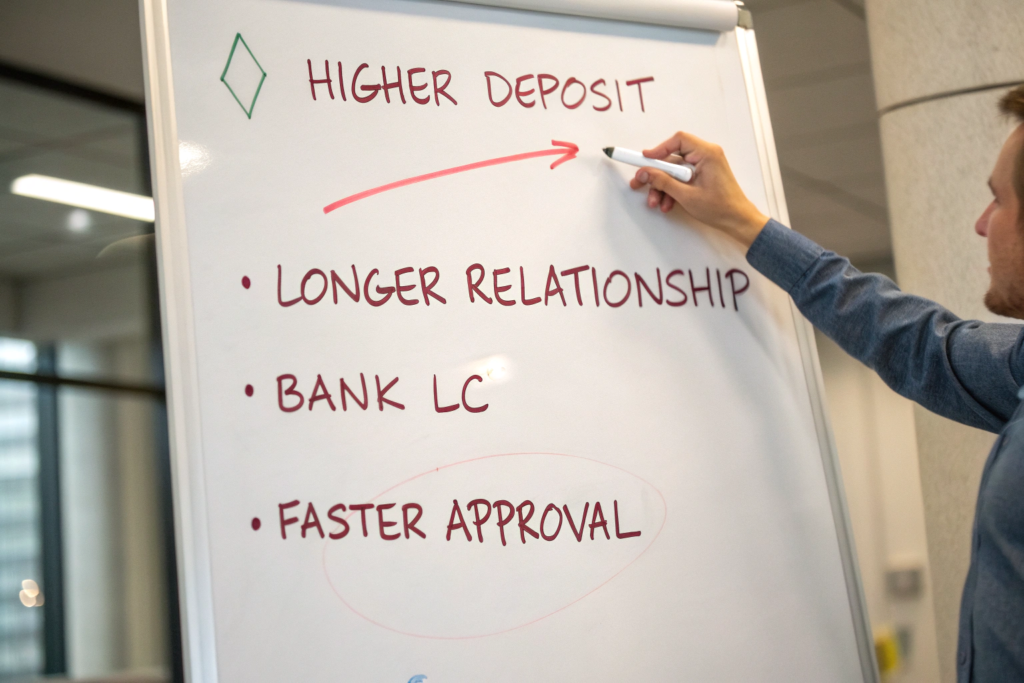
This is one of the most common trade-offs. If you want net terms—meaning you pay after shipment—you can offer a larger deposit to reduce the supplier's risk. For example, instead of 30% deposit and 70% before shipment, you might offer 50% deposit and 50% net 30. The supplier gets more cash upfront, which reduces their financing burden, and they're more willing to wait for the balance.
I negotiated this with a client from a Canadian workwear brand. They wanted net 45 on a 40,000-meter order. I explained that our standard terms were 30% deposit, balance before shipment. They offered 40% deposit and 60% net 45. I accepted. The larger deposit covered our raw material costs, so we weren't financing the order. The net terms gave them the cash flow flexibility they needed. Both sides won.
For a guide to structuring deposit and net term trade-offs, this sourcing article offers a template for payment term negotiation.
How Does a Letter of Credit (LC) Help?
A letter of credit is a bank guarantee. The buyer's bank promises to pay the supplier when certain conditions are met—usually when shipping documents are presented. For the supplier, an LC is much safer than open account terms because the payment is guaranteed by a bank. For the buyer, an LC can be more expensive and requires more paperwork, but it can also unlock better terms.
If you offer to pay by LC, many suppliers will accept less favorable terms. Instead of 30% deposit, you might pay 100% by LC at sight. Or you might pay 10% deposit and 90% by LC. Because the LC guarantees payment, the supplier doesn't need as much upfront cash.
I had a client from a large European retailer who always pays by LC. Their standard terms are 10% deposit, 90% by LC at sight. We accept that because the LC is from a major European bank. We know we'll get paid when we present the shipping documents. The deposit covers our initial raw material purchase. The LC covers the rest. It's a clean, secure arrangement.
For a comprehensive guide to letters of credit in textile trade, this trade finance resource explains how LCs work and when to use them.
Does a Long-Term Relationship Justify Better Terms?
The single biggest factor in getting better payment terms is a long-term relationship. Suppliers are much more willing to offer flexible terms to clients they know and trust. If you've placed five orders with us and paid every one on time, we're going to be much more flexible on the sixth than we were on the first.
I have a client from an Australian activewear brand who has been with us for eight years. They started with 30% deposit, 70% before shipment. After two years of on-time payments, we moved them to 30% deposit, 40% at shipment, 30% net 30. After five years, we moved them to 20% deposit, 80% net 45. Now, after eight years, they're on 10% deposit, 90% net 60. The terms improved because the relationship proved itself.
If you're a new client, you can accelerate this process by offering to do a trial order with strict terms, then proving your reliability. After a few successful orders, you can ask for a review of terms. Most suppliers will be open to that conversation.
For a discussion of how relationships evolve over time, this industry blog has a guide to building supplier trust.
What Payment Terms Should You Avoid?
Not all payment terms are created equal. Some structures put you at unnecessary risk. Some put the supplier at risk, which can lead to quality or delivery problems. Here are the terms I recommend avoiding.
Why Is 100% Prepayment Risky?
Paying 100% before production is risky for the buyer. Once the supplier has all your money, you have no leverage. If the quality is poor, if the delivery is late, if the fabric is wrong, you have no recourse. You're at the supplier's mercy.
I've seen this happen. A client from a US fashion brand paid 100% upfront to a new supplier they found on Alibaba. The fabric never arrived. The supplier stopped answering emails. The client lost $30,000. That's an extreme case, but it illustrates the risk.
We never ask for 100% prepayment, and I would advise any buyer to avoid it. The only exception might be for a very small sample order where the supplier has no other way to cover the sample cost. For bulk orders, a deposit of 30% to 50% is standard, with the balance due at or before shipment.
For a discussion of payment risks, this sourcing guide offers a list of red flags in supplier payment terms.
Why Is 100% Net 90 or Net 120 Unfair to Suppliers?
On the other side, 100% net 90 or net 120 terms are difficult for most suppliers. That means the supplier finances the entire order for three or four months. For a small or medium factory, that can be impossible. They simply don't have the cash flow to buy raw materials, pay workers, and cover overhead while waiting months for payment.
When a supplier accepts these terms, they're often factoring the invoice—selling it to a finance company at a discount. That discount is effectively a hidden cost that the supplier passes back to the buyer in the form of higher prices. So net 90 terms might cost you more in the long run than paying earlier.
I had a client from a European brand who insisted on net 90. We agreed, but we added 5% to the price to cover our financing costs. The client was paying net 90 anyway, but they didn't realize that the higher price was a direct result of their payment terms. When I explained it to them, they switched to 30% deposit, balance before shipment, and the price dropped by 5%. They got better cash flow on the deposit side and saved money on the total order.
For a guide to balancing payment terms and pricing, this trade finance article explains the cost of extended payment terms.
How Do You Prepare for a Payment Term Negotiation?
Before you sit down to negotiate, you need to be prepared. Know what you want, know what the supplier needs, and know what you can offer in return. The best negotiations are win-win.

What Information Should You Have Ready?
Before you start negotiating, you should have a clear picture of your own cash flow. When do you need the fabric? When will you have the cash to pay? What is your maximum deposit? What terms are your own customers giving you? Knowing your own numbers gives you confidence in negotiation.
You should also know the supplier's perspective. What is their standard deposit? What is their typical balance structure? Understanding what's normal in the industry helps you set realistic expectations.
Finally, you should know what you can offer in return. Can you offer a larger deposit? Can you use a letter of credit? Can you commit to a long-term relationship? Can you give them a forecast that allows them to plan production more efficiently? Every concession you offer can be used to get better terms.
I had a client from a UK brand who came to us with a clear proposal. They wanted net 45. They offered 40% deposit, which was higher than our standard 30%. They also offered to provide a rolling forecast for the next 12 months, which would allow us to plan our yarn purchases more efficiently. We accepted. The larger deposit covered our raw material costs. The forecast reduced our planning risk. The net 45 gave them the cash flow they needed. Everyone won.
For a negotiation preparation checklist, this sourcing resource offers a guide to preparing for supplier negotiations.
How Do You Build a Case for Better Terms?
If you're asking for better terms than a new client typically gets, you need to make a case. What makes you different? Are you a large, established company with a strong credit history? Are you willing to sign a long-term contract? Are you placing a very large order? Are you willing to pay a premium for better terms?
Put your case in writing. A short email or document that outlines your proposal and your rationale can be very effective. It shows that you're serious and that you've thought about the supplier's perspective.
I received a proposal from a client in the Netherlands that was very effective. They were a new client, but they wanted net 60. Their proposal included: a 40% deposit, a bank reference from their Dutch bank, a commitment to place at least three orders per year, and a willingness to start with a smaller trial order on stricter terms to prove their reliability. We agreed to the trial order on 30% deposit, balance before shipment. After three successful trial orders, we moved them to net 60. Their proposal showed they understood our concerns and were willing to work with us to build trust.
For a template of a payment term proposal, this business negotiation guide offers a sample letter for requesting better terms.
Conclusion
Negotiating payment terms for bulk knitted fabric is about more than just getting what you want. It's about finding a structure that works for both sides. The supplier needs to cover raw material costs and manage risk. The buyer needs cash flow flexibility. The best terms are the ones that balance these needs.
Understand the standard terms in the industry: 30-50% deposit, balance before shipment. Understand what drives the supplier's requirements—raw material costs, order size, relationship history. And understand what you can offer in return: a larger deposit, a letter of credit, a long-term commitment, a trial period to prove reliability.
Avoid the extremes. 100% prepayment puts you at risk. 100% net 90 puts the supplier at risk and often results in higher prices. The sweet spot is in the middle: a deposit that covers raw materials, and a balance structure that gives you flexibility while protecting the supplier.
Prepare for your negotiation. Know your numbers. Know the supplier's perspective. Build a case for why you deserve better terms. And be willing to start with stricter terms and earn better ones over time. The best payment terms are the ones that come from a long-term relationship built on trust.
At Shanghai Fumao, we're flexible on payment terms. We understand that different clients have different needs. We're willing to work with you to find a structure that works for both sides. But we also need to protect ourselves. The key is open communication and mutual understanding.
If you're looking for a supplier who will work with you on payment terms, let's talk. Tell us what you need. Tell us what you can offer. And let's find a structure that lets both of us succeed.
Contact our Business Director, Elaine, to discuss payment terms for your next order.
Email: elaine@fumaoclothing.com
Let's build a partnership that works for both sides.