I've been in this industry for over 20 years, and I've seen it all—good partnerships that turned into decade-long relationships, and deals that fell apart because someone skipped the vetting process. When you're sourcing knitted fabrics from China, a trade show is one of the most powerful tools you have. But here's the thing: just showing up and collecting business cards isn't going to protect you from late shipments or quality disasters.
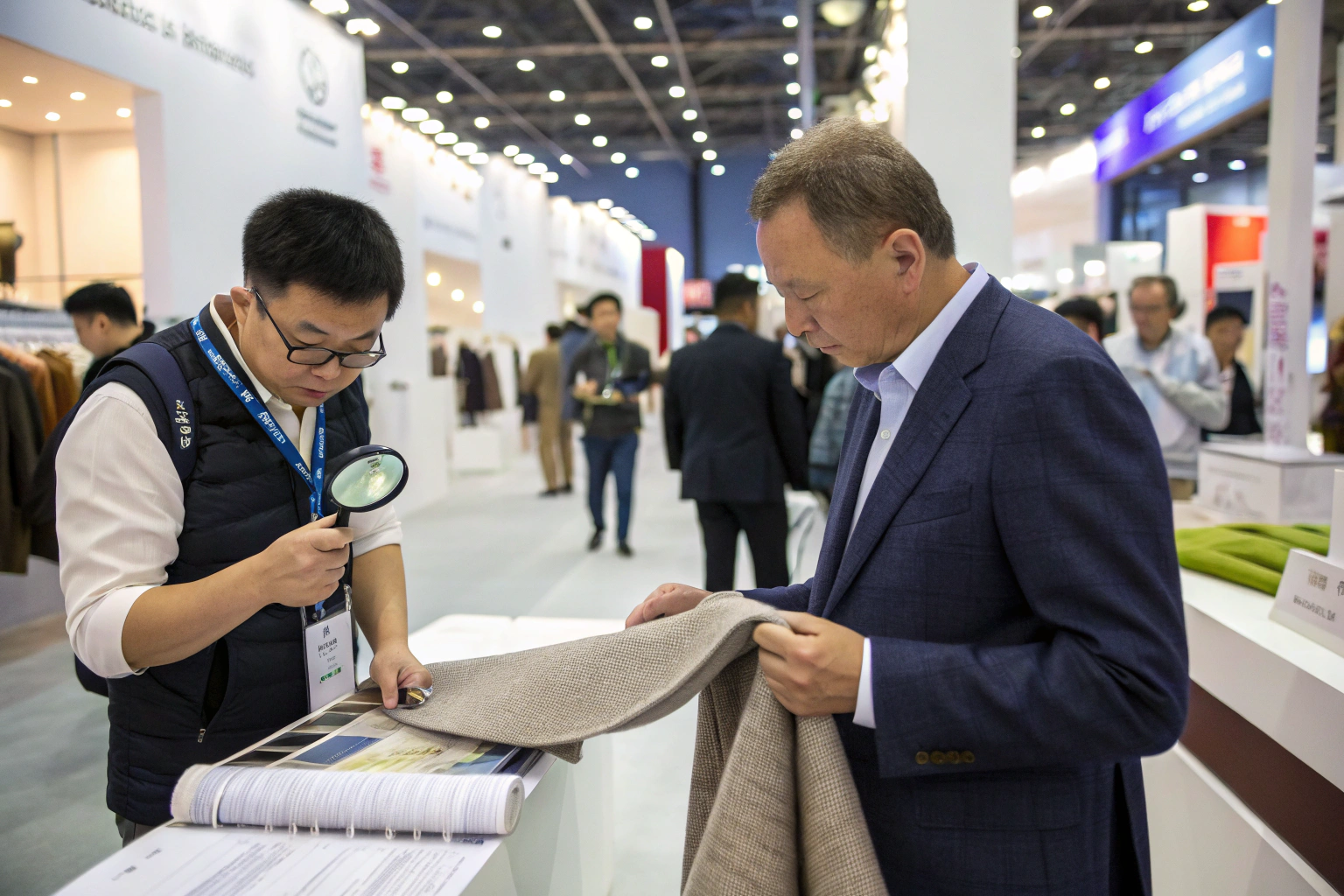
Let me give it to you straight. Trade shows allow you to evaluate a supplier's credibility, quality control systems, and communication style face-to-face before committing to orders. You can inspect physical samples, verify factory capabilities, and establish personal relationships that make problem-solving easier when production inevitably hits a snag. At Shanghai Fumao, we've hosted hundreds of buyers at our booth at events like Canton Fair and Intertextile Shanghai. I've seen what smart buyers do—and what the unprepared ones miss.
The global textile market is full of options, but not every supplier who rents a fancy booth has the infrastructure to back up their promises. This guide comes from my two decades on the supplier side. I'll walk you through exactly how to use trade shows to separate the real manufacturers from the middlemen, and how to build a supplier relationship that lasts.
What Should You Do Before the Trade Show Starts?
Most buyers make their biggest mistake before they even walk through the exhibition hall doors. They arrive with no plan, wander the aisles, and end up talking to whoever has the most attractive booth. That's not vetting; that's window shopping. In our experience, the clients who get the best results are the ones who treat the trade show like a surgical strike, not a fishing expedition.

Which Suppliers Should You Target Before Arriving?
You need a list. Not just any list—a targeted list of potential partners who actually match your specific needs. I recommend starting your research at least 4-6 weeks before the show. Here's what that looks like in practice.
First, use the trade show's official website to get the exhibitor list. Most shows like Intertextile Shanghai or Canton Fair release these lists about two months in advance. Filter by product category—knitted fabrics, functional textiles, sustainable materials, whatever applies to you. Then, cross-reference those names with other platforms like Alibaba or industry directories.
In 2023, a Canadian activewear buyer came to our booth at Intertextile. She told me she had pre-screened 47 exhibitors down to 12 based on three criteria: their listed certifications (GOTS, OEKO-TEX, etc.), their presence on Alibaba with transaction history, and their response time to her pre-show email inquiries. She sent each of those 12 a simple email asking about their minimum order quantities and lead times for recycled polyester interlock. She eliminated anyone who took more than 48 hours to respond or gave vague answers. That's preparation. By the time she got to our booth, she already knew we had passed her initial test.
Second, look for red flags in their online presence. Does their website have clear information about their factory location? Do they list their own machinery or just talk about "partnerships"? Are the photos on their Alibaba page consistent with what you'd expect from a legitimate manufacturer? I've seen suppliers who use stock photos of factories that don't belong to them. If something feels off, trust your gut.
What Information Do You Need to Bring?
Here's where I see buyers get it wrong. They show up with nothing but a vague idea of what they want. Then they get overwhelmed by the sheer volume of samples and promises. The buyers who impress me—the ones I know will be serious partners—come prepared with a proper tech pack or at least a detailed specification sheet.
Bring a folder with your standard requirements. Include:
- Your target fabric weight range (GSM)
- Required certifications (GOTS, OEKO-TEX, recycled content verification)
- Your typical order quantities
- Your quality standards and acceptable tolerance levels
- Samples of fabrics you currently use, with labels showing what you like and dislike about each
In early 2024, a startup founder from Texas came to our booth with a binder that looked like a college thesis. She had fabric swatches taped to every page, with handwritten notes about hand feel, drape, and color accuracy. She also had a list of 20 questions for each supplier. That level of preparation told me she was serious. We spent an hour with her, which is way more time than we usually give to walk-ins. Why? Because she demonstrated that she valued quality and detail—exactly the kind of client we want to work with long-term.
(Let me add a quick note here: time is precious at trade shows. A prepared buyer signals to suppliers that you're worth investing time in. We get hundreds of people stopping by. The ones with clear specs and samples get the detailed conversations.)
How Can You Map Out Your Booth Visits Strategically?
The exhibition hall is massive. I've walked the floor at Intertextile Shanghai, and it can feel like a small city. If you try to see everyone, you'll see no one properly. You need a strategy.
Print the floor plan and mark your top 10-15 suppliers. Group them by location so you're not crisscrossing the hall all day. Schedule your visits during the less busy times—early morning when the show opens or late afternoon when the crowds thin out. Peak hours (around 11 AM to 2 PM) are when booths are packed, and you won't get the attention you need.
Also, leave time for discovery. The best finds are often not on your initial list. Keep some open slots in your schedule to explore booths that catch your eye. In my 20 years here in Keqiao, I've learned that the textile industry has hidden gems—smaller manufacturers with excellent capabilities who don't have huge marketing budgets. They might not show up in your initial online search, but they can be fantastic partners if you find them.
What Questions Reveal a Supplier's True Capabilities?
Now you're at the booth. The samples look good, the salesperson is friendly, and you're feeling positive. This is the dangerous moment. I've seen too many buyers get charmed by a smooth talker and a beautiful display, only to discover six months later that the supplier was just a trading company with no real control over production.
The key is asking the right questions—questions that force the supplier to reveal their actual capabilities, not just their marketing pitch.
Can You Walk Me Through Your Quality Control Process?
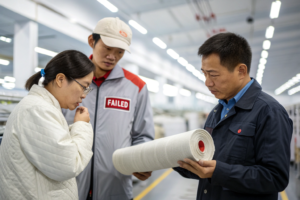
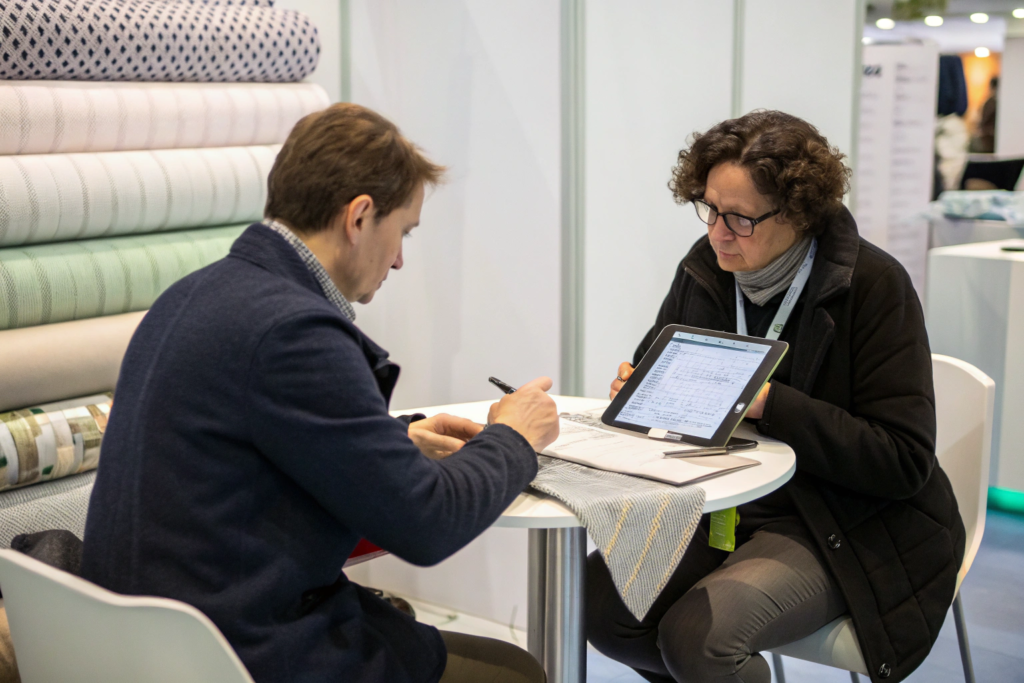
This is my favorite question. It's simple, but the way a supplier answers tells you almost everything you need to know. A real manufacturer will give you specifics: "We have in-line inspection at the knitting machines, followed by greige fabric inspection before dyeing, then final inspection with a four-point system before packaging." A middleman will say something vague like "We have strict quality control" or "All our products meet international standards."
Push for details. Ask about their pass rate. At Shanghai Fumao, we maintain a 98% client pass rate on first inspection. That's a specific number we can verify with data. We have QR code tracking that gives clients real-time access to composition, shrinkage, and colorfastness data from our CNAS-accredited lab. A legitimate supplier should be able to provide similar specifics.
I remember a buyer from a European fashion house who came to our booth in 2023. She asked this question, and I walked her through our entire process. I showed her photos of our inspection stations on my tablet. Then I asked her a question back: "What's your biggest quality challenge with your current suppliers?" That started a conversation that led to her switching 60% of her knit fabric sourcing to us within six months. When suppliers ask about your challenges, it's often a sign that they're thinking about solutions, not just making a sale.
How Do You Handle Production During Chinese New Year and Peak Seasons?
Every textile supplier in China knows about Chinese New Year. It's the biggest disruption to the supply chain. The way a supplier talks about this tells you whether they're proactive planners or reactive order-takers.
A good supplier will tell you their exact shutdown dates—typically 3-4 weeks for Chinese New Year—and explain their advance planning process. They'll recommend completing pre-production 6 weeks before the holiday to secure a production slot. They'll also mention how they handle peak periods (March-May and August-October) when timelines can add 1-2 weeks.
I've had buyers come to me in November, wanting delivery in January, completely unaware that the entire industry shuts down for Chinese New Year. When I explain the timeline, they look panicked. A supplier who gives you this information upfront is doing you a favor. They're helping you plan, not just taking your order.
Also ask about their slower periods (June-July, November-December). A supplier who's transparent about their capacity will tell you when they can offer faster turnaround times. That's valuable information for your production planning.
Do You Own Your Factories, or Do You Outsource Production?
This is the million-dollar question. The textile industry in Keqiao—where we're based—is complex. There are genuine manufacturers like us who own our weaving, dyeing, printing, and finishing facilities. Then there are trading companies who act as middlemen, outsourcing production to various factories.
Neither model is inherently bad. Trading companies can sometimes offer access to a wider range of products. But you need to know what you're getting into. If you need consistent quality and control over the production process, a manufacturer with their own facilities is usually the better choice.
When you ask this question, watch how they respond. A genuine manufacturer will be proud to show you photos of their facilities, talk about their machinery, and describe their in-house capabilities. A trading company will give you a more general answer about their "partners."
At Shanghai Fumao, we own a large-scale weaving factory, cooperative dyeing facilities, two printing factories, two embroidery factories, a coating factory, a fabric inspection factory, a packaging factory, and we have our own professional QC team. When buyers ask about our facilities, we can show them exactly where their fabric will be produced, inspected, and shipped from.
What Physical Inspections Should You Perform at the Booth?
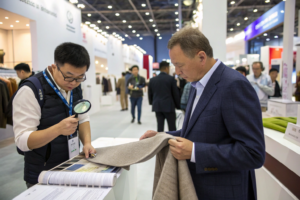
You can ask all the right questions, but nothing replaces physical inspection. This is the advantage of trade shows—you can touch, feel, and test fabrics in person. Smart buyers treat this like a science experiment, not a shopping trip.
How Can You Test Fabric Quality Without Lab Equipment?
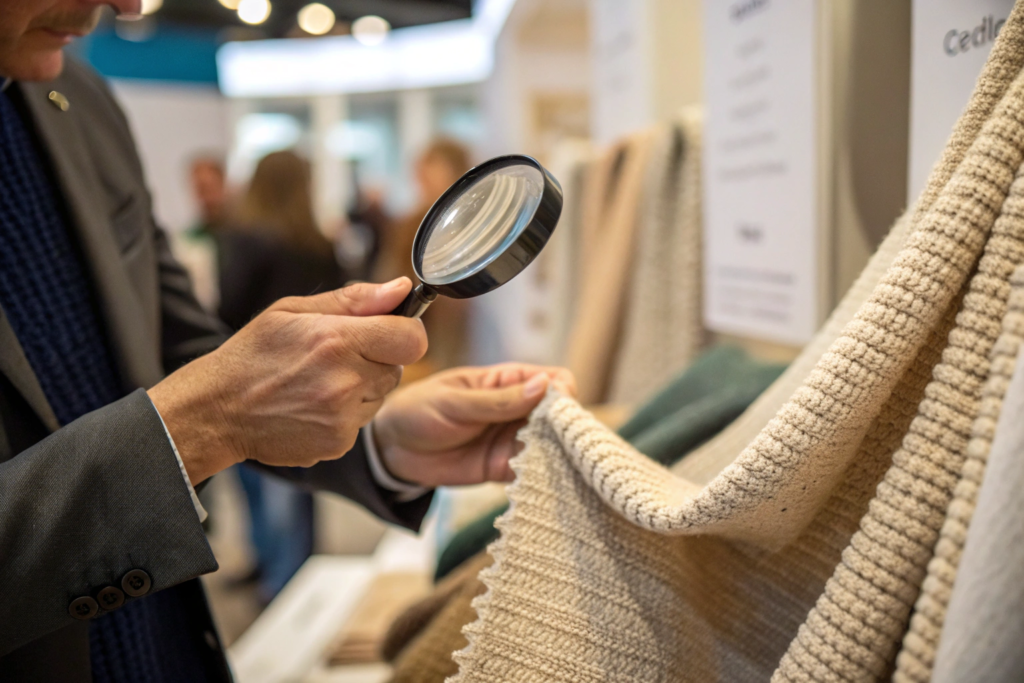
You don't need a full lab setup to spot quality issues. There are simple tests you can do right at the booth that reveal a lot about the fabric's construction and finishing.
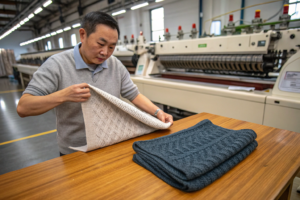
Start with the hand feel. Close your eyes and feel the fabric. Is the softness consistent across the sample? For knitted fabrics like jersey or interlock, run your hand over the surface in both directions. A well-made knit will feel smooth in both directions. Poor quality knits might have rough spots or inconsistent texture.
Next, check for skewing or twisting. Hold the fabric up by one corner and let it hang. Does it hang straight, or does it twist? For a stable fabric like interlock, it should hang completely straight. For jersey, there will be some natural curl at the edges, but the body shouldn't twist dramatically. I've seen jersey samples that were so skewed they couldn't be cut properly. That's a sign of poor knitting tension control.
Test the recovery. Stretch the fabric and see how quickly it returns to its original shape. For activewear or any garment that needs shape retention, this is crucial. A good interlock will stretch and snap back almost immediately. A poor-quality knit will hold the stretched shape or recover slowly.
One buyer from a US sportswear brand taught me something interesting at a trade show last year. She brought a small spring scale and would test fabric stretch by applying consistent tension to different samples. She was looking for consistency across colors of the same base fabric. If the red interlock stretched differently than the black, she knew the dyeing process wasn't controlled properly. That's the level of detail that separates serious buyers from casual shoppers.
What Should You Look for in Color and Finishing?
Color consistency is one of the biggest headaches in textile sourcing. In our dyeing factory, we maintain strict controls to ensure shade consistency from batch to batch. But not all suppliers have that capability.
At the booth, ask to see multiple colorways of the same fabric. Look for variations in shade, especially if the fabric has any special finishes like water repellency or antimicrobial treatment. Sometimes finishes can affect color, and a good supplier will have controlled for that.
Also ask about their lab dip process. How many rounds do they typically do before approval? What's their turnaround time for lab dips? A supplier who can produce accurate lab dips quickly—like our 48-hour sample development—has the technical capability to handle color-critical orders.
Check the edges of the sample. Is the cutting clean? Are there any signs of uneven dye penetration? Look at the fabric under different lighting if possible. Some suppliers have special lighting booths at their booths that simulate different light sources. If they do, use it. Color that looks perfect under fluorescent light might look completely different under natural sunlight.
I had a buyer from a Scandinavian brand spend 20 minutes at our booth just examining the selvage edges of our knitted samples. She told me that how a supplier finishes the edges—the cut, the roll, the packaging—tells you how much they care about the details that matter later in production. She was absolutely right. If a supplier cuts corners on presentation samples, they'll cut corners on your order.
How Do You Verify What the Supplier Tells You?
The trade show conversation is just the beginning. The real vetting happens after you leave the booth. This is where you separate the talkers from the doers.

How Can You Verify Factory Claims?
When a supplier tells you they own their factory, ask for the factory address. Not just the city—the full address. Then, do some research. In Keqiao, where we're based, factory locations are public information. You can cross-reference the address with Google Maps or local business registries.
Ask for photos of the factory floor. A legitimate supplier should be able to show you current photos, not just the glossy marketing images. If you're serious about them, request a video call where they walk you through the facility. This is standard practice now, and any supplier who hesitates should raise a red flag.
Check their certifications. Look for OEKO-TEX Standard 100, GOTS, or other relevant certifications. These require audits, and the certification numbers can be verified online. At Shanghai Fumao, our CNAS-accredited testing center means we can provide verifiable test reports for every batch. A supplier with proper certifications will have nothing to hide.
In 2023, a buyer from an Australian children's wear brand told me she eliminated three potential suppliers because their claimed GOTS certification numbers didn't match the official registry. She took 10 minutes to verify each one at her hotel after the trade show. That saved her from what could have been a disastrous partnership.
What Follow-Up Tests Should You Conduct?
After the trade show, it's time for the real quality check. Request samples—not just the ones they give you at the booth, but specific samples based on your requirements. If you're sourcing a 200 GSM cotton interlock, ask them to send you exactly that.
When you receive the samples, put them through your own testing. Wash them. Stretch them. Test colorfastness. If you have the capability, do a burn test to verify fiber content. Cotton burns differently than polyester, and a blend will behave differently than a 100% natural fiber.
I recommend sending samples to a third-party lab for verification, especially for larger orders. The cost of testing is small compared to the cost of receiving 10,000 meters of fabric that doesn't meet your specifications.
One of our European clients sends every initial sample from potential suppliers to SGS for testing. They've caught issues like mislabeled fiber content and poor colorfastness more than once. That's money well spent.
Also test their communication. After the trade show, send a follow-up email with specific questions. See how quickly they respond. See if they answer all your questions or just the easy ones. A supplier who disappears after the trade show is not a supplier you want to depend on when production issues arise.
Conclusion
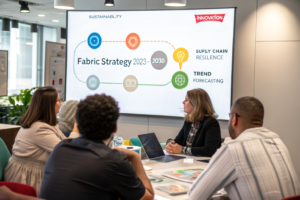
Trade shows are one of the most effective tools for vetting knitted fabric suppliers, but only if you approach them with a clear strategy. Preparation before the show—researching exhibitors, bringing your specifications, and mapping your visits—sets the foundation. During the show, asking the right questions about quality control, production planning, and factory ownership reveals a supplier's true capabilities. Physical inspections of samples test their technical competence. And the follow-up after the show—verifying claims and testing samples—separates the real manufacturers from the middlemen.
At Shanghai Fumao, we've hosted hundreds of buyers at our trade show booths over the past 20 years. The ones who succeed are the ones who come prepared, ask detailed questions, and follow through with verification. They're the ones who build partnerships that last for years, not just single orders.
We understand the challenges you face—quality control, certification requirements, logistics, tariff costs, and the constant pressure of timelines. We've built our business around solving these problems for our clients, from our large-scale weaving factory to our CNAS-accredited testing center. We offer end-to-end support, from yarn sourcing to packaging and shipping, with QR code tracking that gives you visibility into every step of the process.
If you're planning to attend a trade show soon and want to discuss how we can support your sourcing needs, I encourage you to reach out. My team and I are committed to making your next sourcing trip productive and successful.
Contact our Business Director, Elaine, to start the conversation.
Email: elaine@fumaoclothing.com