
After twenty years shipping fabric from China to global customers, I’ve seen every logistics disaster imaginable. Just last month, an American client chose sea freight for their "urgent" order to save $4,000, then paid $18,000 in air freight when their production line stopped. The truth is, choosing the wrong logistics option doesn’t just cost money—it can destroy business relationships and market opportunities.
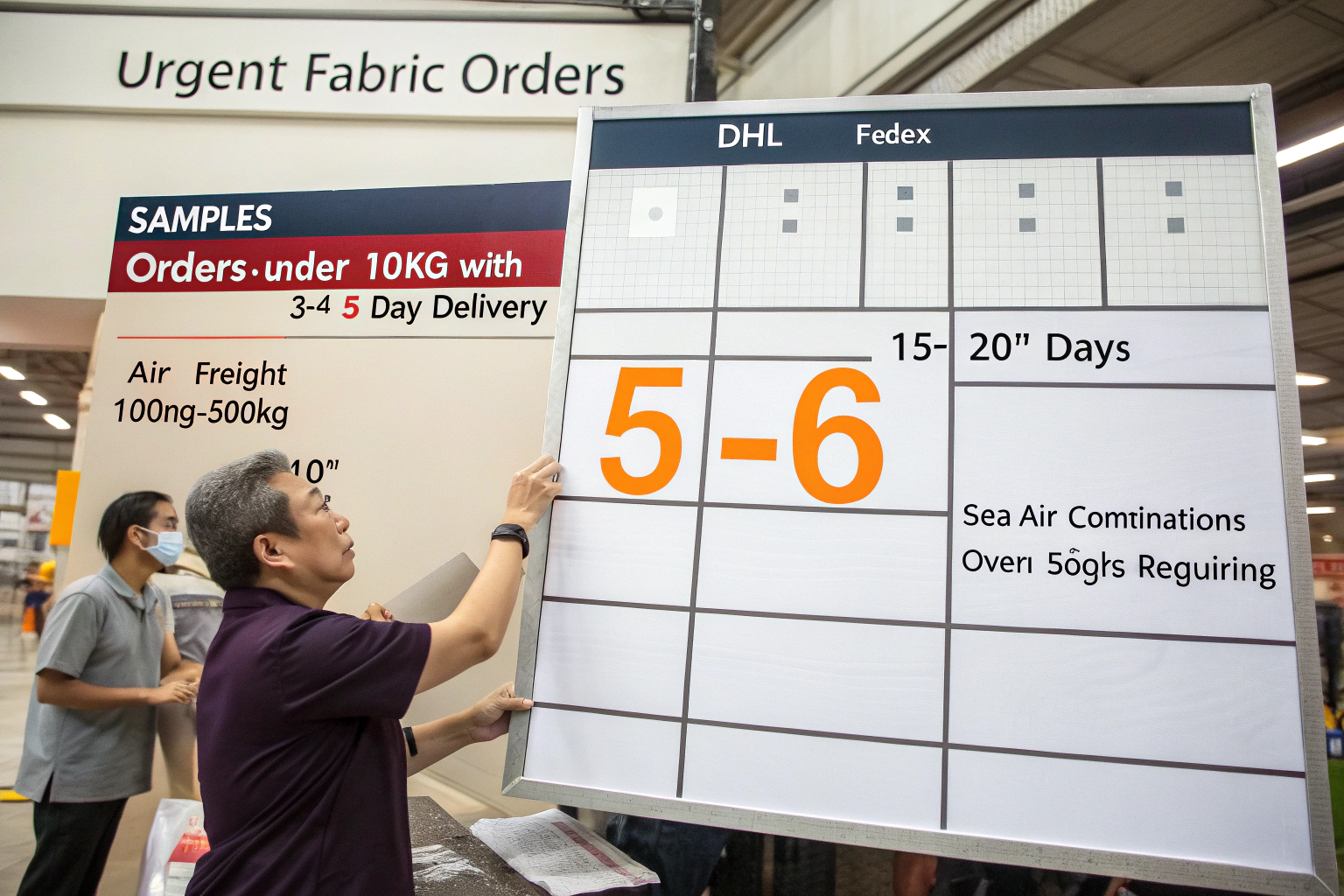
The optimal logistics option for urgent fabric orders depends on three factors: true urgency level, order volume/weight, and budget constraints. Express couriers (DHL/FedEx) suit samples and under 100kg orders with 3-5 day delivery. Air freight works best for 100kg-500kg orders needing 5-10 day delivery. Sea-air combinations balance cost and speed for 500kg+ orders requiring 15-20 day delivery. Understanding these trade-offs prevents both unnecessary costs and catastrophic delays.
I’ll never forget the New York fashion startup that needed 800kg of fabric for their first major production run. They chose express courier without understanding the cost structure and received a $28,000 shipping bill for what should have cost $4,200 via air freight. The shock almost bankrupted them. Meanwhile, a established sportswear brand once missed the entire back-to-school season because they shipped sea freight for a "urgent" order that took 47 days instead of the promised 35. These experiences taught me that logistics decisions require strategic thinking, not just cost comparison.
How Do You Match Logistics Options to True Urgency Levels?
"Urgent" means different things to different businesses. A 7-day delay might be inconvenient for one company and catastrophic for another. The first step in choosing logistics is honestly assessing what "urgent" actually means for your specific situation.
True urgency assessment requires understanding your production calendar, inventory status, and market deadlines. I’ve developed a simple but effective framework that categorizes urgency into three levels, each with appropriate logistics solutions.

What Defines "Critical," "High," and "Medium" Urgency?
Through analyzing thousands of shipments, I’ve categorized urgency into three distinct levels:
Critical Urgency (1-7 day delivery needed):
- Production line stoppage imminent
- Missed delivery penalties exceed shipping costs
- Seasonal launch dates cannot be moved
- Recommended: Express courier for <100kg, air freight for >100kg
High Urgency (8-15 day delivery acceptable):
- Production scheduling flexibility exists
- Buffer inventory provides 1-2 week coverage
- Marketing launches can accommodate slight delays
- Recommended: Air freight for most volumes, sea-air for 500kg+
Medium Urgency (16-25 day delivery workable):
- Planning ahead for known demand
- Replenishment of safety stock
- Production scheduled with contingency
- Recommended: Sea-air combination, premium sea freight
A Denver-based outerwear brand applies this framework systematically. They maintain a "urgency calculator" that factors in their production timeline, inventory levels, and retail delivery commitments. This approach helped them avoid $42,000 in expedited shipping costs last year alone by accurately categorizing their true urgency levels.
How Does Order Volume Determine the Economic Choice?
The economic crossover points between logistics options are surprisingly consistent:
| Order Weight | Express Courier | Air Freight | Sea-Air |
|---|---|---|---|
| 1-50kg | $8-15/kg | $6-12/kg | Not viable |
| 50-100kg | $12-18/kg | $5-9/kg | $7-10/kg |
| 100-500kg | Not economical | $4-7/kg | $4-6/kg |
| 500-2000kg | Not economical | $3-5/kg | $2-4/kg |
These ranges assume standard fabric density and typical China-US routes. Special handling requirements (temperature control, hazardous materials, oversized rolls) can increase costs by 30-100%.
What Are the Real Capabilities and Limitations of Each Option?
Each logistics option has specific strengths and weaknesses that go beyond simple cost and speed comparisons. Understanding these nuances prevents unpleasant surprises and ensures you select the option that truly matches your requirements.
I’ve built this knowledge through painful experience—like when we discovered that a client’s "waterproof" coating made their fabric classify as hazardous material for air transport, requiring complete repackaging and adding 3 days to their timeline.

How Does Express Courier Work for Fabric Samples and Small Orders?
Express couriers (DHL, FedEx, UPS) excel for small, time-sensitive shipments but become prohibitively expensive beyond certain weight thresholds.
Advantages:
- Door-to-door convenience: Single provider handles everything
- Speed: 3-5 days China to most US locations
- Tracking: Real-time visibility throughout journey
- Clearance expertise: Handles customs with minimal client involvement
Limitations:
- Cost structure: Economical only for <100kg shipments
- Size restrictions: Maximum piece weight and dimensions
- Limited bulk handling: Not designed for palletized goods
- Weekend/holiday surcharges: Can add 25-50% to costs
We recently shipped 35kg of development samples to a Miami activewear brand via DHL Express. The cost was $485 with delivery in 4 days—expensive per kilogram but justified by their need to present physical samples to investors.
What Makes Air Freight the Workhorse for Medium Urgent Orders?
Air freight provides the best balance of speed and cost for most urgent fabric orders between 100kg and 500kg.
Key Considerations:
- Airport-to-airport vs door-to-door: You arrange first/last mile or pay for full service
- Consolidation options: Lower costs by sharing space with other shipments
- Flight availability: Direct vs connecting flights impact timing
- Customs clearance: Requires more involvement than express courier
A Chicago uniform company ships 300kg fabric orders via air freight weekly. Their typical cost is $2,100 with 7-day total transit time—including their customs broker clearance. This reliability lets them maintain lean inventories without production disruptions.
Sea-air combines ocean transport from China to a transit hub (usually Dubai, Seoul, or Tokyo) with air freight to final destination. This hybrid approach saves 10-15 days versus pure sea freight at 30-50% of pure air freight costs.
Ideal Scenarios:
- 500kg+ orders with 15-20 day delivery requirements
- Predictable but compressed timelines
- Budget constraints that exclude pure air freight
- Estable production schedules with some flexibility
We shipped 1,200kg of technical fabric to a Portland outdoor brand via sea-air last quarter. The cost was $4,900 with 18-day delivery—compared to $14,000 for air freight or 35 days for sea freight. The savings justified the slightly longer timeline.
How Do Hidden Costs and Risks Impact Total Cost Calculation?
The quoted shipping cost is often just the beginning. Understanding and planning for hidden costs prevents budget overruns, while recognizing risks allows for appropriate contingency planning.
I’ve developed a comprehensive checklist that captures all potential additional costs based on hundreds of shipments. This transparency has become a key value we provide clients.

What Are the Most Common Hidden Costs?
Based on our shipment analysis, these additional costs occur in 65% of fabric shipments:
| Cost Category | Typical Range | Trigger Conditions |
|---|---|---|
| Customs clearance | $150-400 | All international shipments |
| Fuel surcharges | 10-25% of base | Volatile oil markets |
| Security fees | $50-150 | Increased screening requirements |
| Weekend/holiday | 25-50% surcharge | Delivery outside business hours |
| Storage/demurrage | $100-300/day | Customs delays or missed pickups |
| Special handling | 30-100% premium | Oversized, temperature-sensitive |
A Seattle fashion brand learned about hidden costs dramatically when their $3,200 air freight shipment incurred $1,400 in additional charges—mostly from weekend customs storage and special handling for their unusually wide fabric rolls.
How Can You Mitigate Logistics Risks?
Proactive risk management separates successful urgent shipments from disasters:
Documentation Risks:
- Solution: Use standardized commercial invoice templates
- Benefit: Reduces customs clearance from 3 days to 1 day average
Capacity Risks:
- Solution: Book 10-15% earlier than theoretical need
- Benefit: Ensures space during peak seasons
Regulatory Risks:
- Solution: Pre-clear unusual fabric types (coatings, treatments)
- Benefit: Prevents shipment holds for compliance verification
We helped a technical textile importer develop a "logistics risk assessment" that they complete before each shipment. This simple 15-minute exercise has prevented three potential customs holds that would have cost them over $25,000 in production delays.
What Role Does Relationship Management Play in Urgent Situations?
Logistics isn’t just about rates and schedules—it’s about relationships. During truly urgent situations, your relationships with freight forwarders, carriers, and customs brokers determine whether you get the last available space or get told "sorry, fully booked."
I’ve invested years building relationships across the logistics ecosystem, and this network has saved clients countless times when theoretical solutions wouldn’t work in practice.

How Do You Build Effective Logistics Partnerships?
Successful logistics partnerships require more than transactional relationships:
Strategic Forwarder Selection:
- Specialization: Choose forwarders experienced with textiles
- Network strength: Multiple airline and carrier relationships
- Problem-solving capability: Demonstrated ability during disruptions
- Communication standards: Proactive updates versus reactive responses
We maintain relationships with three primary forwarders, each with different strengths. This diversified approach ensured that during the recent Shanghai lockdowns, we could pivot immediately when one forwarder’s operations were completely shut down.
What Communication Protocols Prevent Urgent Situation Escalation?
Clear communication protocols are the emergency brake that prevents small issues becoming catastrophes:
- Daily tracking updates during critical shipments
- Escalation contacts for after-hours issues
- Documentation pre-submission before physical shipment
- Contingency planning for weather, strikes, capacity issues
A Boston performance wear brand implemented our communication protocol after a shipment was held for 8 days without their knowledge. Now they receive daily status reports during urgent shipments and have reduced unexpected delays by 85%.
How Does Technology Improve Urgent Logistics Decisions?
Modern logistics technology has transformed urgent shipping from guesswork to data-driven decision making. The right tools provide visibility, predictive analytics, and automation that dramatically improve outcomes.
We’ve invested heavily in logistics technology, and the returns in customer satisfaction and operational efficiency have far exceeded the costs.

What Tracking and Visibility Tools Matter Most?
Comprehensive visibility requires multiple technology layers:
Real-time Tracking Platforms:
- Global trackers: Follow shipments across multiple carriers
- Exception alerts: Automatic notifications for delays
- ETA algorithms: Continuously updated arrival predictions
- Document management: Centralized access to shipping documents
We provide clients with a branded tracking portal that shows their shipment’s status, documents, and predicted arrival. This transparency has reduced "where’s my fabric?" inquiries by 70%.
How Can Analytics Optimize Future Decisions?
Historical shipping data reveals patterns that inform better decisions:
- Seasonal rate patterns: Identify best/worst times to ship
- Carrier performance data: Objective assessment of reliability
- Route optimization: Identify consistently faster pathways
- Cost forecasting: Predict budgets with 90%+ accuracy
Our analytics identified that shipping through Incheon instead of Shanghai saved an average of 1.7 days for West Coast destinations. This insight now saves our clients approximately 500 production days annually across all shipments.
Conclusion
Choosing the right logistics option for urgent fabric orders requires balancing speed, cost, and reliability against your specific business needs. Express couriers provide maximum speed for small orders, air freight offers the best balance for medium volumes, and sea-air combinations deliver cost-effective solutions for larger shipments with slightly flexible timelines. The most successful approach combines understanding the true capabilities of each option, accounting for hidden costs, building strong logistics partnerships, and leveraging technology for visibility and optimization.
At Fumao Textiles, we’ve developed our logistics expertise through thousands of urgent shipments to US clients. Our integrated approach combines strategic carrier relationships, transparent cost structures, and advanced tracking technology to ensure your fabric arrives when you need it at the optimal total cost. We don’t just ship fabric—we build logistics solutions that support your production schedules and business objectives. If you’re tired of logistics surprises and need reliable urgent shipping, contact our Business Director Elaine at elaine@fumaoclothing.com. Let’s build a logistics strategy that matches your operational tempo.









34 Responses
Thank you for your sharing. I am worried that I lack creative ideas. It is your article that makes me full of hope. Thank you. But, I have a question, can you help me? https://www.binance.info/lv/register?ref=SMUBFN5I
Your point of view caught my eye and was very interesting. Thanks. I have a question for you. https://www.binance.info/bn/register-person?ref=WTOZ531Y
Your article helped me a lot, is there any more related content? Thanks!
I don’t think the title of your article matches the content lol. Just kidding, mainly because I had some doubts after reading the article. https://accounts.binance.info/hu/register?ref=IQY5TET4
I don’t think the title of your article matches the content lol. Just kidding, mainly because I had some doubts after reading the article.
Can you be more specific about the content of your article? After reading it, I still have some doubts. Hope you can help me. https://accounts.binance.com/cs/register-person?ref=OMM3XK51
I don’t think the title of your article matches the content lol. Just kidding, mainly because I had some doubts after reading the article. https://accounts.binance.com/register-person?ref=IHJUI7TF
Thank you for your sharing. I am worried that I lack creative ideas. It is your article that makes me full of hope. Thank you. But, I have a question, can you help me? https://accounts.binance.info/da-DK/register?ref=V3MG69RO
Thanks for sharing. I read many of your blog posts, cool, your blog is very good.
Can you be more specific about the content of your article? After reading it, I still have some doubts. Hope you can help me.
Thank you for your sharing. I am worried that I lack creative ideas. It is your article that makes me full of hope. Thank you. But, I have a question, can you help me?
Your point of view caught my eye and was very interesting. Thanks. I have a question for you.
Thank you for your sharing. I am worried that I lack creative ideas. It is your article that makes me full of hope. Thank you. But, I have a question, can you help me?
I don’t think the title of your article matches the content lol. Just kidding, mainly because I had some doubts after reading the article.
Thank you for your sharing. I am worried that I lack creative ideas. It is your article that makes me full of hope. Thank you. But, I have a question, can you help me? https://www.binance.com/register?ref=IHJUI7TF
Thanks for sharing. I read many of your blog posts, cool, your blog is very good.
Can you be more specific about the content of your article? After reading it, I still have some doubts. Hope you can help me.
Your article helped me a lot, is there any more related content? Thanks! https://accounts.binance.com/lv/register-person?ref=SMUBFN5I
Thanks for sharing. I read many of your blog posts, cool, your blog is very good.
Your point of view caught my eye and was very interesting. Thanks. I have a question for you.
Your article helped me a lot, is there any more related content? Thanks! https://accounts.binance.info/hu/register?ref=IQY5TET4
Can you be more specific about the content of your article? After reading it, I still have some doubts. Hope you can help me.
Your point of view caught my eye and was very interesting. Thanks. I have a question for you.
Thank you for your sharing. I am worried that I lack creative ideas. It is your article that makes me full of hope. Thank you. But, I have a question, can you help me?
Your point of view caught my eye and was very interesting. Thanks. I have a question for you.
I don’t think the title of your article matches the content lol. Just kidding, mainly because I had some doubts after reading the article.
Thanks for sharing. I read many of your blog posts, cool, your blog is very good.
Thanks for sharing. I read many of your blog posts, cool, your blog is very good.
Your article helped me a lot, is there any more related content? Thanks! https://accounts.binance.info/pl/register?ref=UM6SMJM3
Your point of view caught my eye and was very interesting. Thanks. I have a question for you. https://www.binance.com/join?ref=IXBIAFVY
Thank you for your sharing. I am worried that I lack creative ideas. It is your article that makes me full of hope. Thank you. But, I have a question, can you help me?
I don’t think the title of your article matches the content lol. Just kidding, mainly because I had some doubts after reading the article.
Thanks for sharing. I read many of your blog posts, cool, your blog is very good. https://www.binance.com/register?ref=JW3W4Y3A
I don’t think the title of your article matches the content lol. Just kidding, mainly because I had some doubts after reading the article.