
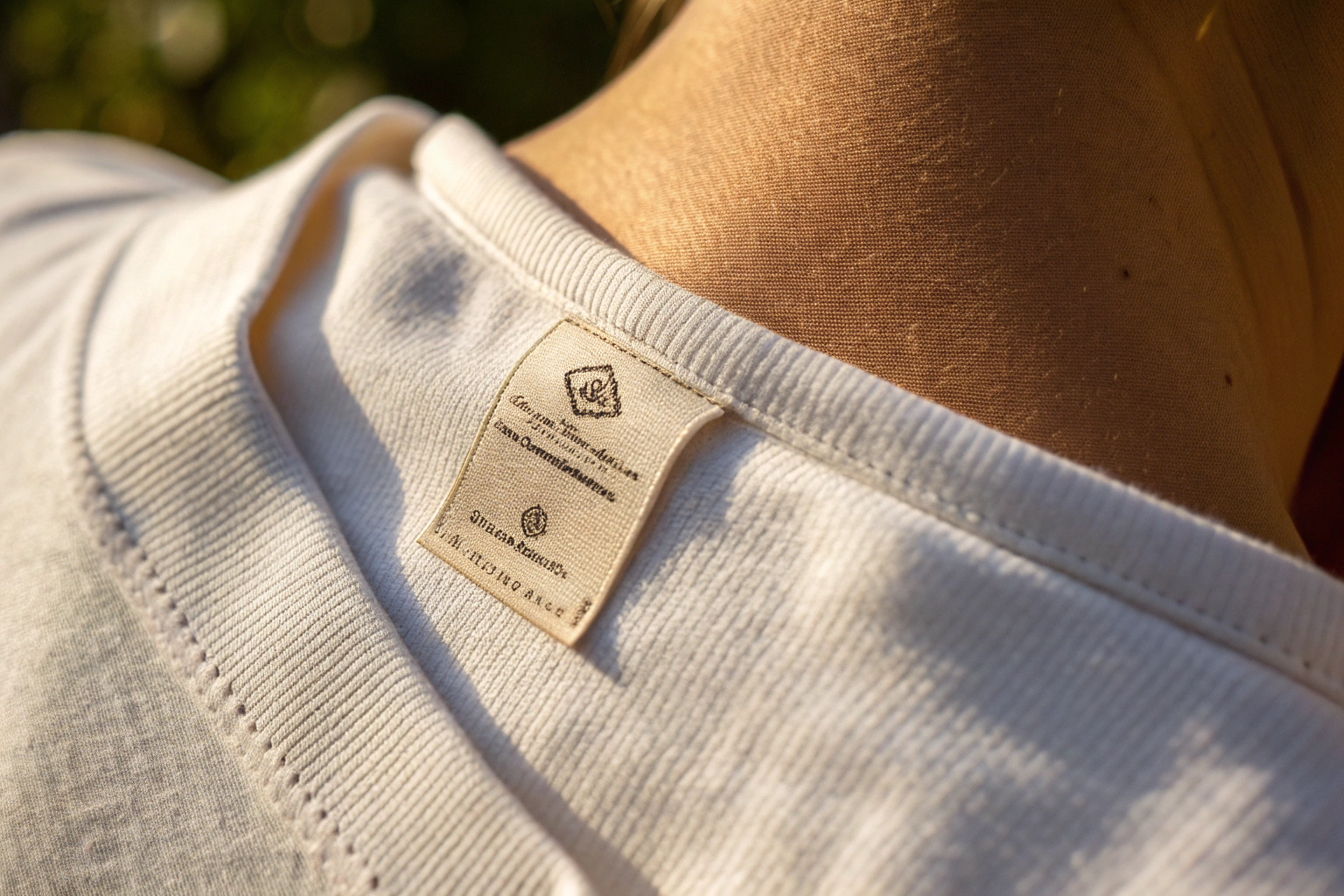
Most brand owners spend months agonizing over the fabric, the fit, and the stitching. Then, at the last minute, they sew in a generic, scratchy polyester label that screams "fast fashion." That label is the very first thing a customer touches when they try on your garment. It sits against the back of their neck. It’s a physical, constant reminder of your brand. A cheap label doesn’t just feel bad. It subconsciously devalues everything around it. The customer’s brain registers the scratchy edge and thinks, "This feels like a $20 shirt," even if the fabric itself is our premium $8-per-yard ring-spun cotton linen. The pain point is that a bad label is a silent profit killer, undermining your hard-won fabric quality in less than a second of skin contact.
Customizing a woven cotton label, using our high-quality cotton yarns and printing technologies, flips that dynamic. It turns a mandatory scratch into a brand touchpoint that feels intentional, soft, and premium. When a customer lifts the collar of your garment and feels a pliable, smooth cotton label, their sensory brain says "luxury" before their logical brain even reads the brand name. This isn’t just branding; it’s tactile psychology. The label becomes proof that you care about every single detail, down to the fiber that touches their skin. At Shanghai Fumao, we’ve helped hundreds of brands upgrade their label programs, and I’ve seen this single change increase a garment’s perceived retail value by 10% to 15% without any other alteration to the design. The label is the smallest investment with the highest return in the entire garment production process.
I want to walk you through why this works, how you can use our custom label service to build an instantly recognizable brand asset, and why the smartest brands are moving away from polyester and back to cotton for their branding. Think of it this way: you wouldn’t put a plastic frame on an oil painting. So why would you put a polyester label on a premium natural-fiber garment?
Why Does a Scratchy Label Devalue Your Premium Cotton Linen Garment?
Your brand is not just your logo. Your brand is the sum of every sensory interaction a customer has with your product. And the back-neck label is the most intimate, unavoidable touchpoint you have. It’s a physical object that literally rubs against the customer’s skin all day. If that object is a sharp-edged, heat-transfer printed piece of polyester, you’re sending a subconscious message that you prioritized cost over comfort. The customer may never articulate "I hate this label," but they will feel vaguely annoyed every time they wear the garment. They’ll associate that irritation with your brand name.
Polyester labels are cheap. I understand why mass-market brands use them. They cost a fraction of a cent per unit. But they are a false economy for a premium garment. They curl at the edges after the first wash. The print fades. They don’t absorb dye the same way the garment fabric does, so they often stand out as a slightly off-color patch. Most critically, they trap heat. A polyester label against the neck doesn’t breathe. In a cotton-linen summer dress, which the customer bought specifically for breathability, a sweaty, sticky polyester label is a betrayal of the fabric’s core promise.
When you upgrade to a soft, woven cotton label, you align the label’s performance with the fabric’s performance. The cotton label breathes. It absorbs moisture. It softens further with each wash. It dyes beautifully to match the garment color. It becomes a seamless part of the garment experience, not an irritating afterthought. This alignment creates a "halo effect." The customer’s positive sensory experience with the label radiates outward, enhancing their perception of the entire garment and the brand it represents.

How Does the "First Touch" Psychology of a Label Affect Purchase Decisions?
In retail, the first touch is a conversion event. A customer browsing a boutique picks up your cotton-linen blazer. They run their fingers over the collar. If the first thing they feel is a soft, textured, obviously natural woven label, their brain releases a micro-dose of dopamine. "Ooh, that’s nice," they think. They’ve just formed a positive, pre-verbal association with your garment. If the first thing they feel is a scratchy, plastic-y tag, their brain recoils slightly. "Ugh." That micro-rejection is almost impossible to overcome, even if the rest of the garment is beautiful.
This phenomenon is well-documented in sensory marketing research. Consumers associate tactile softness with quality, care, and luxury. A soft label signals that the brand is thoughtful, that they’ve considered the wearer’s comfort down to the smallest detail. It creates an immediate perception of higher value. That perception directly supports a higher retail price point. The customer who says "ooh" at the label is far more likely to accept a $148 price tag than the customer who says "ugh."
For online retailers, this "first touch" happens in the customer’s home, not in the store. It’s the unboxing moment. The customer pulls the garment out of the packaging, turns it over to look at the size, and their fingers find the label. If it’s a beautiful, branded, soft cotton label, the unboxing experience is elevated. They’re more likely to leave a five-star review, mention the "attention to detail," and post a photo that shows the label. If it’s a scratchy tag, they might keep the garment, but the magic of the unboxing is diminished. The word "luxury" is built on a thousand tiny sensory decisions. The label is one of the tiniest, and one of the most powerful. A fascinating read on how tactile marketing and sensory branding influence consumer product quality perceptions in fashion explains the neuroscience behind why touch drives purchase decisions more reliably than visual cues.
Why Do Polyester Labels Clash with a "Natural Fiber" Brand Story?
You’ve built your brand story around natural fibers. Your website copy talks about breathable cotton, sustainable flax, and the beauty of natural slubs. Your Instagram posts show sun-drenched fields of cotton. Your customer bought from you because they want to escape the plastic-based, synthetic world of fast fashion. And then they turn over the collar and find a shiny, synthetic, petroleum-derived polyester label rubbing against their skin. That’s brand dissonance. It’s a broken promise.
The modern consumer, especially the premium eco-conscious segment, reads labels. They check fiber content. They look for OEKO-TEX certifications. If your main fabric label itself is 100% polyester, a skeptical customer will notice. It feels like greenwashing. It undermines the authenticity of your entire natural-fiber narrative. A cotton label, by contrast, completes the story. It’s a proof point that your commitment to natural materials extends to every component of the garment, not just the visible fabric.
I’ve seen this play out with a client from Copenhagen in 2024. She runs a small, fiercely sustainable brand. Her entire marketing is built on "100% biodegradable clothing." She used our organic cotton linen for her dresses. But for the first production run, she used standard polyester labels to save cost. A customer—a single customer—posted a review pointing out the plastic label on a "biodegradable" dress. The review went semi-viral in sustainable fashion circles. She was mortified. For her second run, we produced custom organic cotton labels for her, and she made a whole marketing moment out of "fixing our last piece of plastic." Her customer loyalty actually increased because she showed she listened and she cared. The cotton label became a redemption story. That’s the power of alignment between your materials and your messaging.
How Can a Custom Woven Label Become a Recognizable Brand Asset?
A custom woven cotton label is not an expense. It’s an investment in a miniature billboard that advertises your brand every single time the garment is worn, washed, hung, or resold. Think about the lifecycle of your garment. It hangs in the customer’s closet, label visible. It’s tossed on a chair, label peeking out. It’s hung on a hook at the gym, label showing. It’s photographed for a resale app like Depop or Poshmark, label prominently displayed as proof of authenticity. Your custom label is doing marketing work for you, silently, for years after the initial sale.
The key to turning a label into a true brand asset is consistency and distinctiveness. Your woven label should be instantly recognizable, even without reading the text. This means investing in a specific color palette, a specific texture, and a specific shape that becomes synonymous with your brand. Some of the most iconic brands in the world have labels that are as famous as their logos. A plain, generic label is a missed opportunity. A thoughtfully designed, beautifully woven cotton label is a signature that builds brand equity with every wash cycle.
At Shanghai Fumao, we use high-density damask weaving technology to produce labels with incredibly fine detail. Your logo, no matter how intricate, can be rendered in soft, breathable cotton thread. We can match the label’s background color to your garment’s exact shade, creating a "tonal" label that blends in subtly, or we can create a high-contrast label that pops. We can weave in metallic threads for a touch of luxury, or we can keep it pure matte cotton for a minimalist, organic aesthetic. The design possibilities are vast, and the cost, amortized across a production run, is measured in cents per unit. This is not a major line item. It’s a major brand investment at a micro cost.

How Can You Use "Care Labels" as a Subtle Marketing Touchpoint?
The care label is the most underrated piece of real estate in your garment. Every customer has to touch it to find out how to wash the garment. It’s a forced interaction. And yet, most brands fill this space with a generic, ugly, satin-printed label that screams "I bought this in bulk from a label supplier." A custom care label, woven from soft cotton and designed with your brand’s typography, turns that forced interaction into a positive brand moment.
Instead of just the legal washing symbols, you can weave in a small brand message. "Wash cold, wear often, love always." "Made slowly with care." "This garment is 100% biodegradable—wash gently." These tiny micro-copy moments delight the customer. They signal that your brand has personality and that you’re thinking about the entire user experience. It’s the physical equivalent of a witty 404 page on a website. It doesn’t cost extra, but it creates a memorable touchpoint.
You can also use the care label to tell your supply chain story. "Cut and sewn in Los Angeles. Fabric woven in Keqiao by Shanghai Fumao." This transparency is a powerful trust-builder. It answers the questions that conscious consumers are asking. It also creates a direct link back to the fabric’s origin, which, if they research us, reinforces the premium quality of the raw material. I’ve seen brands do this brilliantly, using the care label as a miniature "about us" page for the garment. A brand strategy blog on how to use garment care labels as a storytelling and brand loyalty tool offers excellent examples of this micro-marketing technique in action.
Why Do Tonal Matching and Texture Contrast Make a Label Feel Expensive?
Luxury is in the details that feel unnecessary. A tonal label—one where the label’s background color exactly matches the garment’s body color—is a detail that requires effort. The label manufacturer has to precisely match your dye lot. The sewing team has to select the correct color-matched label for each garment variation. It’s a logistical headache for mass production. That’s precisely why high-end brands do it. The tonal label whispers, "We went to extra trouble for this detail you might not even consciously notice."
When a customer picks up a tonal cotton-linen blazer and sees that the label blends seamlessly into the collar, their subconscious registers the cohesion. The garment feels more intentional, more designed. There’s no jarring white rectangle breaking the visual harmony. This subtle cue is strongly associated with high-end designer collections. By adopting it for your brand, you borrow that luxury association at a marginal additional cost.
Texture contrast is another powerful tool. If your garment is made from a smooth, fine cotton poplin, a label with a slightly textured, slubby weave creates a delightful tactile surprise. If your garment is a heavily textured cotton-linen slub, a fine, smooth damask label offers a pleasing counterpoint. The interplay of textures adds depth and sensory richness to the garment. It makes the act of touching the label a micro-experience, rather than a utilitarian check. This is the level of detail that customers post about in reviews. "Even the label feels luxurious." That’s a direct quote I’ve seen in positive reviews, and it’s a direct driver of higher conversion rates and lower return rates.
What Are the Production Steps for Our Custom Cotton Label Service?
We’ve designed our custom label service to be as streamlined and painless as possible, because I know that for many brand owners, the label is the last thing they want to think about. They’re exhausted from sampling, fitting, and negotiating. I don’t want the label to become another source of stress. Our process is a simple four-step workflow: Design, Weave, Match, and Deliver.
Step one is Design. You send us your logo file, preferably in a vector format like AI or EPS. Our graphic team cleans up the artwork for loom compatibility—simplifying tiny details that wouldn’t reproduce well in thread, and advising on the minimum text size for legibility. We then produce a digital proof, a simulated image of how the woven label will look, including the specific thread colors and the background weave texture. You approve this digital proof, or we iterate until it’s perfect. This usually takes 2-3 working days.
Step two is Weave. Once the design is approved, our partner label weaving facility—which we’ve worked with for over a decade—programs the Jacquard loom with your design file. The loom weaves your labels on a continuous ribbon of fine cotton thread. We use high-tenacity, long-staple cotton yarns specifically engineered for label weaving, ensuring the labels are soft, durable, and won’t fray or distort after repeated washing. The weaving process for a custom label order typically takes 10-14 working days, depending on the complexity of the design and the order volume.
Step three is Match. If you’ve ordered tonal labels that match your garment’s specific color, our dye lab does a precise color-matching process. We take a swatch of your garment fabric, and we dye the cotton yarn for the label background to match it exactly. This is the same CNAS-certified color-matching technology we use for our bulk fabric dyeing, ensuring a perfect, consistent match across your entire production run. Step four is Deliver. The finished labels are cut, folded to your specification, and shipped directly to your cutting-and-sewing facility, wherever that is in the world. The entire process, from design approval to label delivery, takes approximately 3-4 weeks. We coordinate the logistics so the labels arrive before your production run begins, eliminating a common bottleneck.

How Do We Color-Match Your Label to Your Exact Garment Dye Lot?
Color inconsistency between the label and the garment is a tell-tale sign of a cheap product. You see it often: a bright white label sewn into a cream-colored blouse. It looks like an afterthought, a generic piece of trim that doesn’t belong. Eliminating this visual disconnect is one of the highest-impact things you can do to elevate your product’s perceived quality. Our color-matching process ensures your label and your garment are in perfect chromatic harmony.
The process begins with a submission. You send us a physical swatch of your final, approved bulk fabric. This is critical. The swatch must come from the bulk production lot, not the initial sample yardage, because dye lots can vary slightly. Our lab receives the fabric swatch, and our colorist uses a spectrophotometer to precisely measure the fabric’s color. This device quantifies color as a set of numerical coordinates on the Lab* color space—a precise, objective "fingerprint" of the shade.
The colorist then formulates a dye recipe for the cotton label yarn that will match that exact Lab coordinate. We dye a small test batch of yarn, weave a sample label, and compare it to your fabric swatch under a standardized D65 daylight-simulating light booth. We check the match from multiple angles, because color can appear to shift under different lighting conditions—a phenomenon called metamerism. We ensure the match is consistent across at least three different light sources. Only when our colorist signs off on the match do we proceed to bulk yarn dyeing and label weaving. This rigorous process is the same one we use for our bulk fabric dyeing, and it guarantees that your label won’t look like an "off" patch on your beautiful garment. A technical resource on how spectrophotometer-based color matching works in textile trim production* explains the science behind this process in accessible detail.
What File Formats and Minimum Text Sizes Ensure a Sharp Woven Logo?
A logo that looks crisp on a screen doesn’t always translate to a woven label. Woven labels are created with physical threads, not pixels. There’s a minimum resolution, a minimum detail size, that the loom can physically produce. Submitting the wrong file format or designing text that’s too small to weave cleanly is the most common hiccup that delays label production. Getting this right from the start saves you weeks of back-and-forth.
The ideal file format for your logo artwork is a vector file: .AI (Adobe Illustrator), .EPS, or .SVG. Vector files are mathematically defined by paths, not pixels. They can be scaled infinitely without losing sharpness, and our loom programming software can read these paths directly to generate the weaving pattern. If you only have a raster file (.PNG or .JPEG), we can work with it, but the quality of the final woven label will be limited by the resolution of the original image. A 300 DPI or higher resolution is essential for raster files.
Regarding text size, the rule of thumb is that the minimum height of any letter in the woven design should be 1.5mm for uppercase letters and 2.0mm for lowercase letters. If you try to weave letters smaller than this, the individual threads can’t form a clear, legible shape. The text will look like a blurry blob. Our design team will flag any text that falls below this threshold during the proofing stage, but it’s helpful if you consider this when designing your label. Serif fonts with very thin strokes are also problematic for weaving; they tend to break up visually. We generally recommend sans-serif or slab-serif fonts for the cleanest woven result. A practical design guide for preparing logo artwork for woven garment label production provides detailed specifications and visual examples of what works and what doesn’t on a Jacquard loom.
How Can You Test and Iterate Your Label Designs for Maximum Impact?
You wouldn’t go into full production on a garment without making and approving a sample. The same discipline must apply to your labels. Ordering 5,000 custom cotton labels based solely on a digital mock-up is a gamble. The digital proof shows you color and layout, but it cannot convey the tactile softness, the precise woven texture, or the subtle way the label interacts with your specific fabric. Before you commit to a bulk label order, you need to run a physical strike-off.
A strike-off is a small, pre-production sample of your label design, woven on the same Jacquard loom with the same cotton yarns that will be used for the bulk order. It is a physical, tangible, sew-able proof. We always recommend clients order a strike-off set before approving bulk production. This allows you to sew the sample label into your actual garment sample, wash it through a few laundry cycles, and see how it performs. Does the color hold? Does the texture soften nicely? Does the label curl at the edges? How does it feel against the skin after washing? These are questions a digital mock-up can never answer.
We also encourage A/B testing. Order strike-offs of two or three design variations. Maybe one version is tonal, one is a contrasting color. Maybe one has your full logo, one just has an icon. Sew each version into a sample garment. Then, do a sensory test. Hand the garments to friends, family, or trusted customers. Ask them, without prompting, to comment on the garment. See which label gets positive comments, and which goes unmentioned. The best label often isn’t the loudest; it’s the one that feels the most integrated and premium. This small investment in testing can prevent a costly bulk order of labels that look fine on paper but don’t work in the real world. It’s the same "sample before bulk" principle we apply to our fabrics, and it’s just as important for your branding.

How Do You Conduct a Wash Test on Your Custom Label Before Full Production?
A label that looks beautiful on day one but frays, fades, or shrinks after five washes is a liability, not an asset. The customer will associate that degradation with your brand’s overall quality. A wash test is the only way to guarantee your label’s long-term performance. We conduct standard wash tests in our CNAS lab, but you should also run your own real-world test to see how the label behaves with your specific garment construction and your customer’s likely laundry habits.
The protocol is simple. Sew your strike-off label into a sample of your actual garment fabric. Turn it into a small swatch assembly. Wash it in a domestic washing machine on the warmest cycle your care label will recommend. Tumble dry it on medium heat. Repeat this cycle five times. After each cycle, inspect the label. Check the edges for fraying or curling. Check the color against an unwashed control sample for fading. Check the weave for any pulled threads or distortion. Measure the label’s dimensions to see if the cotton has shrunk at a different rate than the garment fabric, which can cause puckering at the seam.
A passing label will show minimal to no color fading, no edge fraying, and no dimensional change that causes visible puckering. If the label fails the wash test, we need to adjust the yarn type, the weave density, or the dyeing process before bulk production. It’s far better to discover this on a strike-off than on 5,000 labels already sewn into finished garments. A textile testing guide on how to perform AATCC standard wash tests on garment labels and trims for small fashion brands outlines the professional protocol that you can easily simulate at home or in your studio.
Why Should You Order a "Strike-Off" Sample Set Before Committing?
Beyond the wash test, a strike-off sample set allows you to evaluate the label’s aesthetic and functional integration with your garment. You can sew the strike-off into different areas—the back neck, the side seam, the hem—and see how the label drapes and feels in each location. A label that feels soft at the back neck might feel bulky and annoying if sewn into a side seam. You won’t know this from a digital mock-up.
The strike-off is also your final opportunity to tweak the design. Perhaps the logo is slightly too large and dominates the collar, or slightly too small and feels insignificant. Maybe the thread color, which looked perfect on the computer screen, has a slightly warmer tone in physical cotton and needs a cooler adjustment. These are small tweaks, but they make the difference between a label that looks "good" and one that looks "intentionally designed."
We treat the strike-off process as a collaborative refinement stage. Our clients often send us photos of the strike-off sewn into their sample garment, with notes like, "Can we reduce the overall height by 2mm?" or "Can we soften the background color by 5%?" We make these adjustments and produce a revised strike-off for final approval. Only when the client is completely satisfied with the physical, in-garment sample do we trigger the bulk production. This iterative process adds a week or two to the timeline, but it eliminates the risk of a costly, brand-damaging error. It’s a discipline that professional buyers and experienced brand owners insist upon, and it’s one of the services that sets Shanghai Fumao apart from mass-market label suppliers.
Conclusion
Customizing your cotton labels with Fumao Fabric is one of the highest-return, lowest-risk investments you can make in your brand’s perceived value. A soft, color-matched, beautifully woven cotton label transforms a mandatory scratch into a premium sensory experience that aligns perfectly with the natural quality of your cotton linen garment. It tells your customer, at the very first touch, that your brand cares about every fiber, every seam, and every detail.
The label is a miniature billboard that works silently for years, advertising your brand’s commitment to quality in every closet, every fitting room, and every resale listing. And with our streamlined design, color-matching, weaving, and testing processes, creating that perfect label is not a logistical nightmare. It’s a straightforward, collaborative process that we’ve refined over two decades of working with brands who demand excellence.
Don’t let a scratchy, generic polyester label be the weak link in your premium garment chain. If you want to feel the difference a custom cotton label makes, reach out to our Business Director, Elaine. She’ll send you a sample pack of our label strike-offs, showing different weave textures, tonal match examples, and the full range of customization options. You can sew them into your own samples and experience the "first touch" transformation for yourself. Email elaine@fumaoclothing.com and put "Custom Label Strike-Off Request" in the subject line. Let’s finish your garments with the detail they deserve.








