I’ve seen too many brand owners leave money on the table simply because they’re afraid to price their products correctly. You import a premium cotton linen fabric from China, you pour your heart into the design, and then you slap on a timid 2.5x markup because you think the market won’t bear more. Meanwhile, a competitor down the street uses a slightly nicer photo and a better brand story, and they sell the same quality fabric at a 6x markup. The pain here isn’t the cost of goods; it’s the fear of rejection. You’re literally pricing your own insecurity into every garment, and it eats your margin alive before you even launch.
The honest answer is that with our good cotton linen, you can comfortably target a retail markup between 3.5x and 6x the landed cost, depending on your brand positioning and sales channel. This isn’t a random guess. This is the standard keystone-plus model that successful American boutique brands use. If a shirt costs you $18 landed, you shouldn’t be selling it for $45. You should be aiming for $68 to $108. The reason you can achieve this is that our fabric carries the hand-feel, drape, and narrative depth of a European import at a direct-from-mill price that creates a massive value gap. You capture that gap as profit.
I’ve been shipping fabric to the US market for two decades, and I’ve watched hundreds of brands scale. The ones who win are the ones who understand that fabric cost is not the ceiling of your price; it’s the foundation of your value story. Think of our cotton linen as a high-performance engine. A cheap chassis can’t justify it, but a well-designed body can command supercar prices. Let me show you exactly how to calculate your true landed cost, position your brand for luxury margins, and avoid the psychological traps that force you to price too low.
What Is the True Landed Cost of Premium Cotton Linen from China?
Before you can even think about markup, you have to stop lying to yourself about what your fabric actually costs. I don’t mean the price I quote you per yard. I mean the total amount of money that leaves your bank account before a single roll sits in your New Jersey or Los Angeles warehouse, ready to be cut. The most common mistake I see from American startups is they calculate their margin based on the FOB price. That’s a dangerous fantasy. The true landed cost includes the fabric, the freight, the duty, the insurance, and even the wire transfer fee.
I always tell my clients to build a "bottom-up" cost sheet, not a top-down one. Start with my price for the greige or finished fabric. Let’s say it’s $4.80 per meter for a premium ring-spun cotton linen. Then you add the ocean freight. If you’re shipping a full container, that might be $0.15 per meter. But if you’re shipping a smaller LCL (less than container load) shipment, it could jump to $0.50. Then you add the US import duty. For cotton-linen blends, this can get tricky, but a good customs broker will classify it for you. Then you add the trucking from the port to your warehouse. Suddenly, that $4.80 fabric is $5.80. If you price your retail markup on $4.80 but your real cost is $5.80, you just lost 20% of your margin before you even sold a shirt. We handle a lot of this complexity on our end through our logistics team, but you need to be aware of every single line item.

How Do You Calculate Fabric Duty and Freight Surcharges Accurately?
US import duties are a maze, but you can’t just guess. If you guess too low, customs hits you with a bill you didn’t budget for. If you guess too high, you think the fabric is too expensive and you walk away from a great deal. The Harmonized Tariff Schedule (HTS) code is your best friend here. For a woven cotton-linen blend, the classification depends on which fiber dominates by weight. If it’s 55% linen and 45% cotton, the duty rate is often different than if it’s 70% cotton and 30% linen. You have to look at Chapter 53 of the HTS for linen and Chapter 52 for cotton.
Here’s a real-world example from one of my LA-based clients. In November 2024, he imported a 50/50 cotton-linen woven fabric for shirts. His customs broker initially classified it under a cotton heading with a 14.9% duty rate. I asked him to double-check with a textile-specific customs specialist because the linen gave the fabric its essential character. They reclassified it under a different subheading with a much lower rate. We saved him $2,800 on that single shipment. This isn’t just about saving money; it directly impacts your landed cost and therefore your markup calculation.
You also need to factor in the freight surcharges that nobody talks about. The ocean freight rate you see on the index is just the base. There’s a Bunker Adjustment Factor (BAF) for fuel, a Currency Adjustment Factor (CAF), and during the peak August-to-October season, a Peak Season Surcharge (PSS) that can add $300 to $600 per container. I always tell my clients to build a 15% buffer into their freight estimate. Our shipping department provides a door-to-door estimate that already includes these variables because we use Keqiao’s multimodal hubs to optimize routes. For a deep dive into the exact rates for textile blends, you can check this resource explaining how to use the USITC HTS database to find exact duty rates for textile imports, which every importer should bookmark. Furthermore, if you are new to the logistics side, a practical guide from a freight forwarding forum on calculating true LCL freight costs from Shanghai to US warehouses will open your eyes to the hidden charges.
Why Must You Include Sampling and Defect Allowance in Your COGS?
This is an invisible cost that the accounting textbooks don’t teach you about fashion. You don’t just pay for the 1,000 meters of bulk fabric. Before that, you paid for the lab dips. You paid for the sampling yardage. You paid for the strike-off approvals. You paid for the courier to send those samples back and forth three times. If you amortize these sampling costs over a small production run of 300 shirts, they add a shocking $1.50 per unit to your Cost of Goods Sold (COGS). Ignore this, and your unit economics are a lie.
Then comes the defect allowance. In textile manufacturing, "zero defect" is the goal, but a realistic standard is a 97% to 98% first-quality yield. At Shanghai Fumao, our CNAS-certified inspection factory ensures we hit at least a 98% A-grade rate, which is industry-leading. But you still need to plan for that 2%. You can’t sell a shirt with a weaving fault on the chest. So you need to order 2% to 3% more fabric upfront, or you need to accept that 2 out of every 100 shirts you cut will end up as a rag. That cost of wasted cutting, sewing labor, and trim must be absorbed by the successful 98 shirts that you do sell. This "waste factor" effectively increases the cost of each good shirt.
I learned this lesson the hard way with a startup client in 2022. He calculated his margin to the exact penny and left no room for sampling or defects. His first batch had a 4% defect rate from a cutting error in his own factory, and his entire profit vanished. He called me in a panic, but it was too late for that order. Now, for every new brand I work with, I force them to create a "fully burdened" COGS. I tell them, "Take the fabric cost per shirt, add the freight, add the duty, then add $2.00 for the hidden gremlins of sampling and waste." Only then do you have a real number to apply your markup to. This method is often discussed in detail in threads on how to calculate true COGS for a small fashion brand to avoid cash flow crises, and I can vouch that it’s the only honest way to do business.
How Should You Position Cotton Linen to Capture Luxury Markups?
You can’t charge $200 for a shirt if you just say "it’s good fabric." That’s like selling a "fast car" without mentioning the V8 engine or the carbon-fiber body. You have to translate our material specifications into an emotional and functional value that the American consumer is already searching for. The US market is currently obsessed with "quiet luxury," "slow fashion," and "natural fibers." Our cotton linen sits at the perfect intersection of these trends. It breathes naturally, it has a distinctive natural slub texture, and it wrinkles in that intentional, "I’m on vacation in the Hamptons" kind of way that signals authenticity.
The positioning strategy is to move the conversation away from "clothing" and toward "lifestyle." You’re not selling a jacket. You’re selling a garment that replaces air conditioning on a humid New York summer day. You’re selling the peace of mind of wearing a biodegradable, sustainable fabric instead of a micro-plastic shedding synthetic. This allows you to escape the price-comparison trap of fast fashion. When you buy fabric from Shanghai Fumao, you’re not buying a commodity. You’re buying a 20-year supply chain legacy, a specific ring-spinning technology, and a lab-tested consistency that allows you to confidently tell that luxury story without worrying about a customer complaint ruining the narrative.

How Can You Build a Brand Story That Justifies a 6x Markup on Linen?
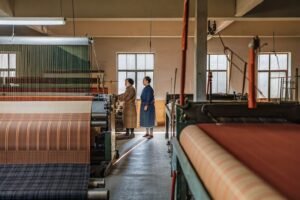
A 6x markup isn’t greedy; it’s a necessary margin for a brand that wants to do wholesale, run a beautiful website, and pay for professional photography. But to get it, you need a story that makes the customer feel smart for buying it, not just rich. You have to let them peek behind the curtain. You can show a photo of our weaving floor in Keqiao. You can talk about how we use long-staple fibers and ring-spinning to create a fabric that softens with age instead of degrading. This isn’t just marketing fluff; it’s a genuine technical advantage that a polyester blend from a fast-fashion mall brand can never claim.
I worked with a small direct-to-consumer brand from Portland in late 2023. She was designing a capsule collection of "heirloom loungewear" using our 100% linen and cotton-linen blends. Instead of just putting up a product photo, she created a short video explaining the yarn structure. She showed our QR code system on the fabric roll and told her customers, "This is the exact test report for the fabric in your pajama set." She framed it as radical transparency. The result? She sold her linen sets at $245, a 7x markup on the landed fabric cost, and her customers actually thanked her for the education. She didn’t just sell pajamas; she sold intellectual satisfaction. This is the power of letting the fabric’s origin be the hero. If you need inspiration, a popular case study on how a DTC brand used supply chain transparency to justify premium markups in 2025 shows exactly this model in action. It proves that customers pay for honesty as much as they pay for quality.
Which Luxury Consumer Segments Are Paying Premiums for Natural Linen Right Now?
You need to know exactly who you’re talking to before you set that price. The generic "25-45 year old woman" is not a customer profile; it’s a census statistic. For premium cotton linen, your money is in three specific psychographic segments. First, the "Sustainability Purists." These are consumers who have already ditched fast fashion. They read labels. They know the difference between linen and viscose. They want certifications, but more importantly, they want traceability. They will pay a premium for our fabric because we can provide the GOTS certification for the organic cotton component and the recycled water certificates for our dyeing processes.
Second is the "Sensory Minimalist." This customer is less about the eco-activism and more about the feeling. They are the ones decluttering their homes Marie Kondo style and wearing neutral, monochrome outfits. They want fabrics that feel substantial but calm. The cool, dry, slightly crisp touch of a freshly ironed linen shirt is a sensory signal of control and simplicity for them. They will pay a high price for "the perfect white linen shirt" because they plan to wear it twice a week for the next five years. They aren’t buying fashion; they’re buying a uniform.
Third, and this is the fastest-growing segment, is the "Hyper-Local American Revivalist." This customer wants American-designed goods but is realistic about manufacturing. They value brands that say "Designed in New York, Crafted with Premium Japanese/Italian/French Fabrics." A Chinese origin sometimes needs a bit of narrative framing here—and that’s fine. You focus on the fiber origin (e.g., "North European flax") and the technology (e.g., "Japanese ring-spinning technology"). The actual cut-and-sew can be done in the USA or a high-trust factory you partner with. By slapping "Made in USA" on a garment made with our technically superior Chinese fabric, you bridge the patriotic buying preference with the reality of global textile excellence. An interesting article on how American apparel brands are blending domestic manufacturing with Asian fabric sourcing for luxury collections reveals that this hybrid model is currently the sweet spot for profitability in the premium market.
What Pricing Psychology Tricks Work Best for Cotton Linen Products?
Setting a price is not a math problem; it’s a brain hack. Once you have your fully burdened COGS from me, you need to present that price in a way that short-circuits the customer’s logical resistance and triggers their desire. The human brain doesn’t calculate value objectively. It uses anchors. If you walk into a store and see a $500 suit next to a $200 suit, the $200 suit looks like a bargain. But if you see the $200 suit next to a $50 suit, it looks like a luxury item. The number you choose for your cotton linen collection has to be anchored against high-end competitors, not against the cheap stuff on Amazon.
We learned this by observing how our most successful European buyers sell our fabrics. They never put the price first. They lead with the feel. They put the garment in the customer’s hands and only reveal the price after the customer has already experienced the cool, soft drape of the linen. Once the customer’s limbic brain has decided "this feels expensive," the rational brain works backward to justify the price, no matter what number you say. If you’re selling online, you must simulate this hand-feel experience through extremely high-resolution macro photography that shows the fabric’s crisp texture and the subtle sheen of the ring-spun fibers. I tell my clients to invest $500 in a macro lens before they invest a single dollar in Facebook ads. A fuzzy photo makes our premium linen look like burlap; a sharp photo makes it look like silk.

How Can “Charm Pricing” and Anchoring Increase Your Cotton Linen Sales?
"Charm pricing" is that thing where you price something at $99 instead of $100. I used to think it was stupid. But the data doesn’t lie. In the US market, a $99.99 price tag for a linen dress signals a "deal" even if it’s only one cent cheaper than $100. However, for the luxury segments that our fabric targets, you need a modified approach. I call it "prestige charm pricing." If you are targeting the Sensory Minimalist, do not use .99. Use whole numbers. Price the item at $195, not $194.99. Whole numbers signal quality and transparency. They suggest you are a designer, not a discounter.
Anchoring is an even more powerful tool. Let’s say you design a beautiful, heavy cotton-linen blazer. That’s your hero piece. You need to create a "decoy" product in your line—maybe a dress in the same fabric but with a simpler construction. Price the blazer at $295 and the dress at $185. The customer sees the $295 anchor first. When they scroll and see the dress for $185, their brain perceives it as a relative bargain, even if the dress still carries a 5x markup on its own. You are guiding their perception of value within your own ecosystem.
I had a client in Chicago in early 2024 who was struggling to sell his linen trousers at $165. He was pricing them at $165.00. I told him to add a simple linen vest to the collection and price it at $195, and change the trouser price to $165.00 but display it next to the vest. Suddenly, the trousers seemed like the "smart" buy. His sell-through rate on the trousers increased by 30% without a single discount. It’s a simple psychological reframe, and it works brilliantly with a fabric that has such a tangible, quality feel. If you want to dive deeper, there’s a great scientific summary of anchoring effects in apparel pricing on consumer behavior studies, which explains why context is more important than the cost base. Also, many successful boutique owners share their pricing split-tests on a forum discussing charm pricing versus round number strategies for high-end womenswear brands; the consensus is that round numbers win for fabrics you can feel.
Why Does Scarcity Messaging Work So Well with Seasonal Linen Collections?
Linen is a seasonal fabric, and that is a feature, not a bug. You must use the calendar to create urgency. Cotton linen has a natural peak season in the American market from April to July. If you have a beautiful collection, you should absolutely not keep it in stock permanently. You do a limited drop. You say, "This fabric was sourced from a single batch from our mill in Keqiao. Once it’s gone, it’s gone until next summer." This isn’t even a lie; it’s the reality of working with a natural, seasonal fiber.
Scarcity messaging works because it triggers a fear of missing out (FOMO). A customer who thinks, "I’ll wait for a sale," will not wait if they believe the item will vanish forever. I’ve seen this with our production cycles directly. When the Chinese Golden Week or Chinese New Year shuts down the mills for weeks, as your background knowledge highlights, it creates a genuine production gap. A smart brand emails its list and says, "The mill is closing for the holidays. This is the last shipment until the fall. Shop now." It’s authentic scarcity, and it sells out inventory at full price.
Furthermore, because we work with small-batch customization at Shanghai Fumao, you can literally create micro-collections. You don’t need to buy 5,000 meters of one fabric. You can buy 500 meters of a unique, custom-dyed cotton linen color. It’s a limited edition by definition. The customer knows they won’t see everyone else in the office wearing the same dress. This exclusivity allows you to hold firm on your price. You never have to discount. I always tell my brands: "Sell it out, don’t sell it off." A sold-out collection at a 6x markup is a success story. A stockroom full of discounted goods at a 2x markup is a bankruptcy waiting to happen. Scarcity is the cure for the discount addiction. It’s a principle widely echoed in a Lean luxury supply chain guide on using small-batch production to maintain pricing power, which confirms that artificial or natural scarcity is the only reliable defense against margin erosion.
How Do You Calculate Your Ideal Retail Markup to Maximize Profit?
The math of a keystone markup is easy: cost x 2. The math of a profitable markup is harder because you need to build your own salary, your rent, and your marketing budget into the formula. I see too many direct-to-consumer brands pricing their goods like they’re a charity. They calculate the fabric cost, the cut-and-sew cost, and then just double it. They forget they need to eat. A proper retail markup in the apparel business needs to cover not just the product, but the operational cost, the selling cost, and the profit.
The standard formula we recommend our US clients to start with is the "3.5x to 4x model" for wholesale and "5x to 6x model" for direct-to-consumer. But this is an output, not an input. You start with the retail price the market will bear, and you work backward. Ask yourself: "For a beautifully tailored cotton-linen dress, using fabric with this exact hand-feel and drape, what is the most a customer would happily pay without blinking?" Let’s say that number is $220. Now work backward. If you sell DTC, your selling platform takes a cut, your ads take a cut, and your fulfillment takes a cut. Suddenly, that $220 dress needs to have a total landed cost of no more than $44 to leave you with a healthy net margin. If my fabric, the trim, and the labor cost you $38, you have a business. If the market price is $180, and your costs are $48, you don’t have a business, even if the fabric is the best in the world. The math must close.

What Is the “Keystone Plus” Model and Why Does It Work for Imported Fabrics?
The Keystone model is retail 101: you take the cost of the product and double it. If the garment costs you $30 to make, you wholesale it for $60, and the store retails it for $120. That’s the old department store math. But for a modern brand importing premium fabric from Shanghai Fumao, I strongly suggest the "Keystone Plus" model. This means you double the cost, and then you add an extra margin percentage for the "import premium."
Why? Because you took a risk. You sourced internationally. You solved the logistics puzzle. You handled the customs bond and the freight scheduling around the Chinese holidays. You curated a fabric that isn’t available on Mood Fabrics’ website. That risk and that effort deserve a return. In the "Plus" part of the model, you calculate your true landed cost, multiply by 2.2 or 2.4 to get your wholesale price, and then the retailer still applies their standard 2.5x or 3x markup to reach the final retail price. This model ensures you, the brand owner, capture the value for your sourcing acumen.
Here’s a specific breakdown. A cotton-linen blazer costs $22 in fabric, $18 in labor, and $5 in trims. Total FOB: $45. Add $5 for freight and duty. Landed cost: $50. A standard keystone would wholesale it at $100. Under "Keystone Plus," you wholesale it at $120. The $20 difference is your profit for managing the supply chain. The boutique still retails it at $300, and the consumer is happy because they’re getting a fabric that looks and feels like a $500 designer piece. This model holds up because the value of the fabric is perceived as international and exclusive. It’s not a local commodity. I have found that this model is also referenced in various business-of-fashion podcasts and an in-depth guide on keystone plus pricing for boutique fashion brands importing from Asia, which explains how to negotiate that extra margin with retailers who are used to domestic suppliers.
How Can You Use Promotions Without Destroying Your Brand’s Value with Linen?
Every time you run a "40% off" sale, you are screaming at your customer: "The real price was a lie." If you have to discount, use a strategy that protects your integrity. The first rule is: never discount the core product line in the same season. Your classic cotton-linen button-down in white and black should never be on sale during the spring season. Instead, you discount by bundling. You offer "Buy the blazer, get the trouser at 30% off." This protects the price point of the hero item while increasing the average order value. You are selling more units per transaction, which effectively gives you a higher margin per customer.
The second rule is to use off-season sales purely for inventory clearance, and frame it as a storage cost avoidance. Tell your customers, "We need to make room for the new fall wools. Our summer linens are on a rare promotion." This makes sense to a customer; it doesn’t devalue the product. It simply acknowledges that storing inventory costs money. This is also where the timelessness of our cotton linen works in your favor. A good linen fabric doesn’t look dated. If you have leftover stock from summer 2025, it will still sell in summer 2026 because the quality doesn’t degrade, and the style is classic.
I recall a client from Miami in 2023 who was addicted to flash sales. She’d release a new linen collection at full price, panic after two weeks, and blast a 30% off code to her email list. Her customers caught on and stopped buying at full price. We had a tough conversation, and she agreed to a "no discount" policy for six months. Instead, she offered a free silk scarf with every linen purchase (made from our bamboo silk, by the way). Her average order value went up, her brand image healed, and she actually increased her net margin because a $2 scrap of fabric turned into a scarf was a cheaper incentive than a $30 cash discount. It’s an excellent example of how to use gift-with-purchase strategies instead of price reductions for luxury apparel brands to maintain full-price integrity. The lesson here is clear: discount the add-on, never the hero.
Conclusion
Marking up our cotton linen isn’t just about applying a random multiplier. It’s a strategic decision that starts the moment you calculate your real landed cost, weaves through the psychology of luxury branding, and solidifies in a disciplined pricing model that refuses to discount. I’ve shown you that the gap between a timid 2x markup and a confident 6x markup is bridged not by greed, but by a deep understanding of your customer’s desire for quality, story, and exclusivity. Our fabric, with its ring-spun smoothness and certified durability, gives you the raw material for this premium story.
The math is clear: if you know your numbers, you can charge a price that makes your brand profitable from day one. You don’t have to be the cheapest option. In fact, you absolutely shouldn’t be. You have access to a fabric that can compete with the best European mills at a cost base that lets you build a healthy, sustainable business. The American market is hungry for natural, high-quality textiles, and the "Made in Italy" tax is getting old. Smart consumers are ready for value, and you can deliver it with a healthy margin.
Stop guessing what your markup should be. Send your design concepts and your volume estimates to our Business Director, Elaine. She can give you an exact FOB quote on our premium cotton linens, breaking down the freight and duty variables so you can lock in your target margin before you even make a sample. Reach out to Elaine at elaine@fumaoclothing.com and ask for a fully burdened landed cost estimate for your specific product line. Let’s build a collection that your customers will love and your accountant will thank you for.