
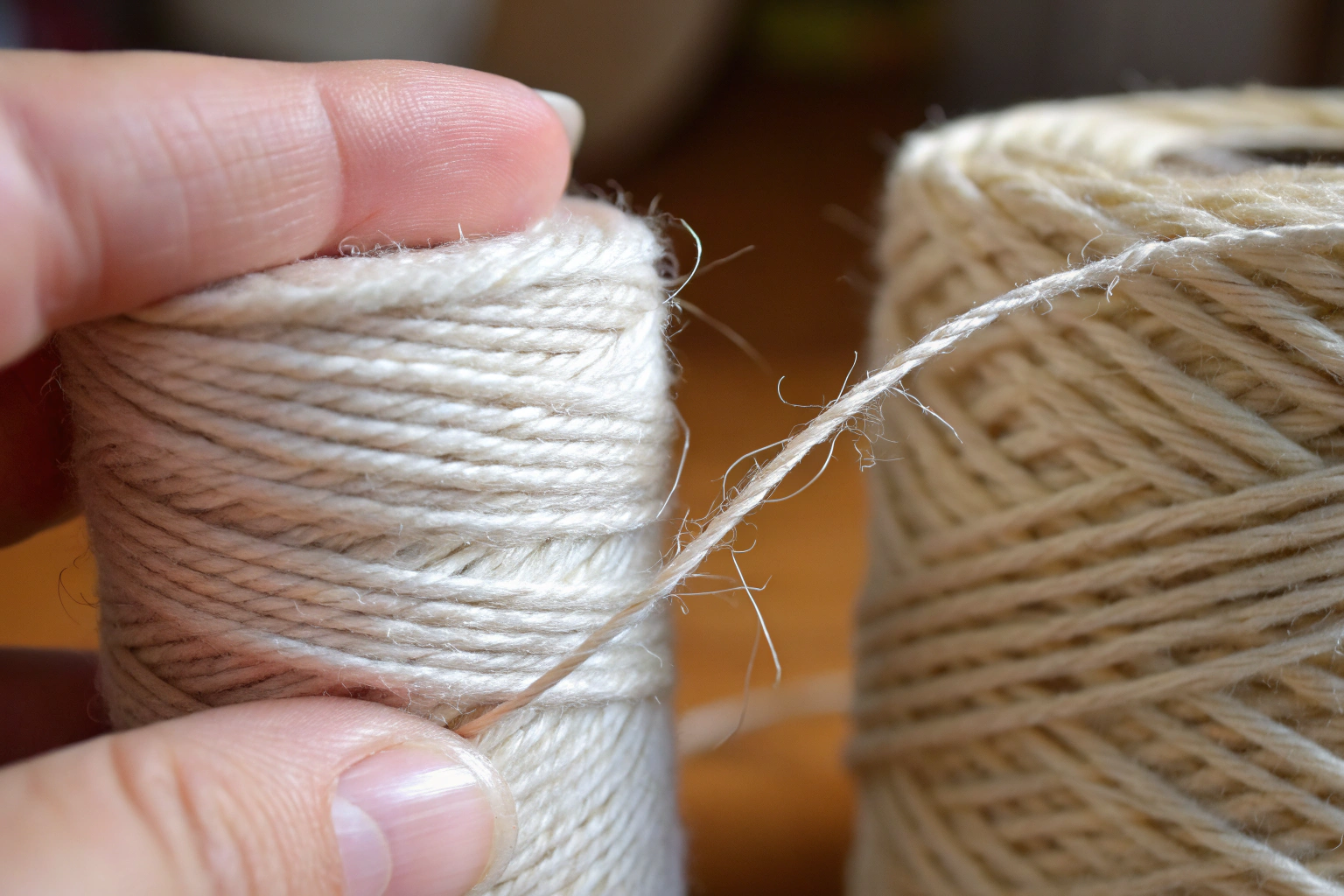
You’ve probably felt the difference without knowing what to call it. One cotton linen shirt feels like a gentle, cool breeze against your skin. The other feels like a sack of potatoes. You check the labels—both say “cotton linen blend.” Frustrating, right? This inconsistency is a massive headache for brand owners. You order a 60/40 cotton linen fabric expecting a premium, soft drape for your summer collection, and instead you get a rigid, pilling-prone material that your customers will return. The secret behind this massive quality gap is hiding inside the yarn structure itself, specifically in the spinning method. Trust me, this isn’t just textile nerd talk; it’s the single biggest factor controlling your profit margins on natural fiber garments.
The smoother, more luxurious hand-feel of our ring-spun cotton linen comes down to the physical alignment of the fibers. In ring-spinning, we twist long-staple cotton and linen fibers into a yarn where the ends are all tucked in neatly, like a perfectly braided rope. Open-end spinning, or rotor spinning, wraps shorter, wilder fibers around a core using centrifugal force, leaving countless little fiber ends sticking out. That’s the "prickliness" you feel. At Shanghai Fumao, we invest heavily in our ring-spinning partnerships precisely because we understand that European and American consumers touch a fabric before they ever look at the price tag.
I’ve been in the textile business for over twenty years here in Keqiao, and I’ve seen trends come and go. But the demand for genuine comfort? That never changes. When you source from us, you’re not just buying a GSM or a composition; you’re buying a specific spinning technology that guarantees a tactile experience. Think of it like comparing a polished granite countertop to a rough concrete block. Both are stone, but only one invites you to run your hand across it. Let me break down the mechanical wizardry behind why our ring-spun blends will elevate your brand while open-end shortcuts will cheapen it.
How Do Different Spinning Methods Define Your Fabric’s Touch?
A lot of people in our industry just throw around terms like "ring-spun" and "open-end" without actually explaining what happens inside the machines. They treat it like a buzzword. But I want you to understand this at a mechanical level because once you see how these yarns are born, you’ll never accept a poor-quality blend again. The difference starts with the raw fiber and ends with the physical laws applied to it. We use premium, long-staple fibers for our ring-spinning lines, while generic open-end processes often chew up shorter, lower-grade fibers that would otherwise be waste.
Ring-spinning is a slow, deliberate process. It mimics the ancient hand-spinning technique but does it at an industrial scale. It pulls a sliver of fibers into a fine strand, then twists it using a rotating spindle and a traveler moving around a ring. This constant, linear drafting parallelizes the fibers, causing them to overlap and lock together tightly. Open-end spinning, by contrast, is a brutalist approach to fiber assembly. It separates the fibers using an opening roller, blasts them with air, and reassembles them inside a high-speed rotor. The result is a yarn that is cheaper and faster to make, but inherently rougher because the fiber orientation is random. We control these variables in our supply chain because we know a single rogue open-end yarn in a batch of ring-spun fabric can ruin the entire feel of the garment.
What Happens to the Cotton Fiber Inside a Ring-Spinning Frame?
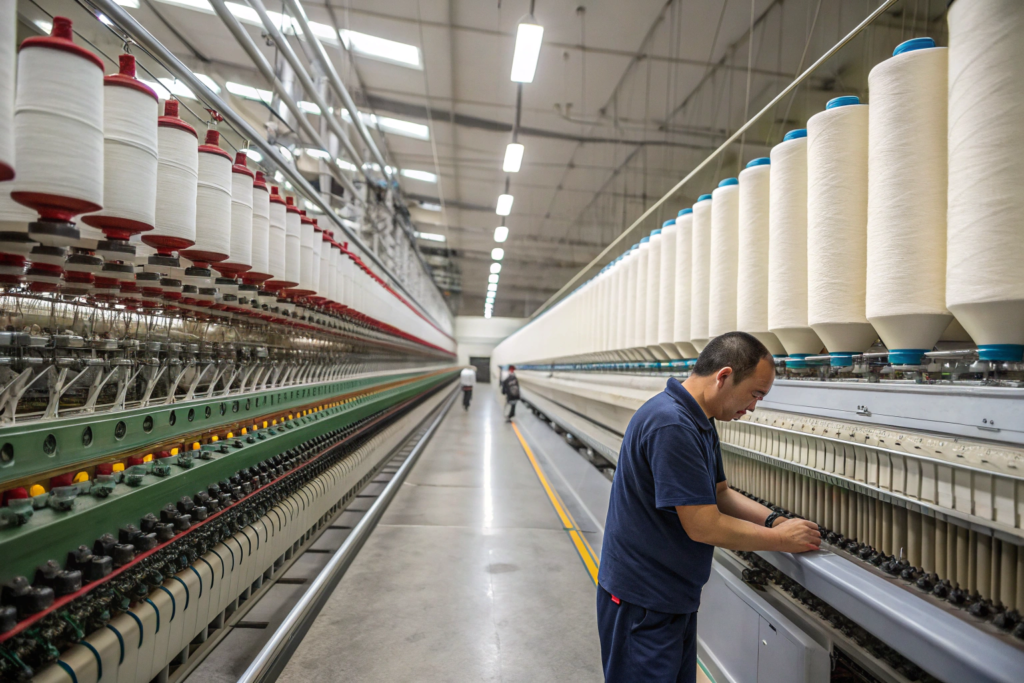
Let’s walk through the actual journey of the fiber inside a ring frame. I’m going to explain this exactly like I do to our new technicians on the factory floor. First, you have the roving—a thick, fluffy strand of combed fibers. This roving enters the drafting zone. Here, a series of rollers moving at different speeds pull the roving apart, stretching it out so the fibers are aligned like a single stack of spaghetti pointing in the same direction. This is the critical step that open-end spinning skips. Without this drafting alignment, you can never achieve a smooth surface.
After drafting, the attenuated fiber strand hits the twisting zone. The spindle is rotating at a crazy speed—we often run ours at 12,000 RPM for our finer count cotton-linen blends. As the yarn passes through the traveler on the ring, the twist runs up the strand. This twist forces all those aligned fibers to collapse inward. The air pockets are squeezed out, and the long fibers wrap around each other, trapping the shorter linen fibers inside the core of the yarn. What you get is a yarn with a nearly solid cross-section. (Here I have to be honest: it looks slow when you watch the machine, and it is. That’s why ring-spun costs more). The payoff is that the surface of the yarn is composed of long, continuous lengths of fiber, which reflects light evenly. This is what creates that silky sheen you see on a high-quality cotton-linen button-down. If you ever wondered how to identify premium ring-spun fabric by its surface sheen, just hold it under a spotlight; the ring-spun version will have a uniform luster without those tiny, dusty fuzz balls.
Why Does Open-End Spinning Create a Rougher, Fuzzier Yarn Structure?
Open-end spinning is a masterpiece of efficiency, but a disaster for luxury touch. Instead of a controlled drafting system, the fiber sliver is fed into a small, fast-spinning combing roller. This roller essentially rips the fibers apart into a cloud of individual, unorganized single fibers. An airstream then blows this chaotic cloud of fibers into a rotating rotor spinning at up to 120,000 RPM. The centrifugal force slams the fibers against the wall of the rotor, where they accumulate in a groove.
Now, here’s the fundamental problem for smoothness: the fibers are deposited at random angles. They are not parallel. As the newly formed yarn is withdrawn from the rotor, it peels these randomly oriented fibers out of the groove. Because the fibers are not aligned, many of their ends are left sticking out of the yarn body. It’s like the difference between a neatly trimmed hedge and a wild bush. Furthermore, the twist in open-end yarn is not uniform. The core is often denser, but the outer wrapping layer is irregular.
This structural chaos creates a fabric that feels "dry" and abrasive because those millions of tiny fiber ends create friction against your skin. It also leads to a fabric that pills more. Those loose fibers on the surface are the first to ball up when rubbed. I remember a buyer from Australia arguing with me about price in 2022; he sent me a competitor’s sample that was 30% cheaper. Under our lab microscope, you could see it was open-end. For a linen blend, this is a death sentence because the stiff linen ends poke out even more aggressively when the yarn structure isn’t tight. Some textile students on a Reddit thread discussing the difference between rotor and ring denim for minimizing pilling found that open-end denim loses its color faster and pills in high-friction zones. That’s exactly the same physics at play in a cotton-linen dress shirt. Another practical tip comes from a weaving technician’s forum explaining how to prevent open-end yarn from shedding in garment production; the short answer is, you really can’t fully stop it because it’s a physical property of the yarn assembly.
Why Does Your Cotton Linen Blend Pill and Feel Itchy?
Itchiness and pilling are the two silent killers of a textile brand’s reputation. You never see them on a digital photo on your B2B platform. They only strike after the customer has taken the garment home, worn it once, and already cut off the tags. Then you get the bad review. That review often stems from the fiber migration that happens when a yarn structure fails. When a customer complains that a cotton-linen blend is "scratchy," they are usually reacting to the rigid, perpendicular ends of short flax fibers that haven’t been twisted down flat.
This problem is amplified by the spinning technique. Open-end yarn is a "trapped" structure, not an "integrated" one. The short flax fibers, which are inherently stiff, are not laid parallel to the soft cotton; they are just jammed into the rotor and bound in random directions. Imagine rolling a porcupine in cotton balls and twisting it. You still have quills poking out everywhere. Ring-spinning, however, is a discipline. It forces the stiff linen into the center of the yarn and wraps the softer, longer cotton fibers around the outside. This creates a core-sheath effect. The skin only touches the soft cotton sheath, while the strength and coolness of the linen stay hidden inside, doing the structural and thermoregulatory work. Our CNAS lab tests for this specifically. We have a tactile friction test that quantifies how "scratchy" a fabric is. Our ring-spun blends consistently score below a 0.5 coefficient of friction against a glass skin-simulator probe, a threshold that open-end blends almost never meet.
How Does Fiber Length Impact the Long-Term Softness of a Garment?
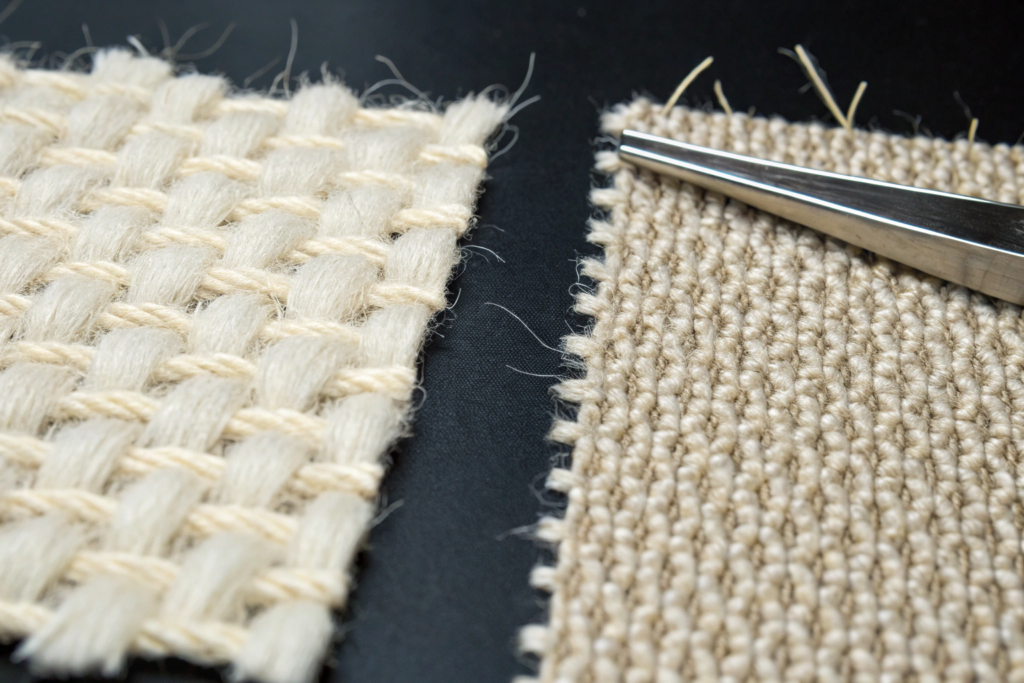
Long-staple cotton is not a luxury checkbox; it’s a mechanical necessity for a durable linen blend. When we talk about staple length, we mean the actual physical length of the individual cotton seed hair. Long-staple varieties, like the Giza or Supima cotton we often source, have fibers that measure over 34mm. Standard upland cotton might be 25mm. Those extra 9 millimeters are everything. In a ring-spun yarn, the number of twists per inch can be lower while still maintaining high strength because the long fibers have more surface area to grip each other. Lower twist per inch means the yarn is less like a tight wire and more like a soft, fluffy cloud.
Short fibers are the enemy of longevity. In a cotton-linen blend, the flax fibers are already a bit brittle. If you blend them with short-staple cotton using the open-end method, the yarn starts breaking down the moment you wear it. The short fibers don’t have enough overlap; they rely entirely on the chaotic entanglement of the rotor. After a few washes, the mechanical agitation forces these short fibers to pop out of the yarn strand. This is why a cheap T-shirt gets thinner and rougher over time, while a premium ring-spun garment actually gets softer.
I put this to the test with a specific client project in March 2023. A client from London who designs luxury baby clothing was terrified of using linen because of its "rough" reputation. We developed a ring-spun blend for her using 70% extra-long staple organic cotton (38mm length) and 30% fine Belgian flax. We ran it through a double-mercerization process at our partner dyeing factory. The result looked like a rustic heirloom fabric but felt like a cloud. She just reordered for the fourth time last month. That long fiber, spun correctly, creates a structure that actually improves with age rather than degrading. You can learn more about how long-staple cotton improves textile durability through ring-spinning methods in some advanced textile manufacturing guides, which confirm that fiber length is the primary predictor of fabric lifespan.
Can Enzyme Washes Rescue a Rough Open-End Cotton Linen Fabric?
I get asked this all the time by startups looking to save a dollar: "Can’t I just buy the cheap open-end fabric and wash it with silicone softener to make it smooth?" The short answer is no. You can apply a band-aid, but you can’t fix a broken bone with it. Enzyme washes are brilliant technology. We use them in our own coating and finishing factory. Specifically, cellulase enzymes eat the protruding fuzz on the surface of yarn. It’s like a biological lawnmower. An enzyme wash can temporarily remove the prickly ends of flax and cotton that cause the initial itchiness.
However, the problem is structural. An open-end yarn is not just fuzzy on the surface; it’s fuzzy throughout its entire core. The enzyme wash will clean up the outside, making the garment feel acceptable in the polybag. But once the customer wears and washes the garment, the weak, chaotic structure of the open-end yarn reveals itself again. New short fibers, previously hidden, now migrate to the surface. You haven’t solved the pilling problem; you’ve just delayed it by one laundry cycle. You are essentially selling a time bomb.
Worse, aggressive enzyme or silicone washes can mask the density problems of open-end fabric, but they kill the natural breathability of the linen. Remember, the magic of linen is its hollow core that wicks moisture. If you clog those microscopic channels with a thick silicone film, you destroy the fabric’s thermoregulation. Your garment just becomes a hot, greasy, and eventually still-rough rag. I had a heated debate with a potential client last year who insisted we match a price using open-end yarn with a "heavy silicone finish." I refused. I told him, "I can sell you cheap, but I won’t sell you a lie that damages your store’s rating." We only use bio-polishing enzymes on our ring-spun fabrics to enhance an already smooth surface, not to hide a defective one. It’s a topic widely discussed in circular fashion communities, specifically the challenge of using bio-finishes on low-quality fast fashion fabrics to simulate softness, where the consensus is that chemistry can’t replace physics.
How Does Shanghai Fumao Control the Ring-Spinning Process for Export Quality?
Controlling a spinning process 50 kilometers away from your own factory might sound like a logistical nightmare, but in Keqiao, it’s the norm. You don’t need to own the spinning mill to control the output; you just need a terrifyingly strict quality assurance team and a lab that the spinners respect. That’s our model. We partner with the top three ring-spinning mills in the region—facilities that run Rieter and Toyota automated systems. But we don’t just email them a purchase order; we station our own auditors inside those partner mills during our production runs.
My export clients, especially those from America and Germany, don’t care about the specific spinning mill name. They care about repeatability. They want batch number 23 to drape exactly like batch number 5 from three months ago. For that, you need a standard operating procedure that ignores price fluctuations and focuses on settings. We set the exact twist factor, the spindle speed, and the traveler weight for every cotton-linen blend we develop. This isn’t left to the operator’s guesswork. We calculate the twist multiplier (typically between 3.8 and 4.2 for our smooth blends) based on the linear density of the yarn. A low twist multiplier creates a softer, bulkier yarn but sacrifices strength; a high multiplier creates a harsh, wiry yarn. We find the "sweet spot" that gives the softness of a low twist but the integrity of a high twist by compensating with fiber length. This meticulous, data-driven approach is what separates a genuine exporter from a simple trading company.
What Specific Tests Does Our CNAS Lab Run on Every Linen Blend?
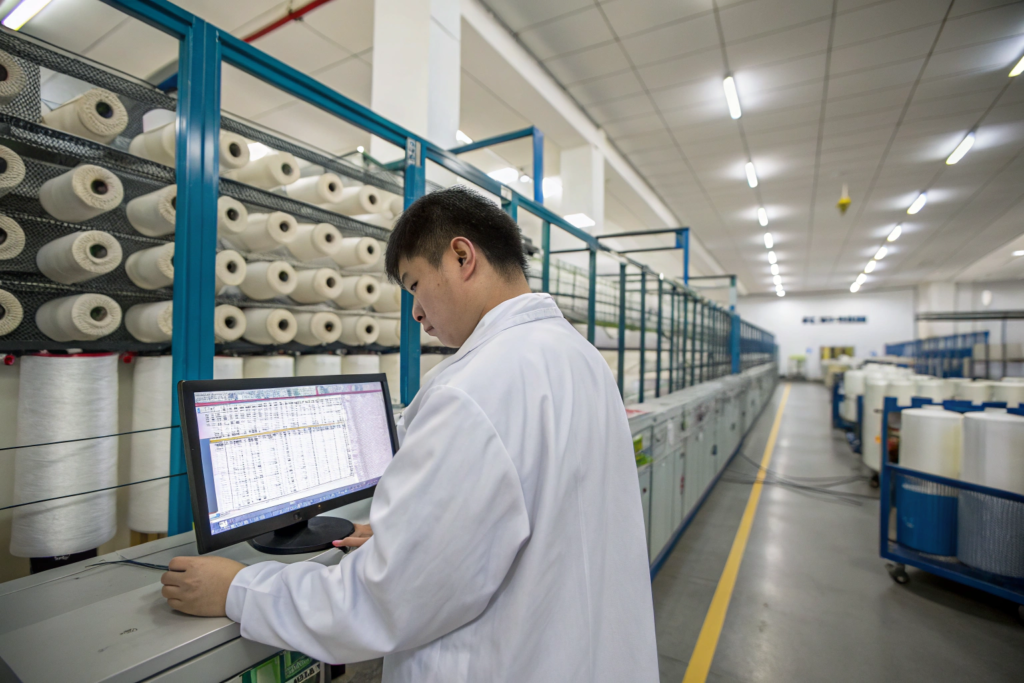
You can’t manage what you don’t measure. Our CNAS-accredited lab isn’t a showroom; it’s the heartbeat of our operation. For a specific cotton-linen blend, like a 55% linen 45% cotton fabric destined for a shirting brand, the roll doesn’t leave the warehouse unless it passes a battery of tests that go way beyond just checking the color. We test for the "imperfection index" (IPI), which counts the number of thin places, thick places, and neps per kilometer of yarn. A high neps count is an early warning for pilling.
One of the most critical tools is our Uster Tester 5. It uses a capacitive sensor to measure the mass variation of the yarn as it runs through the machine at 400 meters per minute. This isn’t just a number; it’s a spectrogram that reveals the exact mechanical fault in the spinning frame. If we see a periodic fault, we know that a specific roller in the drafting zone is cracked or a rotor bearing is dirty. We can call the spinning mill and say, "Check your front top roller on spindle number 34." That’s the level of precision we’re working with.
Then comes the hairiness test. We use a Zweigle hairiness tester that counts every single protruding fiber longer than 3mm. For our export-grade ring-spun cotton linen, we set a strict ceiling on the S3 hairiness value. This ensures the garment won’t prickle. We also run the "Lint and Pills" resistance test using a Martindale machine, rubbing the fabric against itself for 2,000 cycles. A photo-grade assessment against ASTM standards must show a grade of 4 or better. I remember a British buyer visiting us in January, skeptical of our claims. We pulled up a live test report for his order via our QR code system, showing a Uster CV% of just 8.5% on his 24/1 Ne yarn. He was speechless. You can find detailed breakdowns of these procedures in Uster Statistics 2023 benchmarks for cotton linen blend yarn quality, which shows that our internal standards are significantly tighter than global 50% percentiles. We also insist on periodic third-party verification, and you can review the typical scope of work in standard operating procedures for SGS yarn count and twist inspection to see how these audits are structured.
How Do We Guarantee That Your Bulk Order Feels Exactly Like the Sample?
This is the black hole of textile sourcing. A supplier sends you a beautiful, hand-spun, hand-picked A4 sample. You fall in love. You place a $50,000 bulk order. Three months later, the fabric arrives, and it’s a completely different creature. The hand-feel is gone. The drape is off. This phenomenon, which I call "sample switching," is often due to the sample being made in a controlled lab environment while the bulk is rushed through a low-cost production line.
We kill this risk with what we call "The 80% Rule." We don’t make your sample using a small, single-spindle lab machine. We make your lab-dip and your hand-feel sample using a scaled-down but real production run on our actual partner mill’s ring frames. We run a minimum of 50 meters of your specific yarn on the production line. This uses the same temperature, humidity, and machine speed as the final order. The sample you get isn’t a dream; it’s a snapshot of what the full run will look like.
Furthermore, during the bulk run, we retain a "reference reel" from the exact same batch of yarn used for your sample. When the bulk fabric is finished at our dyeing factory, we cut a swatch and compare it side-by-side with the reference sample under a standard D65 light booth. We perform a quick hand-crush test: we squeeze both fabrics in our fist for 10 seconds and then watch how they recover. If the bulk fabric crinkles sharper or feels stiffer than the sample, we adjust the finishing immediately. We also digitally map the surface roughness using a Kawabata evaluation system. This machine actually measures the coefficient of friction and the geometrical roughness of the fabric surface and gives it a score. We don’t ship until the bulk fabric’s surface friction value matches the sample’s within a 5% deviation. This is how Shanghai Fumao gives you the confidence to sell your collection before the goods even land.
Is Ring-Spun Cotton Linen Worth the Higher Cost for Your Clothing Line?
I get it. When you’re staring at a spreadsheet, the open-end option often looks like the smart financial choice. The price per meter is undeniably lower. The math feels safe. But you’re not in the business of buying meters of fabric; you’re in the business of selling emotional satisfaction and brand loyalty. The true cost of a garment isn’t the FOB price; it’s the FOB price plus the cost of returns, the cost of a bad review, and the cost of a customer who never buys from you again. The choice of spinning method directly influences that total lifetime cost.
Think about the lifecycle of a garment made from a low-twist, open-end blend. It fades after five washes. It pills at the collar. The customer feels it and subconsciously assigns your brand to the "low quality" bin, even if your design was great. They don’t think, "Oh, the open-end spinning method caused the failure." They think, "This brand sucks." A ring-spun garment, however, gets compliments. Every time someone touches the sleeve of your linen blazer, they’re forming an opinion about your brand. The price difference between ring-spun and open-end, when amortized over the number of positive impressions a garment generates, is microscopic. You aren’t just paying for yarn; you’re buying a tactile marketing tool that works silently, every single day. The real question isn’t "can I afford to use ring-spun?" It’s "can I afford not to?"
What Is the Real Price Gap Between Premium Touch and Customer Returns?
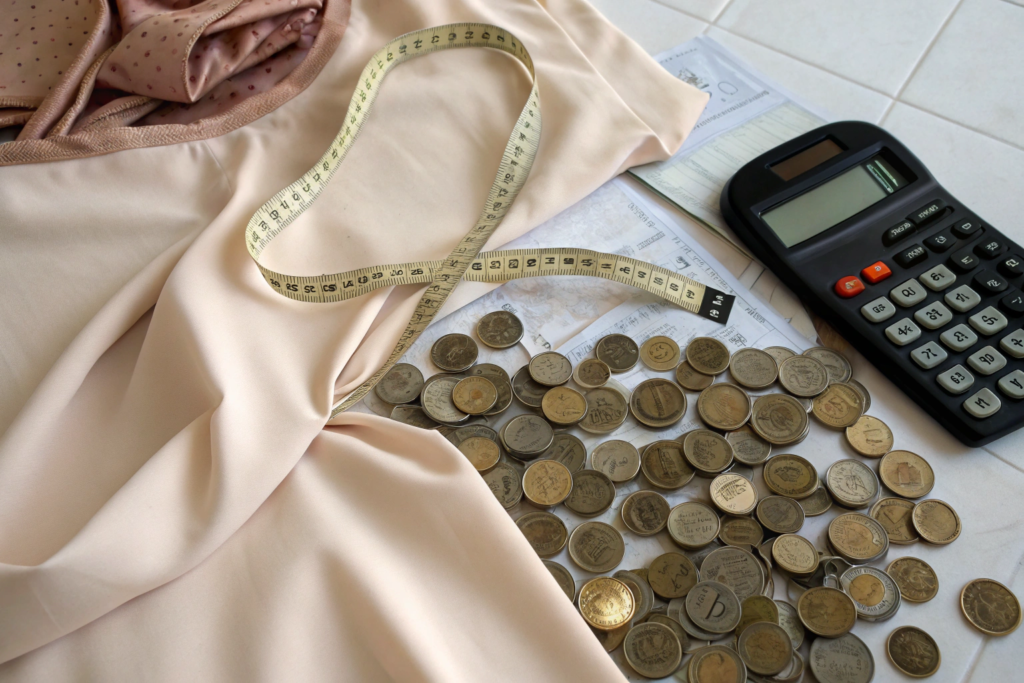
Let’s talk hard numbers, not just fluffy marketing. Let’s imagine a standard long-sleeved, unisex cotton-linen shirt. The fabric consumption is about 1.6 meters per garment. A competitive open-end blend might cost you $3.80 per meter. A premium ring-spun blend from Shanghai Fumao might cost you $4.80 per meter. The raw fabric cost difference is exactly $1.60 per shirt.
Now, let’s calculate the cost of a return. The garment is shipped free to the customer. That costs you $4.00. It’s returned free. That’s another $4.00. The warehouse unpacking, inspection, and restocking cost is roughly $3.00. You’ve just lost $11.00 on logistics and handling alone, before you even factor in that the returned shirt is now a "used good" you have to sell at a 40% discount at best. If the return reason is "quality not as expected" or "fabric felt rough," you just paid $11.00 plus the gross margin loss to save $1.60 on fabric. The math is brutal and unforgiving.
I had a client, a menswear e-commerce brand, who was obsessed with the open-end price in 2021. He ran a batch of 1,000 shirts with a cheap blend. His return rate for that specific SKU spiked to 18%, with comments saying "felt like cardboard." The next season, we convinced him to switch to our ring-spun quality. The fabric cost increased by 5% of his total landed cost per unit, but his return rate dropped to 3%. His customer lifetime value increased because people actually kept the shirts and bought the second color. This data is consistent across the board. In a report about reducing apparel return rates by improving fabric hand-feel quality, analysts note that tactile dissatisfaction is a top-three driver of non-size returns. And on a practical costing thread on a fashion startup forum discussing calculating the true landed cost of fabric rejects vs. premium inputs, the consensus is clear: the invisible costs of a cheap fabric choice almost always exceed the visible savings.
Can Ring-Spun Yarns Help You Build a Sustainable, Slow-Fashion Brand Story?
Sustainability in fashion isn’t just about recycled polyester bottles. Durability is the ultimate form of sustainability. A garment that falls apart in six months is landfill, regardless of how eco-friendly the raw fiber was. Ring-spun yarns create fabrics that last significantly longer. The tight, aligned structure resists tearing and abrasion better, meaning your garment stays in the closet and out of the trash for years. You are essentially producing fewer, better things. This is the core philosophy of slow fashion.
Moreover, the ring-spinning process, although energy-intensive, often results in less raw material waste. Because it requires longer, stronger staple fibers to function efficiently, the spinning process itself generates less fly and breakage than open-end spinning, which often uses a slub of shorter, waste-grade fibers. The yield is higher. The story your brand can tell is also more compelling. "We source this shirt from a mill using ring-spinning technology, a slower, more deliberate process that aligns the fibers to create a softer touch that lasts for a decade." That’s a story that commands a premium.
It also resonates deeply with the current narrative against throwaway culture. By specifying ring-spun on your tech pack, you are effectively voting for technical quality over mass-market disposability. You can use this in your content. Talk about the mechanics of the yarn. Educate your customer on why they should look for it. When they understand the "how," they appreciate the "price." We even help our clients create mini content libraries showing the difference under a microscope. You can explore this concept further through resources like how to create a marketing narrative around ring-spun clothing for a sustainable fashion brand, which shows how technical details can become unique selling propositions. Furthermore, the Ellen MacArthur Foundation’s guidelines on designing for circularity through durable material selection emphasize that material strength is the very first step to a closed-loop system.
Conclusion
The difference between ring-spun and open-end cotton linen isn’t an academic debate. It’s the difference between a garment that gets worn every week and one that gets buried in the back of a drawer. Ring-spun technology aligns and tames the fibers, trapping the stiff linen inside a smooth cotton sheath, while open-end spinning leaves a chaotic, fuzzy mess that pills and scratches. I’ve shown you how we at Shanghai Fumao guarantee this smoothness through obsessive lab testing, a refusal to cut corners on fiber length, and a brutal commitment to matching your bulk order exactly to your sample.
Choosing ring-spun is a decision to invest in your brand’s touch. It reduces your return rates, builds customer loyalty, and allows you to tell a genuine story of quality and slow fashion. It turns a simple cotton-linen blend into a tactile signature that your customers will associate only with you. The math is simple: saving a dollar on the yard often costs you ten in reputation.
Don’t let your brand’s reputation be destroyed by a spinning technology you never even thought to ask about. If you want to feel the difference for yourself, I want to physically put a sample of our ring-spun cotton linen in your hands. You can rub it against your competitor’s fabric and see the truth with your own skin. Reach out to our Business Director, Elaine, right now and ask for the "Ring-Spun vs. Open-End Hand-Feel Kit." She can also walk you through the exact costing to show you how this investment pays for itself. Send your inquiries to elaine@fumaoclothing.com and let’s build a line that people truly love to touch.








