
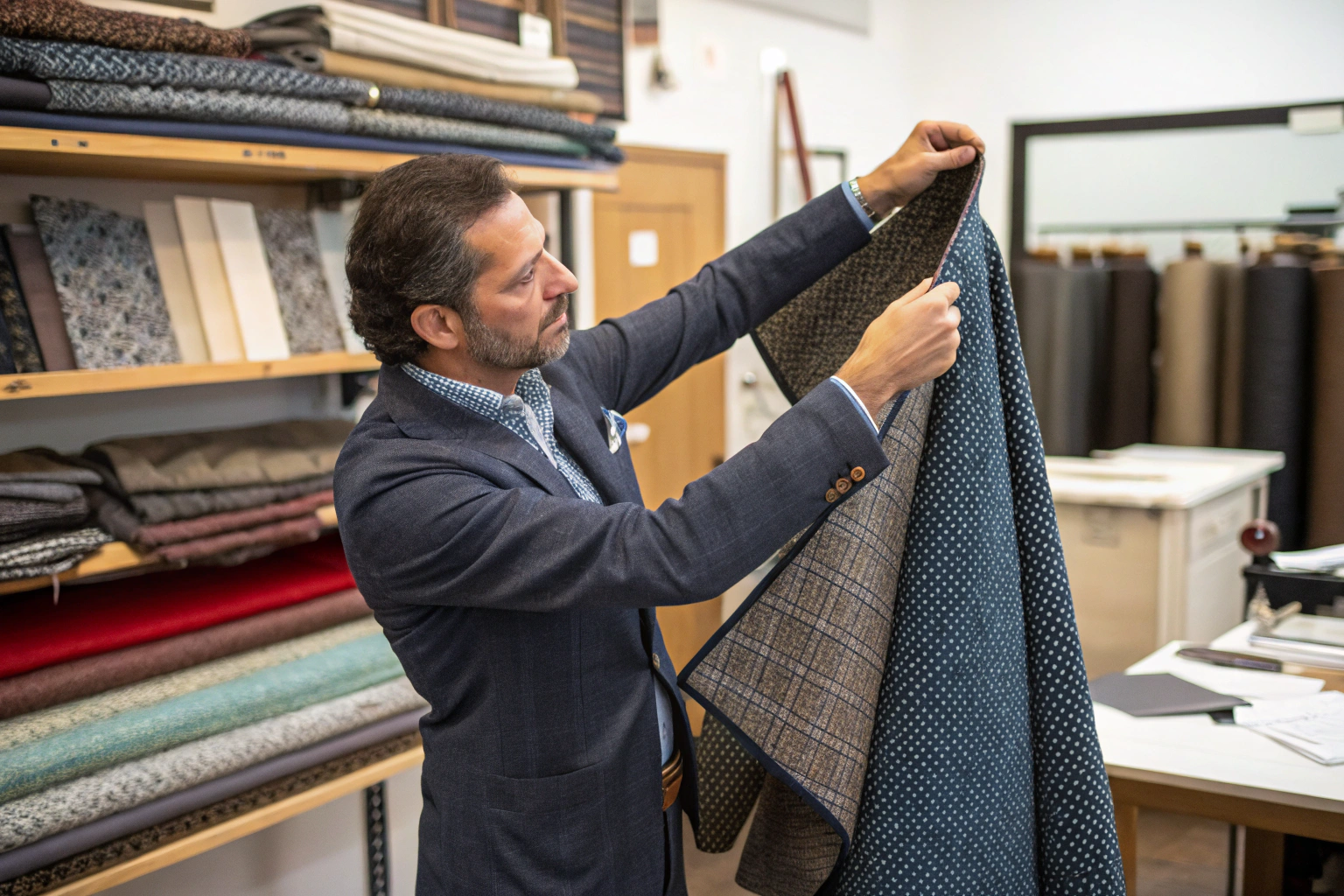
You run a boutique menswear label. Your customer doesn’t walk into your store looking for a basic white button-down. He walks in hunting for texture. He wants a blazer that feels like a vintage find from a flea market in Naples but wears like modern performance armor. The problem is, every mill you email sends you back the same 20 swatches. Plain weave natural. Plain weave black. A generic blue stripe. You start to wonder if there is any real textile innovation left in the linen world, or if it is just a race to the bottom on price. I felt this frustration personally in 2019 when I visited a menswear trade show in Florence. Buyers were begging for "slubby hand" and "dry touch" but suppliers kept showing them dead, flat fabrics. That trip planted a seed in my mind: Shanghai Fumao needed to become a laboratory for rare constructions, not just a factory for commodity cloth.
Yes, we specialize in rare and experimental cotton linen constructions specifically engineered for high-end menswear. We run short-batch, high-texture styles that most commodity mills refuse to touch because the setups are too complex. Think paper-touch overdyed linen, irregular Nep yarn blazers, and washed jacquards that mimic 19th-century French workwear. Our minimum order quantities for these boutique developments start as low as 300 meters, and we hold over 1,200 exclusive seasonal designs in our archive that you won’t find on any generic marketplace platform.
If you think "rare" just means putting a blue stripe on a beige background, you are looking at the wrong mill. I want to walk you through the looms, the yarns, and the dyeing tricks that create fabrics with genuine patina and personality. These aren’t fabrics for mass retailers who panic about a slight shade variation. These are fabrics for designers who print "Made from exclusive deadstock" on their hangtags and charge a premium for the story.
How To Source Textured Slub Linen For Suiting
Flat fabric is the enemy of a boutique suit. I learned this in 2021 when a Japanese menswear designer told me over coffee that his customers "want to see the hand of the maker" in the cloth. That means the yarn needs to be uneven, but intentionally uneven. It needs life. Most mills try to make linen as smooth as polyester, which is missing the whole point of natural fiber. A slub linen suit should look like it was woven on a wooden loom a hundred years ago, but perform like modern armor with high seam slippage resistance.

What Is Nep Yarn And Why Do Tailors Prefer It?
Nep yarn is intentionally flawed, and that flaw is expensive. A "nep" is a small tangled knot of fiber, usually cotton, that gets rolled into the yarn during spinning. In cheap fabrics, neps are a defect caused by dirty cotton or bad carding. In luxury menswear, neps are seeded deliberately using a modified carding engine. We take extra-long staple linen and mix it with roughly 5% to 10% of cotton neps. As the yarn twists, these tiny balls catch the light and create a speckled, tweedy surface that feels granular to the touch.
Tailors prefer nep yarn suiting because it hides wrinkles. A smooth plain-weave linen trouser creases like a map of the subway after one sit. A nep-textured surface breaks up the light reflection, so the creases become invisible. It also drapes softer because the irregular yarn structure has less surface contact area, meaning it doesn’t cling to the leg statically. For a completely unstructured, unlined blazer, nep yarn gives you that "rumpled elegance" without looking like you slept in a barn. If you want to understand the technical side of how these imperfections are manufactured, you can research the controlled creation of nep yarn effects in linen blends for menswear. The process is a balancing act: too few neps and the fabric looks accidentally dirty; too many and it pills instantly.
Can You Really Get A Paper-Touch Finish On Linen Suiting?
Yes, and it is one of our most requested developments for the Japanese and Scandinavian markets. "Paper touch" describes a fabric that rustles slightly when you move. It has a crisp, dry, almost crunchy hand feel, similar to high-grade writing paper. It sounds counterintuitive for clothing, but for a summer blazer, this stiffness creates an architectural silhouette that hangs off the shoulders perfectly without padding. It breathes like linen but holds its shape like a lightweight wool.
To achieve this, we skip the traditional enzyme wash that is designed to soften linen. Instead, we run a high-tension calendaring process. The fabric passes through heated steel rollers under extreme pressure. This crushes the surface fibers flat and aligns them directionally. It effectively glazes the surface. Then we apply a very thin, invisible resin finish that washes out after about three dry cleans, but by then, the garment has molded to the owner’s body. This is a classic "fabric that ages with you" approach. The challenge is maintaining tear strength. Calendaring weakens the fiber if done too hot. We calibrate our roller temperature to exactly 160°C, hot enough to deform the surface but not so hot that it embrittles the core of the flax. Finding a mill that can execute a paper touch finish on garment dyed linen without tearing is the holy grail for boutiques. One bad batch and the elbows blow out.
Why Are Chinese Overdyed Fabrics Perfect For Vintage Looks
The vintage trend isn’t dying anytime soon. But selling a shirt that looks like it survived a war requires a chemical process that most mills consider too risky. You cannot just dye a shirt black and wash it with stones. That gives you a flat, muddy gray. A true vintage overdye looks like a painting. The base color—maybe a bright indigo or a rusty terracotta—sits deep in the crevices of the weave, while the dark top color covers the high points. When you wash it, the high points fade to reveal the warm under-color. This takes cross-dyeing technology and multiple bath sequences that a commodity mill finds too slow and expensive.

How Does Garment Dyeing Change The Linen Texture?
You have two choices: dye the fabric first, or dye the finished garment. For boutique menswear, garment dyeing creates the best vintage effect. You sew the shirt or jacket in its raw, greige state. Then you dump the entire finished garment into a dyeing vat. Because the thread, the zipper tape, and the fabric all absorb the dye differently, the finished product looks like an authentic vintage find.
The downside is shrinkage. A lazy factory cuts the pattern too big, guesses the shrinkage, and hopes for the best. We reverse-engineer the process. We take the raw fabric, measure the precise shrinkage rate through our CNAS lab (usually around 5% to 7% for heavy linen), and then resize the digital pattern so that the finished garment matches the spec after the dye bath. It takes trial and error. A client of ours in Berlin ordered 200 units of a chore coat last year. We did five rounds of shrinkage testing before cutting a single stitch. The result was a coat that fits like a bespoke piece but has a beautifully broken-in color because of the garment overdye. If you plan to go this route, learn more about controlling shrinkage tolerance during high temperature garment dyeing of linen outerwear. If your factory cannot show you a shrinkage matrix, you are gambling with sizing.
What Makes Cross-Dyeing Look Different From Solid Dyeing?
Solid dyeing is one color, one bath. Cross-dyeing is a party trick for fiber blends. We take a yarn that is 70% linen and 30% polyester, but we twist it so the linen sits on the outside and the polyester sits in the core. Then we dip it in a dye bath that only attaches to the linen. The polyester core stays white. The fabric looks solid at first glance, but when it moves and stretches over the elbow, you see a micro-flash of the white core. This creates an optical depth that solid-dyed flat linen simply doesn’t have.
For vintage looks, we take this further with a double-dip method. We dye the linen component a warm base color, like a 70s burnt orange. Then we overdye the whole fabric with a cold reactive black that sits mostly on the surface. When we wash it down, the black cracks and the orange bleeds through. The fabric physically looks 30 years old, but the tensile strength is brand new. This is the kind of proprietary technique that takes a decade to perfect. It also requires a dye house that doesn’t mind cleaning the tanks ten times a day. You can read about how double dip cross dyeing creates multi dimensional color effects in linen blends to understand why it costs more but sells for a much higher retail markup.
Can Small Brands Get Access To Exclusive Fabric Archives
The biggest lie in the textile industry is "What you see is what we have." A big commodity mill shows you 20 pieces of cloth and tells you that’s the collection. Take it or leave it. A boutique brand needs a treasure hunt. We built an archive of over 1,200 rare styles, and we treat it like a wine cellar. Some fabrics in there were woven three years ago as experiments. They are deadstock in the best sense: they have aged, relaxed, and stabilized. I often pull out a roll of 2019 overdyed black linen that has been resting in our warehouse. It is bone-dry, perfectly stable, and ready to cut. You simply cannot replicate that maturity with freshly woven cloth.

Are Low Minimum Order Quantities Possible For Unique Weaves?
Yes, but only if you accept my inventory. If you ask me to develop a completely new exclusive weave from scratch, you need to buy the yarn lot. That might be 2,000 meters. But if you browse my archive, the fabric is already woven. It is sitting on a shelf, 150 meters here, 400 meters there. I can sell you exactly what I have. Low MOQ is a storage game, not a production game. I inventory rare cloth because I know a small brand cannot eat 2,000 meters of a super-heavyweight textured double-weave in mustard yellow.
Last year, a small boutique from Melbourne found a selvedge linen jacquard in our archive that I had forgotten about. It was a geometric pattern based on a 1920s Art Deco wallpaper. We only had 280 meters left. That was exactly enough for a limited run of 65 blazers. They sold out in three days online. Their marketing story wasn’t "we bought fabric from China," but "we discovered a deadstock roll in a specialized textile archive." That story commands a 3x retail markup compared to a generic commodity linen jacket. The key is knowing how to source low minimum order quantity deadstock designer linen from Chinese mills for boutique labels. You are not just buying cloth; you are buying a narrative of scarcity.
How Do You Test Vintage-Style Fabrics For Durability?
Looking old is acceptable; tearing like old fabric is not. A fabric that has been aggressively washed, overdyed, and calendared faces a lot of stress. I would not sell a vintage-effect fabric to a menswear brand without running a modified Martindale abrasion test. This machine rubs the fabric in a Lissajous figure pattern until it breaks. For a commercial upholstery contract, you need 40,000 rubs. For a blazer elbow, I want at least 25,000 rubs to feel safe.
We also test for "frosting." This is a nasty defect where the dark overdye fades instantly on the seams and pocket edges, but instead of looking cool, it looks dirty white. A proper vintage dye job fades to a warm mid-tone. Frosting means the dye didn’t penetrate deep enough into the fiber core. We use a microscopic cross-section camera to check if the dye has soaked to the center of the flax fiber. If it hasn’t, the garment will frost after three wears. You need the confidence that your intentionally aged blazer won’t actually disintegrate. There is a distinct difference between aesthetic aging and mechanical failure, and you can verify this through specific methods for testing abrasion resistance on heavily washed faux vintage linen fabrics. Science doesn’t ruin the romance; it just ensures the romance lasts.
What Are The Emerging Trends In Sustainable Menswear Textiles
Sustainability in menswear is moving away from the crunchy, beige aesthetic. The modern boutique customer wants a fabric that looks like a sharp Italian blazer but carries a deep ecological story. They don’t want to wear a sack made of hemp that screams "I recycle." They want a sleek, black tailored trouser that just happens to be made of mechanically recycled pre-consumer cotton linen waste. We have been investing heavily in regenerated fibers and waterless dyeing precisely for this customer segment.

Can Recycled Linen Blends Look Luxurious?
I had to argue with a French designer about this for three months in 2022. He insisted recycled linen would feel like cardboard. He was wrong. Mechanical recycling of pre-consumer waste—those are the selvedge trims and cutting table scraps from our own production—yields a staple fiber that is a bit shorter than virgin flax. To compensate, we blend it with 30% extra-long staple virgin organic cotton. This creates a soft, lofty hand that is arguably better than 100% virgin linen because the cotton fills in the prickly gaps.
The visual effect is also unique. Because the recycled content comes from different colored scraps, when we skip the re-bleaching process and just spin the mélange of colors, we get a heathered, "salt and pepper" appearance. It looks like a high-end Italian wool fresco cloth, but it is 100% plant-based. The retail price point can sit 40% higher than a virgin linen blazer, and the customer perceives the value because the color has a natural irregularity that synthetic blends cannot fake. You should absolutely understand how mechanically recycled pre consumer cotton linen waste creates luxury melange textures. It is the intersection of zero waste and high fashion, and the technology is evolving so fast that last year’s "rough" recycled linen is this year’s premium suiting.
What Is The Future Of Waterless Dyeing For Menswear?
Water is a crisis, and dyeing linen is thirsty work. A standard reactive dye bath uses about 80 liters of water per kilogram of fabric. For a brand that prides itself on environmentalism, that water footprint is a marketing vulnerability. That is why we have pushed into supercritical CO2 dyeing for certain polyester-rich blends, but for pure cellulose linen, the real breakthrough is the "Dope Dyeing" or "Solution Dyeing" adaptation.
We have started sourcing recycled cotton linen blends where the pigment is added directly to the spinning solution before the fiber is extruded. This skips the water bath entirely. The color is locked inside the very molecular structure of the fiber. For a menswear brand, this means absolute colorfastness under sunlight. A black blazer will stay black for 10 years. It will not fade to purple in the sun like a surface-dyed garment. The limitation is that this works best for regenerated cellulosic fibers like Lyocell, but we are successfully applying it to our recycled waste blends. The range of colors is currently limited to darker, saturated shades—navy, deep teal, black, charcoal—but for menswear, that is perfect. To see where this is going, researching the latest techniques for waterless supercritical CO2 dyeing adaptation for natural cotton linen cellulose fabrics reveals a future where a blazer uses zero water for its color, creating a new level of sustainable luxury that the market is ready to pay a premium for.
Conclusion
Rare cotton linen for boutique menswear is not found in a catalog. It is hidden in the archive of a mill that is obsessive enough to stock deadstock and brave enough to run experiments. I built Shanghai Fumao to be the place where you can find a nep-textured blazer fabric that hides wrinkles like a secret agent, a paper-touch jacket that rustles with architectural precision, or a double-dyed vintage coat that tells a color story before you even sew the label on. We do not require you to buy container loads. We let you browse the archive, take 300 meters, and create a limited drop that sells out at full retail price because the fabric itself is the marketing. Your customer doesn’t need to know about CNAS testing or cross-dyeing chemistry. They just need to touch the cloth and feel a story.
Don’t buy commodity linen that makes your blazer look like every other brand’s Summer 2026 collection. Let’s find you a roll of something strange and beautiful. Email our Business Director, Elaine, with your brand aesthetic, your target retail price, and the kind of texture you dream about. She can pull archival deadstock swatches and new development trials from our library and ship them to your studio within a week. elaine@fumaoclothing.com. Let’s build a capsule collection that no one can copy because the fabric literally doesn’t exist on the open market.








