You land a massive order. Maybe it’s 50,000 yards of a custom blush-pink linen blend for a big-box retailer’s spring collection. You celebrate for about ten minutes. Then the panic hits. You remember the horror stories. Factories that promise the moon but deliver three months late. Mills that run out of yarn halfway through. Suppliers who take your deposit and then tell you the dyeing machine broke down. That fear of a million-dollar delay sitting in your stomach isn’t irrational. I have seen late deliveries kill brands faster than ugly designs. One of my earliest clients, a home textile brand from the UK, missed the entire Christmas window in 2018 because a mill in another region couldn’t handle their volume surge. They ordered 30,000 meters, but the mill’s real capacity was 10,000. They sold air that season. I swore I would never let that happen at Shanghai Fumao.
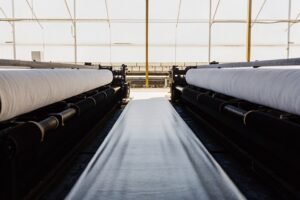
Yes, we can handle high-volume custom cotton linen orders precisely on time. Our advantage lies in redundant parallel production, not just one big machine. When you place a 50,000-yard order with us, we split it across multiple identical air-jet looms running synchronized warp beams from the same mother beam. This means if one loom stops for a technical issue, the other three are still producing your fabric. We combine this with a 12-hour raw material buffer stock of greige yarn specifically reserved for your purchase order, ensuring zero supply interruption.
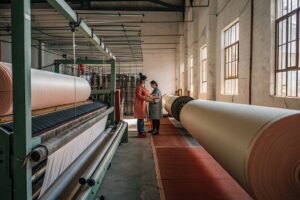
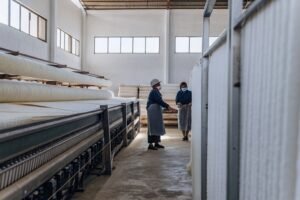
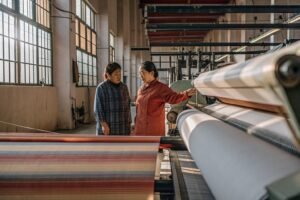
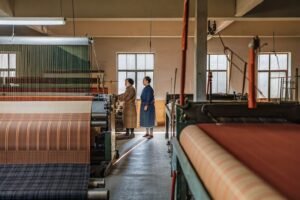
It is one thing to read that promise on a website, but quite another to see the machinery that backs it up. You need to understand the physical reality of how a mill like ours absorbs your peak season pressure without breaking. Let me take you behind the scenes, from the yarn warehouse to the final inspection table, and show you the math that makes a 30-day bulk delivery possible, even when everyone else is telling you 45 days.
How Do Fabric Mills Manage Peak Season Volume Surges
Peak season is a monster that eats most mills alive. From March to May and August to October, every garment brand on earth hits the "go" button simultaneously. A mill that doesn’t structure its capacity booking system collapses under its own greed. They take everyone’s order, promise everyone the same loom slots, and by week two, the schedule looks like a car crash. I run our peak season differently. We sell loom capacity hours first, fabric second.

Can You Reserve Loom Capacity Before The Yarn Exists?
Yes, and this is the most critical piece of supply chain wisdom I can offer you. You don’t start bulk production by buying yarn. You start it by reserving a specific set of air-jet looms in our production planning system. I call this the "Hard Booking" protocol. When you sign a purchase order with Shanghai Fumao for a large volume, we immediately lock a contiguous block of time on four to six looms. We code your project with a Production Order number. This block of time is untouchable. Our production planner, a guy named Lao Zhang who has been doing this for 20 years, cannot reallocate your looms to another buyer even if that buyer offers more money per yard.
The reason we can do this is our specialization in linen blends. If you run a mixed-fiber factory switching between heavy denim and light chiffon, your machine parameters change constantly, creating downtime. We keep our yarn counts within a specific range, meaning the looms are always "warm" for your fabric. You are not waiting for a mechanic to swap reeds for six hours. You step into a production stream that is already flowing. To truly protect yourself, you need to understand how to legally reserve dedicated textile loom capacity in Chinese manufacturing hubs before peak season. It locks in your delivery date at a contractual level, not just a hopeful one.
What Happens When A Dyeing Batch Fails Under Deadline Pressure?
This is the moment where the price of your order gets determined, often in a bad way. Dyeing a massive batch of linen to a precise light shade like lavender or shell pink is a chemical nightmare under time pressure. Linen has a low dye affinity compared to cotton. If the lab dip doesn’t scale up perfectly from a 100-gram sample to a 500-kilogram batch, you get shade banding. A cheap mill that messed up the color has two choices: strip the fabric with caustic soda (which destroys the soft hand feel and creates a harsh, brittle drape), or ship it and hope you don’t notice the two different shades.
We refuse to strip. If a batch is 2% off-spec in shade, we immediately trigger the "Rapid Re-dye" protocol. This is only possible because we hold a digital recipe database of over 5,000 colors. The system instantly calculates a new formula to adjust the bath without overloading the fiber. More importantly, we have a backup dyeing vessel pre-heated and waiting. We don’t wait for the first batch to finish, drain, clean, and reload. We pivot to the backup. This is the advantage of scale. A small Pakistani or Indian job-work dye house doesn’t have a "hot spare" vessel sitting empty. They have one machine. If it fails, you wait a week. This operational redundancy is just part of how you manage preventing color shade deviation in large scale reactive linen dyeing. It separates a reliable supplier from a risky one.
What Is The True Capacity Of The Keqiao Textile Cluster
I sometimes invite skeptical buyers to stand on the roof of our office and just look. In a 20-kilometer radius from where I am sitting right now, there are over 80 yarn twisting facilities, 30 major dyeing cooperatives, and hundreds of finishing plants. The Keqiao cluster is not just a marketplace; it is a living organism that digests raw fiber and excretes finished garments. This density is my secret weapon. When you ask me if I can handle large volume, the real answer is not just what Shanghai Fumao owns, but what I can commandeer within a 15-minute drive.

How Many Yards Of Custom Linen Can Keqiao Produce In A Single Day?
Let’s put some real numbers on this, not marketing fluff. A single standard air-jet loom running a 21s linen warp at 600 RPM with a 190cm width can produce roughly 200 to 250 meters of gray fabric per 24 hours of continuous operation, depending on efficiency stops. Now, I do not just have one loom. If I consolidate four specialized weaving partners within my immediate cluster, I can bring 40 to 50 identical looms online for your order within 48 hours.
That is 10,000 meters of fabric rolling off the line every single day. Think about that pipeline. In 5 days, you have your 50,000 yards. Weaving is rarely the bottleneck at this scale. The bottleneck shifts to the preparatory stage: sizing the warp yarn and drawing-in the threads through the heddles. This is where foreign buyers with no experience in mega-scale production get tripped up. They believe a mill that says "we can weave 10,000 meters a day" but they forget the mill needs a week to prepare the beams. We maintain a buffer stock of pre-beamed linen warps in natural and black, precisely so we can cut the prep time in half. For a deeper understanding of scale, reading about the daily gray fabric output capacity of the Keqiao textile industrial cluster helps visualize why this region dominates global trade. We are not a single factory; we are a factory of factories.
Does Vertical Integration Actually Reduce Lead Times?
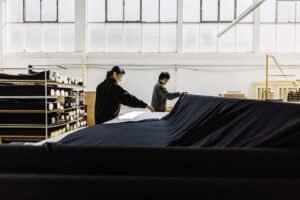
Only if the integration is tight. "Vertical" is a dangerous buzzword. A factory can claim to be vertical just because they own a shed with sewing machines next to a warehouse. That is not integration; that is just real estate. Real vertical integration means the data flows as fast as the fabric. When our quality control team inspects the greige fabric on the loom, they don’t write a paper ticket. They scan the roll with a tablet. The defect map—a 4-point system record—is instantly visible to the dyeing factory two streets away.
Before that roll of gray fabric even arrives at the dye house, the dye master knows there is a weaving defect at meter 45. He marks that spot with a contrast thread during the scouring process so the cutting room automatically rejects it later. This is the tightness I demand. If the weaver and the dyer are 50 miles apart, that defect stays hidden until the finished fabric inspection. By then, you have wasted the cost of dyeing and finishing that defective section. Our integration also eliminates the "ownership dispute." In a fragmented supply chain, when a dyeing defect occurs, the weaver blames the dyer, and the dyer blames the weaver. You, the buyer, get stuck in the middle. Because I control the process from yarn sourcing to finished roll, there is only one phone number to call. To see how this compares globally, explore the role of vertical textile integration in reducing production lead times for custom orders. The data shows that fragmentation adds 30% to the clock, not because machines are slower, but because information gets lost.
Can You Trust A Chinese Mill With Strict Payment Deadlines
Cash flow is the shadow currency of the textile business. You can have a perfect product, but if the financial gears don’t mesh, the deal seizes up. I have met buyers who are terrified of paying a 30% deposit to a Chinese company for a large order because they read a horror story on a forum about a supplier disappearing. That risk exists in the unregulated fringes of the industry. But when you are dealing with a large-volume custom order, the financial structure must be as engineered as the fabric itself. I don’t ask for blind trust. I ask for a trade assurance structure.

How Do Escrow And LC Payments Protect Bulk Linen Orders?
We offer Letter of Credit (L/C) at sight for large orders over $50,000. An L/C is a contract written by banks, not by me or you. My bank (the Bank of China) and your bank (maybe Chase or Wells Fargo) step into the deal. I do not receive a single dollar until I put the cargo on the ship and hand over a clean Bill of Lading to my bank. If the ship is late, I don’t get paid until it sails. This aligns our interests perfectly. I am bleeding interest payments on my working capital loan until that container is on the water, so I am maniacally focused on hitting the sailing date.
Escrow services like Alibaba Trade Assurance work similarly for smaller batches but can scale up. The money sits in a third-party account. We produce the fabric, ship it, and upload the logistics tracking. You verify the goods within a set time after arrival. The money isn’t released until you confirm receipt of the correct specification. The catch with a large custom order is the inspection window. Custom colors and specialized finishes require a longer time to check. You must negotiate the "Inspection Period" clause to start from the date of container arrival, not the date of port discharge, giving you time to cut and test samples. Understanding the complete walkthrough of using a letter of credit for Chinese textile bulk production imports is vital to securing your cash. It costs a few hundred dollars in banking fees but insures hundreds of thousands.
Why Do Factory Financial Audits Matter For On-Time Delivery?
This is the bluntest thing I will say today: a factory that is about to go bankrupt cannot deliver your fabric on time, even if they want to. A supplier might have the best looms in the province, but if their debt-to-equity ratio is insane, they cannot afford to buy your 20 tons of flax yarn. They are waiting on your deposit to pay the yarn supplier for the previous customer’s order. This is called the "robbing Peter to pay Paul" manufacturing model. When it breaks, production halts, and your deposit is stuck in a zombie company.
I encourage you to ask for a financial audit summary or at least a Dun & Bradstreet registration number. A legitimate large-scale exporter will not be offended by a credit check from a serious buyer. It proves stability. We maintain strategic banking partnerships precisely so our working capital line is independent of your deposit timing. We buy the yarn first, using our own credit. Your deposit sits untouched against the finished goods. This is another reason why you should know the importance of verifying the financial stability of textile suppliers during large procurement cycles. A mill with a healthy balance sheet delivers on time because their raw material shelf is full, not empty, when you call. Shanghai Fumao holds inventory. We don’t wait for orders to buy inputs.
How Do You Prevent Bottlenecks In Custom Finishing Workflows
You don’t just want 50,000 yards of linen. You want 50,000 yards of linen with a stain-resistant coating, a soft enzyme wash, and a specific fire-retardant back-coating. Finishing is where the volume battle is truly won or lost. Weaving is a fast digital process; finishing is a slow chemical one. A stenter frame can only dry fabric at a fixed speed. You cannot speed up chemistry by adding more heat without burning the fiber. Managing bottlenecks here is about sequencing, not just speed.

What Is The Fastest Way To Dry A Jumbo Roll Of Coated Linen?
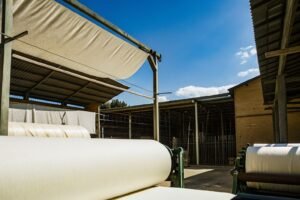
The speed of the stenter frame dictates the speed of your entire order. The stenter is a giant oven that looks like a tunnel. The fabric floats through it on hot air, setting the width and curing the coating. If you need a water-based PU coating for a tablecloth, the water must evaporate entirely before the fabric is rolled up. If the stenter runs too fast, the surface looks dry, but the core of the yarn is moist. You roll that up under tension, and it creates permanent crease marks called "moisture set wrinkles." You cannot iron them out.
To maximize volume, we operate three parallel stenter lines. But the real secret is our pre-treatment moisture control. Before the linen even enters the stenter, we pass it through a vacuum extraction slot. This physically sucks out 60% of the water from the scouring process. The less water the oven has to boil off, the faster the fabric can move through. We can push speeds 20% higher than a mill relying purely on thermal evaporation. This is also where we catch defects. If the coating knocks off a knot from the yarn, it leaves a bare spot. We have a laser scanner at the exit of the stenter that picks up pinholes smaller than a needle tip. To see what this looks like in practice, checking out methods for optimizing stenter frame drying efficiency for coated linen finishing without heat damage explains the physics of the process better than I can. Speed without control is just a faster way to create waste.
Can You Apply Fire Retardant To Linen Without Stiffening It?
You can, but only if you understand the public health and safety requirements of your market. A standard fire retardant (FR) for cellulosics often uses a phosphorous-based salt that crystallizes inside the fiber. It works by starving the flame of fuel. But if you overload it, the fabric feels like cardboard. For hospitality contracts with tight deadlines, this is a major problem. The fabric fails the drape test, and you have 20,000 yards of stiff rags.
Our technique involves a wet-on-wet application. We do not dry the fabric first, then apply FR, then dry again. We apply the FR chemical in the same pass as the softener just before the stenter. The heat of the stenter cures both simultaneously. The softening agent forms a molecular film around the FR salt, keeping the fibers separated and flexible. This cuts the drying time down to one pass instead of two. This one-pass method is literally twice as fast. It also prevents the "white bloom" defect where dried FR migrates to the surface and looks like dust. If you supply hotels or theaters, you need the material to pass the NFPA 701 test. You need to know how to apply fire retardant treatments to linen for hospitality textiles without affecting drape. This is the difference between a fabric that protects lives and one that just protects a liability certificate.
Conclusion
Handling large volume custom cotton linen on time is not about magic. It is about parallel power. It is the ability to split your order across 50 identical looms while simultaneously wet-processing the fabric on three stenter lines. It is about a financial structure that buys the yarn before you pay the deposit, so your production never starves. It is about the raw gravitational mass of the Keqiao cluster, where 10,000 meters of fabric can physically be spun, woven, and dyed within a single square mile without ever touching a truck. That is the Shanghai Fumao guarantee. We do not just promise a date; we engineer a system of redundant backups so that even if a machine breaks, a dyeing batch fails, or a typhoon hits the port, your order moves forward on another machine, in another vessel, through another payment lane.
You should be aggressive in your business. Take that big-box retail order. Sign the contract. But before you do, call me. I want you to come and measure the output speed of our looms with your own stopwatch. I want you to audit the yarn stock in the warehouse that is physically tagged with your Production Order number. If you cannot fly to China, let our Business Director, Elaine, schedule a live walkthrough video. She can take you through the dye house on a FaceTime call and show you the digital dashboard tracking your batch. Stop managing your supply chain through email anxiety. Let’s lock in your loom capacity for the next season right now. Send your specifications and volume estimates to Elaine at elaine@fumaoclothing.com. Let’s prove that "on time" means something real.