You open a shipping container of linen shirts from a new Pakistani mill. The color looks fine. The hand feel is crisp. But when you start cutting, you realize the fabric width varies by almost 3 inches from roll to roll. Suddenly your automated cutting machine is shredding your yield. I have seen this exact disaster ruin a small brand’s holiday launch in 2022. They saved 20 cents a yard on the fabric but lost $40,000 in wasted cutting labor and deadstock. The real cost of "cheap" linen hides in the cutting room, not on the invoice. Many buyers get seduced by the romantic history of South Asian textiles and assume Chinese mills can’t match that heritage. That assumption just cost them a mortgage payment.
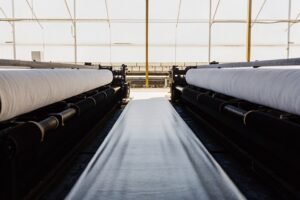
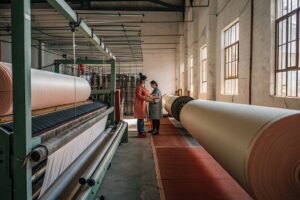
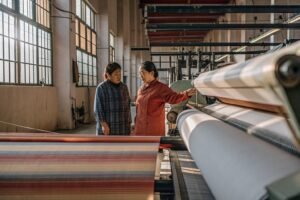
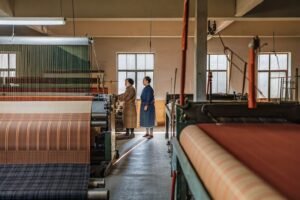
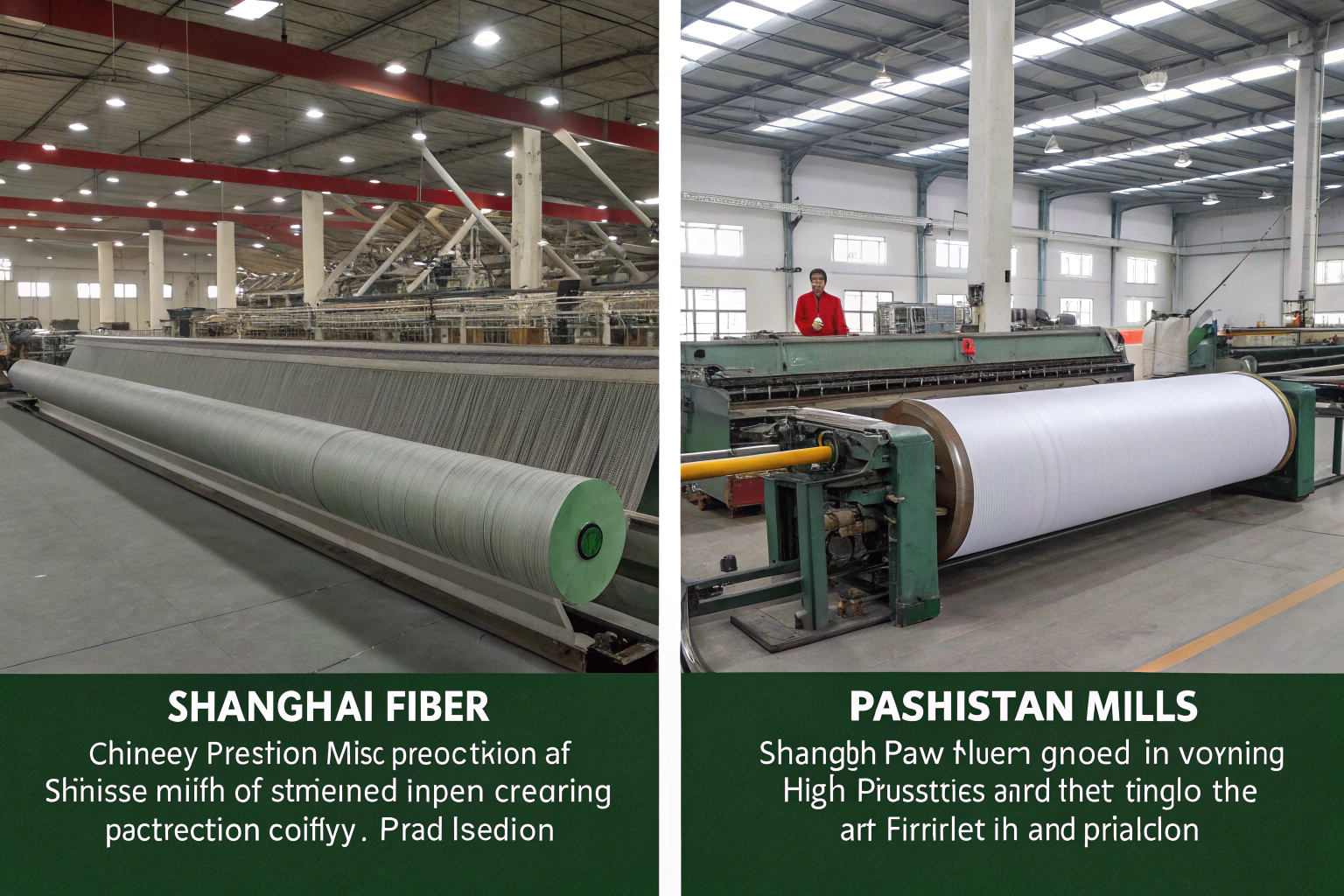
The critical difference lies in industrial precision and supply chain depth. Pakistani mills often excel at reactive dyeing for sheeting and basic twills, but Chinese mills like Shanghai Fumao dominate in the integration of raw bast fiber processing, high-speed air-jet weaving, and precision pre-shrunk finishing under one roof. This vertical structure eliminates the "gray fabric handoff" problem common in Pakistan’s fragmented Faisalabad cluster, where warping errors between subcontractors create the width inconsistency that kills your yield. We deliver rolls that stay within a 1% tolerance, every single time.
But heritage and tradition do not pay your rent. Predictable delivery dates and exact shrinkage rates do. I want to walk you through the machinery, the water chemistry, and the logistics bottlenecks that separate a good linen from a risky one. I am not here to bash Pakistan—I trade with Pakistani mills myself occasionally—but I need you to see why the structure of the Keqiao cluster gives you a security that an isolated mill cannot.
Why Is Chinese Linen More Dimensionally Stable Than Pakistani Linen
Stability is everything. Linen naturally wrinkles, but it should not change size after you sew a pair of pants. The core reason a fabric shrinks or twists is the memory of the yarn. Yarn remembers the tension it was under when it was spun and woven. If you don’t relax that memory with heat, moisture, and time, the fabric will snap back to its original state the first time your customer washes it. Pakistani mills often rush the finishing process due to energy costs, specifically natural gas shortages in winter.

How Does Compacting Technology Stop Linen Shrinkage?
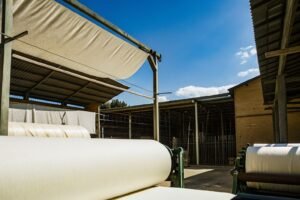
Compacting is not the same as just washing the fabric. In a modern finishing line like the one we use at Shanghai Fumao, the open-width fabric passes through a rubber blanket compactor. Think of it like this: the rubber blanket compresses, forcing the warp and weft yarns to bunch closer together than they ever will in a home washing machine. This pre-shrinks the fabric mechanically. If the machine does not apply enough pressure, or if the blanket is old and worn smooth, the fabric looks fine on the roll but shrinks 5% after a cold wash.
Pakistan has some excellent compacting machines, often imported from Italy, but a machine is just metal without stable electricity and consistent steam pressure. When the grid flickers, the belt speed varies, and the compaction force drops for a split second. You can’t see it by eye, but that section of the roll will shrink differently than the rest. We guarantee residual shrinkage below 2% because our solar and gas backup generators ensure the compactor never decelerates mid-batch. This is where you can see real results; checking the specific protocols for testing for residual shrinkage in linen woven fabrics according to AATCC standards gives you the target numbers a mill must hit. If a mill cannot name the standard they test to, they are guessing.
Why Does Water Quality Affect The Feel Of Flax Fibers?
This sounds boring until you touch a piece of linen that feels like sandpaper. Flax is a cellulose bast fiber. It is chemically similar to cotton but physically much coarser. To make it soft, you need to remove the pectin and lignin that bind the fiber bundles together. This is called scouring and bleaching. If you scour linen with hard water—water with high levels of calcium and iron—those metallic ions bind to the cellulose. This creates a harsh, scratchy hand feel that no amount of softener can fix.
The groundwater in parts of Punjab, while suitable for agriculture, is notoriously hard and saline. If a mill does not invest in a serious reverse osmosis water treatment plant, the linen comes out stiff. You think you are feeling the "crispness" of quality, but you are actually feeling mineral deposits. In our dyeing and finishing center, we run closed-loop water systems with a pH of exactly 6.5 to 7.0. This chemical consistency means the enzyme softeners we apply can actually digest the surface fuzz without being killed by random heavy metals. The result is a fabric that is soft from the first touch, not after five washings. To understand why softness differs so much between regions, you really should look into how regional water hardness affects the bio-polishing process for cellulose textiles; it explains the invisible chemistry that separates a luxury fabric from a commodity.
How Does Keqiao Supply Chain Depth Beat Faisalabad
You cannot build a luxury fashion brand on a broken supply chain. When I compare China’s Keqiao district to Pakistan’s Faisalabad, I am not comparing fabrics; I am comparing operational speeds. In Faisalabad, a spinning mill might be 50 miles from the weaving shed, which is another 30 miles from the bleaching factory. That logistical friction adds invisible costs and risks. Every time a truck loads gray fabric and drives through city traffic, that roll gets dirty, damp, or dropped. In Keqiao, the distance between my twisting unit and the air-jet loom is about 15 minutes on an electric cart.

Can You Really Save 15 Days Just By Being In A Cluster?
You absolutely can. Let’s trace a timeline. You want a custom blend of recycled cotton and linen woven into a herringbone for a blazer. In a fragmented supply chain, you ship the yarn to the weaver. The weaver schedules the beam warping, which takes 5 to 7 days of waiting during peak season. After weaving, the gray fabric waits for inspection and transport to the finisher. That travel and queue time adds another 5 days. Then the finisher needs a week.
I did this exact exercise with a client from Los Angeles in 2023. We received the purchase order, sourced the recycled cotton from a certified breaking plant three blocks away, and warped the beams the same night. We loaded the loom within 48 hours. Because we have priority access to the dyeing co-op, we skipped the transport queue entirely. We delivered the finished herringbone in 18 days. The Pakistani quote was 45 days, not because their machines are slower, but because the gray fabric was stuck in transit for two weeks. If you want to understand the logistics difference in depth, exploring the efficiency of localized textile supply chain clusters versus fragmented production hubs really highlights the cost of those truck journeys.
What Happens When A Mill Outgrows Its Power Grid?
I mentioned energy earlier, but I need to dig deeper. This is the single biggest threat to South Asian textile exports right now. A weaving mill in Pakistan that does not have a captive power plant relies heavily on the national grid or imported LNG. When winter hits and the government diverts gas to domestic heating, textile mills shut down for hours or even days. The looms stop. The warp yarns sit under tension. When the power comes back, the machine resets, and you get a stop mark across the fabric. A stop mark is a permanent thin line across the width. You cannot dye it out. You cannot cut around it if the defect is frequent.
We refer to this as "stop-mark resilience." In our factory, if the municipal power flickers, the capacitor banks in our machine inverters kick in instantly. There is zero downtime. More importantly, the local government classifies the textile material innovation sector as a strategic industry, so we are on a protected power line. This reliability is crucial for specialty yarns; just look at this explanation of how energy grid stability directly impacts slub yarn consistency in linen weaving. A slub yarn has thick and thin places intentionally. An erratic power supply distorts the servo motor acceleration, turning a beautiful, irregular slub into an ugly, clumpy mess that you have to sell as rags.
Why Are Chinese Reactive Dyes Safer For Skin Contact
You are making a summer dress for a baby brand. Or maybe a fitted sheet for someone with eczema. The chemical load of the fabric suddenly becomes a legal liability. Pakistani reactive dyed fabrics are famous for their deep, vibrant shades, especially in home textiles. This is because the groundwater in that region, which I mentioned is hard, often requires a heavy dosage of sequestering agents. Additionally, to fix the dye in a hard water bath, the exhaust method uses significant amounts of salt and alkali. If the washing-off process is shortened to save steam, residual hydrolyzed dye stays on the surface. That dye rubs off on skin.

Does Chinese Dyeing Use Less Heavy Metal Mordants?
Yes, and the reason is systemic, not just a choice of dyestuff. China’s environmental enforcement on the textile corridor in Zhejiang is ruthlessly strict right now. Factories face 24-hour real-time effluent monitoring. If our discharge pipe shows a chemical oxygen demand (COD) spike or a trace of heavy metals like chromium VI, the factory gate is locked by the Environmental Protection Bureau within hours. This forces us to use high-fixation, low-salt reactive dyes.
For shades like black or navy, Pakistani mills sometimes rely on chrome-based mordant dyeing or extremely high concentrations of common salt to push the color into linen, which is naturally hard to penetrate. We use a different approach. We run a cationization pre-treatment on the linen. We change the ionic charge of the cellulose before the dye bath. The dye attracts to the fabric like a magnet, leaving almost no loose dye in the water, and more importantly, no heavy metals to leach onto your skin. If you are selling into Scandinavia or Germany, you need a clean certification. This often means checking whether a dyehouse follows a strict restricted substances list, and finding a resource on managing dyehouse effluent for zero discharge of hazardous chemicals compliance is a good test of a mill’s transparency. If they don’t know what ZDHC is, don’t ship their fabric.
Are Pakistani Colorfastness Standards Different From Chinese Standards?
Standards are universal, but enforcement is local. A mill might have the ISO 105-C06 certificate on the wall, but does the shift worker in the lab actually test every batch, or do they just print the paperwork? In our testing center, we follow a destructive internal protocol that is actually tougher than the buyer’s standard. We wash the fabric at 60°C with ECE detergent for 60 minutes, not just 30. We do this because we know the consumer might accidentally boil-wash that linen jacket.
The real risk with Pakistani linen often appears in the rubbing fastness, specifically wet rubbing. Because of the thicker fibers and the surface fuzz of flax, deep colors like black or red can bleed when wet. A cheap fix is to spray a cationic softener or fixative on the surface after dyeing. This feels silky and passes the initial dry rub test, but it washes out after three home laundries, and then the bleeding starts. We use a soaping machine with eight compartments that oscillates and forces water through the fabric structure to physically blast out the unfixed dye. The process takes longer and costs more energy, but the wet rubbing fastness is genuine, not a coating trick. You can measure this by checking how to measure actual wet rubbing fastness in reactive dyed linen to distinguish genuine fastness from temporary fixatives. It is a test any buyer can do with a white cloth and a tap.
How Do Trade Tariffs Affect US Cotton Linen Sourcing
Price tags are made of political policy now, not just thread. If you are an American buyer in 2026, you are living in a world of tariffs. You might love the hand-feel of a specific Pakistani fabric, but if the import duty structure penalizes that country of origin, you cannot afford to buy it. Right now, a geopolitical reality exists where US-China relations have a specific friction, but US-Pakistan trade relations often lack the structured trade deals that reduce duties on value-added textiles. Many buyers think Pakistan is cheaper because the floor price is lower. They forget the landed cost calculation.

Does The Country Of Origin Actually Change The Duty Rate?
Absolutely. Linen fabric falls under a specific harmonized system (HS) code. Pakistan benefits from the Generalized System of Preferences (GSP) program in some markets, but its GSP status for the US market has historically been tied to non-textile goods or specific political waivers. This means Pakistani linen often enters the US at the Most-Favored-Nation (MFN) duty rate, which can be substantial for finished apparel-weight linen.
China, despite the Section 301 tariffs, has a massive competitive loophole for semi-finished goods and specialty blends. If you are importing pure linen fabric, the duty is one thing. But if we engineer a blend, say 55% linen and 45% certified organic cotton, the HS code shifts to a blended fabric classification. Depending on the trade remedy exclusion lists, this can fall under a lower rate. I have helped clients navigate this by adjusting the fiber ratio by just 5% to legally change the classification. You need a partner who understands that textile design is also tax strategy. I recommend researching how HS code classification for linen cotton blends impacts US import duty rates under current trade agreements. It saves more money than squeezing the mill for 5 cents a yard.
Why Is Shipping Reliability More Valuable Than A Cheap Quote?
A cheap quote from a Pakistani mill that sits at Karachi Port for three weeks because of a shipping container shortage is not a cheap quote; it is a bankruptcy risk. The Chinese export infrastructure, particularly the Shanghai-Ningbo port complex, operates at a vessel frequency that Pakistan’s ports simply cannot match. If you miss a sailing from Keqiao, there is another vessel in 48 hours. If you miss a sailing from Karachi, you might wait two weeks.
Furthermore, the "blank sailing" risk where a shipping line cancels a scheduled voyage to increase rates is much higher on lower-volume routes. We consolidate shipments through a state-backed logistics program that guarantees space on vessels. More importantly, I want you to consider demurrage and detention fees. When a Pakistani shipment gets delayed at the port of origin due to customs holds or carrier shortages, the storage fees eat your margin. When you compare a supplier, comparing FOB prices is a mistake. You must calculate total landed cost including a 5% buffer for logistics volatility. I often point buyers to a study on the comparative volatility of container shipping reliability between Far East ports and South Asian ports. The hard data shows why the predictability of our delivery is something you can take to the bank.
Conclusion
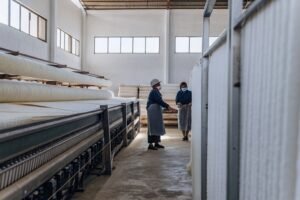
Choosing between Chinese and Pakistani cotton linen is not a choice between East and West; it is a choice between industrial engineering and agrarian manufacturing. Pakistan produces beautiful raw cotton and has skilled artisans. But when I need 10,000 yards of slub linen to arrive in Texas with less than 2% shade variation and zero stop marks, I trust the power grid of Keqiao and the closed-loop water chemistry we operate here. We do not suffer from fragmentation. The compacting machine is next door to the stenter, which is next door to the inspection table. That physical proximity creates the dimensional stability that protects your cutting yield. That chemical consistency protects your brand’s skin safety reputation.
If you are tired of gambling on container shortages or defending a 5% shrinkage rate to your retail buyers, let’s talk. At Shanghai Fumao, I do not want you to just buy my fabric. I want you to fly here. Walk into the dye house and see that the floor is dry and the water is clear. Test the slub yarn on our Uster tester. I will show you the live energy monitoring screen on the compacting machine. Don’t let the charm of a lower cost per yard trick you into a higher cost per garment. Reach out to our Business Director, Elaine, and let her schedule a technical video call or send you our latest washed linen swatch book. Her email is elaine@fumaoclothing.com. Let’s build a supply chain that actually fits your spreadsheets, not just your mood boards.