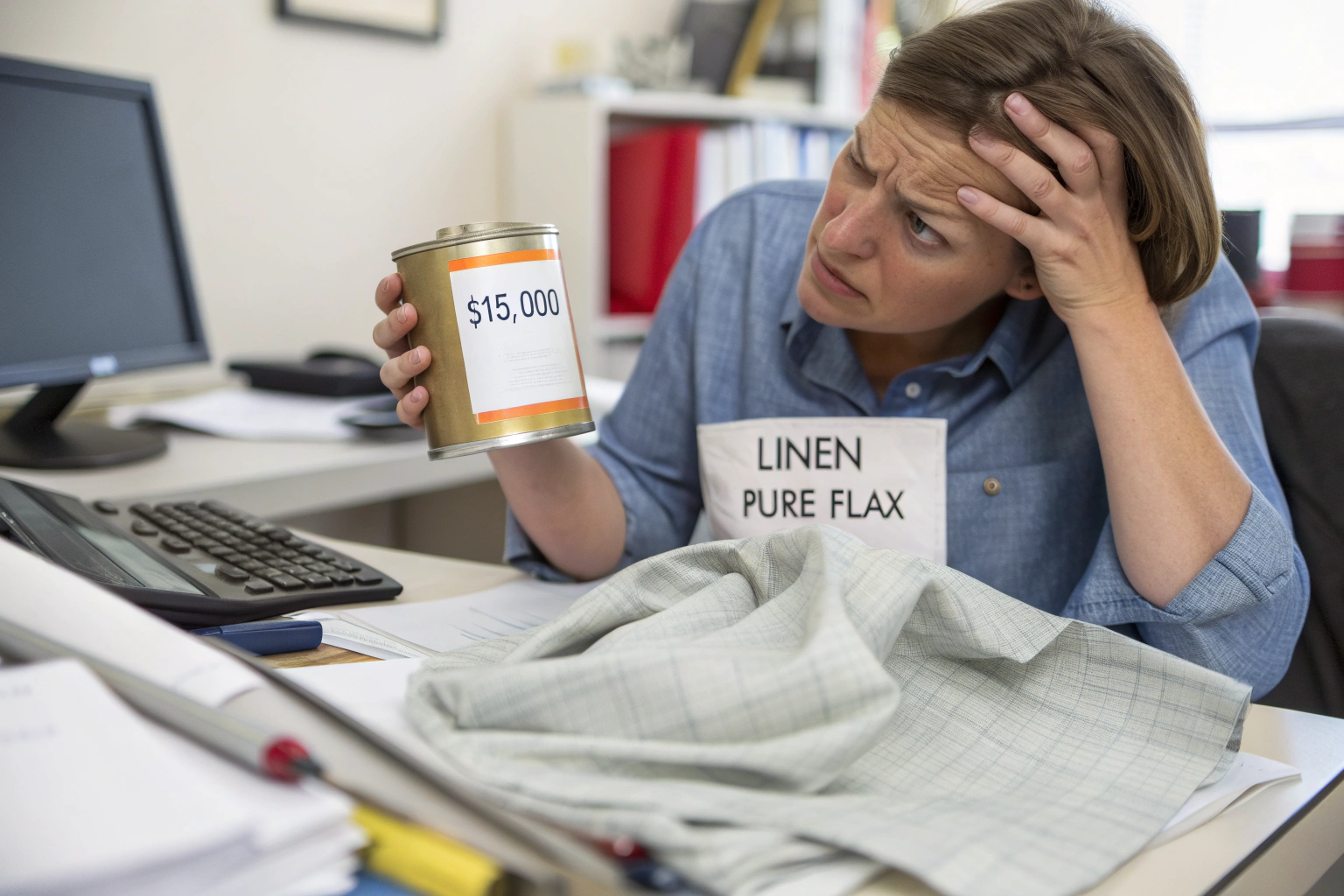
You just spent $15,000 on a container of what you thought was premium European-standard linen. The supplier sent you a shiny certificate that says it’s pure flax. But the fabric feels weird. It melts when you do a lighter test instead of turning to ash. Panic sets in. I see this nightmare happen to buyers almost every month. They think a piece of paper with a logo on it means quality, but in the textile industry, a fake certificate is just a photocopy away. This fear of being cheated stops you from trusting good suppliers. But the truth is, spotting a fake document is easier than you think if you know where to look.
The quickest way to verify a fabric mill certificate is to cross-check the CNAS accreditation number on the document against the official database. Every legitimate testing report from a facility like ours has a unique serial number linked to the QR code on the fabric roll. If the physical swatch doesn’t match the digital report, or if the lab code isn’t registered under the China National Accreditation Service, you are holding a forged document. We embed supply chain data into every yard to stop this exact fraud.
You don’t need to be a chemist to protect your business. You just need to stop trusting the paper and start trusting the data behind it. Let me show you how I personally tell a real fiber test from a fake one in under 60 seconds, and how our team at Shanghai Fumao builds a verification system that makes counterfeiting impossible.
How To Verify Chinese Linen Fabric Certification Online
You know that sinking feeling when a vendor sends you a "certificate" that is just a blurry JPEG? I lost a deal to a counterfeit ring back in 2019 because they could fake a document faster than we could prove we were real. That’s why I went all-in on digital verification. You can’t trust a static PDF anymore. You need to see a live trace of your fabric’s journey.

Can I Check A Cotton Batch Number Online In Real Time?
We do not store our test results on a piece of paper that gets lost in a drawer. The moment our CNAS-certified lab finishes testing a batch for colorfastness or shrinkage, we push that data into a cloud database. A unique QR code is generated and physically sewn into the selvedge of your fabric or printed on the hangtag. You scan it with your phone. It pulls up the exact composition ratio, the shrinkage percentage, and the passing standard.
Make sure you are looking at a real interactive report, not a static image hosted on a fake page. A fraudulent supplier might link you to a cloned website that looks like an SGS or ITS portal. You need to check the URL domain registration. A legitimate report from our supply chain is hosted on a secure server linked directly to the enterprise resource planning system. If the "online report" is just a JPG uploaded to a random blog, walk away. For example, if you want to learn more about how these systems integrate with the internet of things, reading about how to implement textile QR code traceability systems can open your eyes to what the real technology looks like.
Why Does A CNAS Accreditation Number Matter For Linen?
A lot of American buyers don’t know the power of the CNAS stamp. It’s not just a local Chinese mark. The China National Accreditation Service for Conformity Assessment is a signatory to the International Laboratory Accreditation Cooperation (ILAC) Mutual Recognition Arrangement. That means a test done under a valid CNAS scope carries the same weight as one done by AATCC in the U.S. if the standard is mutually recognized.
Here is what scammers miss: the scope of accreditation. Every CNAS lab has a list of standards they are approved to test. A fake certificate often uses a random lab number, but that lab might only be certified to test toys, not textiles. You need to Google the lab name and number. Find the official "Scope of Accreditation" PDF. Search within it for the specific standard printed on your certificate, like ISO 105-B02 for light fastness. If the standard isn’t listed in that scope, the report is technically invalid. We openly display our scope list because we test everything from recycled polyester blend verification to aramid fiber strength internally.
How To Tell If A Flax Certificate Is Counterfeit
Physical certificates are easy to fake. Physical fabric is not. Even if the paperwork looks perfect, the yarn in your hand tells the truth. I always teach my new staff to trust the burn test and the microscope before trusting the paperwork. I had a customer in Germany last year who almost accepted a 40-foot container of "100% French Linen" that was actually heavily blended with jute. The certificate looked perfect—until we did a burn test on a video call.

Does A Burn Test Prove A Flax Certificate Is Real?
Yes, and it is the cheapest chemical analysis you can do from your office. Real flax (linen) comes from the stem of the plant. It has a high cellulose content. When you burn it, it catches fire quickly, burns with a steady yellow flame, and leaves a fine, grayish ash that looks like crumpled paper. It smells exactly like burning leaves or dry grass. Synthetic fibers like polyester melt and drip like hot plastic, forming a hard black bead that you can’t crush between your fingers. Cotton also burns clean, but it doesn’t smolder the way linen does after you blow it out.
But here is where you catch the sophisticated liars. They mix ramie into the linen. Ramie is also a cellulose bast fiber, so the burn test looks almost identical. You cannot tell the difference between flax and ramie by fire alone. You have to check the moisture wicking and stiffness. Flax wicks moisture faster than ramie. If the certificate says 100% European Flax but the fabric feels unnaturally stiff and wiry, they swapped it. I always cross-reference the burn test with a twist test to check the individual fiber ends. To get this right, you might need a step-by-step guide on how to do a professional fabric burn test to identify natural fibers. It saves you from buying a container full of woven weeds.
Why Do Fake Linen Certificates Get The Weight Wrong?
This is my secret trick. Grams per square meter (GSM) is the lie detector of the fabric industry. A fake certificate often copies the numbers from a genuine template but the physical fabric doesn’t match. Why? Because the factory printing the fake document doesn’t have the technical skill to produce the exact weight. A real pure linen sheeting usually sits around 170 to 200 GSM. A fraudster might sell you a heavier fabric to make it feel "premium," but pure flax is actually quite light.
Check the tolerance. Legitimate testing reports always state a tolerance, usually +/- 5%. If your physical swatch is 10% heavier than what the certificate states, the certificate is either forged or swapped from a different batch. I tell my clients to buy a $20 digital scale and a circle cutter. Cut a perfect 100cm² circle of your sample, weigh it, and multiply by 100. If the numbers don’t match the report within the tolerance, refuse the shipment. Also, check for "sizing" agents. Some mills add heavy starch to make cheap open-weave fabric feel heavy. You can detect sizing by checking fabric weight before and after washing, because the starch will wash out and the fabric will become thin and flimsy.
What Makes A Fabric Mill’s Testing Report Trustworthy
You have the burn test down. You checked the weight. Now, how do you judge the paper itself before you even see the fabric? I believe a trustworthy report is one that admits a weakness. If I send you a report for 10 yards of denim and it shows a "Grade 4" for rubbing fastness instead of "Grade 5," you should trust me more. A fake report always claims perfection. It will show zero shrinkage, 100% colorfastness, and infinite tensile strength. Real fabric never behaves like that. It fades a little. It shrinks a tiny bit. We test 100% of our batches, and we always disclose the weak points.

How Can I Spot A Fake SGS Or Intertek Report?
Scammers love copying SGS and Intertek logos because buyers trust them. But they often forget the anti-fraud features. A genuine SGS report has a specific contact verification. You can call the SGS office listed on the report and quote the report number. Most counterfeit reports use a random numeric string that doesn’t exist in the SGS database. Also, look at the "Date of Issue." A fake report is often dated to a time when the testing lab was supposedly shut down for Chinese New Year or a public holiday. That’s a dead giveaway.
Pay very close attention to the sample photo on the report. In a real report from a lab like ours, the attached picture of the tested swatch will match your fabric exactly. A cheap forger will take a screenshot from your website or Alibaba listing and paste it into the report. The weave structure in the photo won’t match the physical sample. If you are sourcing complex textiles, understanding the procedure for verifying an international third party fabric testing report is crucial. I often send clients a "digital fingerprint" of the fabric before I even ship it. It’s a 400x zoom microscopic photo of the weave. You can’t replicate that weave pattern randomly, it’s like a snowflake.
Why Do Real Fabric Tests Include Failed Parameters?
I touched on this before, but let me dig deeper. A completely clean sheet with zero anomalies is a red flag in textile manufacturing. Even the best finishing machines in the world cannot achieve 0% skew. If your fabric is heavily brushed or printed, there will be skew. A technical report should show the actual result against the "Limit" or "Standard."
Let me show you a typical internal tolerance table we use here at Shanghai Fumao to illustrate what a normal report looks like compared to a suspicious one.
| Quality Parameter | Acceptable Real Result (Normal) | Suspicious Result (Likely Fake) |
|---|---|---|
| Tensile Strength | 450 N (Pass/Fail limit 400 N) | 700 N (Unrealistic high) |
| Dimensional Change | -2.5% Length (Within -3% limit) | 0.0% (Impossible for cotton) |
| Saliva Colorfastness | Grade 4 (Slight staining) | Grade 5 (Zero color transfer) |
| Pilling Resistance | 3-4 (Slight fuzzing) | 5 (No change at all) |
Notice how the "Suspicious" column looks like a robot wrote it? Children’s wear requires strict tests on things like saliva colorfastness. A real test often shows a slight drop in color, a "stain" on the multi-fiber ribbon. If the report says absolutely zero color bled onto the ribbon for a dark reactive dye, the data is fabricated. We are dealing with physics and chemistry here, not magic. A piece of reactive dyed black cotton is chemically designed to shed a tiny bit of unreacted dye. I respect a buyer who understands this nuance more than one who blindly demands a perfect score on paper. You don’t need a perfect certificate; you need a safe and honest one.
Why Are Some Cotton Linen Shipping Papers Invalid
This is the part where the money actually leaves your account, so the paperwork matters just as much as the fabric. A valid textile certificate is useless if the shipping documents are fraudulent. I see this often with Eastern European buyers who need preferential tariff treatment. A supplier sends a "Form A" or "Generalized System of Preferences (GSP)" certificate, but the delivery address doesn’t match the export declaration. Customs flags it, the fabric gets stuck for weeks, and you pay storage fees.

Can A Packing List Conflict With A Quality Certificate?
Absolutely, and it happens all the time. The quality certificate might say "Batch A123: 1000 yards." But the packing list shows 800 yards of Batch A123 and 200 yards of an unidentified roll. You are missing product consistency. If the invoices don’t align with the testing scope, you might be receiving untested scrap material mixed into your order. This is especially dangerous for coated fabrics where you are paying for a specific fire retardant or anti-fungal treatment.
For logistics, you must check the container seal number. A legitimate set of shipping papers ties the seal number to the bill of lading. A common scam involves loading fake fabric into the container at a secondary warehouse after you’ve inspected a perfect sample. By the time the ship sails, you have no recourse. I always insist on a live loading video or a supervised loading by a third-party agency like SGS. If you are shipping on a tight timeline, you can mitigate risk by learning how to plan your supply chain around Chinese production schedules for textiles. (Here is a pro tip: we load our containers 1 week before the Chinese New Year shutdown, so the goods are on the water while the factory is closed—saving you 3 weeks of waiting. Timing is everything.)
How Do Incoterms Affect The Validity Of Fabric Documents?
The risk transfer point decides who owns the certificate. If you are buying Free On Board (FOB), the supplier’s liability for the physical state of the fabric ends when the goods cross the ship’s rail at the port of export. That means if the container gets flooded on the ship, the insurance is your problem, but importantly, a fake certificate discovered after loading becomes a legal dispute, not a quality dispute. You can’t easily reject the goods.
Under Delivery Duty Paid (DDP), the supplier takes all the risk until the truck arrives at your warehouse. A supplier offering DDP is far less likely to forge a certificate because they retain full liability for customs clearance. If a customs authority in Germany or the US tests the fabric and finds it is 60% polyester instead of 100% flax, the supplier under DDP pays the fine, the return freight, and the destruction cost. We offer DDP for this exact reason: it forces the seller to be honest. To understand exactly what your obligations are, you should review a comprehensive guide to Incoterms rules for importing textiles into the United States. It will explain how the title transfer impacts your legal standing.
Conclusion
Spotting a fake cotton linen certificate isn’t about finding a hidden watermark. It’s about realizing that a piece of paper is just a shadow of the physical roll. I’ve taught you to distrust perfection, to burn a thread, to weigh the piece, and to check the digital trail behind the lab code. A real certificate documents the slight imperfections of a natural fiber. A fake one pretends those imperfections don’t exist. We have woven QR codes into selvedges and admitted our pilling scores are 3-4 just to prove we are telling the truth. In a market flooded with low-quality forgeries, technical transparency is the only thing that cannot be counterfeited.
You shouldn’t have to risk a $15,000 deposit just to find out if a supplier can tell the difference between flax and ramie. At Shanghai Fumao, we don’t just hand you a certificate; we hand you the lighter to do the burn test and the login to the live server to check the batch number. I invite you to test us. Send us a competitor’s fabric that you suspect is fake. We will run it through our CNAS lab and send you the results, no strings attached. We want you to see how a real supply chain operates. If you are ready to stop worrying about paperwork and start building a clothing line with verified, high-quality natural fibers, reach out to our Business Director, Elaine. She can set up your first batch of certified linen or cotton with full digital traceability. Just drop her an email at elaine@fumaoclothing.com. Let’s get your production right, right from the yarn up.