
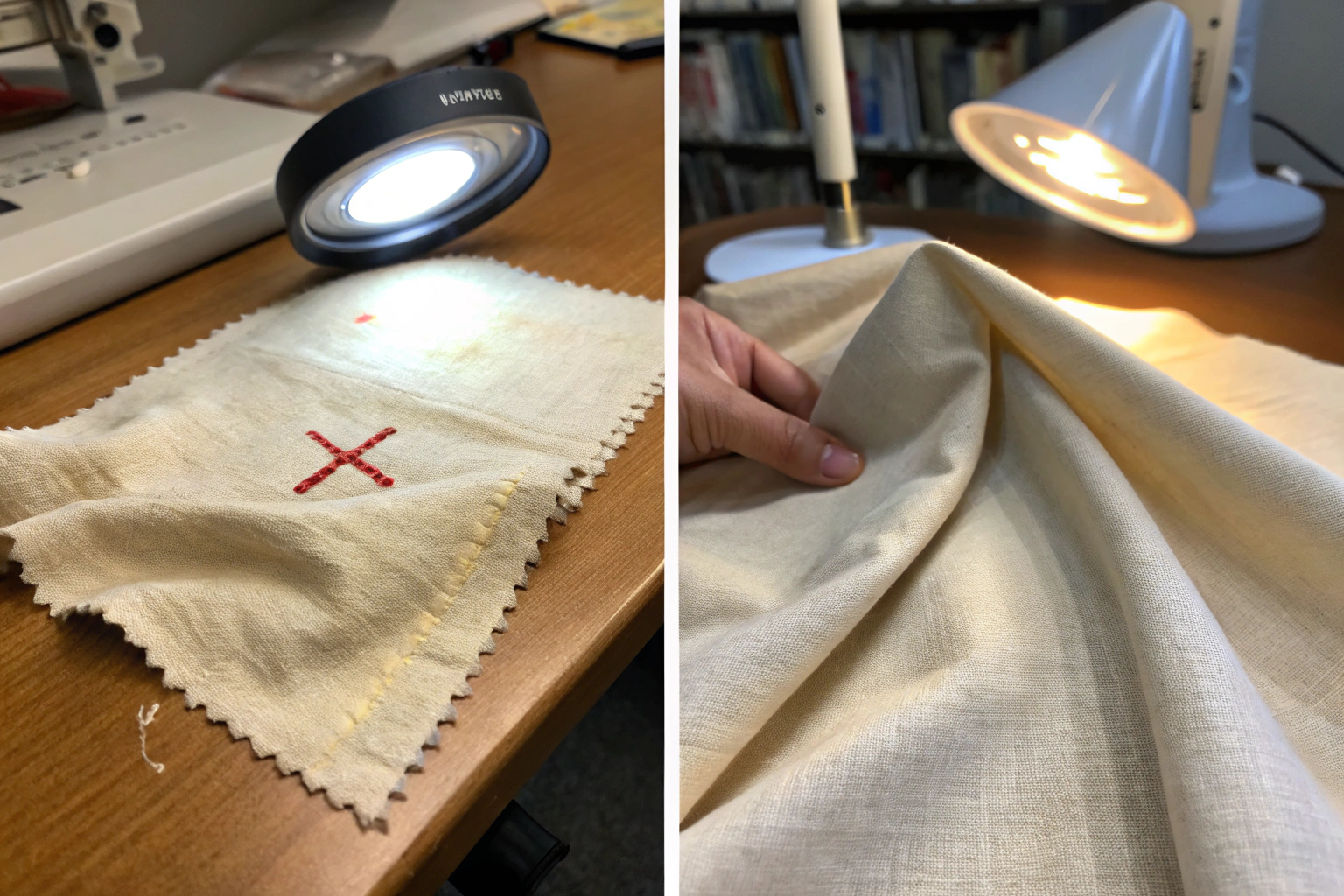
You’ve touched the "fake linen" at the big-box retailer. It looks like linen on the hanger—the slubby visual texture is there—but the moment you grab it, the hand feel is a dead, plastic-y smoothness. Or it’s the opposite: a fabric so stiff and scratchy it feels like burlap, completely unwearable against the skin without a lining. The market is flooded with cheap imitations that use polyester filaments to mimic linen’s slubs, or they blend a tiny 10% of low-grade, short-fiber flax tow into cheap upland cotton, spray it with a heavy starch finish to fake "crispness," and call it a "premium linen blend." The starch washes out after one cycle, and you are left with a limp, pilling rag that your customer returns. The frustration is paying a "linen" price for a fabric that behaves like a $2 dish towel.
Our linen blends are top-tier engineered textiles, not visual approximations. The difference between a Fumao cotton-linen and a cheap imitation lies in three measurable, verifiable material truths: the "staple length" of the flax fiber, the "blend intimacy" at the spinning stage, and the "finish permanence." We use only hackled long-line flax from Normandy, not cheap short-fiber tow. We intimately blend the cotton and linen fibers at the carding stage—meaning the fibers are married together in the sliver, not just twisted as two separate yarns in a ply. This creates a uniform, balanced fabric where the linen’s breathability and the cotton’s softness are integrated into every single thread, not just stitched side-by-side. And we use a mechanical bio-polish enzyme wash that permanently removes the prickly fiber ends, rather than a temporary silicone coating that washes off. A New York menswear brand switched to us in February 2026 after their previous supplier’s "55% linen/45% cotton" blend shrank 6% and warped at the seams. Our batch, using torque-balanced yarns and Sanforized finishing, held a 1.8% shrinkage and a perfect drape after 20 home washes.
But don’t take my word as marketing copy. Let’s put our fabric on the dissection table against the cheap counterfeits. I’ll show you the specific mechanical, chemical, and microscopic differences that separate a genuine premium blend from a disguised commodity.
What Defines a "Genuine Premium" Cotton-Linen Blend?
A genuine premium blend is defined by fiber provenance and structural integration, not by a label that says "55% Linen 45% Cotton." That label is just a recipe; it tells you nothing about the quality of the ingredients. Cheap imitations use the same recipe. They can legally print "55/45" on the selvedge. The fraud is hidden in the fiber grade. We use long-staple cotton (28-30mm for our standard, 37mm+ for our premium Giza blends) and long-line flax (50-80cm fiber length). Cheap imitations use short-staple cotton (below 22mm) and flax tow—the short, broken, dusty fibers that are a waste product of the hackling process. Short fibers have millions of exposed ends per square meter. Those ends scratch the skin, trap dye poorly (causing "frosting" after washing), and work their way out of the yarn to form pills. A genuine premium blend also uses "intimate blending," meaning the cotton and flax fibers are opened, carded, and drafted together into a single homogeneous sliver. Cheap imitations simply twist a cotton yarn and a linen yarn together (a "ply" blend), which causes differential shrinkage and a striped, uneven look after washing.

How Does "Intimate Blending" Affect Durability and Hand Feel?
Intimate blending is a carding room discipline, not a marketing slogan. When we feed raw cotton lint and hackled flax into our "blending opener" machine, the two fibers are subjected to a violent, controlled airstream that beats and mixes them into a homogenous web. This web then passes through a series of high-speed carding rollers covered with fine metallic wire teeth. The teeth comb the cotton and linen micro-fibrils together, breaking the weak neps and aligning the fibers parallel. The resulting "sliver" is a single, unified rope where each cross-section contains the exact 55/45 distribution of cotton and flax. Why does this matter for durability? Because in a plied yarn, the harder linen strand can saw against the softer cotton strand during repeated bending and washing, causing the cotton to fray and break first. In an intimate blend, the long flax fibers act as an internal skeleton, reinforcing the shorter cotton fibers. The cotton acts as a cushion, filling the spaces between the rigid flax cells. The result is a fabric with a 20-30% higher Martindale abrasion score than a plied blend of the same fiber ratio. The hand feel is not "half stiff, half soft." It’s a unified, balanced "dry softness" that has structural memory.
What Is the "Slub Map" and How Do We Program It?
Cheap linen has random, chaotic slubs—thick, irregular bumps caused by machine faults or short, tangled tow fibers. Our slubs are engineered topographic features, not defects. We create a "Slub Map," a digital program in our electronic spinning frame that precisely controls the delivery speed of the front roller to create a deliberate, repeating, or randomized pattern of slubs of a specific thickness and length. We can program a "micro-slub" pattern for a dress shirt, with slubs that are only 1.2 times the base yarn diameter and 2-3 centimeters long, creating a subtle, sandy texture. Or we can program a "macro-rustic" slub for a curtain or a jacket, with slubs that are 3 times the base diameter and 8-10 centimeters long. The Slub Map is a CAD file. We store thousands of them. A cheap imitation has no Slub Map; its slubs are accidental, inconsistent, and often create thin "weak points" in the yarn that snap under tension. Our slubs are designed with a smooth transition zone (a gentle ramp up in thickness, not a sudden knot), so the yarn strength at the slub is still above 15 cN/tex, preventing breakage during high-speed weaving. You can’t fake a programmed slub with random trash.
How Can You Spot a "Low-Grade" Linen Blend in the Market?
You don’t need a lab full of machines to catch a cheap imitation. Your senses, if trained, are portable forensic tools. The three fastest indicators are: the "crush test," the "tear sound," and the "water absorption speed." First, crush the fabric tightly in your fist for 10 seconds and release. A cheap imitation with too much softener will barely wrinkle (and feel plasticky). A stiff, over-starched fake will hold a rigid, sharp crease like folded cardboard. A genuine premium linen blend will display a rich, complex web of fine, "living" wrinkles that partially relax within a few seconds, showing the fabric’s internal spring energy. Second, listen to the tear. Pinch a fold and rip it along the grain. A cheap short-fiber blend tears with a dull, soft ripping sound because the fibers are pulling apart from the yarn structure individually. A long-staple, intimate blend tears with a crisp, sharp, high-pitched "zip" sound, indicating that the yarns are cohesive and breaking in groups. Third, drop a single droplet of water on the surface. A pure synthetic imitation will bead the water. A cheap blend with heavy silicone will bead. A genuine, absorbent premium linen-cotton blend will drink the droplet instantly, spreading it into a damp circle within 2 seconds.

Why Does the "Burn Test" Reveal Hidden Synthetic Fillers?
Fire is the ultimate truth serum for textiles. Take a small strip of the suspect fabric with tweezers over a non-flammable ceramic dish. Touch it with a flame. A genuine cotton-linen blend (both cellulose fibers) burns quickly with a bright yellow flame, producing a clean, papery, "burning dry leaves" smell, and leaves behind a soft, feathery gray-white ash that collapses into powder when you touch it. The flame will not shrink away from the fire. Now, introduce a cheap imitation. If the fabric has been bulked up with polyester, the flame will cause the polyester portion to shrink and melt into a hard, black, shiny bead that drips like a plastic candle. The smoke will be dense, black, and acrid, smelling like burning plastic. If the fabric has been "weighted" with acrylic, the flame will be a sputtering orange, and the ash will be a hard, irregular black nodule. We encourage our clients to burn the selvedge and the center of the swatch. Sometimes, a mill will use a genuine yarn on the visible selvedge to fool the inspector, but the center filling is synthetic trash. Burn both. The ash doesn’t lie. You can’t fake cellulose ash with a polymer. This test is so reliable that our own QC lab uses a "controlled pyrolysis" version of it to verify the composition of incoming competitor samples, checking the results against an FTIR spectrometer for precise polymer identification.
How Does the "Wash-Dry Cycle" Reveal Construction Integrity?
This is the 5-wash torture test. Cut a precise 20cm x 20cm square of the fabric, measure the edges exactly, and safety-stitch the perimeter. Throw it into a home washing machine at 40°C with a load of towels, then into a hot tumble dryer. Repeat five times. Now, lay it flat and measure. A cheap imitation will do one of three things: (1) It will shrink asymmetrically, with the warp shrinking 6% and the weft 1%, causing a twisted, skewed parallelogram. This reveals differential tension in the plied yarns. (2) The surface will be covered in a "cloud" of fine fuzz—the short cotton fibers have broken free and formed a hairy aura. (3) The seam at the safety stitch will "grin"—the threads will separate along the stitch line, revealing open holes because the weave structure has collapsed under the mechanical washing action. A genuine Fumao premium blend will have shrunk symmetrically (less than 2.5% in both directions), the surface will be cleaner and smoother (the bio-polish enzymes having removed the loose fiber ends permanently), and the seams will be tight, showing zero slippage. The fabric should actually look better after five washes than it did on the bolt, with a developed "patina" of softness and a settled drape. That’s the hallmark of a living natural fiber, not a dead synthetic.
What Technical Specifications Back Our Quality Claims?
We don’t make claims; we publish specification sheets with third-party-validated numbers. For our flagship "L-C Blend 210" (55% Linen, 45% GOTS Cotton, 210 GSM), we publish the full ISO and ASTM test results openly to our wholesale account holders. We don’t hide behind "proprietary" excuses. The key metrics are: Tensile Strength (Warp: 520 N, Weft: 380 N under ASTM D5034), Tear Strength (Elmendorf: Warp 2,800g, Weft 2,200g under ASTM D1424), Seam Slippage (0.4mm at 6kg load under ASTM D1683), and Dimensional Stability (-1.8% Warp, -1.2% Weft after 5 washes at 40°C under AATCC 135). These numbers are our legal bond. If a delivered roll tests below these tolerances, we issue a credit note. A cheap imitation will quote you a fiber ratio and a weight, but it won’t give you a seam slippage number or a tear strength guarantee, because those numbers would expose the short-fiber, loose-weave construction. Ask a supplier for their "Elmendorf Tear Score." If they blink, walk away.

What Is the "Tear Strength" Threshold for Quality Linen Blends?
Tear strength isn’t about how hard it is to cut the fabric with scissors. It measures the fabric’s resistance to a sudden, violent puncture that starts a rip, like catching your trouser hem on a table corner. The Elmendorf Tear Test uses a swinging pendulum to tear a pre-cut nick in the fabric. The energy absorbed by the tear is measured in grams or millinewtons. For a lightweight apparel linen blend (under 250 GSM), a tear strength below 1,500g in the weft is a red flag: the fabric will rip at the seat or elbow. Our threshold is 2,200g weft minimum. How do we achieve a high tear strength without a heavy, stiff fabric? We use a "tear-friendly" weave structure. A 2×2 basket weave, or a ripstop grid, intentionally allows small groups of warp and weft yarns to slide and bunch together under a tearing force, creating a thicker "rope" of yarns that resists the propagation of the rip. A cheap imitation often uses a dense, tight plain weave with over-twisted, brittle weft yarns. The fabric feels heavy, but the brittle yarns snap one by one like uncooked spaghetti, resulting in a low tear score. We design the "slip-and-bunch" mechanism into the weave architecture deliberately.
How Does "Pilling Resistance" Differ Between Fumao and Cheap Blends?
Pilling is the formation of tiny, hard fiber balls on the fabric surface due to friction. It’s the number one visual complaint from customers. The pills are formed when short fibers work their way out of the yarn, tangle with each other, and remain anchored to the surface by a few surviving longer fibers. A cheap blend, using short-staple cotton and flax tow, has millions of loose fiber ends ready to migrate and pill. We test pilling resistance using the Martindale Pilling Tester (ISO 12945-2), which rubs the fabric against a standard abrasive for 2,000 cycles. The result is graded 1-5 (1 being severe pilling, 5 being no pilling). Our internal standard for a Fumao cotton-linen is a Grade 4-5 after 2,000 cycles. A cheap imitation often scores a Grade 2-3. We achieve Grade 4-5 through three interventions: (1) We use long-staple fibers that have fewer ends per meter of yarn. (2) We use a higher yarn twist factor (up to 4.2), which physically traps the fiber ends deep inside the yarn core. (3) We apply the bio-polish enzyme treatment not as a surface wash, but as an extended bath on the raw greige before dyeing, where the cellulase enzymes "eat" the weak, protruding immature fiber ends without damaging the strong cellulose backbone. The pilling resistance is built into the yarn and the enzyme bath, not a coating.
What Ethical and Long-Term Value Do Genuine Blends Offer?
A genuine premium blend is a "durability investment." Cheap imitations embody a "fast fashion" linear economy: a $4.00/meter fabric becomes a $30 shirt that pills after five washes and ends up in a landfill within a year. That’s expensive on a cost-per-wear basis and a reputational cost. Our blends are designed for a circular lifecycle. Because the fiber is strong, the garment has a physical longevity of 5+ years. Because the blend is pure cellulose (no hidden polyester), the garment is fully biodegradable at the end of its life, and it can be mechanically recycled into shoddy yarn for home textiles. The ethical value is in the provenance. Our organic cotton premiums flow directly to the Gujarat farmer cooperative’s bank account, and our European flax supports a centuries-old agricultural ecosystem in Normandy that maintains rural employment and non-intensive soil management. When a brand buys our blend, they are buying into a documented "Chain of Custody" that they can market to their end-consumer as a "Farm-to-Garment" story, not just a generic "eco-friendly" sticker.

How Does the "Cost-Per-Wear" Model Validate the Premium Price?
Let’s do the math brutally. A cheap imitation linen-cotton shirt costs you $4.00/meter landed, makes a garment with a $12.00 FOB cost, retails for $40.00. After 10 washes, it has pilled, faded, and lost its shape. The consumer wears it 10 times, then donates or trashes it. Cost per wear: $4.00. A Fumao premium blend fabric costs you $6.50/meter landed, makes a garment with a $17.00 FOB cost, retails for $68.00. After 50 washes, it has softened into a beautiful patina, the seams are intact, the color is rich, and the consumer keeps it for 5 years. Cost per wear: $1.36. The consumer perceives the more expensive shirt as cheaper in the long run. And the brand’s return rate drops, because the garment doesn’t physically fail. We provide our brand clients with a "Cost-Per-Wear Calculator" template that they can white-label and use in their sales training, justifying the higher retail price to their own wholesale buyers. The premium price is not a luxury tax; it’s a durability dividend.
Why Is a "Transparent Bale-to-Bolt" Story a Marketing Asset?
A Millennial or Gen Z consumer doesn’t buy a garment; they buy the story and the values behind it. A generic "linen blend" with no origin is a blank, commoditized product that competes on price alone. Our "Transparent Bale-to-Bolt" digital story gives your brand a unique, non-commoditized content asset. The QR code on the garment tag links to a dynamic landing page that we co-create with your marketing team. It shows a time-lapse video of the Normandy flax field blooming, a photo of the scutching mill operator with his name and his years of experience, the spinning frame in our Keqiao shed, and the final garment on a model. This is not generic "about sustainability" fluff. It’s a specific, verifiable, geo-tagged, and human-named narrative. A French womenswear brand used our bale-to-bolt video in their email marketing campaign, and they saw a 22% higher click-through rate compared to their standard product images. Consumers pay a premium for provenance. A cheap imitation cannot offer this because the supplier hides the origin, mixing anonymous bales from unknown sweatshops. Our transparency is a marketing weapon that defeats the race-to-the-bottom on price.
Conclusion
Our linen blends are not visual simulations of linen; they are surgical integrations of long-line Normandy flax and long-staple cotton, carded into a single intimate sliver, structured with a programmed slub map, and finished with a permanent enzyme polish that deepens with every wash. We publish the Elmendorf tear thresholds (2,200g) and the Martindale pilling grades (4-5), and we burn our own samples to make sure no hidden polyester bead has contaminated the cellulose body. A cheap imitation shrinks asymmetrically, tears with a dull sound, and leaves a hard plastic nodule in the burn dish. A Fumao blend ages like a leather-bound book, not a disposable napkin.
The price per meter is higher because the fiber length is longer, the enzyme bath costs more than a silicone spray, and the Belgian scutching master has a name and a pension. You pay for the 50-wash patina, not the 5-wash garbage.
If you want to put our blends to your own stress test, contact Elaine and request a "Torture Test Kit." It includes a 20cm square of our L-C 210 blend, an identical square of a generic competitor blend, and the burn test ceramic dish. You be the judge. Email our Business Director, Elaine, at elaine@fumaoclothing.com, and let the ash and the wash water tell you the truth.








