I was on a video call with a client in Milan two weeks ago. She’s a mid-sized womenswear brand, been sourcing from China for about five years. She looked worried. "I’m hearing about new EU rules for 2026," she said. "Something about due diligence, digital passports, deforestation? I don’t even know where to start. Is China still viable for Europe?"
That question is echoing through every European buying office right now. The EU is rolling out the most significant package of trade and sustainability regulations in a generation. Some of it is already law. More takes effect in 2026. And if you’re sourcing garments from outside the EU—especially from China—these changes will fundamentally shift how you operate.
But here’s the thing I told her, and I’ll tell you: it’s not the end of sourcing from China. It’s the end of sourcing without documentation. The rules are stricter, but they’re also clearer. And for suppliers like us who’ve been preparing for years, 2026 is actually an opportunity to separate the professionals from the amateurs.
Let me break down exactly what’s changing, what you need to do, and how to keep your EU business flowing smoothly.
What are the major EU policy changes coming in 2026?
The EU isn’t passing one law—it’s passing a web of interconnected regulations that together create a new compliance landscape. You can’t look at them in isolation. They work together to force transparency.
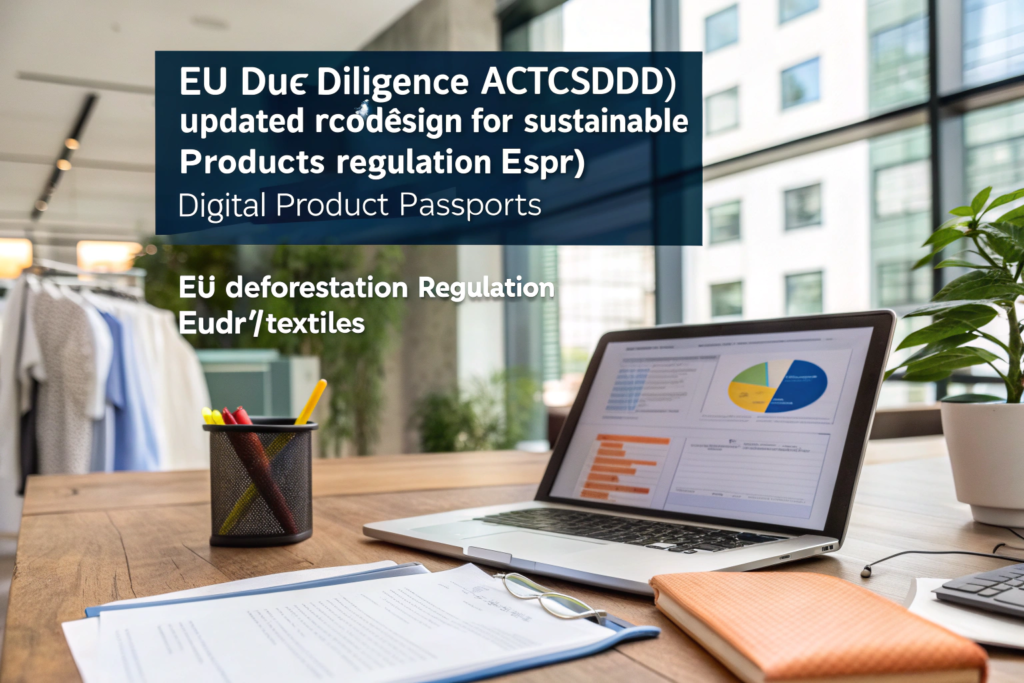
The three biggest changes for garment sourcing in 2026 are: the EU Due Diligence Act (CSDDD), the updated Ecodesign for Sustainable Products Regulation (ESPR) which introduces Digital Product Passports, and the extension of the EU Deforestation Regulation (EUDR) to include textiles. Together, they require brands to prove their products are made without environmental harm, human rights abuses, or deforestation—and to document that proof digitally.
Let me translate that from regulatory language into practical terms. In 2026, when you import a cotton t-shirt from China to the EU, you’ll need to show:
- Where the cotton was grown (down to the farm coordinates, for EUDR)
- That no forced labor was involved anywhere in the supply chain (CSDDD)
- Environmental data about the product (recycled content, water usage, durability) (ESPR)
- And all of this needs to be accessible via a QR code or digital tag on the product (Digital Product Passport)
This isn’t optional. It’s the law. And enforcement is real—fines can reach 4% of EU turnover for non-compliance.
What is the EU Due Diligence Act (CSDDD) and how does it affect me?
The Corporate Sustainability Due Diligence Directive (CSDDD) requires companies to identify, prevent, and mitigate human rights and environmental impacts in their supply chains. For garment importers, this means:
- You must map your supply chain from raw material to finished product
- You need to conduct risk assessments at each step
- You must have a plan to address any identified risks (like forced labor or pollution)
- You need to report publicly on your due diligence
If you’re a brand selling in the EU, you’re responsible for what happens in your Chinese factory—and in your fabric supplier’s factory, and your yarn spinner’s factory. The European Commission’s CSDDD explainer has the full details.
What exactly is a Digital Product Passport for textiles?
The Digital Product Passport (DPP) is a requirement under the Ecodesign Regulation. By late 2026 or early 2027 (timelines still finalizing), most textiles sold in the EU will need a digital passport accessible via QR code. It will include:
- Product composition (fiber types, percentages)
- Supply chain information (country of origin, processing steps)
- Environmental footprint (carbon, water, circularity metrics)
- Durability and recyclability information
- Care instructions
Think of it as a nutrition label for your garment, but one that traces the entire supply chain. We’re already working with clients to prepare their data for DPPs. The EU’s ESPR page outlines the implementation timeline.
How does EUDR apply to textiles and garments?
This one caught a lot of people off guard. The EU Deforestation Regulation (EUDR) was originally for commodities like wood, soy, and palm oil. But in late 2024, the EU signaled it will extend to textiles, focusing on leather and cotton.
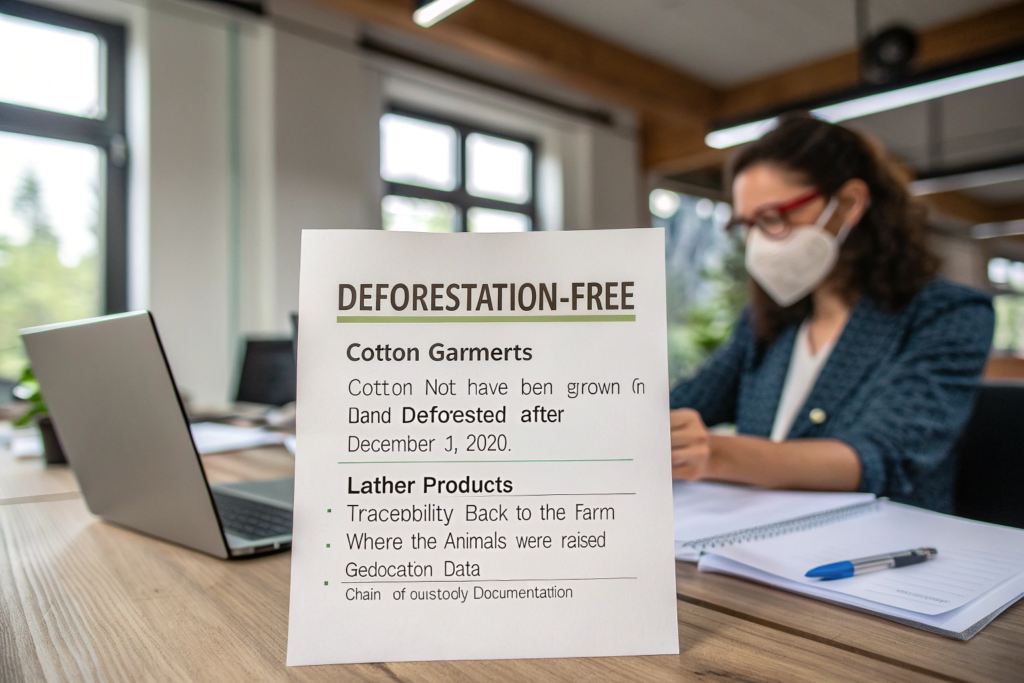
EUDR requires that products placed on the EU market are "deforestation-free"—meaning they weren’t produced on land that was deforested after December 31, 2020. For cotton garments, this means you need to prove the cotton wasn’t grown on recently deforested land. For leather, you need traceability back to the farm where the animal was raised. This requires geolocation data and chain of custody documentation.
The practical challenge here is massive. Cotton supply chains are complex—cotton from thousands of farms gets ginned together, spun together, woven together. Tracing a specific garment back to a specific farm is technically difficult. But that’s what EUDR demands. The solution is segregated supply chains or certification systems that aggregate and verify deforestation-free status at the farm level. We’re working with certified organic and Better Cotton suppliers who can provide this data.
How do I prove my cotton is deforestation-free?
You have two main options:
- Segregated supply chain: Cotton from certified deforestation-free farms is kept separate through ginning, spinning, and weaving. You get a chain of custody document (Transaction Certificate) at each step.
- Mass balance with certification: You source from a certification program (like Better Cotton or organic) that has systems to verify farms and aggregate deforestation-free cotton. The certification body issues a scope certificate to your supplier.
Option 1 is more expensive but provides stronger proof. Option 2 is more practical but requires the certification body’s system to be recognized by the EU (still being worked out). The EUDR guidance for operators explains the requirements in detail.
Does EUDR apply to recycled or synthetic fabrics?
For synthetics (polyester, nylon), EUDR doesn’t directly apply because they’re not agricultural products. But watch this space—there’s discussion about extending similar rules to fossil fuel-derived materials in the future. For recycled materials, if they contain natural fibers (like recycled cotton), the original fiber source needs to be deforestation-free. This is one reason recycled supply chains are getting more attention—they can simplify compliance if the original sourcing is already verified.
How do I find suppliers ready for EU 2026 compliance?
Not every Chinese supplier is ready for 2026. Many are still figuring out what these regulations mean. Working with unprepared suppliers means you’ll be scrambling for documentation at the last minute—and risking customs holds.
Look for suppliers who: already have strong sustainability certifications (GOTS, GRS, OEKO-TEX), can provide supply chain traceability documentation, are familiar with EU regulations (ask them about EUDR and CSDDD), and are willing to sign contracts with sustainability clauses. If a supplier looks confused when you mention Digital Product Passports, they’re not ready.
We started preparing for these regulations three years ago. We invested in traceability systems, got our certifications in order, and trained our team on EU requirements. Now, when a European client asks for deforestation-free cotton or GRS-certified recycled polyester, we can provide the documentation immediately. That’s not just compliance—it’s a competitive advantage. In 2026, the suppliers who adapted early will be the ones with waiting lists.

What certifications prove EUDR readiness?
Currently, no certification is officially "EUDR-approved" by the EU. But several are working toward recognition:
- GOTS and OCS for organic cotton (strong traceability)
- Better Cotton (developing deforestation-free modules)
- GRS and RCS for recycled content
- FSC for wood-based fibers like viscose
The key is whether the certification includes geolocation of farms and chain of custody. Ask potential suppliers: "Do your certification bodies collect farm coordinates?" If yes, you’re ahead of the game. The ISEAL guide to EUDR alignment explains how certification systems are adapting.
How do I audit a supplier’s due diligence system?
When visiting or auditing a supplier for CSDDD readiness, ask:
- Do you have a supply chain map showing all facilities from raw material to finished product?
- Do you conduct risk assessments on your suppliers?
- What is your policy on forced labor and human rights?
- Can you show me training records for workers on their rights?
- Do you have grievance mechanisms for workers to report issues?
- How do you document environmental compliance (wastewater treatment, emissions)?
A supplier who can’t answer these isn’t just non-compliant—they’re a risk to your business. The OECD Due Diligence Guidance for Garment Supply Chains is the global standard these regulations are based on.
What happens if my goods don’t meet the new EU standards?
This is the question that keeps buyers awake. The answer isn’t comforting: non-compliant goods can be stopped at customs, seized, or fined. And you pay either way.
If your goods arrive in the EU and don’t meet the new requirements, customs can: hold them pending additional documentation (costing storage fees), reject them entirely (you pay to ship back or destroy), or allow entry but refer you to market surveillance authorities for fines (up to 4% of turnover). In practice, the first year will see increased inspections, not immediate seizures—but don’t gamble on leniency.
I’ve been through regulatory transitions before—REACH, CPSIA, the first wave of sustainability rules. The pattern is always the same: early confusion, then a few high-profile enforcement actions, then widespread compliance. The brands that get hit hardest are the ones who waited. The ones who prepared early sail through. In 2026, I expect to see the first major fines and import bans. Don’t be the cautionary tale.
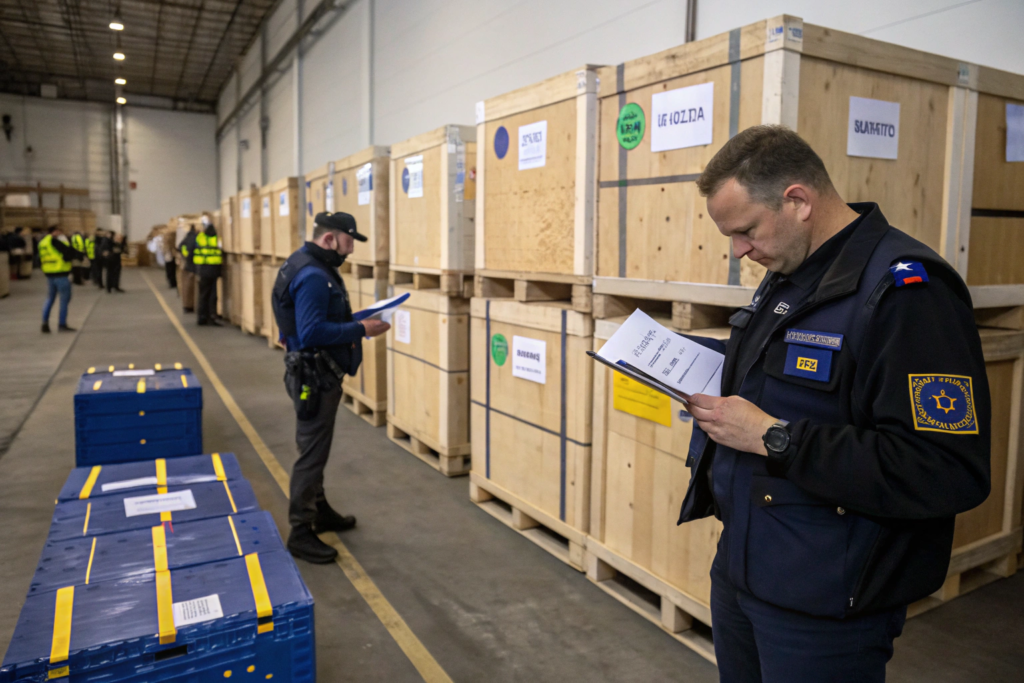
What documentation should I keep for each shipment?
For EU-bound shipments in 2026, maintain a compliance file including:
- Technical file: Product description, fiber composition, test reports (OEKO-TEX, etc.)
- Supply chain traceability: For each component, documentation showing origin and chain of custody (invoices, transaction certificates)
- Due diligence report: Risk assessment for the product and supply chain, with mitigation actions
- Declaration of conformity: Signed statement that the product meets all applicable EU regulations
- Digital Product Passport data: All information required for the DPP, in digital format
We’re building these files for every EU shipment now, even before full enforcement. It’s good practice and reduces last-minute scrambling. The EU’s guidance on documentation for importers has the baseline requirements.
Can I use a compliance partner to manage this?
Yes, and many brands will. There are companies specializing in EU regulatory compliance for imports—they’ll review your supply chain, help with documentation, and even act as the "responsible person" required under some regulations. But they can’t fix a non-compliant factory. The foundation still has to be a supplier who understands the rules and has the systems to meet them. Compliance partners are helpful for documentation and process, but they’re not a substitute for supplier capability.
Conclusion
The 2026 EU policy changes aren’t just another bureaucratic hurdle—they’re a fundamental shift in how garment sourcing works. They demand transparency, traceability, and accountability from raw material to finished product. They make the brand responsible for the entire supply chain. And they’re not going away.
But here’s the opportunity: these regulations will clean up the industry. The suppliers who cut corners, fake certificates, and ignore sustainability will struggle or disappear. The suppliers who invest in systems, certifications, and transparency will thrive. For buyers, working with those prepared suppliers means less risk, better compliance, and stronger marketing claims.
At Shanghai Fumao, we’ve been preparing for this for years. We have the certifications: GOTS, GRS, OEKO-TEX. We have the traceability systems to document our supply chain from fiber to finished fabric. We work with garment factories that meet international social compliance standards. And we’re ready to provide the documentation European buyers need for 2026 and beyond.
If you’re sourcing for the EU and worried about the new rules, let’s talk. We’ll walk you through how we document our supply chain, what certifications we hold, and how we can help you meet your compliance requirements—without the panic.
Reach out to our Business Director, Elaine. She leads our EU compliance team and can answer your specific questions about your products and markets. Email Elaine directly at: elaine@fumaoclothing.com. Let’s make 2026 the year compliance becomes your competitive advantage.