I learned about UPF testing the hard way. In 2017, a client from Australia sent back 10,000 meters of fabric. She said it failed their UV test. I was shocked. We had tested it in our lab. It passed. But their test gave different results. We argued. We tested again. Finally, we realized: we used different test methods. They used AS/NZS 4399 (the Australian standard). We used AATCC 183 (the US standard). The results were not the same. We had to redo the fabric with a different finish. It cost us time and money. That experience taught me: UPF testing is not simple. You have to do it right.
So, how do you test fabric for UV Protection Factor (UPF) accurately? It is not just putting fabric in a machine and getting a number. It involves choosing the right standard, preparing the sample correctly, understanding the equipment, and interpreting the results. In this guide, I will walk you through the entire process, based on our experience testing thousands of fabrics in our CNAS-accredited lab. Whether you are a brand sourcing UV-protective clothing or a manufacturer wanting to verify your product, this guide will help you get accurate, reliable UPF results.
What is UPF and why does it matter?
UPF stands for Ultraviolet Protection Factor. It tells you how much UV radiation a fabric blocks. A UPF 50 fabric blocks 98% of UV rays, allowing only 1/50th (2%) to reach the skin. UPF 15 blocks 93.3%. UPF 50+ is the highest rating, blocking 98%+.
Why does it matter? Because UV radiation causes skin cancer, premature aging, and sunburn. Clothing is the best protection. But not all fabrics protect equally. A thin white cotton t-shirt might have UPF 5 (only 80% blocked). You can get burned through it. So for outdoor clothing, swimwear, and sun-protective garments, UPF is critical.
Standards: Different countries have different UPF standards. The main ones are:
- AS/NZS 4399: Australia/New Zealand (the original and strictest)
- AATCC 183: USA
- EN 13758-1: Europe
- ISO 24443 (for cosmetics) but for textiles, ISO 13688 refers to other standards.
In the US, the FDA regulates sun-protective clothing claims. You must test to AATCC 183 and follow FDA guidance.
What factors affect a fabric’s UPF?
Many factors influence UPF:
- Fiber type: Polyester has natural UV absorption. Cotton and linen have less. Wool is moderate. Nylon varies.
- Fabric construction: Tight weaves block more UV. Loose weaves let UV through. Knits vary by stitch density.
- Color: Darker colors absorb more UV than light colors. A black fabric will have higher UPF than a white fabric of the same construction.
- Moisture: Wet fabric often has lower UPF. Some fabrics lose 50% protection when wet.
- Stretch: Stretched fabric (like in swimwear) becomes thinner and lets more UV through.
- Finishes: UV-absorbing chemicals can be added to boost UPF.
- Age and wear: Washing and wear can change UPF. Some fabrics gain UPF after washing (due to shrinkage), some lose it.
What are the standard test methods for UPF?
To test UPF accurately, you must follow a standard. Here are the main ones and their differences.
AS/NZS 4399 (Australia/New Zealand): This is the original. It is the strictest. It tests from 290 to 400 nm (UVB and UVA). It uses an in vitro method (spectrophotometer). The result is a UPF rating. It also has a separate UVA transmission requirement (must be less than 5% for "Excellent Protection"). This standard is used in Australia and New Zealand, and by many global brands.
AATCC 183 (USA): Similar to AS/NZS 4399, but with some differences. It also tests 290-400 nm. It calculates UPF. It does not have a separate UVA requirement, but the FDA uses this standard. AATCC 183 allows testing in both dry and wet conditions. For swimwear, wet testing is required.
EN 13758-1 (Europe): The European standard. It tests 290-400 nm. It has requirements for both UPF and UVA transmission. It also requires labeling with the UPF number and a sun symbol. It is similar to AS/NZS but with minor differences in calculation.
ISO 13688: This is a general standard for protective clothing. It refers to other standards for specific tests like UV protection.
ASTM D6544 / D6603: These are US standards for preparation and labeling of sun-protective fabrics.
Which standard should you use?
It depends on your market:
- For Australia/NZ: AS/NZS 4399.
- For USA: AATCC 183 (plus FDA guidance).
- For Europe: EN 13758-1.
- For global: Many brands accept AS/NZS 4399 as the gold standard.
We test to multiple standards for clients who sell in different markets. A client selling in both US and Australia requires both AATCC 183 and AS/NZS 4399 reports.
How is the UPF test performed?
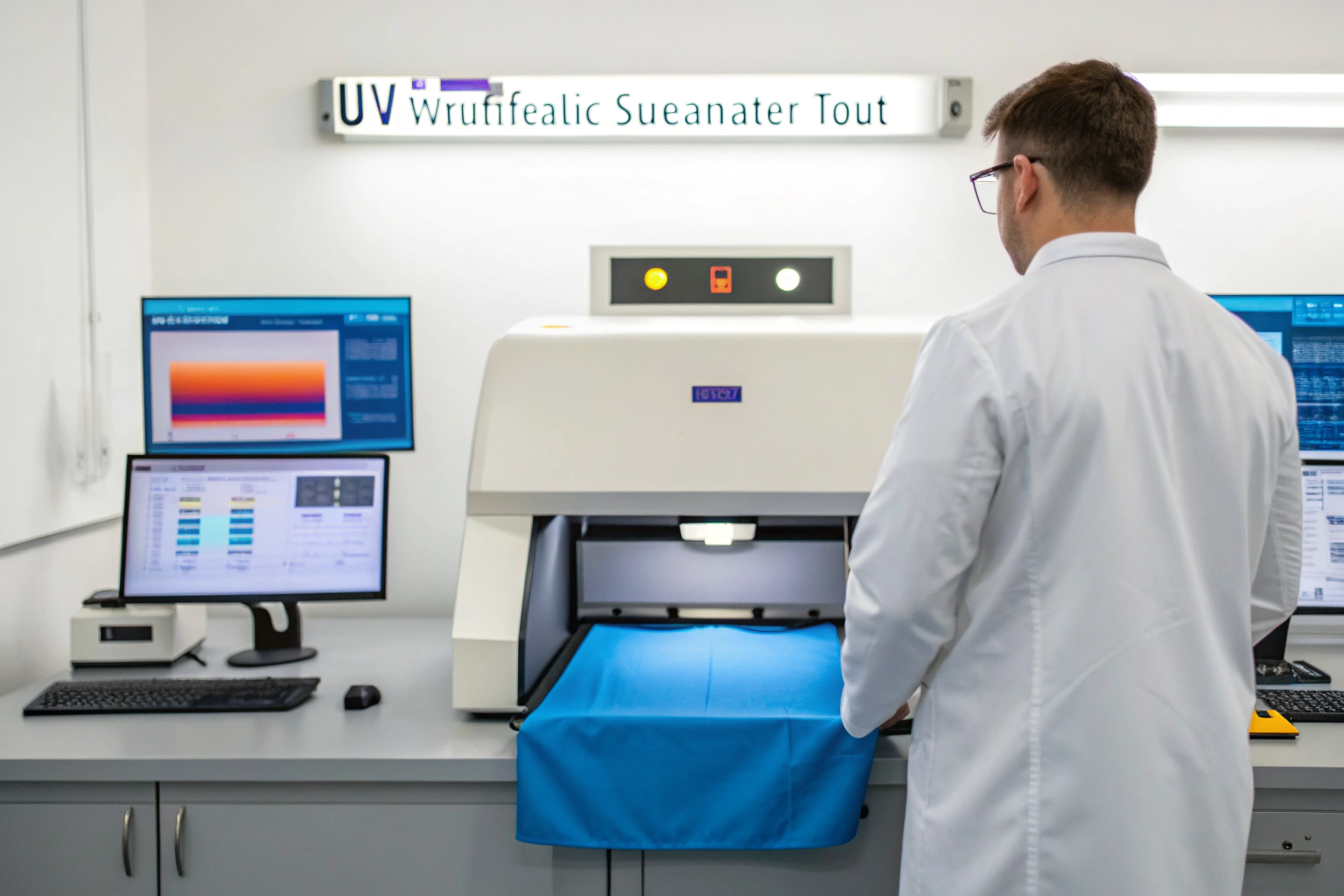
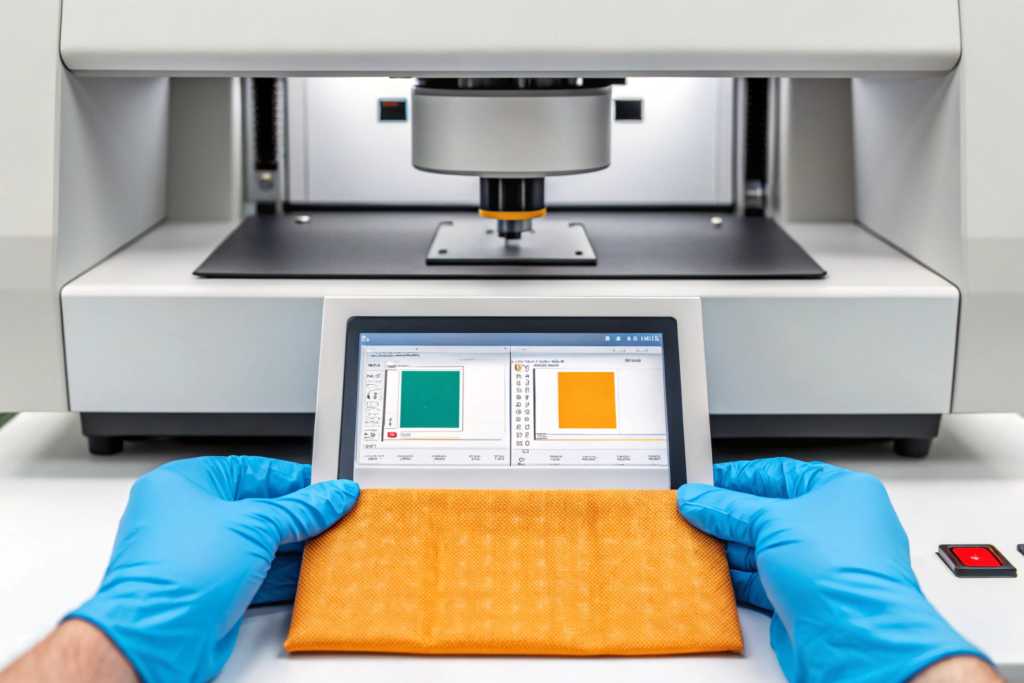
The test is done with a spectrophotometer. Here is the step-by-step process we follow in our lab.
Step 1: Sample preparation. The fabric must be conditioned in a standard atmosphere (21°C, 65% relative humidity) for at least 4 hours. This ensures consistent results. The sample must be representative. We test multiple specimens from different areas of the fabric (left, center, right) to account for variation.
Step 2: Cutting. We cut specimens to fit the spectrophotometer’s sample port. Usually 2 inches by 2 inches, but depends on the instrument. We cut at least 4 specimens per sample.
Step 3: Mounting. The specimen is placed in the sample holder. It must be flat, smooth, and without wrinkles. For stretch fabrics, we do not stretch it (unless testing stretched condition). For wet testing, we wet the specimen with distilled water and mount it immediately.
Step 4: Measurement. The spectrophotometer shines UV light (290-400 nm) onto the fabric. It measures how much light passes through at each wavelength. It scans from 290 to 400 nm in 1 nm or 5 nm increments. The result is a transmission curve.
Step 5: Calculation. The instrument’s software calculates the UPF using the formula:
UPF = (Sum of Eλ Sλ Δλ) / (Sum of Eλ Sλ Tλ * Δλ)
Where Eλ is the solar spectral irradiance, Sλ is the erythema action spectrum (how skin reacts), Tλ is the measured transmission, and Δλ is the wavelength step.
Step 6: Rating. The result is a UPF number. If it is 50 or above, it is rated UPF 50+. If below 15, it is not considered sun-protective.
Step 7: Reporting. The report includes the UPF rating, the UVA transmission (if required), and details of the test method.
What are the critical factors for accuracy?
From our experience, accuracy depends on:
Calibration: The spectrophotometer must be calibrated regularly. We calibrate weekly using NIST-traceable standards. If the instrument drifts, results are wrong.
Sample mounting: Wrinkles or stretching change results. We train technicians to mount samples flat without distortion.
Number of specimens: One specimen is not enough. Fabric varies. We test 4 to 8 specimens and average the results. If variation is high, we test more.
Conditioning: Humidity affects some fibers (cotton, wool). Test in conditioned atmosphere.
Wet testing: For swimwear or activewear, wet testing is essential. We use distilled water and test within 2 minutes of wetting. Water temperature matters (room temperature).
Stretched testing: For elastic fabrics, we sometimes test stretched. We use a special holder that stretches the fabric to a specified percentage (e.g., 20% stretch). This simulates wearing conditions.
How do you prepare and condition samples correctly?
Sample preparation is often the weakest link. If you do not condition properly, results are meaningless. Here is our protocol.
Conditioning: Place samples in a controlled environment: 21°C ± 1°C, 65% ± 4% relative humidity. Leave for at least 4 hours. For thick fabrics, we condition overnight. Do not stack samples; air must circulate.
Handling: Handle with clean gloves. Oils from fingers can affect transmission. Use tweezers or wear gloves.
Marking: Mark the face of the fabric if it has a direction (like nap or pile). Test in both directions if needed.
Wet testing: For wet tests, we condition dry, then wet with distilled water. We use a spray bottle or soak. Then we remove excess water by passing between blotting paper. We test within 2 minutes. The report must state "wet" condition.
Stretched testing: For stretch fabrics, we use a stretching frame. We stretch to the specified percentage (e.g., 20% for swimwear). We measure the stretched dimensions and calculate the stretch percentage. We test in both warp and weft directions if stretch is different.
Multiple specimens: We take specimens from different parts of the roll. For a full production lot, we test at least 5 samples across the width and along the length. This catches variation.
Laundering: Some standards require testing after laundering. For example, if claiming "UPF 50+ after 50 washes," we wash samples according to AATCC 135 or ISO 6330, then condition and test.
What are common sample preparation mistakes?
- Testing unconditioned fabric: Results will vary with humidity.
- Testing only one specimen: Misses variation.
- Stretching fabric unintentionally: If you pull it tight in the holder, you get falsely low UPF.
- Testing wrinkled fabric: Wrinkles create shadows and false high UPF.
- Dirty optics: If the spectrophotometer’s optics are dirty, readings are off.
How do you interpret UPF test results?
The test report will give you a UPF number. But what does it mean? Here is how we interpret results.
UPF rating scale:
- UPF 15-24: Good protection
- UPF 25-39: Very good protection
- UPF 40-50+: Excellent protection
- Below 15: Not rated as sun-protective
UVA transmission: Some standards (AS/NZS, EN) also require that UVA transmission (315-400 nm) be less than 5%. If UVA transmission is high, the fabric may not be labeled as "Excellent Protection" even if UPF is high.
Measurement uncertainty: Every test has uncertainty. Our lab calculates uncertainty and reports it. A UPF of 52 might have uncertainty ±5. So it could be 47 or 57. That is why UPF 50+ is a safe rating for anything over 50.
If results are borderline: If your fabric tests at UPF 48 (just below 50), you have options:
- Improve the fabric (tighter weave, darker color, UV absorber).
- Accept UPF 40+ rating (still good).
- Retest with more specimens to confirm.
If results vary between specimens: High variation means the fabric is not uniform. Investigate why. It could be uneven dyeing, inconsistent weave, or finishing issues.
What if your fabric fails the UPF requirement?
Do not panic. Here are steps we take:
- Check the test method: Are you testing to the right standard? Is the sample conditioned correctly?
- Retest: Test more specimens. Maybe the first sample was flawed.
- Analyze the cause: Is it the fiber? The weave? The color? The finish?
- Add a UV absorber: Many fabrics can be treated with UV-absorbing chemicals during finishing. This boosts UPF significantly. We do this for clients.
- Change construction: Tighten the weave or increase fabric weight.
- Change color: Darker colors absorb more UV. If you can, go darker.
We had a client making white linen shirts. UPF was only 15. We added a UV absorber finish. UPF went to 40. Problem solved.
How do we at Fumao Fabric ensure accurate UPF testing?
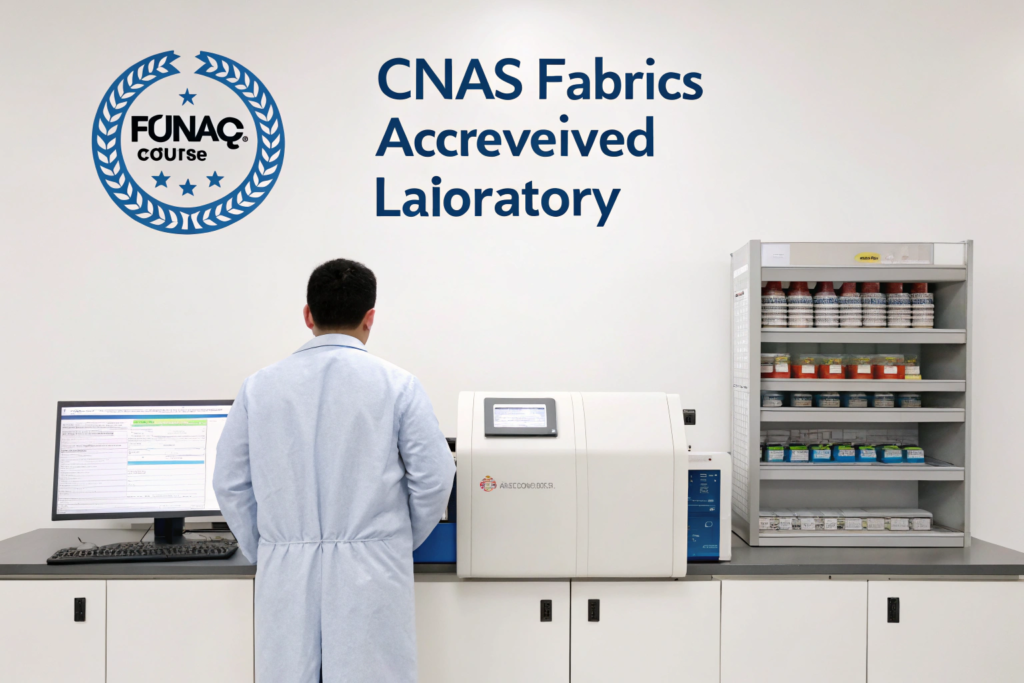
At Shanghai Fumao, we take UPF testing seriously. We have our own CNAS-accredited lab (ISO 17025). This means our results are internationally recognized. Here is our process.
Accredited methods: We are accredited for AATCC 183 and AS/NZS 4399. We follow the standards exactly. Our equipment is calibrated and maintained.
Trained technicians: Our technicians are trained and tested annually. They know how to handle samples, operate instruments, and interpret results.
Multiple specimens: We test 5 specimens minimum. For critical orders, we test 10. We report the average and the range.
Wet and stretched testing: We offer wet testing and stretched testing for clients who need it. For swimwear, we test both dry and wet.
Third-party verification: For clients who require it, we also send samples to third-party labs (like SGS, BV, or Intertek) for verification. We are confident our results match theirs.
Traceability: Every test result is recorded. We can trace back to the fabric roll and the production batch. If a client has a question, we can review.
Consulting: We help clients interpret results. If a fabric fails, we suggest improvements. We work with our chemical partners to add UV absorbers. We adjust weaves and weights.
What do we tell clients about UPF claims?
We advise clients:
- Test to the standard required in your market.
- Test after laundering if you claim durability.
- Consider wet testing for swimwear.
- Do not overclaim. If your fabric tests UPF 48, label it UPF 40+, not 50.
- Keep records. If challenged, you have proof.
Conclusion
UPF testing is not magic. It is science. But it requires care: proper standards, correct sample preparation, calibrated equipment, and trained technicians. A small mistake can give wrong results, leading to failed shipments, customer complaints, or worse, people getting sunburned through your "protective" clothing.
At Shanghai Fumao, we have been testing UPF since 2015. We have a CNAS-accredited lab. We know the standards. We know the pitfalls. We provide accurate, reliable testing for our fabrics. And we help clients understand and use the results.
If you are sourcing UV-protective fabrics, or if you need UPF testing for your own fabrics, contact our Business Director, Elaine, directly. She manages our testing lab and can guide you through the process. Email her at elaine@fumaoclothing.com. Tell her what fabric you have, what market you are targeting, and what UPF rating you need. She will arrange testing, provide reports, and help you achieve your goals. Because at Shanghai Fumao, we believe that protection should be proven, not just promised.