For any apparel business, fabric is the single largest cost component—typically representing 50-70% of the total product cost. Inaccurate consumption calculations lead directly to budget overruns, while inefficient cutting practices turn potential profit into landfill waste. Whether you are a designer sampling a new style or a production manager planning a bulk order, mastering fabric consumption and waste reduction is essential to your bottom line.
Calculating fabric consumption accurately requires a systematic approach combining pattern engineering, marker making, fabric width consideration, and mathematical formulas. Reducing waste in cutting demands strategic decisions in pattern layout, fabric spreading, cutting technology, and off-cut utilization. Together, these practices can reduce fabric usage by 5-15% and significantly increase your profitability.
Let me walk you through the exact methods professional manufacturers use to calculate consumption and minimize waste at every stage.
What Is Fabric Consumption and Why Does Precision Matter?
Fabric consumption is the amount of fabric required to produce a specific garment or order. It is expressed in yards per dozen, meters per garment, or square yards per unit. Precision here is not just about budgeting; it affects pricing, supply chain planning, and environmental impact.
Why Do Small Calculation Errors Create Big Financial Losses?
A seemingly minor miscalculation of just 2% on fabric consumption can have massive financial consequences. If your annual fabric spend is $1 million, a 2% error equals $20,000 in unexpected cost—either in excess fabric you cannot use or in production delays because you ran short. For a single style produced in thousands of units, an error of 0.1 yard per garment multiplied by 10,000 garments equals 1,000 yards of wasted fabric. This is not just a theoretical risk; it is a daily reality in factories without disciplined consumption calculation. Accurate calculation protects your margins and ensures you order exactly what you need.
How Does Waste Reduction Impact Sustainability and Brand Image?
Beyond cost, fabric waste is an environmental liability. The fashion industry is under intense scrutiny for its contribution to landfill and carbon emissions. Reducing cutting waste directly reduces your environmental footprint. Many global brands now require suppliers to report cut-and-sew waste percentages and demonstrate continuous improvement. Efficient cutting that maximizes fabric utilization is not just good economics; it is increasingly a license to operate for major retailers. Sustainable practices here strengthen your brand reputation and qualify you for partnerships with environmentally conscious buyers.
What Are the Standard Methods for Calculating Fabric Consumption?
Several methods exist, ranging from quick estimation techniques to precise, computer-aided calculations. The right method depends on where you are in the product lifecycle.
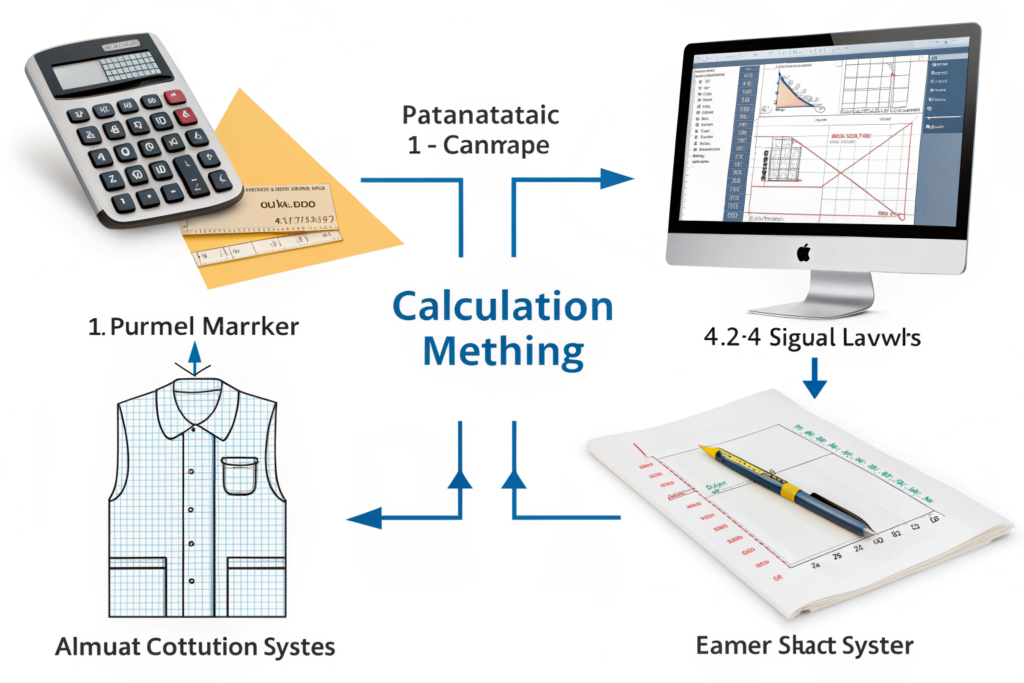
How Do You Calculate Consumption Using Mathematical Formulas?
For quick estimations during costing and development, mathematical formulas provide a baseline. The basic formula for a woven garment is:
(Garment length + Allowance) x (Garment width + Allowance) x 2 / Fabric width x 36
Let's break this down with a real example for a basic long-sleeve shirt:
- Garment Length: 30 inches (including hem allowance)
- Sleeve Length: 24 inches
- Chest Width (1/2): 24 inches
- Fabric Width: 58 inches (usable)
- Formula: (Body Length + Sleeve Length) x (Full Chest Width) x 2 / Fabric Width
- Calculation: (30 + 24) x (48) x 2 / 58 = 54 x 48 x 2 / 58 = 5,184 / 58 = 89.4 inches per garment
- Convert to yards: 89.4 / 36 = 2.48 yards per garment
This method is fast but assumes perfect layout efficiency. It does not account for pattern matching, stripes, or complex shapes. Add a waste factor of 3-5% for woven fabrics and 5-8% for knits when using this method for ordering.
What Is Marker Making and Why Is It the Most Accurate Method?
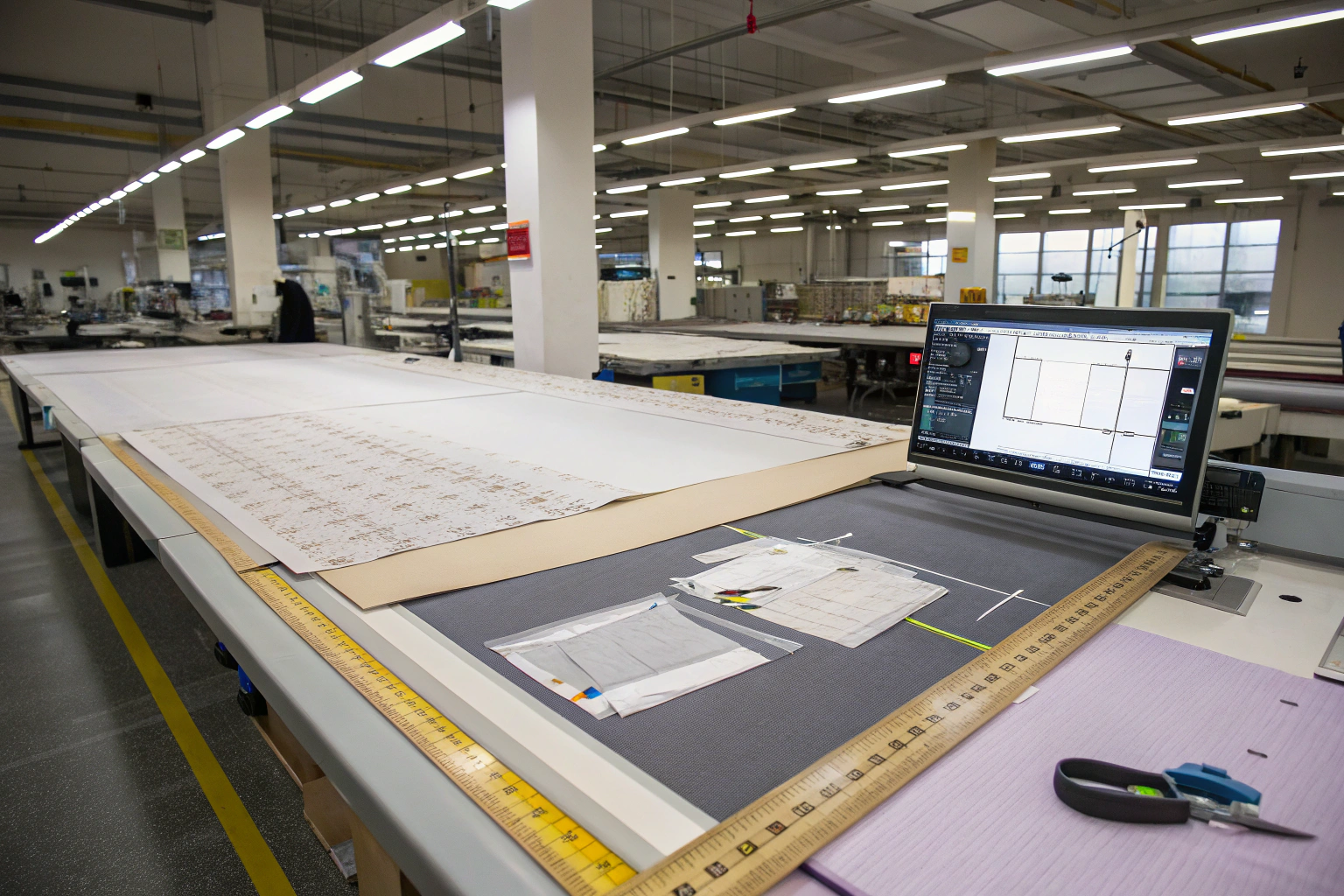
Marker making is the process of arranging all pattern pieces for a garment (or multiple garments) within the fabric width to minimize unused space. The marker efficiency is the percentage of fabric area actually used by pattern pieces. A professional marker maker can achieve efficiencies of 85-95%, depending on garment complexity and fabric pattern.
To calculate consumption from a marker:
- Create a marker for your specific combination of sizes.
- Calculate the total area of the marker (marker length x fabric width).
- Divide by the number of garments in the marker.
- This gives you fabric area per garment.
- Convert to linear yards based on fabric width.
Example: A marker 10 yards long for 58" (1.61 yards) wide fabric contains 6 garments.
- Marker area = 10 yards x 1.61 yards = 16.1 square yards
- Fabric per garment = 16.1 / 6 = 2.68 square yards
- Convert to linear yards: Since fabric width is fixed, 2.68 square yards / 1.61 yards width = 1.66 linear yards per garment
This is the gold standard for bulk production planning.
How Does CAD Software Improve Accuracy?
Modern Computer-Aided Design (CAD) systems like Gerber AccuMark, Lectra Modaris, and Optitex automate marker making with algorithms that optimize layout far faster and often more efficiently than manual methods. These systems:
- Automatically nest pieces for maximum fabric utilization.
- Calculate exact consumption for any size mix.
- Simulate consumption for striped or patterned fabrics by matching repeats.
- Generate digital markers that can be printed or sent directly to automated cutting machines.
For any serious production, CAD-based consumption calculation is non-negotiable.
What Strategies Reduce Fabric Waste During Cutting?
Calculating consumption accurately is step one. Executing the cut with minimal waste is step two. Several proven strategies can dramatically reduce the fabric that ends up on the cutting room floor.
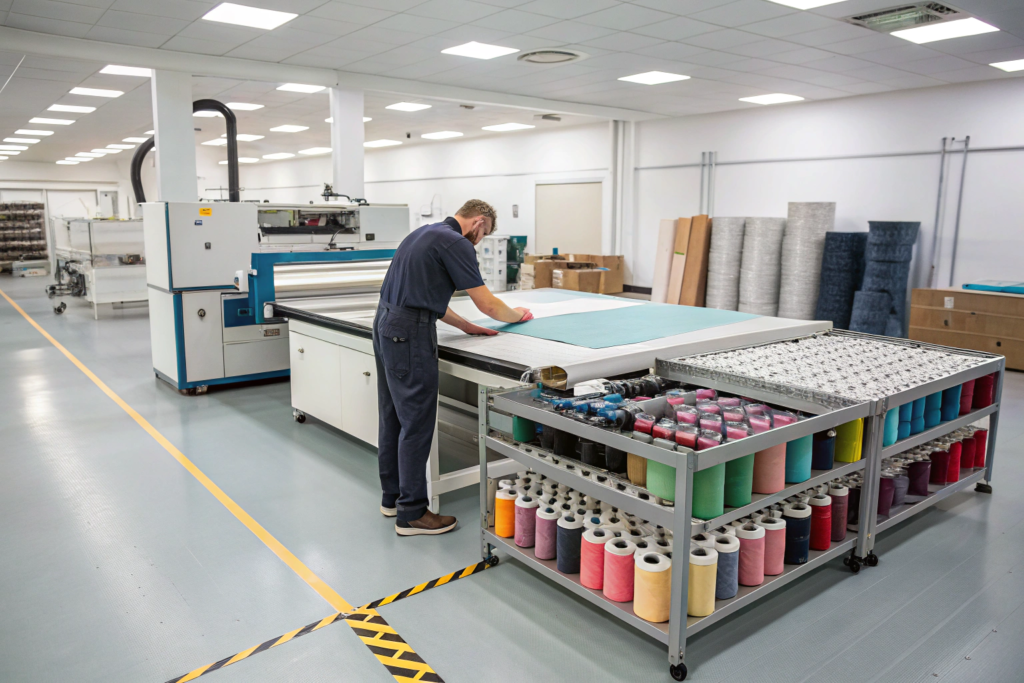
How Does Marker Efficiency Optimization Reduce Waste?
The single biggest lever for waste reduction is maximizing marker efficiency. This is achieved through:
- Nesting: Using software to pack pieces as tightly as possible.
- Size Mixing: Combining different sizes in one marker to allow pieces to interlock. For example, placing a large size next to a small size can utilize space that would otherwise be empty.
- Pattern Engineering: Simplifying pattern pieces during design to reduce complex shapes that create waste. A designer who understands cutting can create styles that inherently waste less fabric.
- Grain Line Consideration: Strict grain requirements limit layout options. Where performance allows, slight adjustments can improve efficiency.
A 1% improvement in marker efficiency on a large order can save thousands of dollars.
What Role Does Fabric Spreading Play in Waste?
Spreading—laying multiple plies of fabric on the cutting table—creates waste at the beginning and end of each lay, known as end loss. Every time you start a new roll, you lose some fabric because the first few inches cannot be aligned perfectly. Every time you finish a roll, you may have a remnant too short to include in the lay.
To minimize end loss:
- Calculate exact lay lengths based on marker length plus a small allowance.
- Plan roll consumption to use entire rolls where possible.
- Use roll lot tracking to manage shade variation without excessive end loss.
How Can You Utilize Off-Cuts and Remnants?
Even with perfect markers and spreading, small off-cuts are inevitable. Smart factories treat these as assets, not trash.
- Small Parts Cutting: Collect off-cuts large enough for pockets, facings, collar stands, or binding. Cut these small parts from remnants rather than opening new fabric.
- Grading for Smaller Products: Remnant fabric can be used for sampling, accessories, or children's wear.
- Donation or Recycling: Partner with textile recyclers who can process clean fabric waste into new fiber or industrial materials.
- Creative Reuse: Some brands now intentionally design products using remnant fabric, creating unique "zero-waste" collections that appeal to sustainability-focused consumers.
Implement a remnant management system where off-cuts are sorted by size, fiber, and color for easy retrieval.
What Technology Investments Improve Cutting Efficiency?
Modern cutting rooms leverage technology to achieve precision and waste reduction impossible with manual methods.
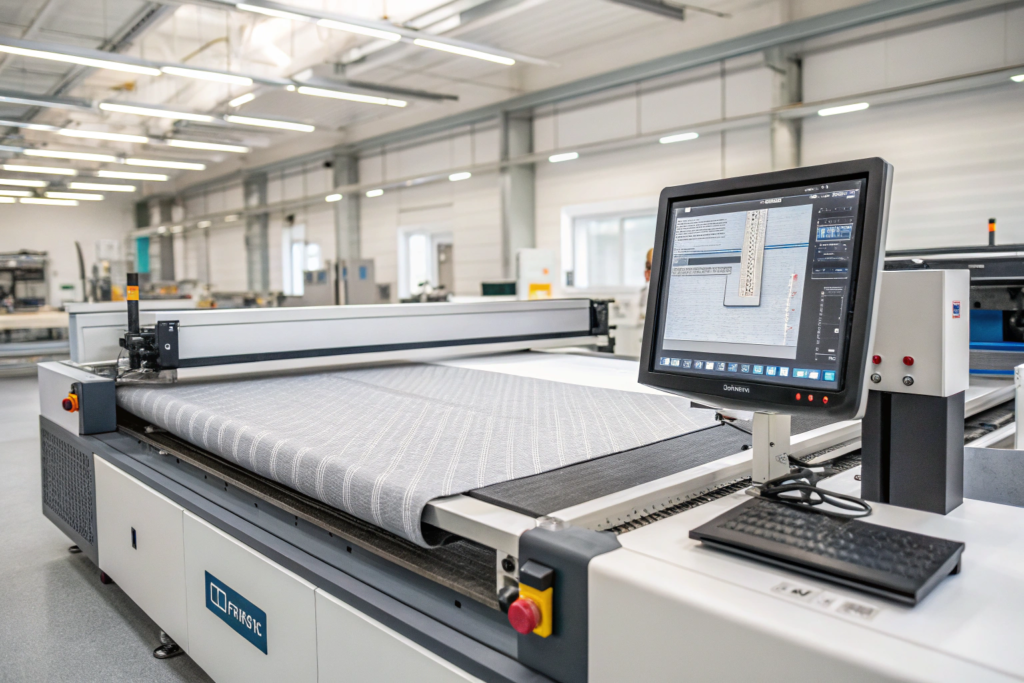
Should You Invest in Automated Cutting Systems?
Automated cutting systems (also called CNC cutters) use computer-guided blades or lasers to cut fabric stacks with extreme precision. Benefits include:
- Accuracy: Eliminates manual cutting errors that ruin fabric.
- Speed: Cuts complex markers faster than any manual team.
- Nesting Capability: Can cut very small, intricate pieces that manual cutters might skip, reducing waste.
- Data Integration: Directly uses digital markers, eliminating paper and transcription errors.
The investment is significant—often $100,000 to $500,000—but for factories with high volume, payback periods can be as short as 12-24 months through fabric savings alone.
What Is a Fabric Spreading Machine and Why Use One?
Fabric spreading machines automate the layering of fabric on the cutting table. They ensure:
- Perfect alignment: Every ply is aligned exactly, preventing mis-cuts.
- Consistent tension: No stretching or distortion, which causes size variation.
- End catchers: Minimize end loss by accurately controlling fabric at start and finish.
For any factory cutting more than a few hundred garments daily, a spreading machine pays for itself quickly through fabric savings and quality improvement.
Conclusion
Mastering fabric consumption calculation and waste reduction is not an optional technical skill; it is a core competency that directly determines your profitability and environmental impact. By moving from estimation to precision—through mathematical formulas, professional marker making, and CAD software—you order the right quantity of fabric every time. By optimizing marker efficiency, managing spreading end loss, and utilizing off-cuts, you ensure that every square inch of that expensive fabric becomes a sellable garment, not landfill waste. And by strategically investing in technology like automated cutters and spreaders, you lock in consistent, measurable savings order after order.
If your brand or manufacturing operation is seeking a production partner with deep expertise in fabric optimization and waste reduction, we are ready to collaborate. At Shanghai Fumao Clothing, we have invested in advanced CAD systems and automated cutting technology to deliver maximum fabric utilization for our clients. For inquiries about production partnerships or to discuss your specific garment needs, please contact our Business Director, Elaine, at elaine@fumaoclothing.com. Let's turn every yard of fabric into value.