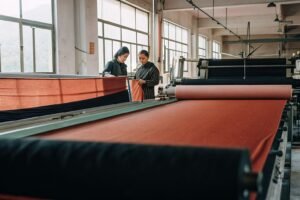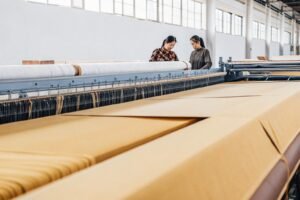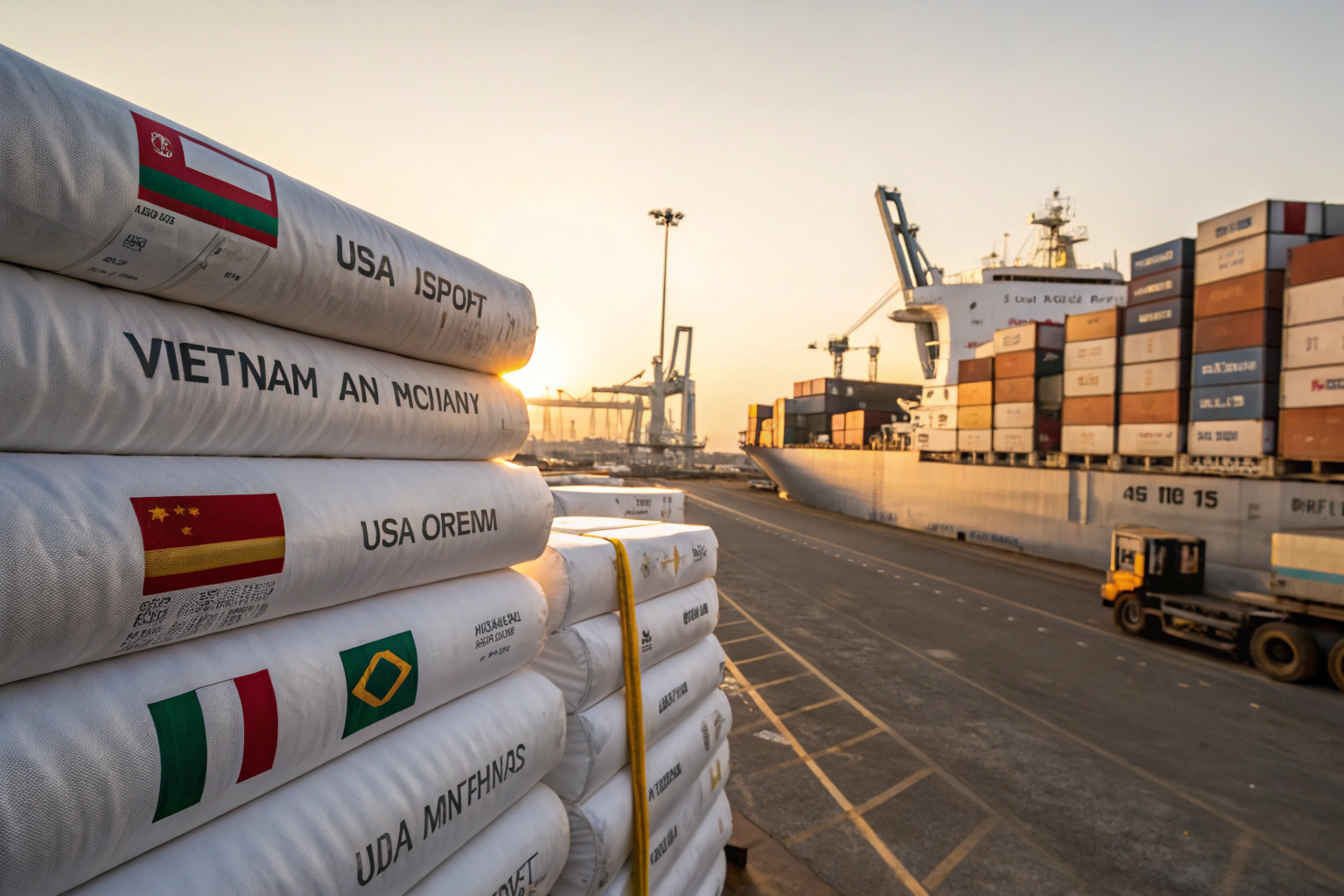
I learned this lesson in a hot, cramped conference room in Ho Chi Minh City in 2019. I was sitting across from the sourcing director of a major American sportswear brand. She had a spreadsheet open on her laptop, 14 tabs visible. Her team was buying greige fabric from us in China, shipping it to Vietnam for dyeing and cutting, sending the cut parts to Cambodia for sewing, and then exporting finished garments to the US. "The problem," she said, pointing at column J, "is that your fabric arrives at the Vietnamese dyer on Tuesday, but their chemical lab doesn’t approve the color until Friday. We lose three days every single shipment. Can you pre-certify the dye recipe with them?"
I said yes, and we spent the next six months building what we now call our multi-country logistics protocol. We didn’t just sell her fabric. We coordinated with her dye house in Binh Duong. We shared our greige specifications with their technical team. We aligned our test methods with their incoming inspection criteria. We cut her lead time from 14 weeks to 9 weeks. That relationship has grown into a $7M annual partnership.
Sourcing fabric for multi-country production is not the same as sourcing fabric for a single-country factory. You are not just managing a supplier; you are managing a network. The fabric you ship from Shanghai must be compatible with the dye machines in Vietnam, the cutting tables in Cambodia, and the final inspection protocols in the US. If any node in that chain fails, the entire order fails.
This article is written from the perspective of a Chinese mill that has spent five years building systems to serve clients with distributed manufacturing. I will not give you generic advice about ‘building relationships’. I will give you specific protocols for greige specification, chemical alignment, quota management, and risk mitigation. Whether you are cutting fabric in China and sewing in Myanmar, or dyeing in Indonesia and finishing in the Philippines, these systems apply.
How Do You Choose Which Stage of Production Happens in Which Country?
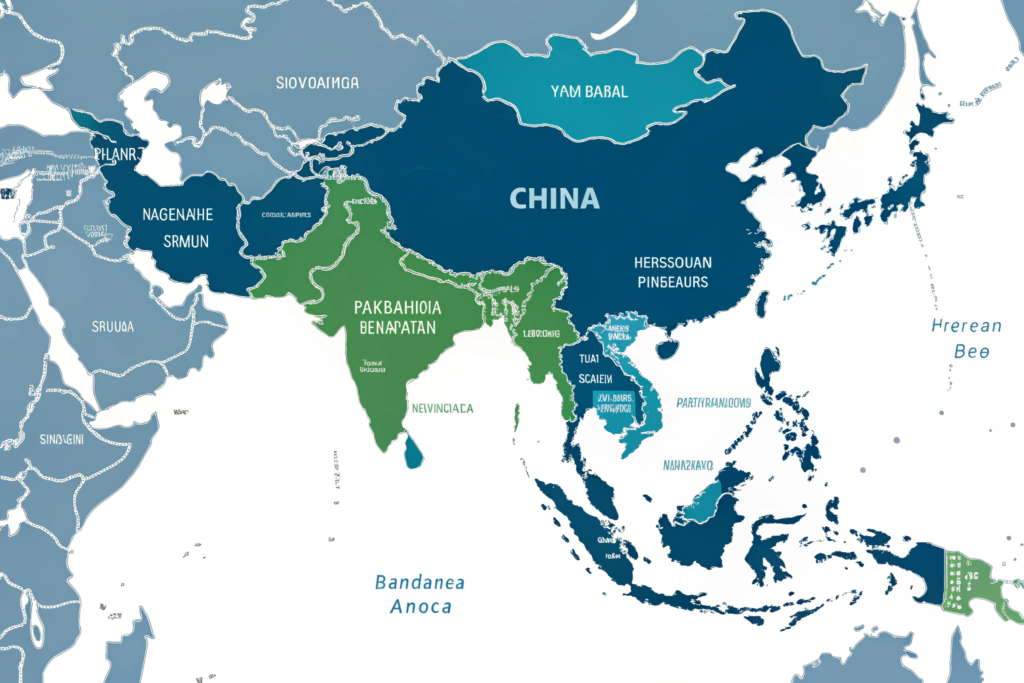
This is the first and most strategic question. You cannot optimize multi-country production until you understand the comparative advantage of each node in your supply chain. China, Vietnam, Bangladesh, Indonesia, Cambodia, Myanmar—each country has distinct capabilities and constraints. Your job is to match the production stage to the country where it can be done best, fastest, or most cost-effectively.
Here is our assessment, based on 20+ years of serving global brands:
China (Mainland):
- Advantage: Vertical integration, technical complexity, speed, raw material availability, advanced finishing, R&D capability.
- Disadvantage: Labor cost, US Section 301 tariffs, geopolitical uncertainty, environmental compliance costs.
- Best for: High-spec technical fabrics, complex finishing (coating, lamination, specialized performance treatments), rapid sampling, large-volume greige production, novelties, and fabrics requiring extensive development.
Vietnam:
- Advantage: Competitive labor cost, improving technical skills, strong EU and CPTPP tariff preferences, increasing vertical integration.
- Disadvantage: Limited domestic fabric production (most fabric still imported), infrastructure constraints (power, water), less mature chemical management systems.
- Best for: Cutting, sewing, assembly; garment finishing; medium-complexity dyeing and printing (if using imported fabric).
Bangladesh:
- Advantage: Lowest labor cost among major apparel exporters, massive sewing capacity, EU tariff preferences.
- Disadvantage: Infrastructure stress (gas, power, water), limited advanced finishing, safety and compliance scrutiny.
- Best for: High-volume, price-sensitive, basic garment assembly; cotton knitwear; workwear.
Indonesia:
- Advantage: Domestic fabric production base (especially polyester), integrated mills, growing technical capability.
- Disadvantage: Logistics complexity (archipelago), inconsistent regulatory environment.
- Best for: Polyester and viscose woven fabrics, basic uniform programs, domestic market production.
Cambodia/Myanmar:
- Advantage: Very low labor cost, preferential EU access (subject to political conditions).
- Disadvantage: Minimal domestic fabric production, lower technical skill base, political instability risks.
- Best for: Simple cut-and-sew operations using imported fabric; basic t-shirts, polo shirts, casual bottoms.
Our strategic recommendation:
Keep capital-intensive, skill-dependent processes in China. Weaving, advanced knitting, coating, lamination, high-precision printing, and complex finishing require equipment that costs millions of dollars and technicians with decades of experience. These capabilities exist in China and, to a lesser extent, in Indonesia and Thailand. They do not yet exist at scale in Vietnam, Cambodia, or Bangladesh.
Move labor-intensive, lower-skill processes to Southeast Asia. Cutting, sewing, folding, packing—these are manual operations where labor cost is the primary driver. Vietnam, Bangladesh, and Indonesia are well-positioned here.
Balance your supply chain with dual sourcing. Do not put all your technical fabric production in China and all your sewing in Vietnam. If a geopolitical event disrupts China exports, your entire supply chain stops. We maintain greige inventory in both China and Vietnam for key clients. This is expensive, but it is insurance.
In 2021, when US Customs began detaining shipments from certain Xinjiang-related entities, several of our clients were caught with fabric orders trapped in transit. Those who had diversified greige sources—including fabric woven in other regions or countries—were able to reroute production. Those who were 100% dependent on a single Chinese province faced cancellations. The US Customs and Border Protection Forced Labor Division publishes withhold release orders and findings, and we monitor this daily for clients with US exposure.
Should I source greige fabric in China and finish it in Vietnam?
It depends on the fabric and the volume.
Case for yes:
- You need Chinese technical expertise for the greige weaving (high-density constructions, specialized yarns, performance wovens).
- You are shipping very high volumes, making the inter-country freight cost negligible.
- You have a qualified, trusted dyeing and finishing partner in Vietnam with proven capability on your specific fabric constructions.
- You need Vietnam’s tariff preferences (EVFTA, CPTPP) and your fabric meets the rules of origin requirements.
Case for no:
- Your fabric is a standard construction that Vietnamese mills can weave domestically.
- Your volume is low (under 5,000 meters per SKU), and the shipping/logistics friction outweighs the cost benefit.
- Your Vietnamese finisher is not equipped for your specific finish (PFC-free DWR, specialized coating, etc.).
- You are at risk of origin cumulation rules requiring substantial transformation in Vietnam.
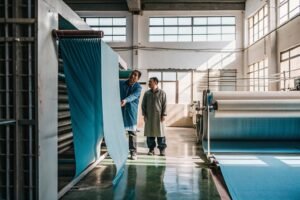
Our model: We offer greige consignment programs. We ship un-dyed, unfinished fabric from our warehouse in Keqiao to our client’s nominated finisher in Vietnam. The finisher processes the fabric, and the client takes delivery for cutting and sewing. We provide the greige specification, the test methods, and the quality arbitration if disputes arise between the weaver and the dyer. We do not control the finishing quality, but we help diagnose problems.
In 2023, we shipped 1.4 million meters of greige cotton twill to a Vietnamese dye house for a Japanese workwear brand. The dye house had never processed this specific construction. The first 50,000 meters had unacceptable weft bowing. Our technical team flew to Binh Duong, spent three days adjusting the stentor settings, and trained the local operators. The remaining 1.35 million meters passed. This is the reality of cross-border finishing: you are not just shipping fabric; you are shipping knowledge.
What are the rules of origin for fabric in Vietnam’s free trade agreements?
This is complex, and I am not a customs attorney. But I have watched clients lose millions of dollars in duty preferences because they assumed fabric sourced from China qualified for EU-Vietnam FTA (EVFTA) or CPTPP preferences. It often does not.
EVFTA (EU-Vietnam): For most apparel, the rule is "from yarn onward" (yarn-forward). The fabric must be woven or knitted in Vietnam or the EU from yarn originating in Vietnam, the EU, or South Korea (cumulation). Fabric woven in China and shipped to Vietnam for finishing and cutting does not qualify for preferential duty rates under EVFTA. The duty on that garment entering the EU is the standard WTO rate (often 12%).
CPTPP (Comprehensive and Progressive Agreement for Trans-Pacific Partnership): The rules are slightly more flexible but still restrictive. For certain products, there is a "fabric-forward" rule allowing fabric made in any CPTPP member country (including Vietnam, Japan, Mexico, Canada, etc.) to qualify. China is not a CPTPP member. Chinese-origin fabric generally disqualifies the garment from CPTPP preferences.
US-Vietnam: There is no FTA. Fabric imported from China to Vietnam, made into garments in Vietnam, and exported to the US is subject to normal duty rates. There is no preference.
What we do: We maintain dual supply chains for clients serving EU markets. For high-volume basics that need EVFTA qualification, we help them source greige fabric from Vietnamese weaving mills or from our partner mills in South Korea (which cumulates with Vietnam under EVFTA). For complex technical fabrics that cannot be woven in Vietnam, we accept that the garment will not receive preferential duty and advise clients to factor the 12% duty into their costing.
The European Commission’s Rules of Origin self-assessment tool is publicly available, and we encourage sourcing managers to use it before committing to a multi-country production strategy.
How Do You Maintain Consistent Quality Across Borders?
This is the hardest operational challenge in multi-country sourcing. When you weave in China, dye in Vietnam, and sew in Cambodia, you have at least three separate quality systems, three sets of test methods, and three cultures of defect tolerance. The fabric that passes inspection at our warehouse in Keqiao may be rejected at the dye house in Binh Duong for a shade issue that was not specified. The finished fabric that passes the dyer’s in-house inspection may be rejected at the Cambodian sewing factory for bowing that is within AATCC tolerance but exceeds their cutting equipment specifications.
You cannot leave quality to chance or goodwill. You must engineer it.
Our protocol for multi-country quality assurance:
-
Unified technical specification. We write a single spec sheet that is used by every node in the supply chain. It includes:
- Fabric weight (gsm, with tolerance)
- Construction (thread count, weave type, yarn count)
- Width (finished, with tolerance)
- Color (Pantone reference, Delta E tolerance, illuminants)
- Physical properties (tear strength, tensile strength, seam slippage, pilling)
- Dimensional stability (shrinkage allowance, wash test method)
- Finishing requirements (DWR, anti-static, anti-microbial, etc.)
- Certification requirements (Oeko-Tex, GOTS, GRS, etc.)
-
Pre-shipment inspection at each node. We do not assume that passing inspection at our factory guarantees acceptance at the next factory. We require that the dyer’s QC team be present (physically or via video) for final inspection of greige goods when the order is critical. We photograph defects, measure width and weight, and share the data in real time.
-
Cross-trained technicians. We have Vietnamese-speaking technical staff who have trained our Vietnamese partners on our specific test methods. When a Vietnamese dyer says "fabric weight is 145gsm," we know they measured it using the same conditioned samples and the same calibrated scale that we use in China.
-
Dispute resolution protocol. Disagreements are inevitable. The dyer claims the fabric is within spec; the cutter claims it is out of spec. Without a pre-agreed dispute resolution process, you lose weeks. Our protocol: a third-party lab (SGS, BV, ITS) selected by both parties performs the contested test. The result is binding. The cost is split 50/50 unless one party is clearly wrong.
-
Quality at source. We train our production team to think like cutters. When we roll fabric, we check for bowing, skewing, and edge-to-edge shade variation at the level required for automated cutting machines. We know that a 2% skew that is invisible to the eye will cause a 15cm pattern mismatch on a 3-meter marker. We hold ourselves to the cutter’s standard, not the weaver’s standard.
In 2022, a German outdoor brand asked us to supply fabric for a program involving weaving in China, dyeing in Vietnam, and garment assembly in Myanmar. The sewing factory in Yangon had extremely high shade-sorting requirements—they demanded that all fabric rolls within a single cutting lot be within 0.6 Delta E of each other. This is tighter than most dye houses can consistently achieve. We pre-sorted the finished rolls in our warehouse in Keqiao before shipment to Vietnam, grouping them by measured shade value. The Vietnamese dyer was offended; they felt we were implying their quality was inconsistent. We explained that the requirement was beyond their commercial spec and that pre-sorting was a shared solution, not an accusation. The program shipped on time. The AATCC Evaluation Procedure 9 for visual assessment of color difference is the common language we use to align expectations across borders.

Who is responsible when fabric fails at the garment factory in a different country?
This must be defined in your contract, or you will have a dispute.
Our standard terms:
-
We (Shanghai Fumao) are responsible for the fabric quality as measured at our loading dock in China. We warrant that the fabric meets the agreed technical specification at the time of shipment. We provide test reports and inspection records to support this.
-
The buyer or their nominated processor (dyer, finisher, cutter) is responsible for damage or deterioration that occurs after the fabric leaves our possession. This includes:
- Damage during international transit.
- Defects introduced during dyeing, printing, or finishing by a third party.
- Storage-related issues (mold, moisture regain, pest damage).
- Shade variation caused by the dyer’s recipe, even if the base fabric was correct.
-
We share responsibility for design-related failures. If the fabric fails because the design (stitch density, seam type, fusible selection) was inappropriate for the fabric’s properties, we will provide technical consultation but do not accept financial liability for the failure.
The grey zone: Latent defects that are not detectable at the greige stage but become apparent only after dyeing or finishing. Examples: The yarn had variable dye uptake; the fabric had residual spinning oils that caused uneven printing; the weave structure relaxed in finishing, causing width loss. These are genuinely ambiguous. We handle these case-by-case. If we believe the root cause is our greige quality, we compensate. If we believe the root cause is the dyer’s process, we do not. When the evidence is unclear, we often split the loss 50/50 to preserve the relationship.
Our recommendation: Do not assume your Chinese fabric supplier will accept liability for defects discovered in Vietnam. You must define the liability boundaries before you place the order, not after the container is rejected.
How do you manage shade matching across multiple production batches and countries?
Shade consistency is the most common source of multi-country production disputes. The first batch, woven in China and dyed in Vietnam, matches the standard. The second batch, woven six months later, is 1.2 Delta E off. The Vietnamese dyer blames the Chinese greige. The Chinese weaver blames the Vietnamese dyer’s recipe. The buyer is stuck with a container of mismatched fabric.
Our system:
-
Physical shade standards. We retain a 1-meter cutting from every approved production lot. This physical standard is sent to the dyer. It is the reference, not a PDF or a Pantone chip.
-
Greige qualification. Before shipping new greige production, we test its dye uptake characteristics. We run a laboratory-scale dyeing using the dyer’s standard recipe. If the new greige dyes significantly lighter or darker than the standard, we adjust the weaving parameters (yarn tension, heat-set) or reject the greige lot.
-
Digital shade archive. We maintain a database of spectrophotometric data for every color we have produced on every base fabric. When a client reorders a color from 18 months ago, we can provide the dyer with the precise Lab* target and the dye recipe used previously. This is not a guarantee of match—dye chemistry changes, base fabric changes—but it reduces the iteration time from four rounds to one or two.
-
Tolerance alignment. We require that the dyer and the cutter agree on the acceptable Delta E tolerance before production. A tolerance of 1.0 is achievable but expensive. A tolerance of 0.6 is extremely tight and will result in high reject rates. We help clients choose tolerances that are appropriate for their product category and price point.
In 2024, we implemented a blockchain-based traceability system for a luxury Italian client. Every roll of greige fabric is assigned a unique digital ID. That ID travels with the fabric through the Vietnamese dyer and the Cambodian sewing factory. The spectrophotometric data from each production stage is recorded and immutable. When a shade complaint arises, we can trace exactly which greige lot, which dye batch, and which finishing run produced the offending roll. This is overkill for most clients, but for high-value, high-reputation brands, it provides incontrovertible evidence of compliance. The TextileGenesis platform is one example of this technology, and we are active participants.
What Are the Hidden Costs and Risks of Multi-Country Sourcing?
Buyers often model multi-country production based on FOB prices and labor rates. They miss the friction costs that accumulate when fabric crosses borders. These costs are not always visible in the unit price, but they destroy margins.
Hidden cost 1: Transit time and pipeline inventory. Fabric shipped from China to Vietnam by truck takes 3-5 days. By sea, 7-10 days. This is not ‘lead time’ in the sense of production; it is dead time. Your capital is tied up in inventory that is not adding value. You must order fabric earlier, which reduces your responsiveness. For a client shipping 40-foot containers monthly from Shanghai to Ho Chi Minh City, we calculated the pipeline inventory cost at $0.08 per meter. Not huge, but not zero.
Hidden cost 2: Communication friction. Your Chinese weaver speaks Mandarin and some English. Your Vietnamese dyer speaks Vietnamese and some English. Your Cambodian cutter speaks Khmer and some English. You are communicating in everyone’s second language. Misunderstandings are inevitable. We have seen:
- "Light khaki" interpreted as three different shades by three different factories.
- "Width 57/58 inches" assumed to be finished width by the weaver, greige width by the dyer.
- "Delivery by March" interpreted as "on the water by March 31" by one party, "received at factory by March 1" by another.
Hidden cost 3: Compliance duplication. The fabric must meet Chinese export requirements, Vietnamese import requirements, and the final market’s product safety regulations. Each country has different documentation. Each border crossing risks delay. We maintain a library of country-specific import requirements for textiles. When a client proposes a new multi-country route, we flag potential compliance issues before they ship.
Hidden cost 4: Dispute resolution across jurisdictions. If your Chinese supplier and your Vietnamese processor have a contractual dispute, where do you resolve it? Chinese courts? Vietnamese courts? International arbitration? This is not hypothetical. We have seen a shipment of premium cupro fabric held hostage for six weeks because the buyer’s Vietnamese dye house claimed the fabric was substandard and refused to release it without a cash deposit against potential losses. The buyer had no leverage. The fabric was physically in Vietnam. The Chinese supplier had been paid. The buyer ended up paying twice.
Our risk mitigation checklist for new multi-country programs:
-
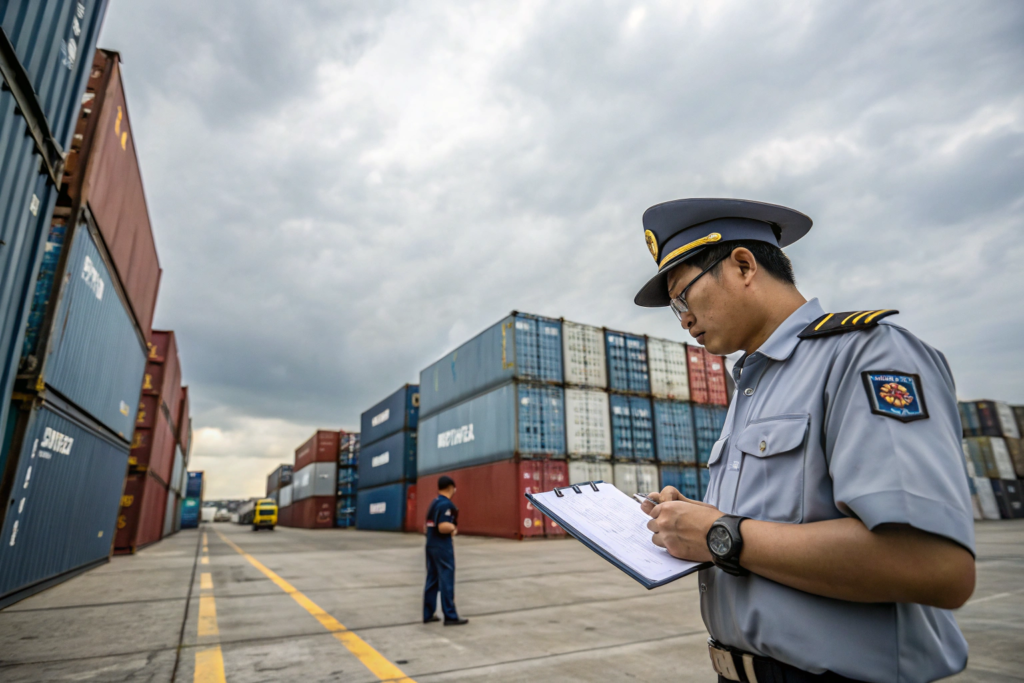
Define Incoterms at each transfer point. We strongly recommend shipping on FOB or CIF terms from China, with title and risk passing to the buyer at the port of loading. Do not retain ownership of fabric that is sitting in a third country.
-
Require pre-shipment inspection at each border. We offer optional third-party inspection at our loading dock. The buyer’s representative (or their nominated lab) inspects the fabric before it leaves China. Once it is on the truck, the buyer accepts responsibility.
-
Build buffer inventory. Multi-country production is not just-in-time friendly. We recommend a 15-20% buffer of greige fabric held in China or in-country for replenishment of rejected rolls.
-
Test, test, test. Test the fabric at the greige stage. Test it after finishing. Test it after the first production garments. Do not assume that passing at one stage guarantees passing at the next.
-
Visit all nodes. If you are managing a supply chain that spans three countries, you should have boots on the ground in each country. Virtual management is insufficient. We host buyer visits weekly. The buyers who come see the fabric, touch the rolls, and meet the production managers have far fewer quality surprises than those who manage entirely by email.
In 2020, a UK-based retailer launched a major program with fabric woven in China, dyed in Vietnam, and cut-and-sewn in Indonesia. They did not visit the Vietnamese dyer. They relied on the dyer’s certifications and the agent’s assurances. Eighteen months into the program, they discovered the dyer was subcontracting portions of their finishing to an unapproved facility. The facility’s wastewater treatment was inadequate. The client’s GOTS certification was jeopardized. They had to requalify three new dyers under extreme time pressure. They now require site visits for all strategic partners. The Sustainable Apparel Coalition’s Facility Environmental Module (FEM) provides standardized environmental performance data, but it does not replace physical inspection.
How do I handle US Section 301 tariffs on Chinese fabric shipped to Vietnam for garment assembly?
This is a critical issue for US-bound production.
The current structure: Chinese-origin fabric imported into Vietnam, made into garments in Vietnam, and exported to the US is subject to:
- US duty on the garment (typically 15-32% depending on product category).
- No Section 301 duty on the garment, because the garment is of Vietnamese origin, not Chinese origin. Section 301 applies to products of China, not to products of Vietnam containing Chinese components.
However, US Customs may scrutinize these shipments for evasion. If the Vietnamese factory is performing only minimal processing (e.g., cutting and sewing a small component), and the ‘essence’ of the product remains Chinese, Customs may deem the country of origin to be China and assess 301 duties plus penalties.
The safe harbor: Substantial transformation in Vietnam. To claim Vietnamese origin, the Vietnamese processing must be substantial and meaningful. For a garment, this generally includes cutting of all components and complete assembly. Simply attaching a label to a fully made-in-China garment is not sufficient.
Our advice: Document the Vietnamese processing thoroughly. Maintain records of cutting orders, sewing line schedules, and workforce data. If US Customs audits your entry, you need to prove that Vietnam, not China, was the country of origin. The US Customs and Border Protection Country of Origin Marking requirements are explicit, and we recommend consulting with a qualified customs broker before shipping.
What is the real cost of carbon footprint reporting for multi-country production?
This is an emerging cost that many buyers have not yet modeled. The EU Carbon Border Adjustment Mechanism (CBAM) currently applies to cement, steel, aluminum, fertilizers, electricity, and hydrogen—not textiles. But the trend is clear: regulators are moving toward requiring embodied carbon reporting for all imports.
Multi-country production complicates carbon accounting. Your fabric is woven in China (coal-powered grid), dyed in Vietnam (increasingly renewable but still coal-dependent), and sewn in Cambodia (hydro-powered). Who owns the emissions? Who reports them? What is the allocation methodology?
We are seeing:
-
Brands requesting product carbon footprint (PCF) data for fabrics manufactured in multi-country supply chains. This requires primary activity data from each node: electricity consumption, fuel use, chemical inputs, waste generation.
-
Auditors requiring third-party verification of this data. A spreadsheet self-declaration is no longer sufficient.
-
Customers prioritizing suppliers with verified low-carbon production and penalizing those who cannot provide data.
Our response: We are conducting a scope 1, 2, and 3 inventory of our entire operation, aligned with the GHG Protocol. We are working with our Vietnamese and Cambodian partners to collect their energy and material data. We are piloting the Higg FEM reporting platform with key clients. This is expensive and time-consuming. We believe it is necessary for continued market access in Europe and, eventually, North America.
If your brand is subject to climate disclosure requirements (CDP, SEC, CSRD), you should be asking your fabric suppliers for their emissions data now. Waiting until 2026 will leave you scrambling.
How Do You Build Resilient Multi-Country Supply Chains?
Resilience is not the opposite of efficiency; it is a different optimization function. A supply chain optimized solely for cost-per-unit is brittle. A single factory closure, a single container ship stuck in the Suez Canal, a single COVID lockdown—and the chain snaps.
Resilience strategies we support:
-
Geographic diversification within China. We maintain weaving capacity in Zhejiang, Jiangsu, and Guangdong. If one province faces power rationing or COVID restrictions, we shift production to another. This is more expensive than single-sourcing from our lowest-cost mill, but it ensures supply continuity.
-
Greige inventory prepositioning. For key clients, we hold 30-60 days of greige fabric in our warehouse in Keqiao and also in a bonded warehouse in Vietnam. The client pays a monthly storage fee, but they can draw down inventory with 48-hour notice. This is the textile equivalent of just-in-case inventory.
-
Dual finishing routes. If our primary Vietnamese dye house has a capacity issue, we have qualified a backup dyer in Indonesia and a tertiary option in China (for non-preferential programs). We do not disclose these backups during commercial negotiations, but we maintain the technical qualifications.
-
Supply chain mapping. We require our raw material suppliers (yarn, chemicals) to disclose their own supply sources. We do not accept "proprietary" as an answer. We need to know where the polyester chips come from, where the cotton is ginned, where the dyes are formulated. This is not curiosity; it is risk management.
-
Scenario planning. In 2020, we conducted a war-game exercise with a major European client. Scenario: China’s ports are closed for 60 days. What do we do? Our plan involved air-freighting urgent orders, activating our Indonesian weaving partner, and re-routing fabric through Da Nang. We have never needed to execute this plan, but having it reduced the client’s anxiety and strengthened our partnership.
Our honest assessment: No supply chain is fully resilient. You cannot eliminate risk; you can only choose which risks to accept. The question is not "Is this supply chain resilient?" The question is "Is this supply chain resilient enough for the margin you are earning?"
In 2024, a US-based brand asked us to quote a program that required fabric woven in China, dyed in Vietnam, and sewn in Haiti. The landed duty rate was 0% (Haiti HOPE/HELP Act). The margin was attractive. We quoted the fabric, but we also provided a risk assessment: political instability in Haiti, transit time through the Panama Canal, potential for US Customs scrutiny of Haitian origin claims. The client accepted the risk. The program has shipped successfully for 12 months. The client has not asked us to waive our fees when a Haitian port closure delayed their shipment. They understood the risk because we articulated it clearly. The World Bank’s Logistics Performance Index provides comparative data on supply chain reliability by country, and we reference it in these risk assessments.
Should I use a trading company or source directly from mills for multi-country production?
This is a strategic decision, not a cost decision.
Direct mill sourcing advantages:
- Lower price (10-20% depending on product and volume).
- Direct technical communication with the production team.
- Visibility into the mill’s capacity and quality systems.
- No intermediary margin.
Direct mill sourcing disadvantages:
- Mills are optimized for volume, not complexity. They may lack experience with multi-country logistics, customs documentation, and cross-border dispute resolution.
- Mills sell fabric. They do not typically manage the relationship with your Vietnamese dyer or Cambodian cutter. You are the integrator.
- If something goes wrong, you have no buffer between you and the mill.
Trading company advantages:
- Supply chain integration. A good trader manages the entire network: greige sourcing, finishing, logistics, compliance.
- Risk intermediation. The trader holds inventory, manages quality disputes, and often extends credit.
- Market intelligence. Traders see broader trends and can recommend alternative sourcing routes.
Trading company disadvantages:
- Cost. The trader’s margin is real.
- Opacity. Some traders obscure their supply sources, making it difficult for you to audit sub-tier suppliers.
Our hybrid model: We operate as a mill-direct supplier with trader services. We manufacture fabric. We do not trade third-party goods. But we also provide supply chain coordination: we book the freight, we communicate with your nominated dyer, we provide translation services, we mediate disputes. We charge for these services separately or bundle them into the fabric price. This is not the right model for every buyer, but for clients who value both technical capability and supply chain integration, it works.
What is the minimum volume for multi-country production to be viable?
There is no universal threshold, but here is our rule of thumb:
-
Per SKU: Minimum 5,000 meters per color per construction. Below this, the logistics friction (documentation, testing, transit) consumes the labor cost advantage.
-
Per program: Minimum $250,000 annual spend. Below this, it is difficult to justify the management attention required from all parties.
-
Per order: Minimum 1 full container (20ft or 40ft) per shipment. Less-than-container-load (LCL) shipping for cross-border fabric movement is expensive, slow, and high-risk for damage.
For smaller brands: Multi-country production is often not viable. You are better served by:
- Single-country production (all fabric and assembly in China, or all fabric and assembly in Vietnam).
- Domestic production in your home market for capsule collections.
- Working with a vertically integrated supplier who manufactures fabric and garments under one roof.
We support small brands through our greige stock program. We hold inventory of standard constructions (cotton twill, poplin, satin) in China. You order 500 meters, we ship it to your nominated sewing factory anywhere in Asia. You do not get the cost advantage of Vietnamese dyeing, but you also do not get the complexity. This is often the right trade-off.
Conclusion
Multi-country fabric sourcing is not a trend. It is the structural reality of the global apparel industry. China will remain the dominant producer of high-complexity, capital-intensive fabrics for the foreseeable future. Southeast Asia will continue to expand its garment assembly capacity. The brands that win will be those that can integrate these nodes into a seamless, reliable, cost-effective network.
At Shanghai Fumao, we made a strategic decision in 2018 to stop being just a fabric manufacturer. We became a supply chain integrator. We still weave fabric. We still dye and finish fabric. But we also hold greige inventory in Vietnam. We have trained technical representatives in Ho Chi Minh City and Phnom Penh. We have qualified finishing partners in Indonesia and Bangladesh. We have mapped our clients’ rules of origin requirements and structured our production accordingly.
This is not altruism. It is self-interest. The more complex our clients’ supply chains become, the more they need partners who understand the entire network, not just one node. We have grown our multi-country business by 34% annually for three consecutive years. We expect this growth to accelerate.
If you are currently managing fabric sourcing from China and garment assembly in Southeast Asia as two separate, siloed activities, you are leaving margin on the table and accepting unnecessary risk. You need a partner who can bridge the gap.
Contact Elaine, our Business Director, to discuss your multi-country production requirements. Elaine oversees our supply chain solutions division and has successfully managed programs spanning China, Vietnam, Cambodia, Indonesia, and Bangladesh. Elaine’s email is: elaine@fumaoclothing.com. Tell her where you are weaving, where you are finishing, and where you are sewing. She will help you connect the dots.