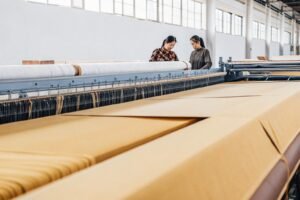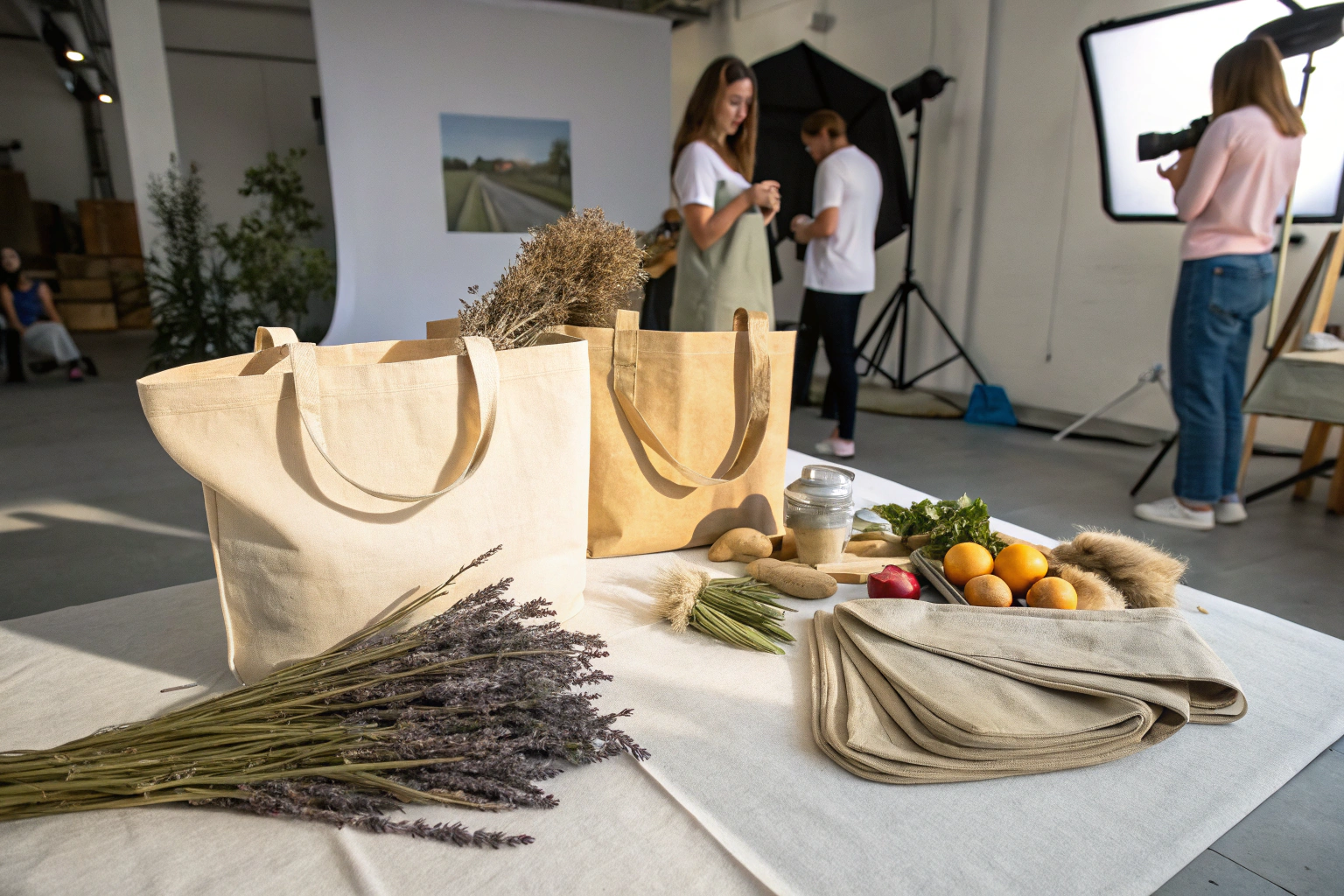
I was in a meeting with a buyer from a major European cosmetics house in April 2024. She was not there to discuss garment fabrics. She was there to discuss packaging. Her company had pledged to eliminate all virgin plastic shopping bags and polybags by the end of 2025. Their current non-woven polypropylene ‘eco’ bags were under fire from their own sustainability team because consumers were discovering that polypropylene, while recyclable in theory, is rarely recycled in practice. She needed a fabric solution for their gift-with-purchase tote bags and their inner packaging that was genuinely circular, cost-effective for a run of 2.2 million units, and aesthetically consistent with a luxury brand. "I don’t even know what questions to ask," she said. "I know fabric, but this is a different world."
She is not alone. The surge in demand for fabric-based packaging—shopping bags, dust covers, polybag alternatives, wine carriers, produce sacks, e-commerce mailers—has caught many textile suppliers off guard. We spent 2022 and 2023 building out an entire dedicated packaging fabric division at Shanghai Fumao because we saw this coming. Our garment clients were increasingly asking for the same sustainability credentials for their packaging that they demand for their clothing. They want GRS-certified recycled content. They want home-compostable options. They want water-based, solvent-free coatings. And they want it at a price point that works for a disposable or semi-durable item, not a luxury garment.
This article is the roadmap I wish I had in 2021. I will walk you through the specific fabric constructions used in eco-packaging, the certifications that actually matter for circular economy claims, the hidden pitfalls in coated fabrics for bags, and how to balance durability against biodegradability. Whether you are sourcing 500 promotional tote bags for a boutique or 500,000 polybag replacements for a multinational retailer, the information here will help you avoid the greenwashing traps and the functional failures I have seen firsthand.
What Are the Best Fabric Constructions for Reusable Shopping Bags?
Let us kill the most common misconception immediately: non-woven polypropylene is not a sustainable miracle material. It is plastic. It is made from fossil fuels. It is often labeled ‘eco-friendly’ because it is thicker than a single-use plastic bag and can be reused a few times, but its end-of-life reality is grim. Most municipal recycling systems do not accept soft polypropylene. It ends up in landfill or incineration. If you are sourcing ‘eco-friendly’ non-woven PP bags today, you are likely greenwashing, even if you do not intend to.
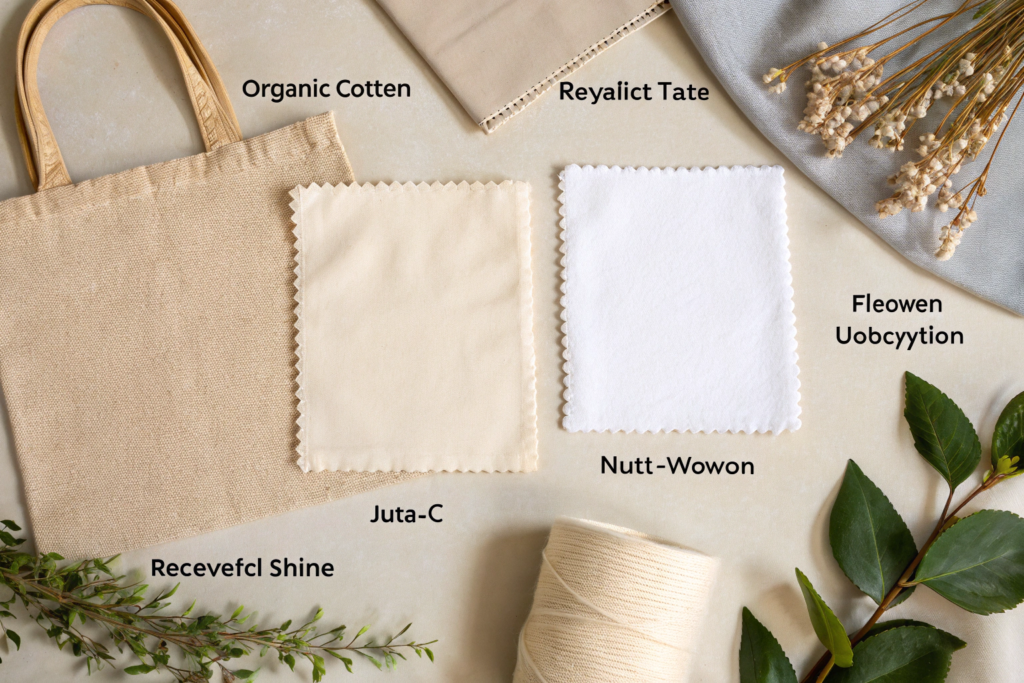
So what should you use instead? There are four primary fabric categories for reusable bags, each with distinct trade-offs.
1. Organic Cotton Canvas. This is the gold standard for premium retail bags. It feels substantial, it is fully biodegradable, and it communicates luxury and sustainability simultaneously. The downsides: weight (shipping costs are higher), water footprint (even organic cotton requires irrigation), and price (often 3-5x non-woven PP).
2. Recycled Polyester (rPET). Made from plastic bottles. Strong, lightweight, dries quickly, and can be recycled again at end of life if the infrastructure exists. The catch: it sheds microplastics during washing, and the mechanical recycling process shortens fiber length, limiting the number of closed-loop cycles possible.
3. Natural Fiber Non-Wovens. Think hemp, flax, or jute needle-punched into felt-like sheets. These are fully compostable and have beautiful natural aesthetics. The challenge is consistency and availability in large volumes.
4. Ingeo PLA (Polylactic Acid). A bioplastic derived from fermented corn starch. It can be spun into fibers and made into non-wovens or woven fabrics. It is industrially compostable (not home compostable in most cases). However, it has low heat resistance and can deform in a hot car.
At Fumao, we steer most high-volume packaging clients toward organic cotton for premium giveaways and rPET for utility-focused reusable bags. Both have established supply chains and verifiable certification pathways. For a deep dive into the life cycle assessment data comparing these materials, the Ellen MacArthur Foundation’s analysis of reusable packaging materials provides neutral, peer-reviewed comparisons.
What fabric weight do I need for a bag that will carry heavy items?
This is the most common technical failure I see in sourced bags. A buyer chooses a beautiful 140gsm organic cotton for a grocery tote. The bag looks great on the counter. The customer loads it with three bottles of wine and a bag of oranges. The handles rip off on the walk to the car.
Handle attachment is often the weakest point, not the fabric itself. But the fabric must have sufficient tensile strength and dimensional stability to support the load. For a medium-duty grocery tote (5-8kg capacity), we recommend a minimum of 240gsm for cotton canvas and 180gsm for rPET taffeta if reinforced with bar-tacking at stress points. For heavy-duty (10kg+), step up to 320gsm cotton or 240gsm rPET with doubled handles.
We learned this the hard way in 2022. A German organic food chain ordered 80,000 tote bags in 200gsm organic cotton. The first customer complaint came three days after distribution: a handle had detached, spilling a jar of honey. The client was furious. We inspected the returned bag. The fabric weight was correct per the specification, but the handle attachment stitching used a straight stitch instead of a box stitch, and the thread tension was too high, causing perforation of the fabric. We air-freighted replacement panels, re-sewed 80,000 handles, and shipped them back. The client stayed with us, but the lesson cost us €47,000. Now, we conduct handle pull tests (ASTM D5034) on every production lot of bag fabrics. I recommend you request this test data before shipping.
If you are designing bags for specific weight capacities, the ASTM D5034 breaking strength and elongation test method is the relevant standard, and most Chinese textile labs can perform it with 48-hour turnaround.
Can I get GRS-certified recycled polyester for bags, and what is the lead time?
Yes, and we now stock it as a standard greige item specifically for the packaging and bag market. This was a strategic decision in 2023. We realized that packaging clients have different timelines than garment clients. A garment brand might plan 6 months ahead. A marketing director ordering promotional bags often needs them in 6 weeks.
We now maintain an inventory of GRS-certified recycled polyester taffeta in 75D and 150D weights, in both plain weave and dobby constructions. We stock undyed (greige) rolls, and we dye to order. For a standard color (black, navy, natural), we can ship finished fabric in 12-15 days. For custom Pantones, add 5 days for lab dip approval.
The certification chain for GRS is rigorous. You will receive a Transaction Certificate (TC) from our certification body (we use CU 811279) covering the specific quantity shipped. This TC is your proof for your own sustainability reporting. We also provide the Scope Certificate for our facility. Do not accept a GRS claim without both documents.
The price premium for GRS-certified rPET over virgin polyester is approximately 8-12% today, down from 25% in 2020. Economies of scale are finally catching up. The Textile Exchange’s annual Preferred Fiber & Materials Market Report tracks these price differentials and supply volumes, and the trend is clearly toward cost parity within 3-5 years.
How Do I Source Fabric for Polybag Replacements and Inner Packaging?
This is the fastest-growing segment of our packaging fabric business. Major brands are under intense pressure to eliminate the single-use LDPE (low-density polyethylene) polybags that protect garments during shipping and storage. A single Zara order might consume millions of polybags annually. The waste is staggering.
The alternative materials fall into three camps, and none is a perfect replacement yet.
1. Biodegradable/Compostable Films. These are not fabrics; they are films made from PBAT, PLA, or starch blends. They look and feel like plastic but are designed to break down in industrial composting facilities. The catch: they are often weaker than LDPE, they have shorter shelf life, and they cannot be recycled with conventional plastics, causing contamination in recycling streams.
2. Non-Woven Fabric Wraps. Lightweight (30-60gsm) spunbond or needle-punched fabrics made from natural fibers or PLA. These are reusable by the consumer, unlike a film which is immediately discarded. They add cost and weight to the shipment.
3. Fabric Dust Bags. This is the premium solution, already standard for luxury accessories. A reusable cotton or RPET drawstring bag replaces dozens of single-use polybags over the product’s lifetime.
We have developed a specific lightweight organic cotton voile (60gsm) for this application. It is semi-sheer, extremely soft, and weighs almost nothing. A European designer brand now wraps all their e-commerce shipments in these bags, printed with their monogram. Customers keep the bags for jewelry, cables, or travel. The brand reports a 23% increase in positive unboxing social media mentions since the switch. For a detailed analysis of polybag alternatives and their material properties, the Sustainable Packaging Coalition’s How2Recycle program provides clarity on which materials are actually recyclable in current US municipal systems.
What is the difference between ‘biodegradable’ and ‘compostable’ in fabric packaging?
This distinction matters legally and environmentally, and many suppliers blur it deliberately.
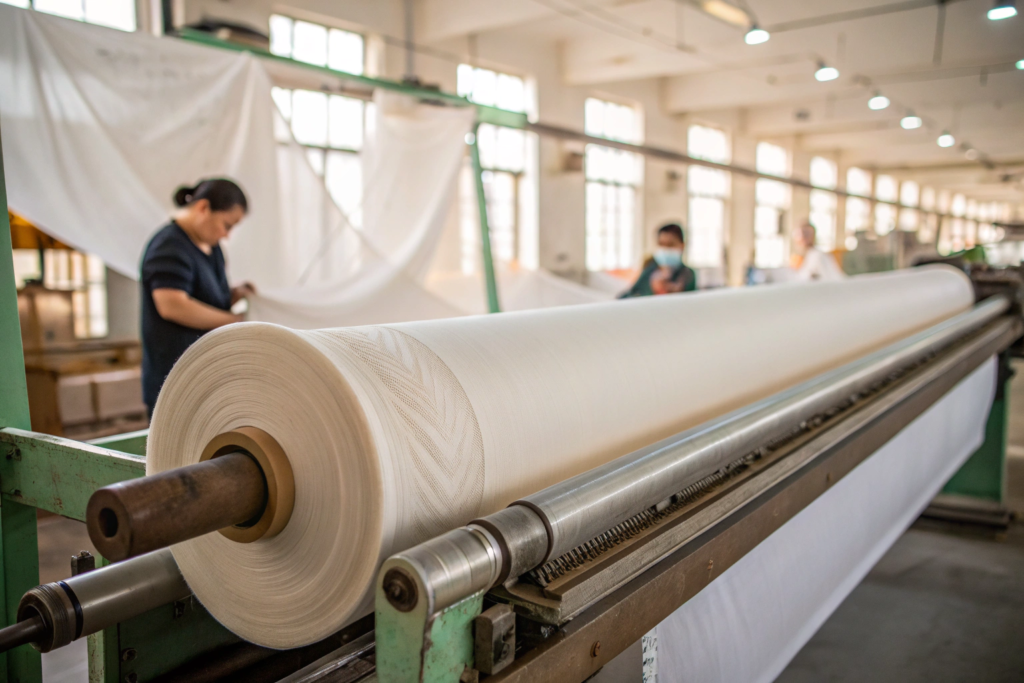
Biodegradable means the material will break down into natural elements over time, given the right conditions. It does not specify how long this takes, what conditions are required, or whether toxic residues remain. A cotton t-shirt is biodegradable. A PLA non-woven is biodegradable. A standard LDPE polybag is also biodegradable—it just takes 400 years. The term alone is nearly meaningless without a timeframe and environment specification.
Compostable is a stricter, certified claim. It means the material will break down in a composting environment within a specific timeframe (usually 90-180 days), leave no toxic residue, and support plant growth. The relevant standards are ASTM D6400 (US) and EN 13432 (EU). If a fabric or film is certified compostable, you will see these standard numbers on the certificate.
Here is the uncomfortable truth: most fabric packaging labeled ‘biodegradable’ in China is not certified compostable. It is standard PLA or viscose with marketing language attached. We do not make compostability claims unless we have the test reports and certification from TÜV or DIN Certco. In 2023, we explored launching a ‘home compostable’ non-woven bag. We tested three different PLA/PBAT blends. None passed the full EN 13432 criteria for home composting (which is stricter than industrial). We shelved the project. I refuse to sell a product that will sit intact in a customer’s backyard compost bin for three years while they wonder if they did something wrong.
If compostability is essential to your brand, request the certificate of conformity to EN 13432 or ASTM D6400 from your supplier. The European Bioplastics website has a certification database listing certified materials and converters.
How do I prevent mold on cotton or linen packaging during ocean freight?
This is a silent killer of natural fiber packaging orders. Cotton and linen are hygroscopic. They absorb moisture from the air. A container leaving Shanghai in June, crossing the equator, and arriving in Los Angeles in July experiences massive temperature and humidity swings. Condensation forms inside the container. The fabric absorbs this moisture. By the time the container opens, the bags may have black mold spots. The shipment is rejected. The client misses their product launch.
We prevent this through three layers of defense.
First, moisture regain control. We dry the finished fabric to a specific moisture content (6-8% for cotton) before cutting and sewing. We measure this with a moisture meter on the production line.
Second, desiccant loading. We place silica gel desiccants inside the master cartons, not just the container. We use indicating desiccants that change color when saturated, so the client can verify at arrival.
Third, anti-mold finishes. For clients willing to accept a chemical treatment, we apply a non-leaching anti-fungal finish (zinc pyrithione or silver-based) that is Oeko-Tex certified. This adds cost and is not compatible with GOTS organic certification. For GOTS-compliant shipments, we rely on the first two measures and accept a slightly higher risk.
In 2021, a client ignored our recommendation for desiccants on a 40-foot container of organic cotton tote bags. The shipment arrived in Hamburg with visible mold on the outer cartons. The client’s customer rejected the entire order. We helped them reprocess the bags through an industrial ozone chamber, which killed the mold but left faint staining. It was salvageable, but the delay cost them their seasonal placement. I wrote a detailed guide to preventing mold on natural fiber textile shipments that explains the relative humidity thresholds and container ventilation strategies we use.
What Certifications Are Essential for Credible Eco-Packaging Claims?
The packaging industry is awash in false and exaggerated environmental claims. Regulators are finally cracking down. In 2023, the European Commission proposed the Green Claims Directive, requiring companies to substantiate environmental marketing with third-party certification. In the US, the FTC Green Guides are under revision to further restrict vague terms like ‘eco-friendly’.
If you are sourcing fabric packaging for a brand that makes public sustainability commitments, you need the following certifications to avoid greenwashing accusations.
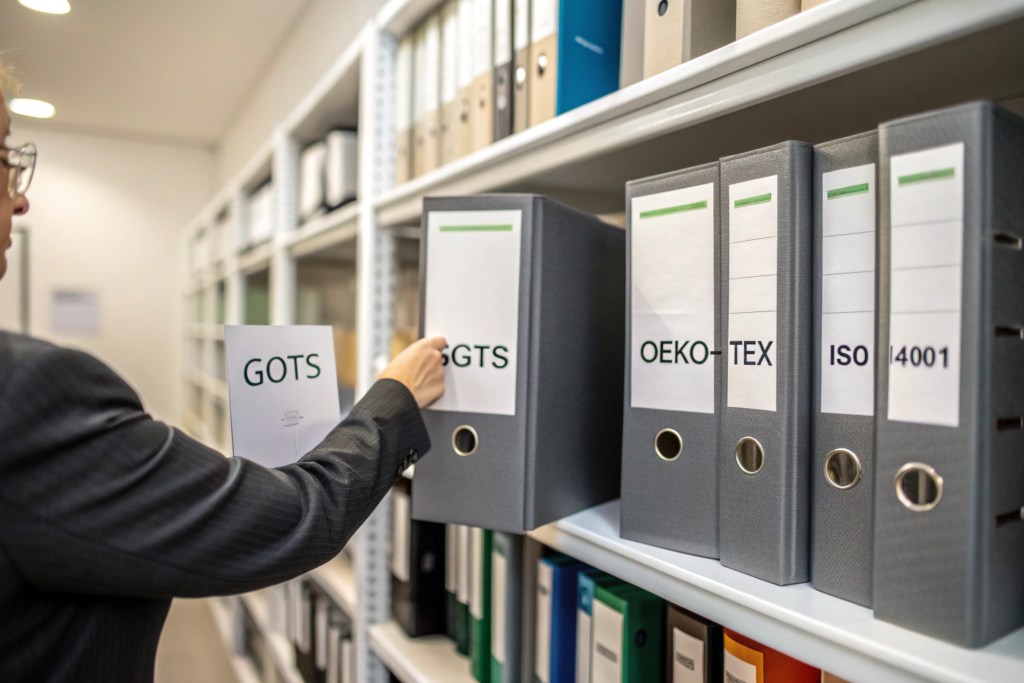
For organic content: GOTS or OCS. GOTS is preferred because it also covers chemical inputs and social compliance. If you claim ‘organic cotton bag’, you must have a Transaction Certificate proving the fiber origin.
For recycled content: GRS or RCS. GRS includes social and environmental criteria; RCS is chain-of-custody only. Both are administered by Textile Exchange. Your supplier must provide a Transaction Certificate for your specific shipment.
For biodegradability/compostability: OK Compost (TÜV) or BPI certification. These are not fabric certifications per se; they apply to the finished product. If you sell a bag as ‘compostable’, the entire bag—fabric, thread, label, zipper, coating—must be certified compostable. A cotton bag with a polyester thread is not compostable.
For chemical safety: OEKO-TEX Standard 100. This is not a sustainability claim; it is a consumer safety claim. It verifies that the fabric does not contain harmful levels of regulated substances. For packaging that contacts food (produce bags, bread bags), you may need OEKO-TEX Standard 100 Product Class I (baby articles), which has the strictest limits.
We maintain GOTS, GRS, and OEKO-TEX certifications across multiple production lines. When a client asks for ‘eco-friendly bags’, my first question is: "Which certification do you need to put on your hang tag?" Their answer determines everything else. The Global Ecolabelling Network provides a comprehensive directory of legitimate Type I environmental labels recognized by the International Organization for Standardization (ISO 14024). If your supplier’s ‘eco’ claim is not backed by a GEN member certification, proceed with extreme caution.
Is FSC-certified fabric a thing, or am I confusing it with paper?
You are partially correct. FSC (Forest Stewardship Council) certifies forest products—wood, paper, cork. It does not certify fabric directly. However, man-made cellulosic fibers like viscose, modal, and lyocell are made from wood pulp. These fibers can be certified under FSC Chain of Custody if the pulp originates from FSC-certified forests.
For fabric packaging, this matters for rayon and Tencel bags. If you are sourcing a luxurious viscose dust bag or a Tencel produce sack, you can and should ask for FSC-certified pulp. The fiber producer (Lenzing, for Tencel) holds FSC certification. Your fabric mill must maintain chain of custody documentation from the fiber producer through to the finished fabric.
We offer a Tencel lyocell non-woven made from FSC-certified pulp. It is exceptionally soft, has natural anti-bacterial properties, and is fully biodegradable. It costs approximately 4x standard non-woven PP, so it is a niche premium product. But for luxury brands that have already eliminated plastic from their packaging, it is the next frontier. The FSC Certificate Database allows you to verify any supplier’s certification status by certificate number.
Can I use deadstock or surplus fabric for packaging to reduce waste?
Yes, and this is one of the most genuinely circular sourcing strategies available. Deadstock fabric—roll ends, cancelled orders, overproduction—is a massive waste stream in the textile industry. Using it for packaging diverts material from landfill and requires no new virgin resource extraction.
The challenge is consistency. Deadstock is, by definition, unpredictable. You cannot guarantee color matching across large volumes. You cannot guarantee continuous availability for reorders. For a one-off promotional campaign, this is fine. For a core SKU you expect to replenish quarterly, it is risky.
We operate a deadstock sourcing service for packaging clients. We maintain a digital inventory of available surplus fabrics from our own production and from partner mills. When a client needs 5,000 tote bags, we search this inventory for a suitable base cloth—minimum 1,500 meters continuous, consistent weight and construction, aesthetically acceptable. The client approves the swatch. We cut and sew. The client receives a unique product with a sustainability story and a lower carbon footprint. The price is often 20-30% below virgin fabric.
In 2024, we supplied 12,000 meters of end-of-roll organic cotton twill to a Japanese lifestyle brand for their holiday gift bags. The fabric was originally destined for a cancelled apparel order. The color was a specific ‘cactus green’ that the brand loved. They built their entire seasonal campaign around that color. It sold out in 11 days. The Fashion for Good Deadstock Marketplace is a B2B platform attempting to scale this concept, and we are active participants.
How Do I Balance Durability, Cost, and End-of-Life?
This is the central tension in eco-packaging. If you make a bag too durable, it will last for years. That is good for the use phase. But if it is made from mixed materials (cotton with polyester thread, RPET with PP webbing), it may be un-recyclable at end of life. If you make it fully compostable, it may tear after five uses and need replacement sooner. There is no universal right answer; there are only trade-offs aligned with your brand’s priorities.
The durability-first approach. This favors heavy cotton canvas or thick RPET. The bag is designed to survive 100+ uses. The environmental impact is dominated by the manufacturing phase, so maximizing lifespan is critical. Choose mono-material construction (all cotton, all RPET) to enable eventual recycling. This is appropriate for paid retail products.
The compostability-first approach. This favors unbleached organic cotton, hemp, or PLA non-wovens. The bag is designed to biodegrade at end of life. Accept that it may have a shorter useful lifespan. This is appropriate for single-use replacements and promotional giveaways where return rates are low.
The low-cost approach. This favors standard non-woven PP. It is the incumbent for a reason. It is cheap, it is lightweight, and it is available everywhere. If your budget is truly constrained and you cannot pass a 300% cost increase to your customer, this may be your only option. But do not call it ‘eco-friendly’. Call it ‘reusable’. That is a truthful claim.
We guide clients through this trade-off using a simple matrix: budget, desired lifespan, disposal pathway, and brand positioning. In 2023, we helped a large US grocery chain transition from non-woven PP giveaway bags to a 50% post-consumer recycled LDPE bag with a take-back program. The bag was not fabric, but the logic applies: they accepted a higher per-unit cost in exchange for a closed-loop recycling system and credible circular economy marketing. The Cradle to Cradle Certified Product Standard provides a framework for evaluating these trade-offs across material health, product circularity, and renewable energy use.
Should I choose woven or non-woven fabric for my bags?
This is not a sustainability question; it is a performance and aesthetic question.
Woven fabrics (canvas, twill, taffeta) are made by interlacing warp and weft yarns. They are stronger, more durable, and have better printability. They look and feel like ‘real fabric’. They cost more. Lead times are longer because weaving is slower than non-woven production.
Non-woven fabrics are made by bonding fibers together mechanically, thermally, or chemically. They are cheaper, lighter, and faster to produce. They have a paper-like or felt-like hand feel. They are less durable, especially at the seams. They do not hold detailed prints as crisply.
We offer both. For a premium retail bag intended for years of reuse, we recommend woven. For a lightweight trade-show giveaway intended for 5-10 uses, we recommend non-woven. For a polybag replacement where softness and weight are the priorities, we recommend a lightweight spunbond non-woven.
One emerging category is woven RPET taffeta with a matte finish. It looks and feels like nylon but is made from recycled bottles. It is water-resistant, extremely strong for its weight, and fully recyclable. Several activewear brands now use this for their e-commerce dust bags. The cost is approximately 30% higher than standard non-woven PP, but the customer experience is vastly superior.
What are the MOQs for custom-printed eco-packaging fabric?
This is the barrier that kills most emerging brand packaging projects. A mill that weaves 100,000 meters per week of standard greige cannot economically stop to weave 500 meters of custom fabric for a start-up brand. The setup time is the same, the labor cost is the same, but the volume is 0.5% of their normal order.
Our solution is a modular customization model.
For woven fabric, we maintain stock greige in standard weights (240gsm organic canvas, 150gsm RPET taffeta). We dye to your Pantone (MOQ 500 meters per color) and print your design via digital transfer (MOQ 100 pieces). This is not cheap per unit, but the absolute commitment is low.
For non-woven fabric, the MOQ for custom color is typically 1,000 kg (approximately 8,000-10,000 bags depending on weight). Below this, you are buying stock color only. Most non-woven producers run standard colors (black, white, green, blue) continuously. Custom colors require a production campaign.
For deadstock sourcing, the MOQ is whatever the available roll length is. Sometimes we find 300 meters. Sometimes we find 3,000 meters. You take what exists. This is not suitable for large-scale, repeatable programs.
If you are a small brand needing 200 custom tote bags for a launch event, do not try to commission custom fabric. Buy stock fabric bags and have them screen-printed locally. The cost will be lower and the timeline shorter. We do this for clients every week. The Custom Tote Bag Sourcing Guide from the Promotional Products Association has vetted supplier lists and typical MOQ benchmarks.
Conclusion
Sourcing fabric for eco-friendly packaging is not the same as sourcing fabric for garments. The performance requirements are different. The cost structures are different. The certification pathways are different. And the greenwashing risks are, frankly, higher because packaging is often purchased by non-textile specialists who do not know the right questions to ask.
At Shanghai Fumao, we have built a dedicated packaging fabric division precisely because this is a distinct discipline. We maintain separate greige inventory for packaging applications. We have developed specific QC protocols for bag fabric (handle pull tests, seam slippage, moisture control). We have trained our sales team to understand the difference between GOTS and GRS, between biodegradable and compostable, between woven and non-woven. We do not treat packaging as an afterthought to our garment fabric business. It is a core competency.
If you are responsible for sourcing sustainable packaging for your brand—whether you need 500 custom tote bags for a VIP event or 500,000 polybag replacements for global distribution—I invite you to contact us. We will ask you the hard questions about your disposal pathway, your budget constraints, and your certification requirements. We will not sell you a ‘compostable’ bag that cannot actually be composted. We will not sell you an ‘organic’ bag without transaction certificates. We will sell you the right fabric for your specific circular economy goal.
Contact Elaine, our Business Director, to discuss your eco-packaging fabric needs. Elaine manages our sustainable packaging division and has overseen major programs for cosmetics, grocery, and luxury goods clients. Elaine’s email is: elaine@fumaoclothing.com. Tell her what you are packaging, and she will recommend the fabric.