
You’ve just approved the final pre-shipment sample. The intricate lace is perfect—every floral motif crisp, the net ground flawless. A month later, the container arrives. You unroll the first bolt and your heart sinks: deep creases that won’t steam out, snags from friction, and worse, a musty smell from moisture trapped during the voyage. The lace isn’t ruined, but the hours spent repairing, re-cutting, and the yield loss eat your entire margin. For delicate lace, standard fabric packaging is a recipe for disaster. So, what specific steps transform a fragile roll into a shipment that arrives in showroom condition?
The packaging requirements for shipping delicate lace are a multi-layered defense system designed to combat four enemies: compression, friction, moisture, and contamination. It goes far beyond a cardboard box. The gold standard protocol involves an inner core stabilization, layered protective wrapping, vacuum-sealing with desiccants, rigid external support, and clear hazard labeling. Success hinges on treating the lace not as fabric, but as a sensitive, three-dimensional structure that must be immobilized and isolated from the maritime or aerial environment.
This guide will detail the military-grade packing protocol used by top mills. You’ll learn the materials list, the step-by-step process, how to inspect a properly packed roll, and the critical clauses to write into your purchase order. Let’s ensure your lace arrives as pristine as it left the inspection table.
Why is Standard Fabric Packaging a Death Sentence for Delicate Lace?
To understand the specialized needs, you must first see how lace fails in transit. It’s not a solid weave like denim; it’s an open, sculptural network of threads.
- Compression & Creasing: When a lace roll is stacked under other heavy rolls or boxes, the pressure flattens the motifs permanently. Raised patterns in guipure or cords in Alençon lace can be crushed, creating shiny, permanent creases that cannot be steamed out. This is a physical deformation of the fibers.
- Friction & Snagging: If the lace can shift inside its packaging, the delicate threads rub against each other or the cardboard, causing pulls and snags. Even a micro-snag can unravel a motif under tension during cutting.
- Moisture & Mold: Lace, especially natural fibers like silk or cotton, is hygroscopic. Changes in humidity during sea freight (container sweat) can lead to mildew, discoloration, and a musty odor. For synthetic laces, moisture can cause unsightly water marks.
- Contamination: Dust, dirt, and even oils from handling can become embedded in the open net structure, requiring complex cleaning upon arrival.
I witnessed the cost of neglect in 2023. A client in Los Angeles received a shipment of expensive embroidered lace where the supplier had used only a single layer of plastic. The rolls shifted, the plastic tore, and industrial grease from the container floor contaminated six rolls. The loss was over $15,000. The root cause? A vague PO that only stated “standard export packing.”
What Specific Transit Hazards Target Lace?
Beyond general mishandling, lace is uniquely vulnerable to:
- Vibration: Long-haul truck and ship engines cause constant, low-grade vibration. This can slowly grind fibers against each other (internal abrasion) and work loose any poorly secured rolls, leading to impact damage.
- Pressure Changes (Air Freight): In plane cargo holds, pressure changes can cause trapped air inside rolls to expand and contract, potentially weakening the roll structure if not properly wrapped.
- Static Electricity (Synthetic Laces): Polyester and nylon laces can generate static, attracting dust and lint that is nearly impossible to remove from intricate patterns.
- Carbon Black from Container Floors: A specific and common contaminant in sea freight that stains on contact.
The packaging system must be engineered as a countermeasure to each of these threats. It’s not just padding; it’s a stable micro-environment.
The 6-Step Gold Standard Packing Protocol
This is the process we follow at our warehouse for all lace orders valued over a certain threshold or with intricate constructions. Each step has a clear physical and chemical purpose. Demanding this protocol from your supplier is the single most effective quality control step you can take after production.
Think of it like preparing a fragile archaeological artifact for loan to another museum. Every point of contact, every layer of atmosphere, is controlled.
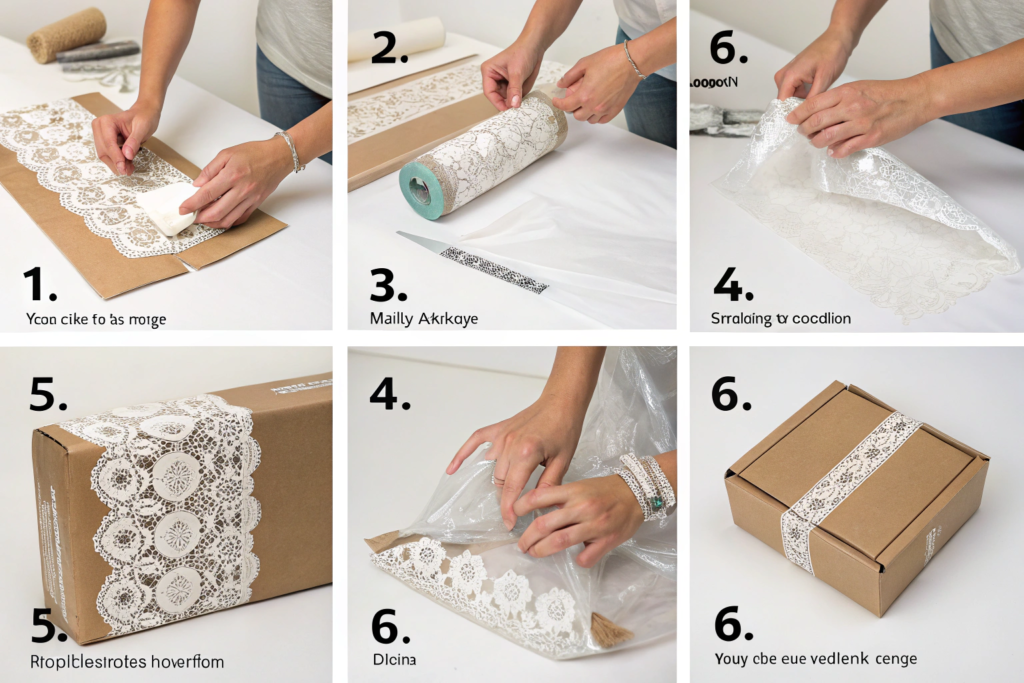
Step 1-3: The Inner Defense (Core to Seal)
These steps create a stable, clean, and dry core unit.
- Mandatory Core Tube: The lace must be rolled around a rigid cardboard or plastic tube with a minimum 3-inch (7.5cm) diameter. Never allow a center-fold or a small, tight core. The large diameter prevents sharp creases at the core and maintains the lace’s natural roll memory. The tube must extend slightly beyond the fabric width to protect edges.
- Layered Cushioned Wrap: Before rolling, a layer of smooth, acid-free paper is laid on the lace. Once rolled, the entire roll is wrapped in 2-3 layers of this paper. This prevents the outer layer of lace from imprinting onto the layer beneath (a common cause of “shadow” marks). For ultra-delicate laces, a layer of soft polyethylene foam sheet is added.
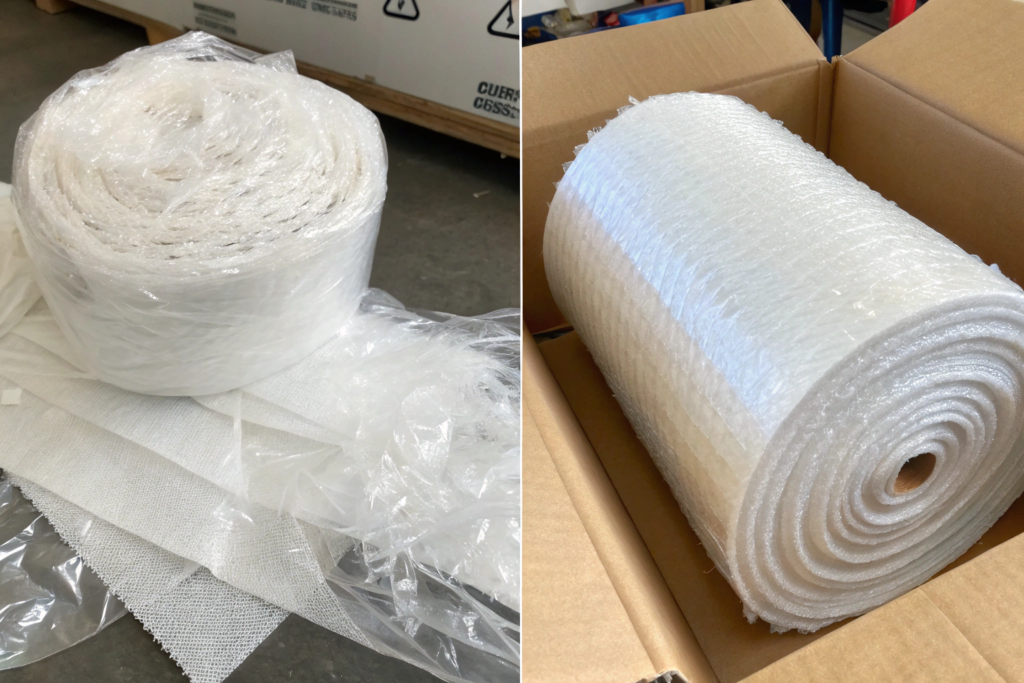
- Vacuum-Sealing with Desiccants: The wrapped roll is inserted into a heavy-duty, clear polyethylene plastic sleeve. The air is extracted via a vacuum pump (not just rolled to push air out), and the bag is heat-sealed. Inside the bag, 2-3 units of silica gel desiccant (indicating type preferred) are included. This creates a moisture-proof, dust-proof barrier and immobilizes the roll.
Why This Matters: In Q4 2023, we shipped a batch of silk Chantilly lace to a bridal atelier in London via sea. The humidity log inside the container showed peaks of 85% RH. Upon arrival, our sealed rolls had a stable 45% RH inside the bag, and the lace was perfect. Other, non-sealed textiles in the same container showed mild moisture marks.
Step 4-6: The Outer Defense (Armor and Identification)
These steps protect the sealed unit from physical crush and ensure proper handling.
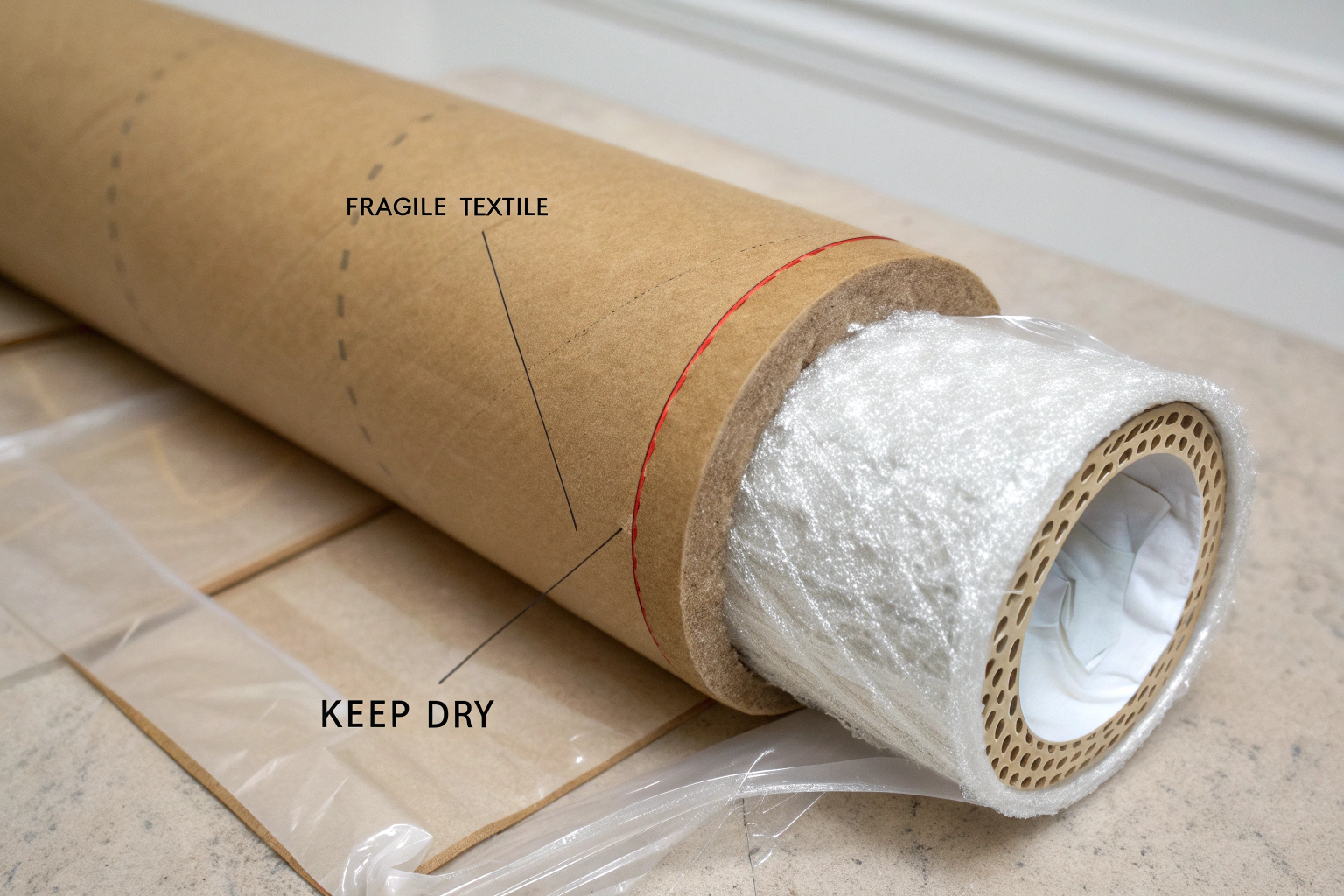
- Rigid Outer Sleeve: The vacuum-sealed bag is then placed inside a close-fitting, corrugated cardboard sleeve (like a poster tube). This sleeve provides crush resistance from side impacts. The ends of the inner tube should be capped with cardboard discs to prevent puncture.
- Labeled Outer Carton: The sleeved roll is placed in a high-quality, double-wall (BC-flute or stronger) corrugated carton. The carton should be sized to leave minimal air space—use additional biodegradable loose-fill or air pillows to prevent movement. The carton must be clearly labeled:
- FRAGILE TEXTILE – DO NOT CRUSH
- KEEP DRY / ÉVITER L’HUMIDITÉ (in multiple languages)
- USE NO HOOKS
- Internal: Item #, Roll #, Length, Width, Color.
- Palletization for Volume Shipments: For full container loads, cartons must be unitized on a wooden pallet. They should be stacked in an interlocking pattern, never directly column-stacked. The entire pallet must be stretch-wrapped tightly and covered with a plastic shroud if there is any risk of exposure during port transfers.
How to Inspect and Verify Packaging Before Shipment?
Your right to inspect doesn’t end with the fabric. The packaging is part of the product delivery. The Pre-Shipment Inspection (PSI) must include a dedicated packaging check. This is your last chance to catch cost-cutting before the freight is loaded.
You or your third-party inspector need a simple checklist. If the supplier knows you will fail the shipment for poor packing, they will comply. I’ve seen factories have two packing lines—one for clients who check, and one for those who don’t. Be the client who checks.

What is the Pre-Shipment Packaging Audit Checklist?
This should be part of your official Inspection Specification Sheet.
- Core: Confirm presence of rigid tube. Is the diameter sufficient? Is the lace rolled evenly without sagging?
- Inner Wrap: Is acid-free paper used? Are there sufficient layers? (Open a sample roll if permitted).
- Vacuum Seal: Is the plastic bag heavy-duty? Is the seal strong and continuous? Can you see the silica gel inside? Does the bag conform tightly to the roll without air pockets?
- Outer Sleeve & Carton: Is the cardboard sleeve present? Is the outer carton double-wall? Does the carton pass a “knuckle rap” test (it should sound solid, not hollow or soft)?
- Labeling: Are all required hazard and content labels present, legible, and in the correct locations?
- Dunnage: Is the interior of the carton packed to prevent movement? Shake the box gently—you should hear nothing move.
Real-World Enforcement: For a client in New York, our third-party inspector rejected the first packing attempt for a guipure lace order. The factory had used flimsy plastic and no cardboard sleeve. Photos were sent, the client upheld the rejection, and the factory repacked all 50 rolls to standard. The extra three-day delay saved weeks of potential claims and preserved the client relationship.
What are the Red Flags of Cost-Cutting in Packaging?
Spot these, and you’ve caught a major risk:
- Lace rolled on itself (no tube): Immediate rejection.
- Thin, single-layer plastic bag: Especially if just tied or taped, not heat-sealed.
- Absence of desiccant: A major red flag for moisture sensitivity.
- Flimsy, single-wall carton: Easily dented by hand pressure.
- Oversized carton with excessive empty space: Allows for dangerous shifting.
- Missing or generic labels: Shows lack of attention to detail and handling instructions.
Key Contractual and Logistical Considerations
The best protocol is useless if not contractually binding and logistically supported. Your terms must define the standard, and your logistics partner must understand the nature of the cargo.
How to Specify Packaging in Your Purchase Order?
Vague language is your enemy. Your PO must reference a detailed, attached specification.
- Bad: "Standard export packing."
- Good: "Packing must comply with the attached ‘Lace Fabric Packaging Specification Sheet, Version 2.0’, including mandatory use of 3” core tubes, vacuum-sealing with 3 units of silica gel per roll, and double-wall cartons. Non-compliance will result in refusal of shipment at supplier’s cost."
- Leverage Payment Terms: Tie the final payment or balance payment to your approval of the PSI report, which includes packaging compliance. This gives you real economic leverage.
Our Template: We offer our clients a clear packing spec sheet they can append to their POs. It removes all ambiguity and sets a professional tone from the start.
What to Communicate to Your Freight Forwarder?
Your forwarder is a partner in final-mile protection. They need to know what’s in the box.
- Classify the Cargo: Inform them it is “Delicate Textiles / Lace” requiring “Dry and Clean” container conditions.
- Request a Dry Container: Specifically request a “waterproof” or “weatherproof” container inspection certificate prior to loading. Ask about best practices for preventing container rain and condensation.
- Stowage Instructions: Request that cartons be stowed away from container doors (greater temperature swings) and not placed on the floor if possible (use pallets). They should not be stacked under heavy machinery or hardware.
- Insurance: Ensure your marine cargo insurance explicitly covers damage due to improper packing or water damage. The insurance surveyor will use your PO packing specs as a reference in case of a claim.
A Prevented Disaster: We once had a shipment to Hamburg scheduled on a vessel where the only container available was one with a minor roof leak noted on the log. Because we had informed the forwarder of the sensitive nature (lace), they flagged it, held the shipment for the next vessel, and secured a sound container. That single communication saved a $40,000 order.
Conclusion
The packaging requirements for shipping delicate lace rolls constitute a rigorous, non-negotiable standard that is as critical as the quality of the lace itself. It is a engineered defense system—combining inner stabilization, vacuum-sealed moisture barriers, rigid external armor, and clear hazard communication—specifically designed to counteract the unique threats of compression, friction, humidity, and contamination during transit. Verifying this protocol through a pre-shipment packaging audit and enshrining it in your purchase order are essential steps to protect your investment. Ultimately, successful delivery depends on a three-way partnership between you (setting the standard), your supplier (executing it faithfully), and your freight forwarder (respecting it in the logistics chain).
Treating lace packaging as a critical path item, not an afterthought, is the mark of a professional and ensures your designs begin their journey with the raw material in perfect condition. At Shanghai Fumao, this gold-standard protocol is built into our fulfillment process, because we understand that our responsibility ends only when your roll is unboxed flawlessly at your destination. If you are looking for a partner who respects your fabric as much as you do, from loom to loading dock, contact our Business Director, Elaine, at elaine@fumaoclothing.com to discuss your next order.








