So, you’re designing a stunning blazer and want a unique embroidered lace motif on the lapel. Or maybe you’re creating a line of jeans and envision custom lace patches on the back pockets. You find the perfect design, send an inquiry, and then get hit with the reality: a Minimum Order Quantity (MOQ) of 5,000 pieces. Your entire production run might only be 200 jackets. Your dream hits a wall. This is the most common, frustrating roadblock for designers and small brands. The problem isn’t just the number—it’s the disconnect between your creative needs and the factory’s economic reality.
The truth is, there is no single "industry standard" MOQ. It’s a flexible number, a starting point for negotiation that depends entirely on what you’re asking for and how you approach the supplier. The MOQ for embroidered lace patches can range from as low as 50 pieces for very simple, stock designs to 10,000+ for complex, multi-color custom work. The key to success is understanding the variables that drive that number up or down, and then strategically navigating them to find a feasible path for your scale.
At Shanghai Fumao, we bridge this gap daily. We work with indie designers ordering 100 patches for a limited collection and with global brands ordering 50,000 motifs for a mass-market line. The process is different, but the principles are the same. Let me demystify the factors behind the MOQ so you can plan, negotiate, and get your unique designs produced without needing fast-fashion volume.
What Factors Drastically Increase the MOQ?
Before you even design your patch, you need to know what makes a factory manager sigh and quote a high number. These are the cost and complexity drivers. Each one adds setup time, specialized labor, or expensive machine downtime. Understanding them lets you make informed trade-offs between your vision and your budget.
Think of it like ordering a custom cake. A simple round vanilla cake has a low "MOQ." But if you want a five-tiered cake shaped like a castle, with hand-painted sugar flowers and a specific gold leaf imported from Italy, the baker will need a much bigger commitment from you to make it worthwhile. It’s the same with lace motifs.
How Does Color Count and Design Detail Impact MOQ?
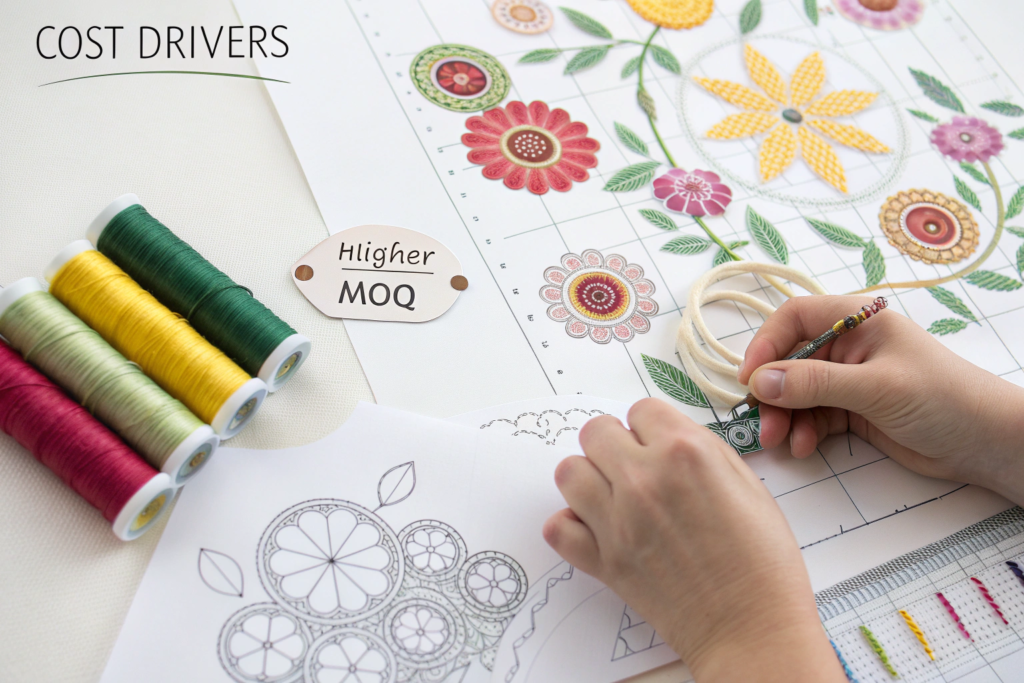
This is the number one driver. Each color in your embroidery requires its own thread spool on the machine, its own programmed path, and its own manual thread change (unless using high-end multi-head machines).
- The Rule of Thumb: More colors = higher MOQ. A 2-color logo will have a significantly lower MOQ than an 8-color photorealistic floral motif.
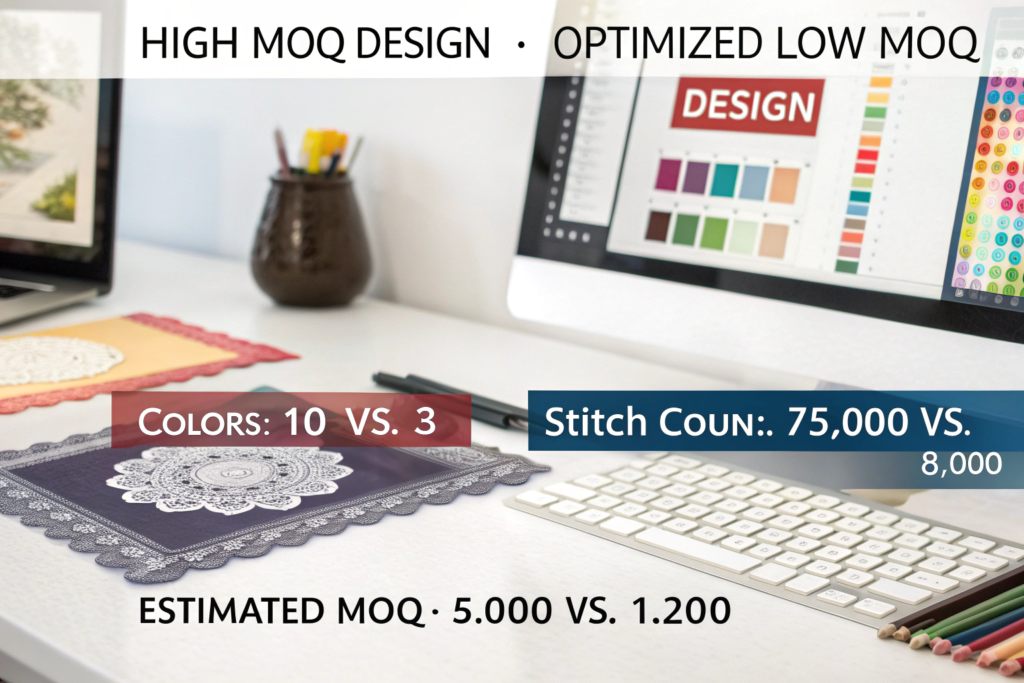
- Stitch Density & Coverage: A design that is mostly empty lace ground with a few embroidered outlines is far less demanding than a "filled" motif where the embroidery covers a solid area. Dense stitching consumes more thread and much more machine time. For a US streetwear brand’s dense, 5-color emblem patch, the initial MOQ quoted was 3,000. By simplifying the design to 3 colors and converting some filled areas to open satin stitch outlines, we helped them bring the viable MOQ down to 800 pieces with minimal visual impact.
To navigate design complexity, utilizing resources like The Designer’s Guide to Embroidery File Formats and Specs is essential. For a deeper dive into production economics, reading about how embroidery digitizing affects production cost clarifies why intricate designs are so much more expensive at low volumes.
Why Do Specialty Materials Like Metallic Thread or Beads Raise the MOQ?
Standard polyester embroidery thread is cheap and runs smoothly on high-speed machines. The moment you introduce metallic thread, glow-in-the-dark thread, chenille yarn, or require applied elements like sequins, beads, or pearls, you’re entering specialty production.
- Machine Modifications: These materials often require slower machine speeds, specialized needles, and even different types of embroidery machines (e.g., Schiffli for very large areas, or combination sequin/embroidery machines).
- Manual Labor: Applying beads or pearls is often still a semi-manual process post-embroidery, adding significant labor cost per piece. This labor cost is amortized over the MOQ.
- Material Cost & Waste: Metallic threads are more expensive and break more easily, leading to more downtime and waste.
A client wanted a motif with tiny pearl accents on their bridal lace patches. The pearl application alone doubled the per-piece cost and pushed the initial MOQ from 1,000 to 2,500. We solved it by sourcing a high-quality synthetic pearl-effect thread that could be machine-embroidered, mimicking the look at 80% of the MOQ and 60% of the cost.
How Can You Design to Achieve a Lower MOQ?
You have creative control. Use it to design with production feasibility in mind from the very first sketch. This is "Design for Manufacturing" (DFM) applied to embellishment. A small tweak in your design can slash your MOQ by 50% or more, making your project viable.
The goal isn’t to sacrifice your vision, but to achieve it in the most production-efficient way possible. This often means embracing the strengths of embroidery and lace-making machinery rather than fighting them.
Simplifying Your Artwork: Less is More (and Cheaper)
Work with your designer or the supplier’s digitizer early.
- Reduce Colors: Can two shades of blue be combined into one? Can you use the base lace color as one of your "colors" through negative space?
- Increase Stitch Width: Thinner lines require more precise, slower stitching. Slightly thicker outlines are more robust and faster to produce.
- Avoid Tiny Text: Text smaller than 0.2 inches (5mm) in height becomes blurry and difficult to embroider cleanly. Either enlarge it or consider an alternative.
- Use Openwork & Negative Space: Instead of filling a petal with stitches, use an open satin stitch border and let the lace ground show through. It’s faster, uses less thread, and often looks more sophisticated.
We had a Scandinavian brand that designed a beautiful, intricate bird motif with 7 colors. The MOQ was prohibitive. Our in-house digitizer reworked it into a stunning 3-color silhouette version using clever stitch direction to imply detail. The brand loved the modern interpretation, and the MOQ dropped by 65%.
Choosing the Right Base: The Lace Ground Matters
The lace patch isn’t just the embroidery; it’s the combination of the embroidered motif and the lace fabric it’s stitched onto.
- Stock vs. Custom Ground: Using a stock lace fabric (like a standard tulle, net, or pre-made lace) as your ground is infinitely cheaper than creating a custom woven or knitted lace just for your patch. The custom lace itself would have a huge MOQ.
- Die-Cutting vs. Laser Cutting: The shape of your patch matters. Simple shapes (circles, squares, ovals) can be die-cut efficiently in bulk. A complex, irregular shape (like a detailed flame or animal silhouette) requires laser cutting, which is slower and has a higher setup cost, thus raising the MOQ. Designing a patch that fits within a standard shape you can later trim can help.
What Negotiation Strategies Work with Suppliers?
Getting a lower MOQ is a conversation, not a demand. You need to present yourself as a valuable partner, not a one-time, high-risk nuisance. Factories have fixed costs (machine setup, digitizing, sample making). Your goal is to help them see how to cover those costs with your order, or to spread them across other opportunities.

The Power of "Shared Setup" and Pre-Production Fees
This is the most effective strategy for small orders. Propose this structure:
- You Pay the Non-Recurring Expenses (NRE) Upfront. This includes the digitizing fee (creating the embroidery machine file), the sample making cost, and any custom mold/die charges. This removes the supplier’s risk of not recouping these sunk costs.
- They Charge a Fair Unit Price for the Production Run. With the setup costs covered, the factory can then quote a per-piece price that only needs to cover material, labor, and a small profit margin. This can dramatically lower the viable MOQ.
- Example Script: "We understand the setup costs for our custom 3-color motif. We are prepared to pay the digitizing and sample fees upfront. Could you then quote us a unit price for a production run of 300 pieces?" At Shanghai Fumao, we openly offer this model because it builds trust with growing brands.
Can Flexible Timelines and Combined Orders Reduce MOQ?
Yes. Factories have slow seasons (often post-holiday periods like July-August or January-February). If you can be flexible with your delivery date, they might slot your small order into a machine’s downtime, accepting a lower MOQ.
- The "Piggyback" Option: Ask if they have other orders using a similar base lace fabric or thread colors. If so, they might be able to run your smaller batch immediately after a larger one without a full machine tear-down and setup, reducing your effective setup cost.
- Forecast Future Volume: Be transparent. If this is a test for a potentially larger seasonal line, say so. A supplier is far more likely to work with you on a 300-piece MOQ if you have a credible forecast for 2,000 pieces next season. We once accepted a 200-piece MOQ for a new brand because their business plan was solid. They are now a steady 5,000-piece-per-season client.
Are There Realistic Low-MOQ Sourcing Options?
For very small quantities (under 100 pieces), the traditional factory model breaks down. But the market has evolved. Several alternative paths now exist for micro-brands and prototypes.
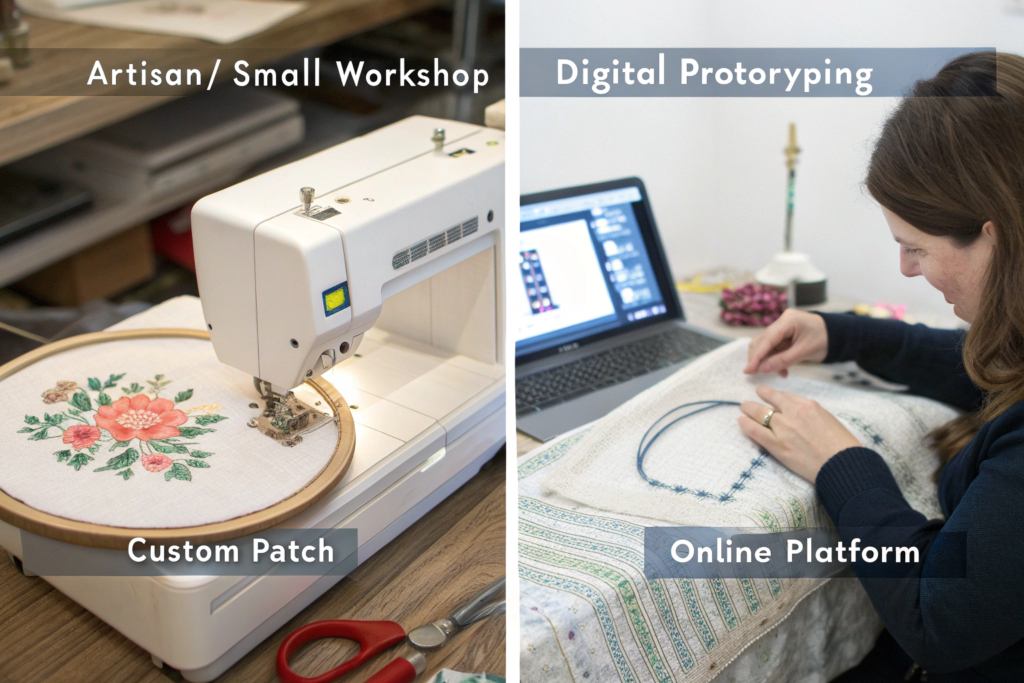
When to Consider Small Workshops or Artisan Co-ops?
For highly specialized, luxury, or extremely small runs, look beyond large factories.
- Hand Embroidery Workshops: In regions like India, Vietnam, or Eastern Europe, skilled artisans can produce exquisite hand-embroidered lace motifs. The MOQ can be as low as 1 piece, but the cost per piece is high and the lead time long. This is only viable for true luxury or one-of-a-kind pieces.
- Small-Batch Digital Embroidery Services: Many cities now have local businesses with single-head or multi-head digital embroidery machines that cater to small orders for businesses and events. They are perfect for prototypes and sampling before committing to bulk production overseas. The per-piece cost is high, but the total outlay is low.
The Rise of Online Platform Sourcing: Pros and Cons
Websites like Alibaba, Maker’s Row, or even Etsy connect you with smaller producers.
- Pros: Transparent pricing, often lower MOQs (100-500 pieces), and easier communication.
- Cons: Quality control is a gamble, you have less leverage, and intellectual property protection can be weak. It’s critical to order a physical sample before paying for bulk. A client used an online platform for 500 patches; the colors were wrong and the stitching was sloppy. We had to help them salvage the situation by reworking the entire batch locally, which cost more than doing it right the first time. (Here’s my blunt advice: a sample isn’t a suggestion, it’s a requirement.)
Conclusion
The MOQ for embroidered lace patches is not a fixed barrier but a flexible equation defined by your design’s complexity, your choice of materials, and your relationship with the supplier. By designing with production in mind—limiting colors, embracing simplicity, and using stock materials—you can inherently lower the starting point. By negotiating intelligently—offering to pay setup fees and demonstrating growth potential—you can often meet the factory halfway to a feasible number.
For very small runs, alternative sourcing from local embroiderers or specialized platforms exists, albeit with trade-offs in cost and control. The key is to align your expectations with the economic realities of manufacturing: custom, intricate work requires volume, but smart, strategic planning can make unique embellishment accessible at almost any scale.
If you’re tired of hearing "the MOQ is too high" and want a partner who will work creatively to make your custom lace motifs a reality, let’s talk. At Shanghai Fumao, we specialize in scalable solutions, from low-MOQ prototyping with clear cost structures to efficient high-volume production. To discuss your specific patch design and get a transparent MOQ breakdown, contact our Business Director, Elaine, at elaine@fumaoclothing.com. We believe great design shouldn’t be stopped by a number.