Stop for a second and ask yourself: what are you really buying when you contract a B2B clothing manufacturer? You're buying capability, yes. But more than that, you're buying risk management. In today's market, the single greatest source of risk isn't a missed stitch—it's a failed compliance audit, a customs seizure over false claims, or a viral accusation of greenwashing. Partnering with a factory that just "can make clothes" is like hiring a driver without a license. Partnering with one that holds OCS (Organic Content Standard) credentials is hiring a professional with a perfect driving record, a certified vehicle, and GPS tracking on every trip.
Choosing a B2B manufacturer with OCS credentials is a strategic business decision that goes far beyond sourcing organic fabric. It is partnering with a company that has institutionalized transparency, embedded traceability into its operations, and is pre-audited for the very due diligence processes that are now legally required in your key markets. This partnership doesn't just give you a product; it gives you a defensible, market-ready sustainability proposition from the ground up.
Let's break down why this specific credential is a proxy for a superior, lower-risk, and more valuable manufacturing partnership.
De-Risking Your Supply Chain from Farm to Final Audit
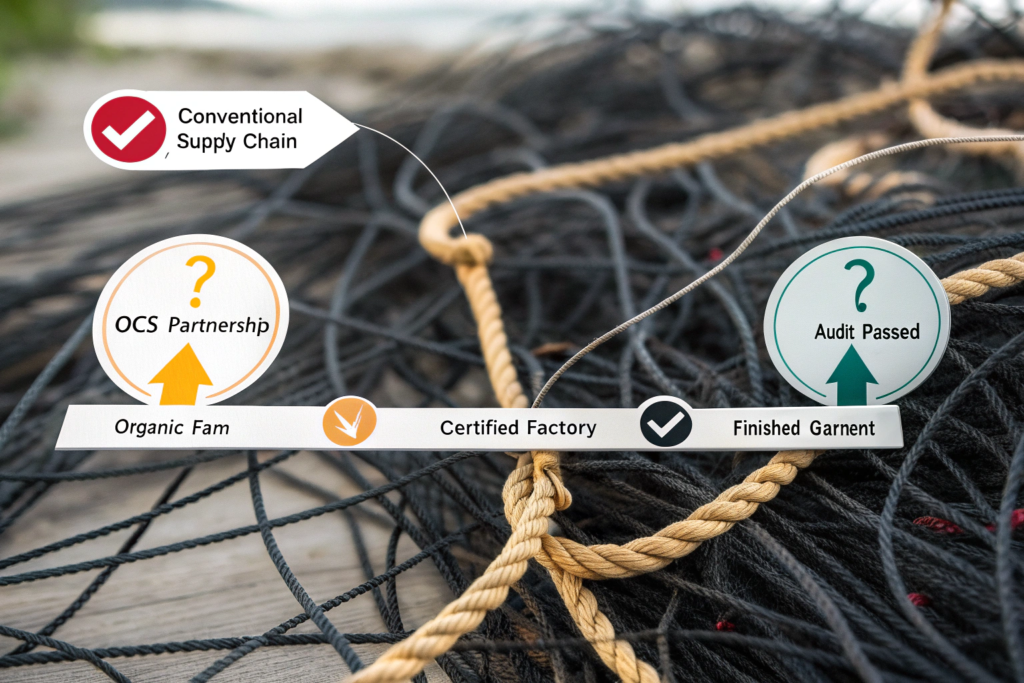
Your supply chain is only as strong as its most opaque link. A manufacturer without OCS credentials operates in shadows—you have to trust their word on material origins. An OCS-credentialed manufacturer operates in a floodlight of documentation. The OCS standard is, at its core, a risk mitigation framework. It forces a factory to map, document, and verify every step of the organic material's journey. By partnering with them, you are effectively outsourcing and institutionalizing a huge portion of your supply chain due diligence.
This is no longer a "nice-to-have." With the EU's Corporate Sustainability Due Diligence Directive (CSDDD) and similar laws emerging, brands are legally liable for environmental claims and practices deep in their supply chain. An OCS-credentialed partner provides you with a pre-built, audited system to meet these obligations.
How does OCS documentation protect you during retailer compliance audits?
Major retailers now conduct rigorous ethical and environmental audits. When they ask for proof of your organic claims, you need more than a supplier's invoice. You need the Transaction Certificate (TC).
An OCS-credentialed manufacturer doesn't just give you a TC; they understand the entire system that produces it. They can provide the supporting chain-of-custody documents that prove the TC is valid. This turns a stressful audit into a simple document handover. In late 2023, a brand we work with faced a surprise audit from a major German retailer. Because we provided a complete OCS dossier within 2 hours, the brand not only passed but was commended for their supply chain transparency, strengthening their relationship with the retailer. A non-credentialed factory would have caused a multi-day scramble, if they could provide the documents at all.
What is the impact on intellectual property and quality consistency?
The discipline required for OCS certification spills over into all operations. A factory meticulous enough to track organic cotton bales across continents is also meticulous about:
- Tech Pack Adherence: Their systems ensure your specifications are followed accurately across large productions.
- Sample Approval Workflows: They understand the importance of a signed Pre-Production (PP) sample as a binding standard, similar to a certified reference material.
- Batch Traceability: If a quality issue arises (e.g., a dye lot problem), they can isolate it to a specific batch of certified fabric, minimizing the impact on your total order. This level of control is rare in generic factories.
Partnering with them means your designs and quality standards are executed with a higher degree of precision and accountability.
Unlocking Market Access and Premium Commercial Terms
An OCS credential is a key that opens doors. It signals to retailers, distributors, and end-consumers that you are a serious player in the sustainable arena. This isn't just about marketing; it's about accessing commercial opportunities that are contractually closed to others. Many retailers now have "preferred vendor" lists that explicitly require certified manufacturing capabilities.
Furthermore, this credential allows you to structure more profitable business models. You can move away from competing solely on FOB price and instead compete on the value of a verified, low-risk supply chain.

How does this partnership improve your bargaining position with retailers?
You shift the conversation from "Here is our price" to "Here is our value proposition." You can confidently enter negotiations with retailers who have strict sustainability mandates, knowing you can meet them. This can lead to:
- Longer-Term Contracts: Retailers seek stable, compliant partners.
- Better Payment Terms: Proof of a robust supply chain can sometimes justify more favorable terms like Net 60.
- Exclusive Collaborations: For a retailer's own "conscious" line, an OCS-credentialed manufacturer might be a mandatory requirement.
You become a solution to the retailer's compliance problem, not another vendor adding to it. For insights into evolving retailer demands, resources like the latest sustainable sourcing mandates from global retailers are valuable for strategic planning.
Can it lead to cost savings beyond the fabric price?
Yes, through efficiency and waste reduction. The procedural rigor of an OCS-certified factory often translates to better overall production planning and material utilization.
- Reduced Over-Production: Accurate tracking prevents the "just make a bit more to be safe" mentality that leads to unsold inventory.
- Lower Error Rates: Systematic processes mean fewer mistakes in cutting, sewing, and labeling, reducing seconds and remakes.
- Optimized Logistics: Experienced certified manufacturers often have stronger relationships with freight forwarders specialized in handling documented, high-value sustainable goods, potentially securing better shipping rates.
Think of it as operational excellence that happens to include sustainability. The cost of the OCS fabric premium is often partially or fully offset by these hidden efficiencies. A UK-based brand reported that after switching to an OCS partner, their production error rate fell by 40%, as the factory's systematic approach eliminated previously common errors like wrong label placement or size runs.
Leveraging Technical Expertise and Innovation
A manufacturer that invests in OCS credentials is typically forward-looking. They are not stuck in the "fast fashion, low cost" mentality. They are investing in the future of textiles. This often means they have deeper technical expertise, not just in certification, but in fabric performance, dyeing chemistry, and sustainable innovation.
Partnering with them gives you access to this R&D capability. They can advise you on the best organic cotton blends for performance, recommend compliant finishes, and help you troubleshoot development challenges specific to sustainable materials.

What kind of product development support can you expect?
This goes far beyond basic sampling. Expect support on:
- Fabric Sourcing & Development: Guidance on which OCS-certified base fabrics (jersey, interlock, twill) are best for your design, and the ability to develop custom blends.
- Dyeing and Finishing Expertise: Knowledge of how to achieve vibrant, colorfast results using GOTS-approved or low-impact dyes on organic cotton—a technical challenge many conventional factories fail at.
- Testing and Validation: They will insist on, and facilitate, proper fabric testing (shrinkage, pilling, colorfastness) in accredited labs before bulk production, saving you from catastrophic post-production failures.
This is the difference between a factory that executes your order and a partner that helps you perfect your product. At Shanghai Fumao, our CNAS-certified lab is a core part of our service, providing clients with pre-emptive test data that de-risks their entire production run.
How does this partnership future-proof your brand?
Sustainability regulations and consumer expectations will only get stricter. By embedding an OCS-credentialed manufacturer into your supply chain now, you are:
- Building a Scalable Foundation: As you grow, your certified production capacity can grow with you, without needing to requalify new, risky suppliers.
- Staying Ahead of Regulations: You are already aligned with the traceability requirements of future laws.
- Attracting Investment: Investors are increasingly applying ESG (Environmental, Social, and Governance) criteria. A transparent, certified supply chain makes your brand a more attractive investment.
You're not just solving for today's order; you're building the resilient infrastructure for your brand's next decade. Learning about emerging EU regulations on supply chain due diligence underscores why this partnership is a strategic necessity, not an option.
Ensuring Ethical Alignment and Long-Term Partnership Stability
Finally, an OCS credential is a signal of values. While OCS itself focuses on material traceability, the type of factory that pursues and maintains this certification is often one that takes a broader view of responsibility. They are more likely to adhere to better social standards, invest in their workforce, and view their client relationships as long-term partnerships rather than transactional deals.
This alignment reduces turnover, improves communication, and creates a stable foundation for growth. You spend less time managing supplier drama and more time building your brand.
How does this impact communication and problem-solving?
Factories with certified systems are used to clear communication and documentation. Issues are resolved through a process of review and evidence, not through argument. If a delivery is delayed, they can show you the cause in their production logs. If there's a quality question, they can reference the test reports. This factual, transparent approach minimizes conflict and builds trust.
What is the true long-term value of a stable manufacturing partnership?
The cost of switching manufacturers every season is enormous: new sampling, new quality learning curves, new relationship building. A stable partnership with a competent, certified manufacturer compounds in value:
- Faster Time-to-Market: As they learn your standards, sampling and approval cycles shorten.
- Shared Innovation: They proactively suggest improvements based on their growing knowledge of your line.
- Predictable Costs: Long-term partnerships often lead to more stable pricing, as the manufacturer can plan their capacity and material purchases more efficiently.
Your manufacturer becomes a true extension of your own team, invested in your success. This is the ultimate competitive advantage.
Conclusion
Partnering with a B2B clothing manufacturer holding OCS credentials is one of the most impactful strategic decisions a modern brand can make. It is a direct investment in supply chain resilience, market relevance, and brand integrity. This partnership de-risks your business against compliance failures, unlocks premium commercial opportunities, provides deep technical expertise, and establishes a stable, values-aligned foundation for long-term growth.
In a world where transparency is the new currency, an OCS-credentialed partner doesn't just make your clothes—they build the trust your brand is sold on.
If you are looking to build or scale a brand where sustainability claims are backed by unbreakable systems, the choice of manufacturer is critical. At Shanghai Fumao, we are that partner. Our OCS credentials are the visible tip of an iceberg of integrated quality control, technical expertise, and a partnership mindset. Contact our Business Director, Elaine, to explore what a true strategic manufacturing partnership can do for your brand: elaine@fumaoclothing.com. Let's build not just a collection, but a legacy.