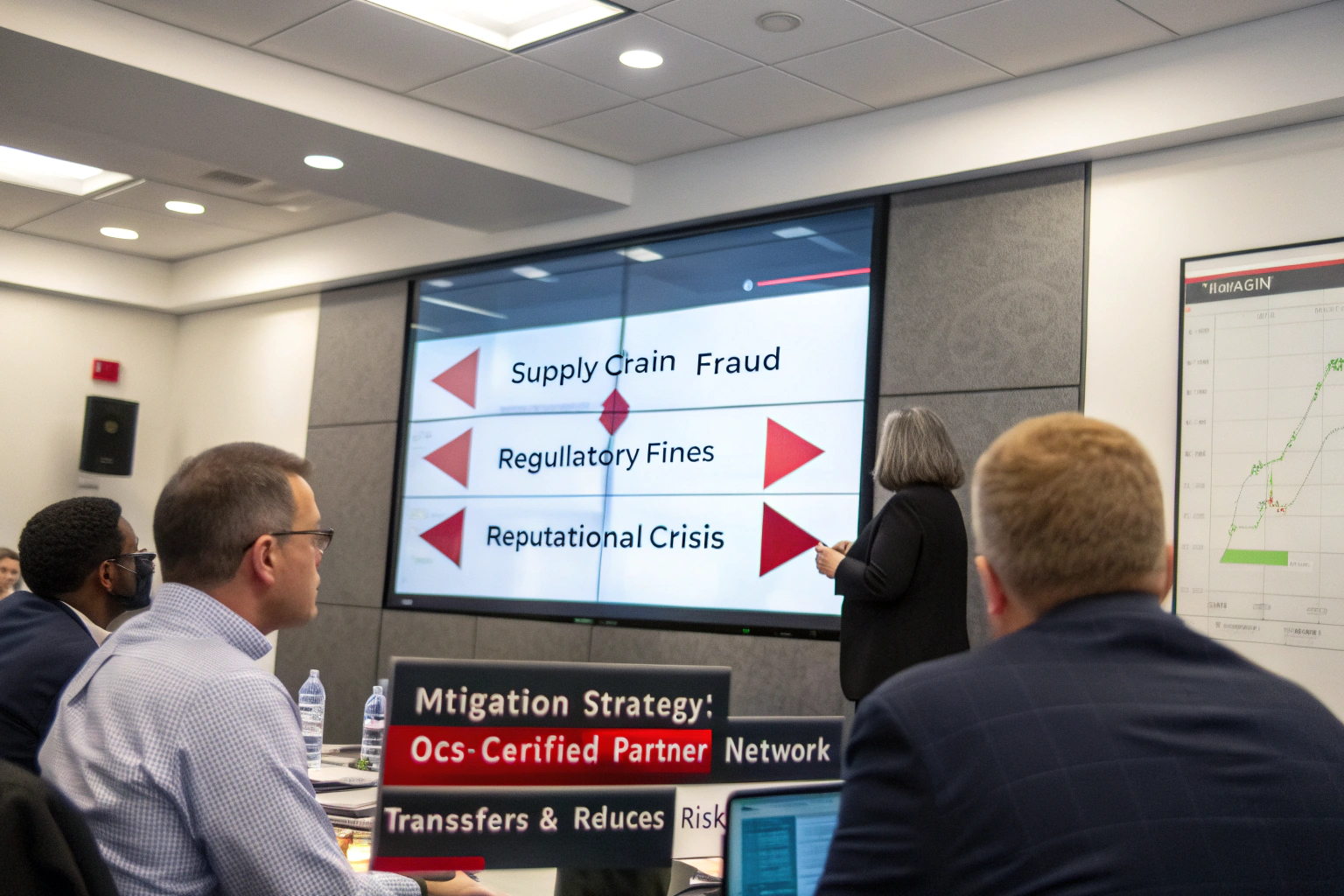
Let's cut through the corporate speak. When a Fortune 500 retailer or a global apparel giant sources garments, they aren't just buying clothing—they are managing catastrophic risk. A single supplier scandal involving false "organic" claims can trigger a multi-million dollar recall, tank stock prices, and ignite a media firestorm that takes years to recover from. For these companies, an OCS-certified partner isn't a "nice-to-have" sustainability choice; it's a non-negotiable risk mitigation asset. They aren't choosing OCS for marketing; they are choosing it as a defensive, auditable system that protects their balance sheet and their brand's trillion-dollar valuation from the existential threat of greenwashing litigation and supply chain fraud.
Large companies prefer OCS-certified garment partners because the certification provides a standardized, legally defensible due diligence framework that satisfies internal compliance mandates, external regulatory pressures, and investor ESG scrutiny. It transforms the opaque, high-risk process of verifying organic claims into a streamlined, vendor-agnostic protocol that procurement, legal, and sustainability teams can uniformly apply across a vast, global supply base. In short, OCS turns a subjective trust exercise into an objective, scalable compliance checkpoint.
This is a decision driven by lawyers, CFOs, and risk officers, not marketers. Let's examine the cold, hard business logic behind this preference.
Risk Transfer & Legal Defense: The Indemnity Layer
For a large corporation, every supplier is a potential liability. If a brand sells a garment labeled "organic" that is later found to be conventional, the brand bears the legal and financial responsibility—not the unnamed factory in another country. OCS certification, when properly implemented by a partner, creates a clear chain of accountability and a paper trail for indemnification.
The OCS Transaction Certificate (TC) is not just a piece of paper; it is a warranty document issued by a third-party certifier. In a court of law or during a regulator's investigation, this TC is the primary evidence that the company performed due diligence.

How does OCS certification simplify liability in the supply chain?
It creates a contractual and evidential waterfall:
- Brand ⇨ OCS-Certified Garment Partner: The brand's contract states the partner warrants all organic claims via OCS and will provide TCs.
- Garment Partner ⇨ Fabric Mill: The partner's contract with the mill demands OCS TCs for fabric.
- Fabric Mill ⇨ Spinner/Gin: And so on...
If a claim is false, the brand can point to its partner's TC. The partner is liable to the brand and must then pursue their own supplier. The OCS system, with its mandatory TCs at each sale, makes this chain of liability traceable and enforceable. Without it, the brand is left holding the bag with no recourse. A major European retailer we supply includes a clause in all contracts that voids payment and triggers penalties if an OCS TC is invalid or missing—shifting the financial risk of certification failure entirely to us.
What is the value of a "competent and reliable" evidence standard?
Regulatory bodies like the U.S. FTC require "competent and reliable evidence" for environmental claims. An internal factory invoice stating "organic cotton" is not competent evidence. An OCS TC issued by an ISO-accredited certification body (like Control Union) absolutely is. For a large company's legal team, mandating OCS from partners is the most efficient way to uniformly meet this evidentiary standard across hundreds of products and suppliers. It's a compliance checklist item that reduces legal vulnerability at scale.
Operational Scalability & Vendor Management Efficiency
Imagine a corporate sustainability manager overseeing 200 garment suppliers across 15 countries. Without a standard like OCS, verifying organic claims would require 200 unique audits, 200 different documentation formats, and endless subjective judgments. This is operationally impossible. OCS provides a universal language and process.
It allows the corporation to set one rule: "For any product with an organic claim, the supplier must be OCS-certified and provide a valid TC." This rule can be programmed into vendor onboarding software, enforced by procurement, and audited by a small central team.
How does OCS reduce the cost and complexity of audits?
Large companies conduct third-party social and environmental audits (like SMETA, BSCI). Adding a deep, forensic organic traceability audit for each supplier would be prohibitively expensive.
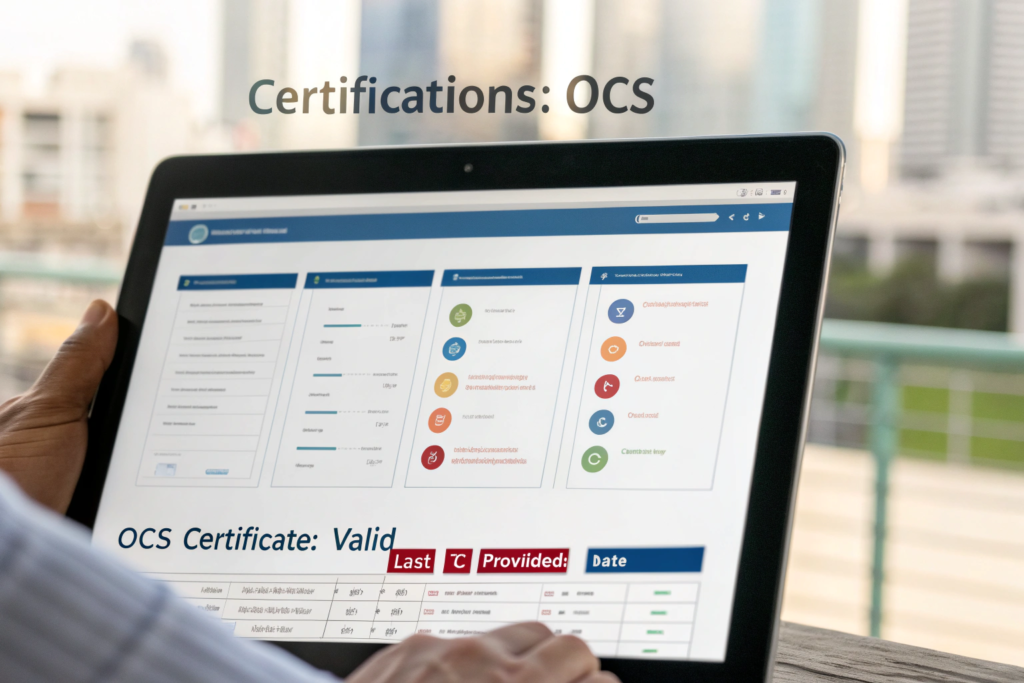
OCS externalizes this cost. The supplier pays for their own annual OCS audit to maintain their certificate. The corporate buyer simply requests a copy of the valid certificate and the TCs for their orders. They are leveraging an existing, paid-for audit system. This is a massive efficiency gain. We are audited twice a year for OCS by Control Union. Our large clients accept these audit reports, saving them the $5,000-$10,000 and week of time it would cost to send their own auditor to do the same thing.
Can OCS data integrate into corporate ESG reporting?
Seamlessly. Modern large companies have ESG software (like Workiva, Sphera) that aggregates data across the business. The quantitative data from OCS TCs—kilograms of certified organic cotton purchased per supplier, per year—is golden for Scope 3 (supply chain) emissions reporting and for claims like "X% of our cotton is organic."
This turns procurement data into sustainability performance data automatically. A partner that can provide clean, digital OCS data (not just PDFs) becomes a higher-value vendor. We provide our key accounts with quarterly spreadsheets summarizing their OCS volume and estimated impact (water, pesticide reduction), which their ESG teams directly input into their reports.
Market Access & Pre-emptive Compliance
Large companies, especially retailers, are both buyers and gatekeepers. They have their own sustainability mandates to meet (e.g., Walmart's Project Gigaton, Target's Sustainable Product Standard). To satisfy these, they must push requirements down onto their suppliers. OCS is a ready-made tool for this.
Furthermore, they are planning for regulations that don't even exist yet in all markets. They are future-proofing their supply chains.

How does OCS secure access to key markets like the EU?
The EU's Corporate Sustainability Due Diligence Directive (CSDDD) will require large companies to identify, prevent, and mitigate environmental harms in their value chains. A false organic claim is a clear environmental harm (misleading the public).
When an EU-based brand sources from an OCS partner, they are building a due diligence file. The OCS TC, the audit reports, and the mass balance records are the direct evidence that they have "identified" and "mitigated" the risk of false claims. Choosing an OCS partner is a pre-emptive compliance step that avoids future legal exposure in one of the world's largest markets.
Why do multi-brand retailers insist on OCS from their vendors?
It's about risk consolidation. A retailer like Amazon, Nordstrom, or Zalando might have 10,000 brands selling "organic cotton" products on their platform. If one brand is exposed for greenwashing, the retailer's entire "Sustainable Style" category loses credibility. To de-risk their platform, they mandate that any brand making an organic claim must provide evidence—and OCS is one of the accepted forms of evidence. This protects the retailer's reputation by standardizing and outsourcing verification.
Strategic Sourcing & Long-Term Stability
Beyond risk, large companies need predictability. They plan collections years in advance and make billion-dollar inventory commitments. An OCS-certified partner, particularly a vertically integrated one, represents a more stable, professional, and forward-looking supplier.
These partners are invested in systems, not just short-term margins. They are more likely to have robust planning, quality control, and the financial health to be a long-term strategic ally, not just a transactional vendor.

What is the total cost of ownership (TCO) advantage?
While the FOB price from an OCS partner may be higher, the TCO is often lower for a large company:
- Reduced Cost of Quality: Fewer defective goods, returns, and customer complaints.
- Reduced Compliance Cost: No need for expensive bespoke organic verification audits.
- Reduced Legal & Recall Risk Cost: Avoidance of catastrophic financial events.
- Reduced Reputational Cost: Protection of brand equity.
Procurement teams at sophisticated corporations are increasingly evaluated on TCO and risk, not just unit price. OCS partners score highly on these advanced metrics.
How does this preference shape the future of supply chains?
It creates a bifurcated market. On one side: low-cost, opaque, high-risk suppliers for commoditized, non-branded goods. On the other: higher-cost, transparent, systems-driven partners like Shanghai Fumao for branded, claim-driven, and regulated products. Large companies are consciously allocating their business to this second tier. This isn't charity; it's strategic supply chain hardening.
Conclusion
Large companies prefer OCS-certified garment partners because the certification is a risk management and operational efficiency technology disguised as an environmental standard. It provides legal defensibility, scales vendor management, pre-empts regulation, and identifies strategically superior suppliers. In the high-stakes game of global apparel sourcing, OCS is the playbook for safe, scalable, and sustainable growth.
For suppliers, achieving and maintaining true OCS competency is no longer just about accessing the sustainable niche—it's about qualifying for the mainstream business of the world's most demanding and valuable clients.
If your company seeks to become a preferred partner for the giants, your systems must speak their language of verifiable compliance and managed risk. At Shanghai Fumao, we have built our entire operation to meet this exacting standard. Contact our Business Director, Elaine, to discuss how we can help you become a strategic, OCS-certified asset to your largest clients: elaine@fumaoclothing.com. Let's build the supply chain of the future, today.