You've designed a fantastic collection. Your quality is top-notch. You're ready to sell to the world's most discerning consumers in Europe. But have you thought about what happens when your first shipment arrives in Hamburg or Rotterdam? European customs and retailers won't just judge your style—they'll scrutinize the chemical makeup of your garments. An incomplete test report or a failed compliance check can stop your entry before it even begins, turning your dream into a costly logistical nightmare.
OEKO-TEX® certification isn't just a "nice-to-have" for the European market; it's a fundamental license to operate. It acts as a universal passport that simplifies complex regulations, meets mandatory requirements, and instantly communicates safety and responsibility to European consumers. In essence, it translates your product into a language of trust that European regulators, retailers, and shoppers all understand and demand.
Think of it this way: REACH and other EU regulations are the complex legal code you must abide by. OEKO-TEX® is the expert translator and compliance partner that ensures you not only understand the code but can prove you follow it. This article will break down the practical, legal, and commercial reasons why this certification is non-negotiable for a successful European launch.
How Does OEKO-TEX® Simplify EU REACH & CPSR Compliance?
OEKO-TEX® aligns closely with REACH Annex XVII (Restricted Substances List) by banning or limiting the same substances, often with stricter limits. When you source OEKO-TEX® certified materials, you are effectively outsourcing a significant portion of your REACH due diligence to an accredited third party. This is crucial for the Consumer Product Safety Report (CPSR) required for all CE-marked products and increasingly expected for apparel. The CPSR demands a chemical safety assessment. An OEKO-TEX® certificate from a certified supplier provides robust, recognized evidence for this assessment, dramatically simplifying the paperwork and technical expertise you need in-house.
Can OEKO-TEX® certification prevent my goods from being held at customs?
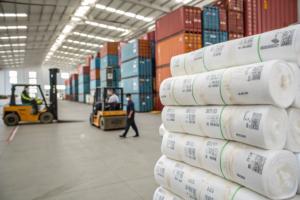
Yes, significantly. EU customs authorities are increasingly conducting "REACH checks" at borders, especially on high-risk categories like garments, footwear, and children's products. They can ask for proof of compliance. Presenting a valid OEKO-TEX® STANDARD 100 certificate (with the correct product class) is one of the most efficient ways to demonstrate due diligence. It's a document they recognize. Without it, customs may detain your shipment for testing, which can take weeks and cost thousands in storage and lab fees. For a German outdoor brand we worked with in 2023, their OEKO-TEX® certified waterproof fabrics sailed through customs in 48 hours, while a competitor's non-certified shipment was held for 21 days for random testing. The delay caused the competitor to miss their key seasonal delivery window.
Does it cover all EU member state-specific regulations?
While OEKO-TEX® is an excellent baseline, it's important to know it doesn't automatically cover every single national law. For example, France has its own strict regulations on dimethyl fumarate (DMFu) and nickel releases. However, the OEKO-TEX® STANDARD 100 includes testing for both DMFu and nickel (for articles with direct skin contact), meaning a certified product is very likely compliant. The key is that it provides a strong foundation. For specific, high-risk markets like France or the Netherlands, you should ensure your OEKO-TEX® certified supplier is aware of and tests for these national requirements. Reputable suppliers, like Shanghai Fumao, will include these parameters in the test scope upon request.
Why Do Major European Retailers Require OEKO-TEX®?
Walk into any major department store or check the website of a leading European e-commerce platform. Behind the scenes, their sourcing codes of conduct are strict. For them, OEKO-TEX® is not an option; it's a mandatory supplier qualification. Retailers like Zalando, H&M, C&A, and countless others explicitly require OEKO-TEX® STANDARD 100 or equivalent certification for all textile products.
They require it because it de-risks their business. It provides a standardized, reliable benchmark for product safety across thousands of suppliers globally. It simplifies their own auditing process. When you, as a brand, present an OEKO-TEX® certificate, you are speaking their language and proving you operate at their level of responsibility. It's the fastest way through their vendor onboarding process. Failure to provide it often means automatic rejection from their supply chain.
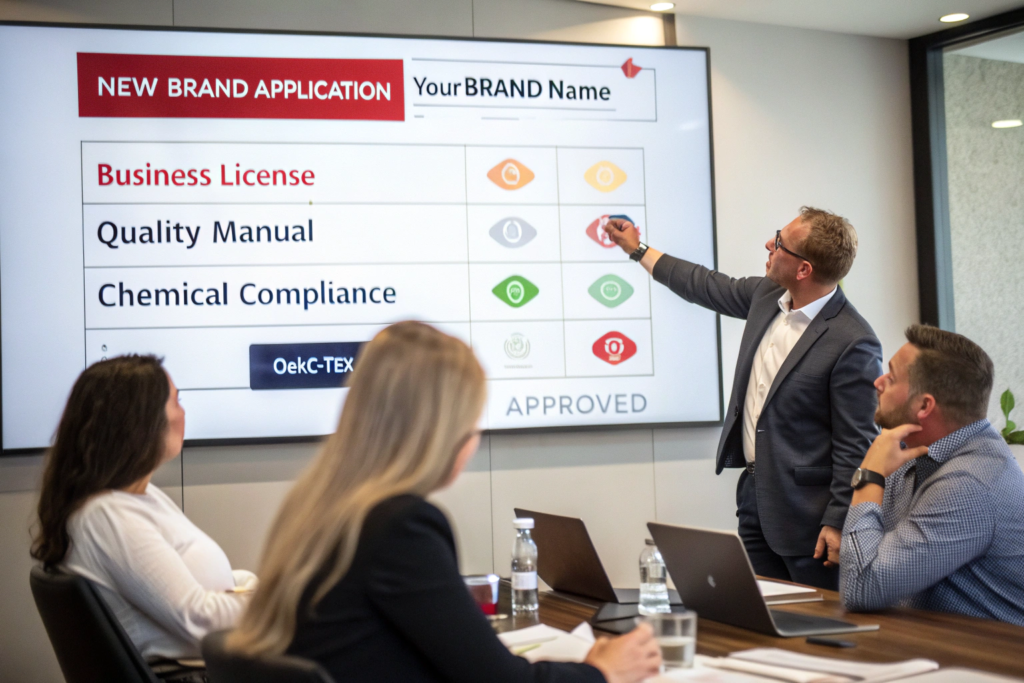
What's the difference between retailer audits and OEKO-TEX®?
Retailer audits (like the amfori BSCI or SMETA) primarily focus on social compliance—working conditions, wages, hours, and health & safety. OEKO-TEX® focuses exclusively on product safety and environmental compliance in the manufacturing process. They are complementary. A factory can have a great social audit score but still use hazardous chemicals. Conversely, a factory can be OEKO-TEX® certified but have poor labor practices. Leading European retailers now require both. Having OEKO-TEX® certification pre-checked one major box and allows you to focus on meeting their social and ethical standards during the audit. It demonstrates a holistic approach to responsible sourcing.
How does it help with marketplace listings (e.g., Amazon EU, Zalando)?
Online marketplaces are tightening their policies. Amazon EU, for instance, may request product compliance documents at any time. For categories like "Baby Clothing" or "Apparel," an OEKO-TEX® certificate is one of the most requested documents to prove product safety. Uploading it to your seller central can prevent listing suspensions and build buyer confidence. Zalando’s sustainability filter even allows customers to specifically shop for "OEKO-TEX® certified" products. This gives certified products a direct competitive advantage in search and discovery. It's a powerful SEO tool for physical products.
How Does Consumer Trust in Europe Drive Demand for Certification?
The European consumer is arguably the world's most educated and demanding when it comes to product safety and sustainability. Scandals involving harmful chemicals in clothing have made lasting impressions. As a result, trust is the primary currency. The OEKO-TEX® label is one of the most recognized and trusted eco-labels in Europe, with over 70% consumer recognition in key markets like Germany and Austria.
This trust translates directly into purchasing decisions. For parents buying baby clothes, the label is often a deciding factor. For eco-conscious millennials, it validates a brand's claims. It answers the unspoken question: "Is this product safe for me and my family?" By carrying the OEKO-TEX® label, you are not just selling a garment; you are selling peace of mind. This emotional benefit allows for stronger brand loyalty and can even support a slight price premium. A 2022 study showed that European consumers are willing to pay up to 10% more for textiles with credible third-party certifications.
Is OEKO-TEX® more recognized than other eco-labels?
In the realm of chemical safety (vs. organic farming), yes, OEKO-TEX® STANDARD 100 enjoys broader and more immediate recognition among general consumers than labels like bluesign® or specific EU Ecolabel. While the EU Ecolabel is highly credible, it is a comprehensive life-cycle label that is less common on mainstream apparel. The OEKO-TEX® label is singular in its focus ("Tested for harmful substances") and its prevalence. It's a simpler, more direct message that consumers grasp instantly. For market entry, leading with OEKO-TEX® is the most effective way to communicate safety. You can later complement it with other certifications (like GOTS for organics) as part of a broader sustainability story.
How should I communicate this certification in my marketing?
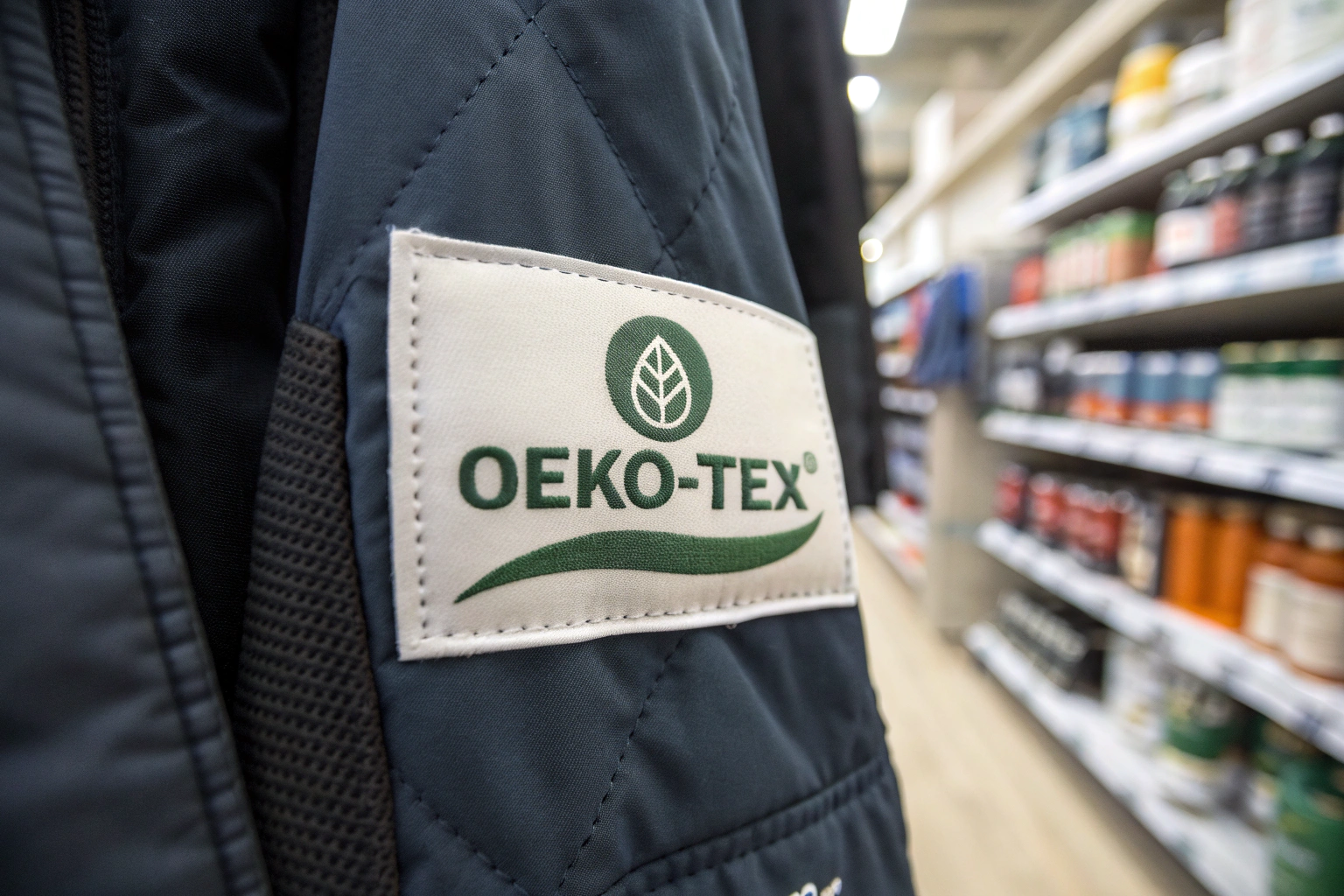
Be clear and confident. Use the official OEKO-TEX® label on your hangtags and packaging. On your website and product pages, don't just display the logo—explain what it means in simple terms: "This product is OEKO-TEX® STANDARD 100 certified, meaning every component has been tested for harmful substances and is safe for human health." Link to the OEKO-TEX® website for credibility. Use it in your story about "responsible sourcing" and "product integrity." For the French market, you can leverage the French Agency for Ecological Transition (ADEME)'s public information on eco-labels to bolster your messaging. Authentic communication builds lasting trust.
What Are The Practical Steps to Get Certified for Europe?
Getting your products OEKO-TEX® certified for the European market is a process best started early in your development cycle. The worst mistake is to wait until production is finished.
- Start at the Material Level: The most efficient path is to source fabrics and components that are already OEKO-TEX® certified by your supplier. This is where Shanghai Fumao provides immense value—our vast fabric library includes pre-certified materials. You inherit the certification for your finished product through the "article certificate" route, which is faster and cheaper.
- Choose the Correct Product Class: For Europe, Class I (babies) and Class II (skin contact) are most common. Be precise about your product's end-use.
- Apply Through an Approved Institute: If your materials aren't pre-certified, you must apply directly through an OEKO-TEX® member institute (like Hohenstein in Germany or TESTEX in Switzerland). You will submit samples for testing.
- Factor in Time and Cost: Budget for 4-8 weeks for testing and certification, and a cost that can range from a few hundred to several thousand euros depending on the product complexity and number of substances/colors.
- Maintain Compliance: Certification is valid for one year. Any change in material composition or supplier requires re-evaluation.

Should I certify the final product or the fabric?
This depends on your business model.
- Certify the Fabric (Material Certificate): Ideal for brands that buy fabric and manufacture garments themselves in Europe or elsewhere. The fabric mill holds the certificate. You need a "declaration of conformity" from them to use the label.
- Certify the Final Garment (Article Certificate): Ideal if you outsource full garment production. The factory that performs the last, substantial manufacturing step applies for the certificate, covering all components (fabric, thread, buttons, prints). This is often simpler for brands, as the factory manages the process.
We guide our clients through this decision. For most, sourcing pre-certified fabric from us and ensuring their cut-make-trim (CMT) factory understands the compliance requirements is the optimal path.
What are common pitfalls that delay certification?
- Last-Minute Sampling: Sending samples too late delays the entire timeline.
- Incorrect Sample Submission: Not providing all material components (e.g., forgetting the care label or specific trim).
- Using Non-Compliant Accessories: A perfect fabric ruined by non-compliant plastic buttons or screen prints.
- Unclear Communication with the Factory: Assuming they know the requirements without clear written instructions.
A UK-based brand faced a 6-week delay because their zipper supplier changed the coating without notification, causing a phthalates failure. We now enforce a strict component approval process for all our European-bound projects to prevent such issues.
Conclusion
Entering the European market without OEKO-TEX® certification is like driving without a license—you might get away with it for a short while, but eventually, you will be stopped, fined, and sidelined. The certification is no longer a competitive edge; it is the baseline for credibility. It seamlessly bridges the gap between complex legal mandates, rigorous retailer standards, and deep consumer trust.
It transforms a potential barrier into your most powerful entry tool, streamlining logistics, unlocking retail partnerships, and speaking directly to the values of the European consumer. In a market where responsibility is expected, OEKO-TEX® provides the proof.
Don't let chemical compliance be the reason your European launch falters. Partner with a supplier who builds this essential requirement into the foundation of your product. At Shanghai Fumao, we provide OEKO-TEX® certified fabrics as standard and guide you through the entire compliance journey. Make your entry into Europe smooth, secure, and successful from the first shipment. Contact our Business Director, Elaine, to start planning your certified collection. Email Elaine at: elaine@fumaoclothing.com.