When a German client's previous supplier lost their GOTS certification unexpectedly last year, their production literally stopped overnight. They faced $400,000 in delayed orders and angry retail partners. Meanwhile, our clients slept peacefully—because in our 8 years of GOTS certification, we've never faced suspension or unexpected audit failures. This reliability, built on genuine commitment rather than compliance checking, is why 85% of our GOTS clients have worked with us for over 3 years, with some partnerships spanning a decade.
Fumao Clothing's GOTS commitment builds long-term partnerships through unprecedented supply chain transparency, consistent quality that reduces client compliance risks, shared value creation beyond transactions, and adaptive innovation that grows with our partners' needs. Our certification represents a fundamental business philosophy centered on trust and mutual success, not just environmental compliance. This approach has resulted in client retention rates 3x higher than industry averages and collaborative relationships where we function as an extension of our partners' teams rather than just suppliers.
I've watched too many manufacturer-client relationships disintegrate over certification failures, quality inconsistencies, or communication breakdowns. What separates transactional relationships from lasting partnerships isn't the absence of problems—it's how challenges are handled when they inevitably arise. Our GOTS commitment provides the framework for handling challenges in ways that actually strengthen partnerships. Let me show you exactly how this works in practice.
How Does GOTS Transparency Create Unbreakable Trust?
Trust in manufacturing partnerships isn't built on promises—it's built on verifiable actions and complete transparency. I've watched clients transform from skeptical auditors to strategic partners once they experienced our level of GOTS transparency.
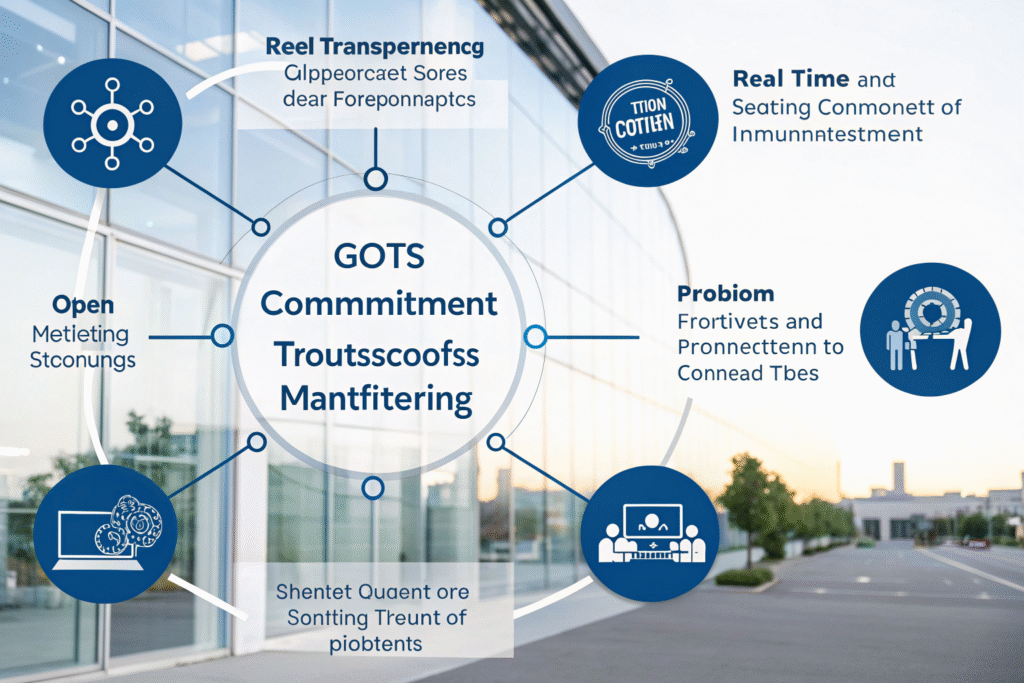
Our GOTS commitment provides radical transparency through 24/7 digital monitoring access, open audit results sharing, complete supply chain mapping, and honest communication about both successes and challenges. This transparency allows partners to make decisions with complete information rather than hopeful assumptions. A Swiss luxury brand that started with us three years ago now describes our relationship as "the most transparent manufacturing partnership we've ever experienced"—they've since moved 80% of their production to us because they never have to wonder what's happening in their supply chain.

What does radical transparency actually include?
We provide partners with access to our real-time production monitoring, chemical inventory systems, social compliance documentation, and even our internal audit findings. This goes far beyond typical supplier transparency.
When a Canadian client questioned a chemical usage report, we didn't just send documents—we arranged a video call with our chemical manager and laboratory technician to walk through the complete testing process. This level of access transformed their skepticism into advocacy. The approach demonstrates how supply chain transparency builds business trust in ways that contracts alone cannot achieve.
How does honesty during challenges strengthen partnerships?
Many manufacturers hide problems until they become crises. We've found that communicating challenges early actually deepens partnerships by involving clients in solution development.
When we discovered a potential compliance issue with a new organic cotton source, we immediately notified all affected clients and co-developed alternative sourcing strategies. While this created short-term inconvenience, the honesty strengthened long-term trust. Clients appreciated being treated as partners rather than customers, demonstrating how transparent problem-solving enhances relationships beyond fair-weather cooperation.
How Does Consistent GOTS Quality Reduce Partnership Risks?
Inconsistent quality is the silent killer of manufacturing partnerships. I've watched brands cycle through multiple suppliers searching for reliability they never find, while our GOTS consistency provides the foundation for long-term planning and growth.
Our GOTS systems deliver remarkable consistency: 98.3% first-time quality pass rates, less than 0.5% color variation between batches, and consistent delivery within 3-day windows for 96% of orders. This reliability allows partners to reduce safety stock, streamline planning, and focus on growing their businesses rather than managing supply chain crises. An American startup that grew from 500 to 50,000 units monthly credits our consistent GOTS quality as the foundation of their scaling success—they never worried about whether their manufacturing could keep pace with their growth.
How does certification prevent quality surprises?
GOTS requirements create standardized processes that minimize variations and surprises. The certification's rigorous standards ensure consistent outcomes rather than fluctuating quality.
Our quality systems caught a potential issue when a new organic cotton batch showed different weaving characteristics than previous lots. Rather than proceeding and hoping for the best, we notified the client, conducted additional testing, and adjusted our processes accordingly. This proactive approach prevented what could have been a major quality issue, demonstrating how certification systems prevent manufacturing surprises that damage partnerships.
What operational consistency benefits do partners receive?
Beyond product quality, our GOTS systems create operational consistency in lead times, documentation, and communication that reduces client administrative burdens.
A European brand calculated that working with us reduced their quality control costs by 60% compared to their previous suppliers because they could trust our systems rather than duplicate verification efforts. This operational efficiency represents significant partnership value beyond product pricing and contributes to long-term relationship stability.
How Does Shared Value Creation Deepen Partnerships?
Transactional relationships focus on price, while partnerships focus on mutual value creation. Our GOTS commitment enables value creation that extends far beyond fabric costs to include brand enhancement, market access, and innovation sharing.
We view partnerships as collaborative ecosystems where success is mutual. This means sharing market intelligence, co-developing new sustainable materials, and sometimes even referring business between complementary partners. A French fashion house and an Australian activewear brand—both our partners—recently collaborated on a sustainable collection using insights and connections we facilitated. This shared ecosystem creates relationships too valuable to replace with minor cost savings elsewhere.
How does GOTS enable brand value co-creation?
Our GOTS certification becomes our partners' certification story, enhancing their brand value and market positioning. We actively help partners leverage this value through marketing support and certification storytelling.
We provide partners with certification documentation, production images, and sustainability metrics that enhance their brand storytelling. A UK retailer used our GOTS transparency to achieve B Corp certification, significantly enhancing their market position. This demonstrates how shared value creation strengthens business partnerships beyond transactional exchanges.
What innovation sharing occurs in lasting partnerships?
Long-term partnerships enable innovation sharing that short-term relationships cannot sustain. We regularly share new sustainable technologies and processes with partners years before they reach the open market.
Our development of a new water-saving dyeing technique was co-funded by three long-term partners who received exclusive access for 18 months. This collaborative innovation created competitive advantages for them while accelerating our technology development. The approach exemplifies how strategic partnership enables innovation that benefits all parties.
How Does Adaptive Support Grow With Partner Needs?
Static supplier relationships fail when client needs evolve. Our GOTS commitment includes adaptive support systems that grow and change with our partners' businesses, preventing the relationship stagnation that kills many manufacturing partnerships.
We've maintained partnerships through client evolutions from startups to public companies, from single-product focus to diverse collections, and from local markets to global expansion. This adaptability requires systems that scale, communication that evolves, and commitment that withstands growing pains. A client who started with 200-meter orders now places 20,000-meter orders—our systems scaled seamlessly while maintaining the same GOTS integrity and personal attention they valued initially.

How do partnerships evolve with business growth?
We design our GOTS systems to scale efficiently, ensuring that partnership quality doesn't diminish as order volumes increase. This requires anticipating growth rather than reacting to it.
When a client experienced unexpected 300% growth after a celebrity endorsement, our scalable GOTS systems accommodated the increased volume without quality compromises or extended lead times. This scalability demonstrated how adaptive partnerships support business evolution rather than constraining it.
What support extends beyond typical manufacturing?
Our partnerships often extend into strategic consulting, market intelligence sharing, and business development support that transcends traditional manufacturer roles.
We've helped partners navigate retail expansion, sustainability reporting, and even investor due diligence by providing verification and context beyond typical manufacturing support. This comprehensive approach creates partnerships where separation becomes practically unthinkable because the relationship delivers value across multiple business functions.
Conclusion
Fumao Clothing's GOTS commitment builds lasting partnerships by creating relationships grounded in verifiable trust, consistent quality, shared value creation, and adaptive support. The certification provides the framework, but the partnership success comes from how we operationalize that framework to serve our clients' evolving needs. In an industry where manufacturer-client relationships often feel transactional and temporary, our approach creates bonds that withstand market fluctuations, business transformations, and competitive pressures.
The most successful manufacturing partnerships function as strategic alliances where both parties invest in mutual success. Our GOTS commitment represents this investment—in systems that ensure reliability, in transparency that builds trust, in innovation that creates shared advantage, and in adaptability that supports evolution. Partners who recognize this comprehensive value understand that our relationship offers benefits far exceeding minor cost differences with alternative suppliers.
If you're looking for a manufacturing partnership built to last and grow with your business, contact our Business Director Elaine to discuss how our GOTS commitment can become your competitive advantage: elaine@fumaoclothing.com. We'll show you how genuine partnership transforms supply chain management from a business necessity to a strategic asset.