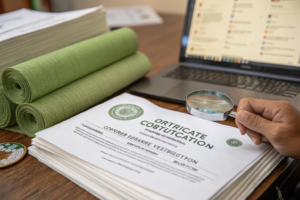
Let me tell you about a conversation I had just last month with a potential client from Chicago. He was shopping for 10,000 yards of Recycled Polyester for an activewear line. He got a quote from another mill in Jiangsu for $1.85/yd. Our price at Shanghai Fumao was $2.15/yd. He came back to me swinging that quote like a weapon. "Elaine," he said, "they promised me GRS certification at this price. Why can't you match it?" I took a deep breath. I asked him one question: "Send me the certificate number they provided." He did. I looked it up on the Textile Exchange public database. It was Expired. By two years. I told him, "You aren't buying certified recycled fabric. You're buying virgin polyester with a fake sticker on the swatch card."
This happens every single day in this industry. I've been in the Keqiao textile trade for over 20 years, and I've seen the rise of "Certificate Culture" create a whole new category of fraud. Buyers want sustainable, safe, compliant fabric. They demand OEKO-TEX, GOTS, GRS, and CNAS reports. Suppliers know this. So some of them—not the honest ones—promise the moon and deliver a PDF. But here's the truth: A piece of paper is worthless if the supply chain behind it doesn't match. A certificate is a snapshot of a moment in time for a specific facility. It's not a blanket permission slip to slap a logo on every container that leaves the port. Let's peel back the curtain on why this happens, how you can spot a fake a mile away, and how to protect your brand from a compliance scandal that could ruin your reputation with retailers like REI or Target.
Why Is Certificate Fraud Common in the Textile Industry?
This isn't about making excuses. It's about understanding the pressure cooker that creates the fraud so you can avoid it. The textile supply chain is long and fragmented. You have the fiber grower, the ginner, the spinner, the knitter/weaver, the dyer, the finisher, and the trader (me). Each step has a cost. And in the last five years, the demand for "Green" fabric has skyrocketed. Everyone wants to tell a sustainability story. But most buyers don't want to pay the true cost of that story.
A GOTS-certified organic cotton supply chain costs about 15-25% more than conventional cotton. The reason isn't just the raw fiber price. It's the Segregation Cost. In a GOTS or GRS certified facility, you have to clean the entire production line before running the certified batch. You can't just let the organic cotton mix with the conventional cotton in the blow room or the carding machine. That cleaning downtime costs money. The certified dyes (which don't contain heavy metals or azo compounds) cost 30% more. The paperwork and audit fees for the certification body (like Control Union or Ecocert) cost $5,000 - $10,000 a year per facility.
So when a buyer says, "I want the cheapest price AND I want all the certificates," they are essentially asking for a unicorn. Some suppliers, desperate for the order, decide to give them a Photoshopped unicorn instead. They roll the dice, hoping the buyer never checks the database, never audits the mill, and just needs a PDF to tick a box for their own marketing team.
What Is the Difference Between Transaction Certificates and Scope Certificates?
This is the single most important technical distinction you need to learn. It's the key that unlocks 90% of the scams out there. I tell my clients to memorize these two terms: Scope Certificate (SC) and Transaction Certificate (TC) .
Let's use a driver's license analogy.
- Scope Certificate (SC): This is the Driver's License. It proves the factory is qualified to make certified products. It lists the address of the facility, the products they are allowed to make (e.g., "Knitted Cotton Fabric"), and the expiry date. It is issued after a physical audit of the factory.
- Transaction Certificate (TC): This is the Registration for the specific car. It proves that this specific batch of fabric originated from that certified factory and was sold to you.
Here is the scam: A trading company shows you their own Scope Certificate. They are a trading office. Their SC says they are certified to trade GOTS products. But they don't own the dye house. They source the fabric from a cheap, uncertified dye house. They cannot issue a valid Transaction Certificate because the actual manufacturer is not certified. The product is conventional. The paper is real, but the fabric is fake.
Let's visualize this in a table:
| Document Type | What It Looks Like | What It Actually Means | Red Flag |
|---|---|---|---|
| Scope Certificate (SC) | Fancy PDF with logos and license number. | Facility is Audited. They have the capability to make certified goods. | Expired Date. Wrong Product Category. |
| Transaction Certificate (TC) | A form that links the invoice number to a specific weight of fabric. | This specific shipment is Certified. It tracks the flow of goods. | Missing or Blank 'Input' section. (This means they can't prove where the certified yarn came from). |
I had a US client in 2023 who was buying "GRS Recycled Polyester" for a large corporate uniform order. The supplier gave them a nice Scope Certificate. I asked, "Did you get a Transaction Certificate for this specific PO?" They hadn't. I helped them ask for it. The supplier ghosted them for two weeks, then admitted they "couldn't provide it for this lot." The fabric was virgin polyester. The client canceled the order and came to Shanghai Fumao. We provided the TC from our certified spinner and our own dye house audit trail. It cost them $0.20 more per yard, but they kept their corporate contract. To understand the official rules governing these documents, you must read the Textile Exchange official guide on Scope vs Transaction Certificates for GRS and OCS. And for the organic side, this is the definitive GOTS standard document explaining the flow of certification and TC requirements.
Why Do Some Mills Show Expired OEKO-TEX Standard 100 Reports?
OEKO-TEX Standard 100 is the baseline for chemical safety. It's the "This won't give you a rash" certificate. It's the easiest one to get and the easiest one to fake. Because it's a Product Certificate, not a full supply chain audit. It simply means: A sample of this specific article number was tested in a lab and found free of harmful substances.
But here's the catch: The certificate is only valid for 12 Months. And it's only valid for the Exact Composition and Construction listed on the certificate. Factories are lazy. Or cheap. They get one OEKO-TEX certificate for "100% Cotton Poplin, White" in 2022. It expires in 2023. But they keep using that PDF for their "Cotton/Spandex Jersey, Black" in 2024. Why? Because renewing the test costs a few hundred dollars, and testing the black dye (which is more likely to have restricted chemicals) costs extra.
I can spot an expired or misapplied OEKO-TEX report in 30 seconds. I look at three things:
- Expiry Date: If it's more than 12 months old, it's dead.
- Product Class: OEKO-TEX has Class I (Baby), Class II (Skin Contact), Class III (No Skin Contact), Class IV (Decoration). If you're making underwear, you need Class II. If the certificate says Class III, it's Not Valid for your use case.
- Composition: Does the certificate mention "Spandex/Elastane"? No? Then the fabric with spandex is Not Covered.
We had a European baby wear brand that came to us after a disaster. Their previous supplier gave them an OEKO-TEX certificate. The fabric was fine until they did their own random testing at Eurofins. They found Lead in the zipper tape coating. The OEKO-TEX certificate from the supplier was for the fabric only, not the finished trims. The brand had to recall the garments. It cost them over €50,000. At Shanghai Fumao, we test the whole garment package when asked—fabric, thread, zipper, and button. That's the only way to be sure. You can verify any certificate yourself using the official OEKO-TEX Label Check tool for validating certificate numbers online. And for a deeper look at the testing criteria, this resource explains what substances are actually tested for in an OEKO-TEX Standard 100 certification.
How Can You Verify a Supplier's Certifications Are Genuine?
Okay, so now you're paranoid. Good. You should be. But don't let the paranoia stop you from sourcing. Let it make you a better, smarter buyer. The beautiful thing about legitimate certifications is that they are Publicly Verifiable. The organizations that issue these standards—Textile Exchange, Global Standard gGmbH, OEKO-TEX—they want you to catch the fraudsters. They provide free online databases.
You don't need a private investigator. You need 10 minutes and an internet connection. When a supplier sends you a PDF of a certificate, your first move should not be to file it away. It should be to open a new tab and go to the verification portal. Let's walk through the two most important ones: GOTS and the dreaded "Self-Declaration" loophole that many Alibaba sellers exploit.
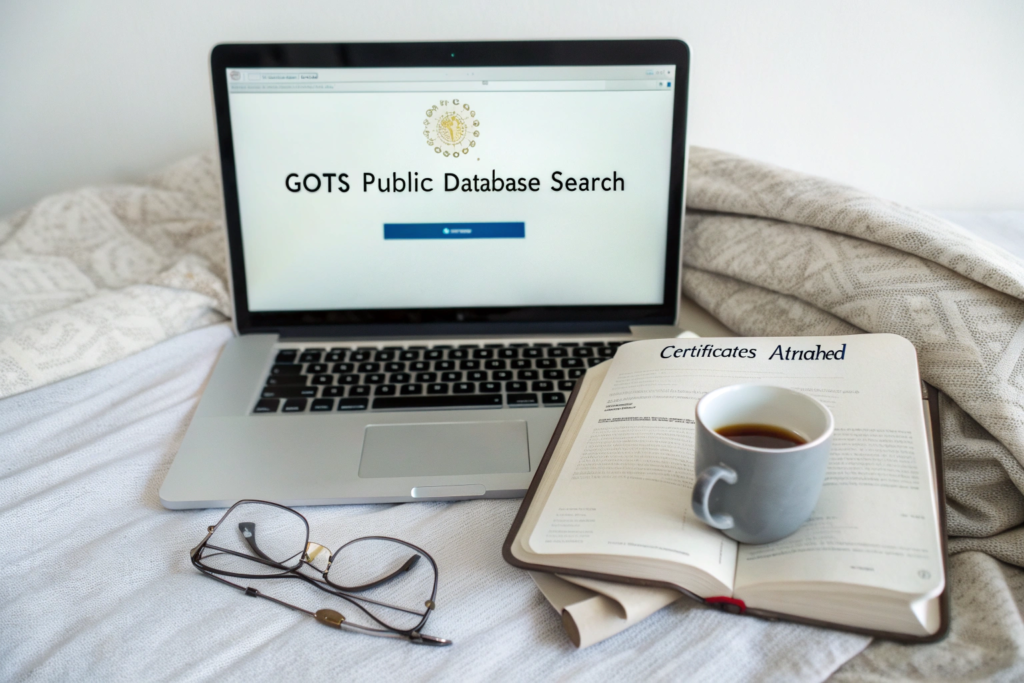
How to Use the GOTS Public Database for License Checking?
The Global Organic Textile Standard (GOTS) is the gold standard for organic fiber processing. It covers everything from the farm to the finished garment, including social criteria (no child labor, fair wages). Because it's so strict, it's also the most faked. But it's also the easiest to verify.
Here is the step-by-step process I use at Shanghai Fumao to verify our upstream suppliers, and the same process I teach my US buyers to verify me.
Step 1: Get the License Number.
Look at the certificate PDF. Every valid GOTS Scope Certificate has a unique License Number or CB Number. It usually looks like CU 123456 or CB-GOTS-2024-001. It must be clearly printed on the document.
Step 2: Go to the GOTS Public Database.
Visit the official website. Do not Google "GOTS Verify" and click an ad. Use the official URL.
Step 3: Enter the Number and Country.
Select "China" (or whatever country the factory is in). Enter the License Number.
Step 4: Check the Match.
The database will show:
- Company Name: Does it match the name on the PO and Invoice exactly?
- Address: Does the address match the factory address where production happens? (If it's a trading company address and they claim to be a mill, that's a red flag).
- Scope: What products are they certified for? If you are buying "Woven Fabric" but the scope only says "Yarn Spinning," they are Not Certified to weave fabric.
- Status: Valid or Expired?
I had a situation in early 2025 with a buyer sourcing Hemp/Organic Cotton blend. The supplier sent a GOTS certificate that looked perfect. I ran the number. It was Valid. But the company name on the certificate was for a dyeing plant in Shandong. The company on the invoice was a trading company in Guangzhou. The trading company was essentially "borrowing" the dye house's certificate. Unless that dye house specifically issued a Transaction Certificate listing that trader as the seller, the goods are uncertified. This is a classic trick. Always ensure the entity selling you the fabric is the one named on the Scope Certificate, OR they have a valid TC showing the chain of custody. You can access the tool directly here: GOTS Public Database for verifying certified operators and scope certificates. And for more context on how the audits work, this is a detailed overview of the GOTS certification process for textile mills.
What Are Self-Declared Eco Labels and Why Avoid Them?
(This is a pet peeve of mine. You'll hear me get a bit sarcastic here.) You're scrolling through a supplier's page and you see a little green leaf logo that says "Eco-Friendly Fabric" or "Natural Dye." There's no third-party organization name. No license number. Just a pretty graphic they made in Canva. That's a Self-Declaration. It is Legally Worthless.
In the industry, we call this Greenwashing. The supplier is making an environmental claim without any independent verification. They might believe the fabric is eco-friendly because it's made of bamboo (even though the viscose process to make bamboo fabric is chemically intensive). They might think the dyes are low-impact (even though they bought cheap reactive dyes with high heavy metal content).
Here is a table to help you distinguish the Real from the Fake at a glance:
| Certification Type | Logo Examples | Verification Method | Trust Level |
|---|---|---|---|
| Third-Party Certified | GOTS, GRS, OEKO-TEX, Bluesign, RWS | Public Database Check + Transaction Certificate | High |
| Self-Declared / Private Label | "EcoPure", "GreenTex", "Natural Choice" | Supplier's own website only. No audit trail. | Zero |
| In-House Lab Report | Shanghai Fumao CNAS Report | Cross-check with third-party (SGS/ITS) if unsure. | Medium-High (If from accredited lab) |
I recently saw a startup brand in Brooklyn advertise their line as "Sustainably Made with Eco-Silk." I looked up their supplier. The fabric was standard polyester satin with a "Eco" tag on the hangtag. The only thing sustainable about it was the markup. Don't fall for this. If a supplier uses a term like "Bamboo Silk" (which we sell as BAMSILK), they should be able to back it up with a FSC Certificate for the wood pulp source or an OEKO-TEX for the finished fiber. If they just say "trust me," don't. This guide from the FTC helps clarify the legal line between real certifications and fake eco-labels: FTC Green Guides for environmental marketing claims in textiles. And for a more informal look at how to spot the BS, this blog does a great job of debunking common greenwashing terms in the fashion industry.
What Are the Real Costs and Timelines of Proper Certification?
Let's get down to brass tacks. Why do suppliers cut corners on certification? Because doing it right is Expensive and Slow. If you understand the true cost and time involved, you'll understand why that $1.85/yd quote for GRS fabric was a lie from the start.
When we decided to go all-in on Eco-Friendly Innovations at Shanghai Fumao (with our ¥550M green investment), we didn't just change the hangtags. We rebuilt part of our workflow. Here is the reality of what it takes to get a mill certified to GOTS or GRS, and why this cost is inevitably baked into the price of the fabric. If a supplier quotes you a certified price that is identical to their conventional price, your alarm bells should be deafening.
How Much Does GOTS Certification Actually Cost a Mill?
I'll be transparent with the numbers from our experience. This isn't a secret. It's just a cost of doing business that many buyers don't see because it's wrapped up in the FOB price per meter.
Direct Audit Costs:
- Annual Audit Fee: $5,000 - $8,000 USD per year, per facility. This is the fee paid to the Certification Body (CB) like Control Union or Ecocert. It covers the auditor's travel, the day of inspection, and the report writing.
- Testing Costs: $500 - $2,000 per year for residue testing of raw materials and finished goods to ensure no GMO contamination or banned pesticides.
Indirect Operational Costs (The Big One):
- Raw Material Premium: GOTS-certified organic cotton yarn is consistently 20-30% more expensive than conventional cotton yarn. It fluctuates with the commodity market, but the premium is fixed.
- Dye and Chemical Costs: GOTS approved dyes and auxiliaries cost about 15-25% more. You cannot use heavy metal dyes or certain azo compounds.
- Segregation Cleaning: This is the hidden killer. Every time we switch from a conventional polyester run to a GOTS organic cotton run in our finishing plant, we have to Stop Production for 4-6 Hours. We clean the padder, clean the drying cylinders, clean the floor. That's 6 hours of machine time that generates zero revenue.
Let's put that in a simple cost impact table for a single 5,000 meter order of Jersey Knit:
| Cost Component | Conventional Cotton | GOTS Organic Cotton | Difference |
|---|---|---|---|
| Yarn Cost | $2,500 | $3,250 | +30% |
| Dyes/Chemicals | $300 | $390 | +30% |
| Audit Fee Allocation | $0 | $150 | N/A |
| Cleaning Downtime | $0 | $200 | N/A |
| Total Cost Impact | Baseline | +$1,190 | Roughly +15-20% |
That's why the math doesn't lie. If you're not paying that premium, you're not getting certified goods. You can read more about the financial realities of certification in this industry analysis of the true cost of GOTS certification for textile manufacturers. And for a broader view of organic pricing, this organic cotton market report summary provides context on price premiums.
Why Do Certifications Like GRS Take Months to Obtain?
You can't just pay the fee and get the certificate next week. There is a mandatory Implementation Period followed by a Correction Period.
For the Global Recycled Standard (GRS), the timeline usually looks like this:
- Application & Gap Analysis (Month 1): We compare our current systems to the standard's requirements. We realize our warehouse has no physical barrier between recycled polyester bales and virgin polyester bales. We need to build a wall. Or at least a taped-off quarantine zone.
- System Implementation (Months 2-3): We train the staff. "Do not move this pallet of rPET yarn into the regular area." We set up the Chain of Custody paperwork. We have to prove, with weighbridge tickets and invoices, exactly how many kilos of certified input went in and how many kilos of certified output came out. The mass balance must reconcile.
- Initial Audit (Month 4): The auditor comes. They walk the floor. They check the mass balance spreadsheets. They find three non-conformities. Maybe a label on a machine was wrong. Maybe a training record was missing.
- Corrective Actions (Month 5): We fix the issues. We send photo evidence to the auditor.
- Certification Decision (Month 6): We get the Scope Certificate.
That's six months minimum. And that's assuming we already had the customer demand to justify the cost. If a supplier is a small trading company, they simply don't have the clout to force their dye house to get certified. So they fake it. At Shanghai Fumao, we invested in this years ago because we saw the direction the European and US markets were heading. Now, our lead time for certified goods is the same as conventional, but the setup cost is already sunk. This detailed guide explains the exact steps a factory takes to get GRS certified: GRS implementation and audit process timeline for textile recyclers.
How to Protect Your Brand from False Certification Claims?
Ultimately, the responsibility for what is on your hangtag falls on You. Not the supplier in China. If the US Federal Trade Commission (FTC) finds that your "Organic Cotton" t-shirt is actually conventional cotton, they will fine your brand. They will issue a press release that will be picked up by every eco-conscious blogger. Your supplier in China will just change their Alibaba store name and keep selling. You're the one left holding the bag.
This is why you need to build Legal and Contractual Shields into your sourcing process. It's not about trusting Shanghai Fumao or any other supplier. It's about verifying everything and having a paper trail that covers your backside in case of an audit. Here are the two most effective tools you can use right now to protect your brand equity.
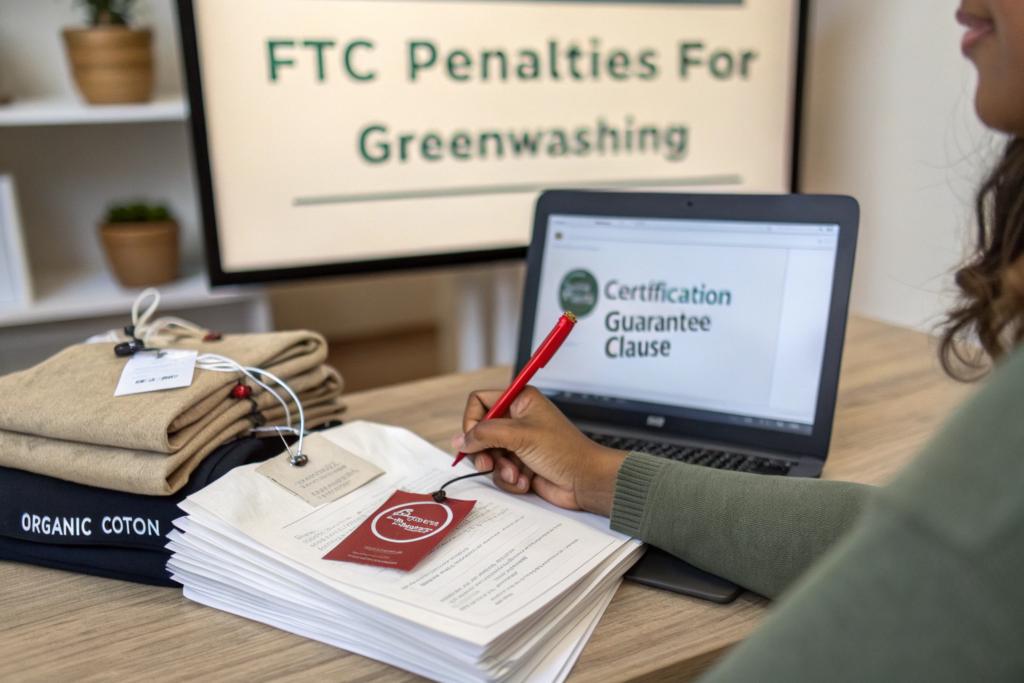
Should You Include a Certification Guarantee Clause in Your PO?
Absolutely. Always. Your Purchase Order or Proforma Invoice should not just say "Fabric: 100% Organic Cotton." It should contain a specific Certification Guarantee Clause.
Here is the exact clause I advise my US legal counsel to provide for clients. You should adapt this for your own contracts:
"Supplier warrants and guarantees that all goods supplied under this Purchase Order are produced in compliance with [Insert Standard e.g., GOTS Version 6.0 / OEKO-TEX Standard 100 Appendix 4]. Supplier shall provide a valid Transaction Certificate (TC) or Scope Certificate (SC) for each shipment. Supplier agrees to indemnify and hold harmless Buyer against any and all claims, damages, fines, or legal fees arising from any misrepresentation of certification status or product composition. In the event of a breach, Supplier agrees to a full refund of the invoice value plus reimbursement of all associated shipping and customs duties."
Why is this clause so powerful? Two reasons:
- It creates a legal cause of action. If they lie, you can sue them for breach of contract and fraud. Even if you're in the US and they're in China, this clause makes a chargeback dispute with your bank or a claim on their Alibaba Trade Assurance bond much easier to win.
- It Scares the Fakers Away. A supplier who intends to provide fake certificates will usually Refuse to Sign a PO with this clause. They'll make excuses. "Our legal team doesn't allow changes to the standard PO." That is your signal to walk away. A legitimate supplier like Shanghai Fumao will sign this clause because we know we can back it up with the audit trail.
I had a client who used this clause with a new vendor for a large order of Tencel denim. The vendor balked at the "indemnify and hold harmless" language. They eventually admitted they "source the Tencel from a trader who says it's Tencel." They had no proof. The deal died. My client avoided a potential $60,000 mislabeling issue. You can find more details on legal protections in this resource on how to draft a strong product guarantee clause in an international sales contract. And for the specific issue of labeling, the FTC provides clear guidance on threading the needle of the Textile Fiber Products Identification Act.
How to Conduct a Random Lab Test to Verify Fabric Content?
Don't trust the paper. Trust the lab. Even with a valid GOTS certificate and a strong contract, smart brands do Random Spot Testing. This is what separates the hobbyist from the professional.
You don't need to test every roll. But for a new supplier, or for a high-value fiber like Cashmere, Alpaca, or Silk, you should test the first shipment. And then maybe test one out of every five shipments after that.
The Process for US Buyers:
- Receive Shipment: Upon arrival at your warehouse, do not cut bulk yet.
- Take a Sample: Cut a small swatch (12" x 12") from a random roll. Keep the roll label with the sample.
- Send to a US Lab: You do not need to send it back to China. Use a US-based lab like SGS North America, Bureau Veritas, or Intertek. They have offices in major textile hubs (LA, NY, NC).
- Request Fiber Content Analysis (AATCC 20/20A): This is the standard test. It uses a microscope and chemical dissolution to determine exactly what fibers are in that fabric.
- Wait 3-5 Days: The report costs about $150 - $300. It's the cheapest insurance policy you will ever buy.
Here's a real-world example from 2024. A client ordered "70% Bamboo / 30% Cotton" fleece from a new supplier (not us). It felt great. But he was suspicious because the price was too good. He spent $250 on an AATCC 20 test. The result? 100% Rayon (Viscose). Zero Bamboo. Zero Cotton. He had paid for premium fiber but received the cheapest cellulosic on the market. He was able to cancel the balance of the order and get a refund on his deposit because he had the Lab Evidence.
At Shanghai Fumao, we welcome these tests. We keep our own CNAS lab records, and we are happy to see them match up with SGS results. It proves we're doing our job. Don't be shy about asking your supplier for a Certified Retain Sample that you can test against. If they refuse, you know why. You can find a list of accredited labs near you using this directory of AATCC certified textile testing laboratories in the United States. And for a deep dive into the specific test method, this is the official scope of the AATCC 20 Fiber Analysis standard.
Conclusion
The world of textile certifications is a minefield of expired PDFs, borrowed license numbers, and self-declared green leaves. Suppliers promise certificates they can't provide because the demand for sustainable, safe fabric is high, but the willingness to pay the true cost of compliance is often low. They count on buyers being too busy, too trusting, or too confused to verify the paperwork. But now you know the game. You know the difference between a Scope Certificate (the license) and a Transaction Certificate (the proof). You know how to run a license number through the GOTS database in 30 seconds. And you know that a $250 lab test can save you from a $50,000 brand reputation disaster.
Remember, a certificate is not a product. It's a promise. And that promise is only as good as the systems and the ethics of the people behind it. At Shanghai Fumao, we've invested the time and capital to make sure our promises are backed by CNAS lab data, valid scope certificates, and transparent supply chains. If you're tired of playing detective with your fabric suppliers and you want a partner who can provide both the quality and the verifiable compliance paperwork, let's connect. Reach out to our Business Director, Elaine, at elaine@fumaoclothing.com. She can walk you through our current certification portfolio and help you source fabric that lives up to the label.