Let's be honest, Ron. As a U.S. apparel buyer, your biggest headaches probably aren't just about finding fabric. They're about tariffs, unpredictable shipping schedules, and that sinking feeling when a shipment is held up because paperwork doesn't pass muster. You want quality, you need speed, but above all, you demand certainty and security in your supply chain. One major leak in this boat is sourcing without verifiable sustainability credentials. That's where the OCS (Organic Content Standard) comes in, not as a trendy badge, but as a critical business tool for American brands.
The short answer is, you need an OCS certified supplier like Shanghai Fumao to de-risk your business. It's your verified shield against "greenwashing" claims, a key to avoiding customs delays related to false content declarations, and increasingly, your ticket to meeting the stringent sustainability demands of both U.S. retailers and end consumers. An OCS certification is proof that the organic cotton in your fabric can be traced from field to finished roll, a process that directly impacts your brand's credibility and your supply chain's reliability.
Think of it this way: without OCS certification, you're taking someone's word for it. In today's market, that's not just risky—it's a potential business-ending liability. Let's dive into how this specific certification turns a common pain point into a clear competitive advantage for your brand.
What is OCS Certification and How Does It Actually Protect Your Brand?
You hear "certification" all the time. But OCS isn't just another logo to slap on your website. It's a hard-nosed, transaction-based verification system. For you, Ron, it's less about feeling good and more about having concrete, defensible proof. It protects your brand from the financial and reputational fires that start when claims can't be backed up.
At its core, the Organic Content Standard (OCS) is an international standard that tracks and verifies the flow of organic raw materials through the supply chain. It uses a document trail and on-site audits to confirm the exact percentage of certified organic material in your final product. This isn't a "we think" system; it's a "we can prove it" system. For a U.S. brand, this proof is your first line of defense.

Why can't I just trust my supplier's word on organic content?
You can, until you get audited by your own retail partner or face a challenge from a consumer group. The fashion industry is riddled with "greenwashing," where vague terms like "eco-friendly" or "natural" are used without proof. We saw this firsthand in early 2023 when a major European retailer demanded full OCS documentation from all its vendors. One of our clients, a mid-sized American activewear brand, was caught off-guard. Their previous, non-certified supplier in South Asia could only provide a purchase invoice for "organic cotton yarn," with no chain of custody. The retailer put their entire spring line on hold. They came to Shanghai Fumao in a panic. Because we maintain OCS certification for our entire organic cotton workflow, we provided the full transaction certificates (TCs) from our GOTS-certified yarn spinner all the way through to our finished knitted fabric. Their shipment was cleared within 48 hours. The cost of that near-miss? Almost their entire season's profit margin. This is exactly why understanding the difference between recycled polyester and organic cotton certifications matters for your compliance strategy.
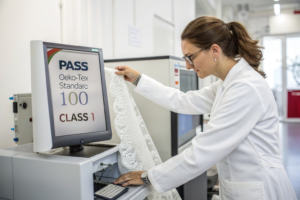
Trust is good, but verification is business. Relying on word-of-mouth in global trade, especially for a regulated claim like "organic," opens you up to immense risk. Customs authorities, particularly in the EU but increasingly in the U.S., are scrutinizing environmental claims. A false declaration can lead to goods being seized, fines, and your importer of record status being flagged. The OCS system removes subjectivity. Every party in the chain, from the farm to us, the fabric manufacturer, is audited by a third party like Control Union or SGS. This creates an unbroken, paper-backed trail. It turns a marketing claim into a logistical fact, which is what your logistics and legal teams actually need to sleep at night. (Here's a tip from our QC head: always ask for the supplier's latest OCS scope certificate and a sample Transaction Certificate before you even discuss price.)
How does the OCS audit process work in a real Chinese factory?
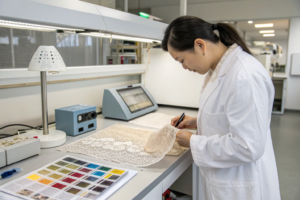
It's gritty and detail-oriented, which is exactly what you want. It's not a cozy office chat. When auditors come to our facilities, they're forensic accountants for fabric. They start with mass balance. They tally the weight of certified organic cotton yarn we received (with its unique TC number) against the weight of finished fabric we shipped out (with our new TC). They allow for a small, scientifically calculated loss factor for moisture and waste. If the numbers don't add up, certification fails.
Then, they inspect physical segregation. In our warehouse, OCS cotton cones are stored separately, with clear labeling. Our production schedule is checked to ensure that when we run an OCS order on a loom or knitting machine, the equipment is thoroughly cleaned of any conventional fiber residue beforehand. They interview staff, check training records, and examine invoices and inventory systems. For example, in our June 2023 surveillance audit, the auditor spent two hours cross-referencing our digital inventory system's entries for OCS cotton jersey against the physical stock tags and the logistics records for that batch's shipment to a client in California. This level of scrutiny is what gives the certificate its teeth. It's this rigorous, on-ground understanding of navigating textile compliance audits in Asia that separates serious suppliers from the rest.
Beyond Marketing: The Tangible Cost-Saving Benefits of OCS for US Importers.
Alright, let's talk dollars and cents. Certification costs money, so where's the ROI for you? It's not just in premium pricing (though that's possible). The real savings are in avoiding costs—the hidden, catastrophic costs of a broken supply chain. For a pragmatic buyer like you, Ron, this is where OCS stops being a "nice-to-have" and becomes a "must-have" for risk management.
Think about your biggest logistical nightmares: unexpected tariffs, port delays, rejected shipments, or chargebacks from retailers for non-compliance. OCS directly mitigates these. It provides a standardized, globally recognized documentation package that smooths customs clearance. Officers see a clear, audited content declaration and are less likely to flag your container for intensive (and costly) inspection. In a volatile trade environment, this predictability is golden.

Can OCS certification really help me avoid US tariff issues?
Indirectly, but powerfully, yes. While OCS itself doesn't change tariff codes, the accuracy and verifiability of your product's content declaration do. The U.S. Customs and Border Protection (CBP) is increasingly focused on enforcement of trade laws, including accurate classification and valuation. If you declare a fabric as "100% organic cotton" without proof, and CBP testing finds even a small percentage of unaccounted-for conventional cotton or synthetic, you could face accusations of misdeclaration.
This leads to penalties, delayed shipments, and increased scrutiny on all your future imports. The OCS documentation is your evidence kit. It doesn't guarantee no inspection, but it does give you a robust, third-party-verified defense if questioned. We had a client in Seattle importing our OCS-certified linen-cotton blends. During a random CBP review, they were asked to substantiate the organic content claim. Our client simply forwarded the complete Transaction Certificate chain. The matter was resolved in a day, while a concurrent shipment from a non-certified supplier in another port was held for weeks for lab testing. That speed saved them thousands in demurrage and missed in-store dates. This proven reliability is a cornerstone of why brands choose to partner with a vertically integrated fabric manufacturer in China for complex, compliance-heavy orders.
How does planning with an OCS supplier improve my production timeline?
This is the counter-intuitive magic. You'd think more paperwork means more delay. With a truly integrated OCS supplier, the opposite is true. Here's why: The discipline required for OCS certification forces a hyper-organized, transparent, and documented workflow. We know exactly where every kilogram of certified material is at any time.
For you, this means accurate, reliable lead times. There's no "we lost track of that organic batch" or "we had to mix it with conventional to meet your deadline." Our MRP system is built around certified lot tracking. When you place an order for OCS fabric with Shanghai Fumao, we immediately know which certified yarn lot to allocate, which production line to schedule, and how to manage the workflow to preserve chain of custody. This eliminates a major source of variability and delay. Furthermore, because we control weaving, dyeing, and finishing in our partner network under strict protocols, we avoid the weeks of back-and-forth and potential contamination that can happen when coordinating between multiple, uncertified sub-suppliers. It's the efficiency of vertical integration, supercharged by traceability. Think of it as having a GPS for your fabric order instead of just hoping it arrives at the port on time.
Choosing Your OCS Partner: Key Questions Beyond the Certificate.
So, you're convinced you need an OCS supplier. Not all certified suppliers are created equal. The certificate is the ticket to the game, but it's the supplier's underlying infrastructure, expertise, and mindset that win it. For an American brand, you need a partner who understands your need for clarity, communication, and a proactive approach to problem-solving.
You need to look beyond the PDF of the certificate. You need to assess their operational reality. Can they handle your volume? Do they understand the nuances of the fabrics you need? Most importantly, are they set up to make your compliance easy, or is the certification just a wall decoration for them?

What should I look for in an OCS supplier's audit reports and documentation?
Don't just ask, "Are you OCS certified?" Ask for the documents. First, request their current OCS scope certificate. Check the issuing body (it should be reputable like CU, SGS, ITS), the validity date, and most crucially, the scope. Does it cover the specific processes you need? If you're buying knitted fabric, their certificate must list "knitting" or "manufacturing." If it only says "trading," they are not manufacturing certified goods; they are just reselling, which adds a risky, opaque link to your chain.
Second, ask for a sample Transaction Certificate (TC) from a previous order. Examine it. It should list all parties in the chain, from the yarn supplier to them, and show the unique certificate numbers linking each step. The material descriptions and weights should be precise. A good supplier like us can generate this sample instantly because the system is part of our daily work. A hesitant supplier is a red flag. This deep dive into documentation is part of developing a comprehensive guide to sustainable fabric sourcing for startups.
| Document to Ask For | What It Tells You | Red Flag |
|---|---|---|
| OCS Scope Certificate | Legitimacy, valid dates, certified processes (e.g., weaving, dyeing). | Expired, only "trading" listed, from an unknown certifier. |
| Sample Transaction Cert (TC) | Practical experience, detail orientation, transparency of chain. | Cannot provide one, vague material descriptions, broken number chain. |
| Quality Test Reports (e.g., SGS) | Commitment to overall quality beyond just content. Uses same rigorous data. | No standard testing offered, or tests don't align with OCS batch. |
How does a supplier's vertical integration impact OCS reliability?
This is the ultimate advantage. A vertically integrated supplier—or one like us with tightly controlled, certified partner facilities—dramatically reduces your risk points. Every time your material changes hands between uncertified entities, the chain of custody breaks, and the risk of contamination or fraud multiplies.
Our model at Shanghai Fumao means the OCS-certified organic cotton yarn comes into our control. We then manage its journey through our cooperative dyeing factory (which is also included in our certification scope), our weaving/knitting mills, and finishing. The entire process is under one management system, one audit trail. There's no finger-pointing between a weaver, a dyer, and a finisher about who lost the paperwork or mixed up batches. We had a case in August 2023 with a client from New York who needed a urgent re-order of an OCS certified baby rib knit. Because our knitting and dyeing partners are within our certified ecosystem and located close by in Keqiao, we could trace the original yarn lot, confirm its availability, and rush the re-production in 3 weeks—something that would be impossible if we were just a trader coordinating between independent, geographically scattered factories. This control is what turns a certification from a piece of paper into a reliable production reality.
Conclusion
Navigating the complexities of sourcing from Asia requires turning potential vulnerabilities into structured strengths. For American clothing brands, OCS certification is far more than a sustainability checkbox; it's a foundational strategy for supply chain security, risk mitigation, and operational predictability. It transforms the opaque journey of organic material into a transparent, documented highway, giving you the confidence to make claims, the evidence to clear customs, and the reliability to hit critical market windows.
The decision, therefore, isn't just about finding an OCS supplier, but about partnering with one whose operational excellence matches the rigor of the standard itself. You need a partner embedded in the world's largest textile cluster, with the vertical control to guarantee integrity from fiber to fabric, and the experience to guide you through the entire process seamlessly.
If you're ready to build this level of security and transparency into your brand's sourcing, let's talk. Shanghai Fumao has been the behind-the-scenes fabric engine for global brands for over two decades, turning challenges like OCS compliance into streamlined, dependable processes. Contact our Business Director, Elaine, to discuss how we can co-create your next collection with verified quality and peace of mind. Reach out to Elaine at elaine@fumaoclothing.com.