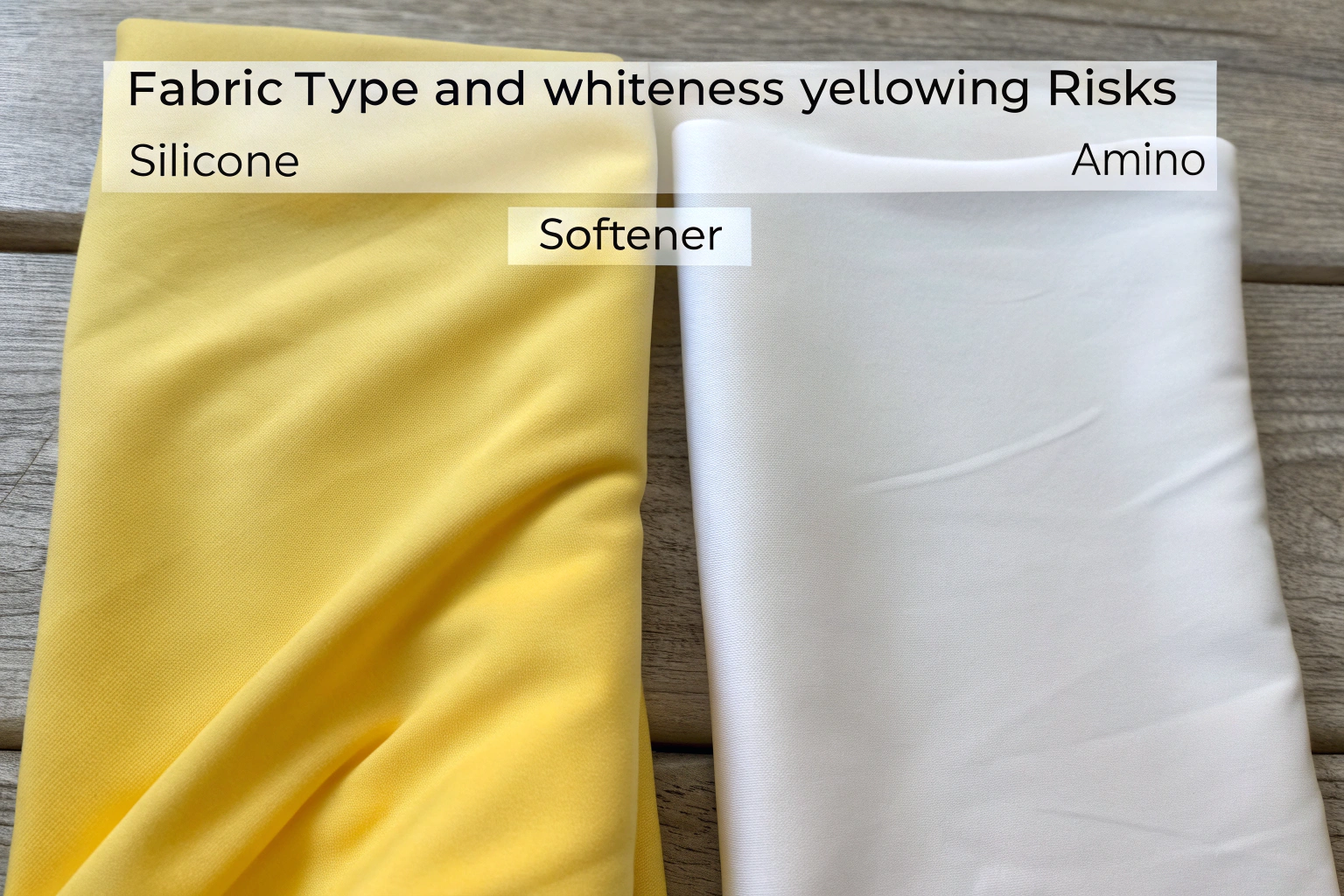
Choosing the wrong softener can turn premium white fabrics into disappointing yellows while delivering poor hand feel. You invest in quality textiles only to see them degrade during finishing—this isn't just frustrating; it impacts your brand reputation and bottom line. At Fumao, we've navigated these challenges for global clients across thousands of production runs.
The choice between silicone and amino softeners involves balancing superior hand feel against yellowing risks. Silicone softeners typically provide exceptional smoothness and softness but can yellow under heat, while amino softeners offer good whiteness retention with moderate softness. The optimal selection depends on your fabric type, whiteness requirements, and desired hand feel characteristics.
If you're tired of compromising between perfect softness and color integrity, understanding the chemistry and application specifics is crucial. Let's examine how to maximize hand feel while minimizing yellowing in your textile finishing.
What Are the Key Differences Between Silicone and Amino Softeners?
Silicone softeners create a flexible, lubricating film on fiber surfaces, dramatically reducing friction between yarns. This results in that characteristic silky, smooth hand feel customers love. However, certain silicone types—particularly those with amino functional groups—are prone to thermal yellowing due to oxidation when exposed to high temperatures during curing or storage. The very chemistry that makes them effective also creates vulnerability.
Amino softeners, typically cationic compounds like quaternary ammonium salts, work by neutralizing negative charges on fiber surfaces and orienting their hydrophobic tails outward. This provides good softness but through a different mechanism—more of a fluffy, bulky softness compared to silicone's slickness. Amino softeners generally maintain better whiteness since they lack the chemical structures that cause yellowing under heat. However, they may not achieve the same level of slick softness as premium silicones.
How Does Molecular Structure Affect Performance and Yellowing?
The molecular architecture determines everything. Amino silicones—the most popular category for superior softness—contain basic nitrogen groups that catalyze oxidation when heated, forming chromophores that cause yellowing. The higher the amine value, typically the better the softness but also the greater yellowing potential. In contrast, polydimethylsiloxane (PDMS) without amino groups shows minimal yellowing but provides less durable softness. Amino softeners like esterquats have molecular structures without the silicon-oxygen backbone, making them inherently less prone to thermal degradation and yellowing. The carbon chains in amino softeners are stable under typical textile processing conditions, which explains their superior whiteness retention.
What Application Factors Influence Yellowing Tendency?
Multiple processing factors can trigger or minimize yellowing. For amino silicones, curing temperature is critical—staying below 150°C significantly reduces yellowing. The pH of the application bath also matters; alkaline conditions accelerate amino silicone yellowing. Catalyst selection is another key factor; certain metal-containing catalysts can dramatically increase yellowing. We always recommend using non-metallic catalysts for white fabrics. The table below shows how different parameters affect yellowing:
| Parameter | High Yellowing Risk | Low Yellowing Risk |
|---|---|---|
| Curing Temperature | >160°C | <150°C |
| Bath pH | Alkaline (>8) | Slightly acidic (5-6) |
| Catalyst Type | Metal-based | Organic acid |
| Storage Conditions | Warm, humid | Cool, dry |
| Fabric Composition | Synthetic blends | 100% cotton |
In 2023, a European client processing white polyester-cotton blends reduced their yellowing complaints by 90% simply by switching from an amino silicone to a modified epoxy silicone and adjusting their curing temperature from 165°C to 145°C.
How to Maximize Softness While Minimizing Yellowing?
Achieving the perfect balance requires strategic softener selection and process optimization. For applications where whiteness is absolutely critical, starting with macro-emulsion amino silicones or non-yellowing modified silicones provides good softness with minimal color change. These formulations have reduced amine content or incorporate phenyl, epoxy, or polyether groups that resist yellowing while maintaining decent hand feel.
The application method significantly impacts results. Padding generally gives more uniform distribution than exhaust methods, ensuring consistent softness without localized over-treatment that can cause uneven yellowing. Concentration control is vital—we typically use 1-3% owf (on weight of fabric) for amino silicones and 2-4% owf for amino softeners, carefully balancing effect with risk. Exceeding these ranges rarely improves softness but dramatically increases yellowing potential.

What Are the Optimal Application Parameters for Different Fabric Types?
Different fabrics respond uniquely to softener types. For premium white cotton, we often recommend modified silicones (epoxy or polyether) at 2-3% owf, padded at 70-80% expression, and cured at 150°C for 2 minutes. For polyester-cotton blends, macro-emulsion amino silicones at lower concentrations (1.5-2.5% owf) often work well with reduced curing temperatures. For 100% synthetic fabrics, micro-emulsion amino silicones provide excellent softness with minimal yellowing risk due to the lower processing temperatures typically used. A Japanese lingerie manufacturer we worked with in early 2024 achieved perfect results on their white nylon-spandex fabrics by using a specially developed polyether silicone at 1.8% owf with steam fixation instead of high-temperature curing.
How Can You Test Yellowing Potential Before Full Production?
Always conduct preliminary yellowing tests before committing to large batches. The industry standard involves treating fabric swatches with your softener system, then curing them at your production parameters. Measure the whiteness index (WI) before and after treatment using a spectrophotometer, and also after accelerated aging (typically 4 hours at 130°C). A WI change of less than 3 points is generally acceptable for most white fabrics. We also recommend testing under different lighting conditions since some yellowing is more visible under specific light sources. For critical applications, conduct storage tests by keeping treated samples in sealed plastic bags at 50°C for one week to simulate long-term storage conditions. Understanding how to measure textile whiteness index accurately is essential for objective quality control.
What Are the Best Non-Yellowing Alternatives?
When even modified silicones present too much yellowing risk, several excellent alternatives deliver good softness with superior whiteness retention. Polyether silicones represent perhaps the best balance—they provide about 80-90% of the softness of amino silicones with virtually no yellowing because they lack the problematic amino groups. These work particularly well for technical textiles and medical applications where whiteness is critical.
PEG-based softeners and esterquats offer completely non-yellowing options with good softness characteristics, though they typically can't match the slickness of premium silicones. Newer bio-based softeners derived from vegetable oils are gaining popularity for their excellent environmental profile and minimal yellowing tendency. These are particularly suitable for organic and sustainable textile lines where chemical residues are a concern.
How Do Polyether Silicones Compare to Traditional Options?
Polyether silicones modify the standard silicone backbone by adding polyether groups (ethylene oxide/propylene oxide chains). This modification creates several advantages: excellent compatibility with other finishing chemicals, superior resistance to yellowing, and good solubility in water. The hand feel is slightly less slick than amino silicones but still significantly better than most non-silicon options. They're particularly valuable for white fabrics that require multiple finishing treatments, as they're less likely to cause issues with subsequent processes. A US medical textiles company eliminated their yellowing problems completely by switching to a polyether silicone while maintaining the required softness for patient comfort.
When Should You Consider Hybrid Softener Systems?
Sometimes the optimal solution combines multiple softener types. Hybrid systems can deliver the best of both worlds—excellent softness without yellowing. A common effective combination uses a small amount of amino silicone (0.5-1% owf) for base softness, complemented by a larger amount of polyether silicone (1.5-2% owf) to build fullness and prevent yellowing. Another successful approach uses amino softeners as the primary softener with a minor silicone addition to enhance smoothness. The key is thorough testing to ensure compatibility and uniform application. We helped an Australian towel manufacturer develop a hybrid system using an amino softener for bulk and a non-yellowing silicone for surface smoothness that reduced their yellowing rate from 8% to under 1% while improving customer satisfaction scores for softness by 25%.
How to Troubleshoot Existing Yellowing Problems?
When yellowing already exists, several approaches can salvage affected fabrics. For amino silicone-induced yellowing, rewashing with a chelating agent like EDTA can sometimes reverse the discoloration by complexing metal ions that catalyzed oxidation. Light bleaching with hydrogen peroxide or sodium hydrosulfite may also help, though this can affect other finishes.
Prevention is always better than cure. Implementing strict process controls—particularly monitoring curing temperatures and times—prevents most yellowing issues. Using antioxidants like BHT (butylated hydroxytoluene) in your softener formulation can significantly reduce yellowing by preventing oxidative degradation. Storage conditions also matter; keeping finished fabrics in cool, dark environments minimizes post-production yellowing.
What Corrective Treatments Can Reverse Yellowing?
For mildly yellowed fabrics, a reduction clear with sodium hydrosulfite (1-2 g/L) at 60-70°C for 20 minutes often improves whiteness. For more severe cases, a peroxide treatment (3-5 g/L H₂O₂ at pH 8-9) at 80°C for 30 minutes may be necessary. However, these treatments can affect other fabric properties, so always test on swatches first. In 2023, we successfully salvaged a 5,000-meter batch of yellowed white poplin for a UK retailer using a combination of chelating wash followed by optical brightener reapplication, saving them over $40,000 in potential losses.
How Can Process Optimization Prevent Future Yellowing?
Systematic process control is your best defense against yellowing. Implement regular calibration of curing ovens to ensure temperature accuracy. Monitor softener bath pH and maintain it in the optimal range for your specific softener type. Consider installing UV exposure monitoring in storage areas since light can accelerate yellowing. Most importantly, maintain detailed batch records that allow you to trace any yellowing issues back to specific processing conditions. The Society of Dyers and Colourists offers comprehensive guidance on preventing thermal yellowing in textile finishing that's invaluable for quality assurance.
Conclusion
Choosing between silicone and amino softeners involves careful consideration of your specific requirements for hand feel versus whiteness retention. While amino silicones typically deliver superior softness, their yellowing potential makes them risky for white fabrics. Modified silicones and amino softeners offer safer alternatives with good performance characteristics. The optimal choice depends on your fabric type, processing conditions, and quality standards.
Successful softener selection requires balancing multiple factors and often involves customizing solutions for specific applications. There's no universal best choice—only the best choice for your particular needs. If you're struggling to achieve the perfect balance of exceptional hand feel and color integrity, our technical team can help. We've developed customized softener solutions for clients across diverse market segments. For personalized recommendations based on your specific fabrics and requirements, contact our Business Director, Elaine, at elaine@fumaoclothing.com. Let us help you achieve the perfect finish that enhances both feel and appearance.